
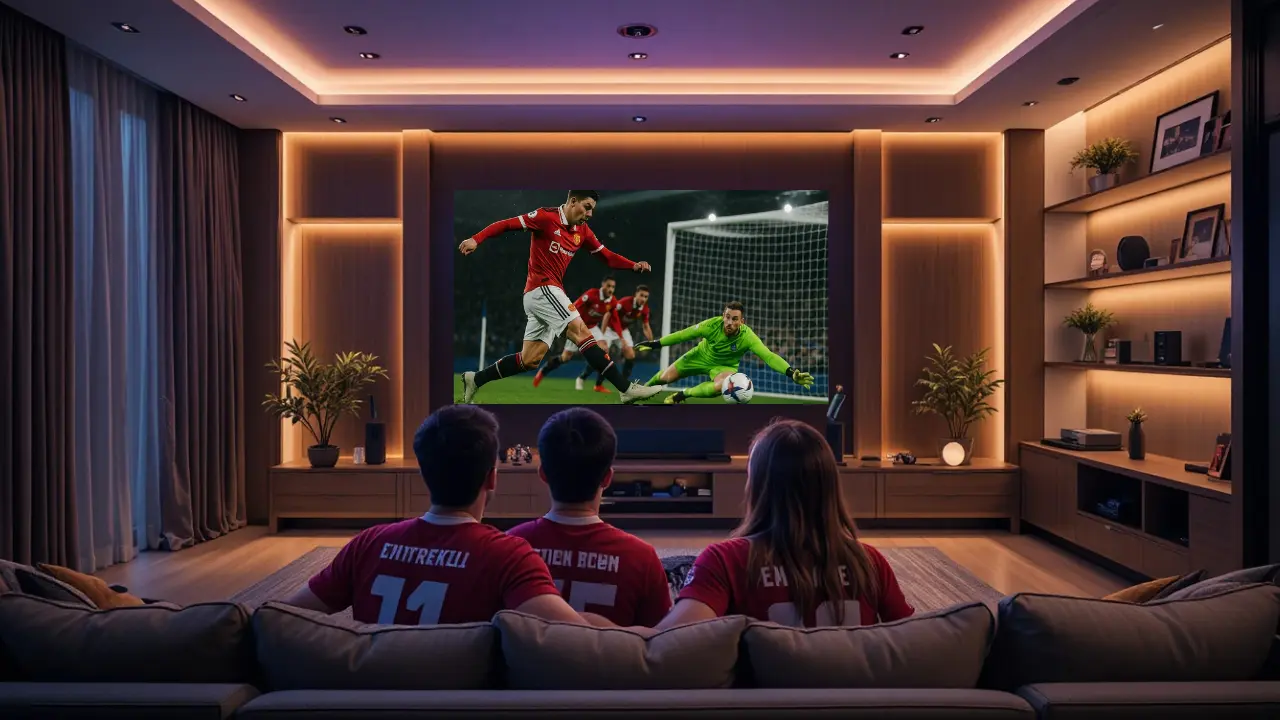

Big screen TVs transform sports from passive viewing into shared experience. Bigger displays reveal player movement, crowd energy, ball trajectory, and stadium atmosphere with far more clarity. In Indian homes, where cricket finals become family events and football nights stretch past midnight, a large-screen TV turns the living room into the closest thing to being inside the stadium.
There is a reason people remember where they watched the match.
Not just the score.
The room.
The shouting.
The last-over silence.
The replay everyone demanded three times.
Sports are emotional theatre. And the theatre changes when the screen changes.
A 32-inch TV shows the match.
A 254cm (100) TV changes how the match feels.
That distinction matters more than most people realise.
Sports are built on motion. Small screens lose motion first.
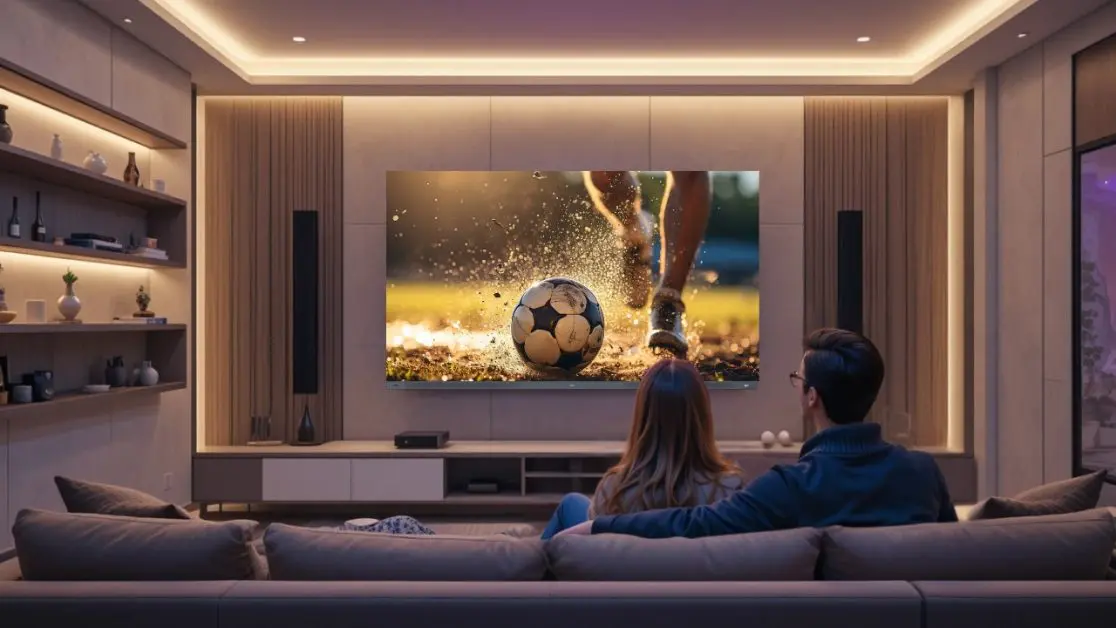
Watch a fast cricket outfield on an older TV.
The ball blurs.
Edges soften.
Fast camera pans feel shaky.
Now compare that to a large-screen TV with higher refresh rates and motion handling.
Suddenly:
- The football pass looks cleaner
- The tennis rally feels sharper
- The IPL boundary replay carries depth
- Stadium lighting appears more natural
- Camera tracking feels fluid instead of jittery
Sports viewing is less about resolution and more about motion intelligence.
That is why the refresh rate matters.
The Haier S90 QLED 254cm (100) Google TV with Ultra Sense AI features a 144Hz refresh rate designed for smoother motion and reduced blur during fast-paced content like sports and action scenes.
The same principle appears in the New M96 Series 254cm (100) QD-Mini LED AI Smart Google TV, which also supports 144Hz refresh rates alongside AI-driven motion optimisation.
A sports broadcast is really a test of motion consistency.
And motion exposes weak screens immediately.
The hidden psychology of sports viewing
Most people think bigger TVs are about luxury.
That is incomplete thinking.
Big-screen sports viewing solves three invisible problems inside modern Indian homes:
1. Shared viewing
India watches sports collectively.
Friends arrive unplanned.
Family members walk in during tense moments.
Neighbours suddenly become analysts during India-Pakistan matches.
A larger screen reduces viewing friction for groups.
Nobody fights for “the good angle.”
2. Distance flexibility
Modern apartments are changing.
Living rooms are larger.
Furniture layouts are deeper.
Wall-mounted TVs sit farther away.
A small TV forces viewers to lean in.
A big TV allows viewers to relax.
Comfort changes engagement.
3. Emotional immersion
Crowd noise matters.
Player expressions matter.
Rain delays feel cinematic.
The stadium atmosphere becomes visible.
The bigger the screen, the more emotional detail survives compression.
A memorable sports night is rarely about pixels alone.
It is about presence.
Why Mini LED and QLED matter during sports
Not all large TVs perform equally.
This is where many buyers make poor decisions.
They optimize for screen size alone and ignore display technology.
That trade-off usually backfires.
One option is basic LED panels
Affordable.
Functional.
But weaker contrast and brightness handling.
The second option is QLED
Stronger colours.
Better brightness.
Improved HDR handling.
The third option is Mini LED
More precise lighting control.
Deeper blacks.
Better stadium lighting visibility.
Stronger contrast during night matches.
Sports broadcasts constantly shift lighting conditions.
Bright daylight shots.
Dark stadium tunnels.
Floodlights.
Rain interruptions.
Fast camera transitions.
Mini LED handles those transitions more naturally.
The Haier M80F Mini LED 215cm (85) Google TV uses Mini LED technology combined with Dolby Vision and Sound by KEF for more immersive sports and cinematic viewing.
The New Haier M96 Series 254cm (100) QD-Mini LED AI Smart Google TV pushes this further with 2160 dimming zones, HDR10+, and AI Ultra Sense Processor technology.
The hidden truth?
Good sports TVs are not just bigger.
They are faster, brighter, and smarter at handling chaos.
Sports is controlled chaos.
Your TV either keeps up or falls behind.
Sound changes sports more than people expect
Close your eyes during a football match.
You still know what is happening.
Crowd reactions.
Commentary urgency.
Whistle echoes.
Bat impact.
Stadium chants.
Audio creates scale.
This is why weak TV sound ruins sports immersion even when the picture looks sharp.
The Haier M96 Series includes Sound by KEF alongside a 6.2.2 channel speaker setup designed for layered, multidimensional sound.
That matters because modern sports broadcasts are increasingly mixed for spatial audio environments.
The crowd should not sound flat.
It should sound around you.
What strong TV audio improves during sports
- Crowd atmosphere
- Commentary clarity
- Stadium immersion
- Match tension
- Replay drama
- Viewer engagement during quieter moments
The picture creates attention.
Sound creates emotion.
The best sports setups need both.
The modern Indian living room is becoming a viewing arena
Ten years ago, TVs were furniture.
Today, TVs are environments.
That shift changes buying behaviour completely.
People now design rooms around screens.
Especially after:
- Hybrid work lifestyles
- Weekend binge culture
- Streaming sports subscriptions
- Rise of football and Formula 1 fandom
- Growing esports audiences
- Increased time spent indoors
Sports viewing has become social infrastructure.
One large TV now replaces:
- Theatre outings
- Café screenings
- Match-day projectors
- Multiple smaller screens
And unlike projectors, modern large TVs work even in bright Indian daylight.
The New Haier M96 Series QD-Mini LED TV supports over 2100 nits peak brightness and anti-reflective screen optimisation for clearer daytime viewing.
That solves a real Indian problem.
Most matches are watched with room lights on.
Curtains open.
Family moving around.
Food is constantly arriving.
Real homes are not dark theatres.
A sports TV must perform in real conditions.
AI in TVs is no longer gimmick technology
People hear “AI TV” and assume marketing.
Sometimes they are right.
But the useful part of AI inside modern sports TVs is adaptive optimisation.
The system constantly adjusts:
- Motion clarity
- Contrast
- Brightness
- Scene recognition
- Audio balancing
- Colour tuning
The Haier Ultra Sense AI system integrates AI across visuals, sound, gaming, and entertainment for adaptive viewing experiences.
That matters because sports broadcasts are inconsistent.
Different cameras.
Different lighting.
Different production quality.
Different streaming compression.
AI processing helps stabilize those differences in real time.
Good technology disappears.
That is the goal.
You should notice the match.
Not the TV struggling to keep up.
What sports lovers should actually prioritise while buying a TV
Most buyers overfocus on brand names and underfocus on viewing behaviour.
A better system is this:
If you mostly watch cricket
Prioritise:
- Motion clarity
- Brightness
- Wide viewing angles
- Upscaling quality
If you watch football or Formula 1
Prioritise:
- Refresh rate
- MEMC technology
- VRR support
- Motion handling
If your living room hosts groups
Prioritise:
- Screen size
- Audio power
- Anti-glare performance
- Wide seating visibility
If sports and gaming both matter
Prioritise:
- HDMI 2.1
- AMD FreeSync Premium Pro
- ALLM
- High refresh rates
M96 Series both include gaming-focused technologies like VRR, ALLM, HDMI 2.1 eARC, and AMD FreeSync Premium Pro.
The overlap between sports viewing and gaming is growing rapidly.
Both demand speed.
Both expose lag.
Both punish poor motion handling.
Big screens change rituals, not just rooms
This is the part specifications cannot fully explain.
A large TV quietly changes household behaviour.
People gather more often.
Parents stay for “just one over.”
Children remember finals.
Friends stop scrolling during penalties.
Shared viewing creates shared memory.
And modern homes increasingly need anchors that bring people into the same room again.
Not every appliance does that.
A sports-focused big screen often does.
That may be the real reason large TVs continue growing in popularity across Indian households.
Not because people want bigger technology.
Because they want bigger experiences.
And sports has always been about shared experience first.
Frequently Asked Questions
Should I buy a big screen TV mainly for watching sports?
Yes, especially if sports nights are shared with family or friends. A large TV makes player movement, crowd energy, replays, and stadium atmosphere feel more immersive.
Why does my old TV make the cricket ball look blurry?
Fast camera pans and ball movement expose weak motion handling. A higher refresh rate, such as 144Hz, helps reduce blur during fast sports.
I watch football and Formula 1, what TV features should I prioritise?
Look for a high refresh rate, MEMC, VRR, HDMI 2.1, and strong motion processing.
Is 144Hz useful for sports or only gaming?
It is useful for both. In sports, 144Hz helps fast movement look smoother and cleaner.
Why do fast matches look shaky on some TVs?
The TV may have poor motion interpolation, weak processing, or a low refresh rate.
Is QLED better than basic LED for sports?
Yes. QLED usually offers better brightness, richer colours, and stronger HDR performance.
Should I consider Mini LED for night matches?
Yes. Mini LED improves contrast, deeper blacks, and floodlight detail during stadium matches.