
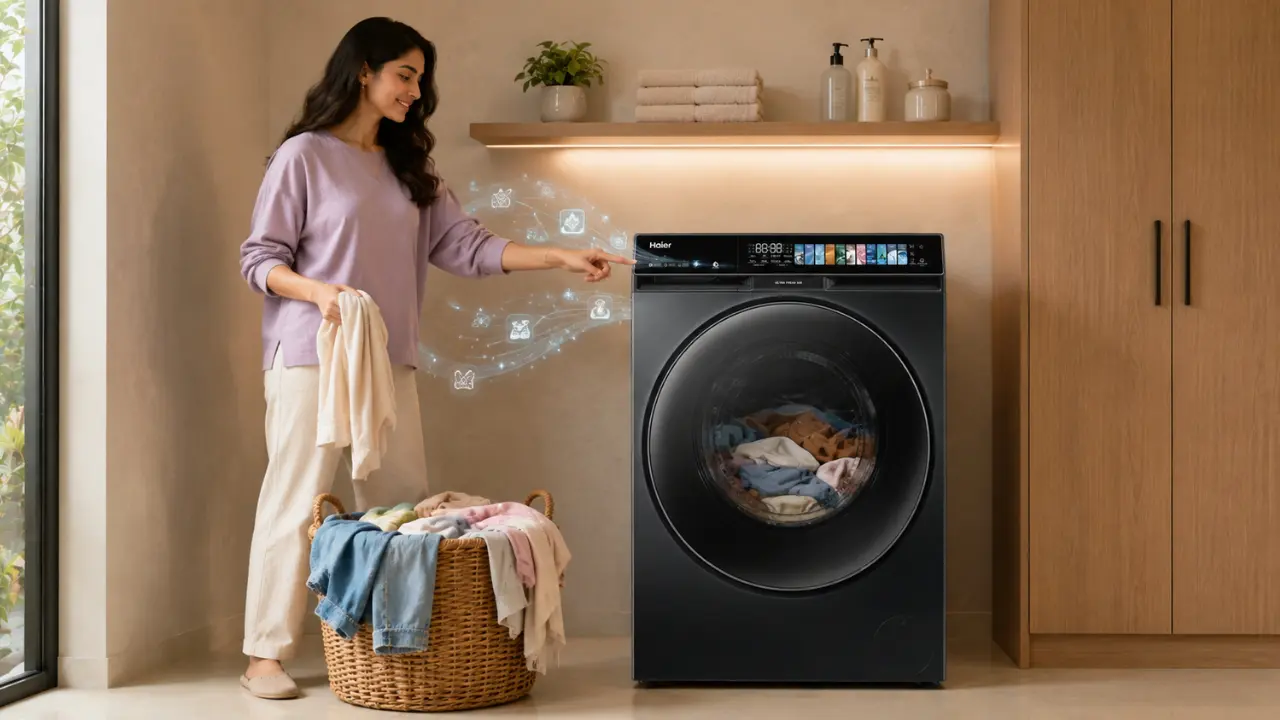

A washing machine can complete a cycle perfectly and still deliver disappointing results.
Why? Because every load is different.
A drum filled with cotton bedsheets does not behave like one carrying delicate tops. Mud on children’s trousers needs a different approach from coffee on an office shirt. Even two loads of similar-looking clothes may differ in weight, fabric type and soil level.
Yet, many households use the same familiar programme every time.
That is where artificial intelligence begins to make practical sense. In a modern washing machine, AI is not merely an extra icon on the control panel. It helps the appliance understand the load, select suitable washing parameters and reduce the everyday guesswork involved in laundry.
The result is not simply automation. It is a more responsive wash.
What Does AI Do in a Washing Machine?
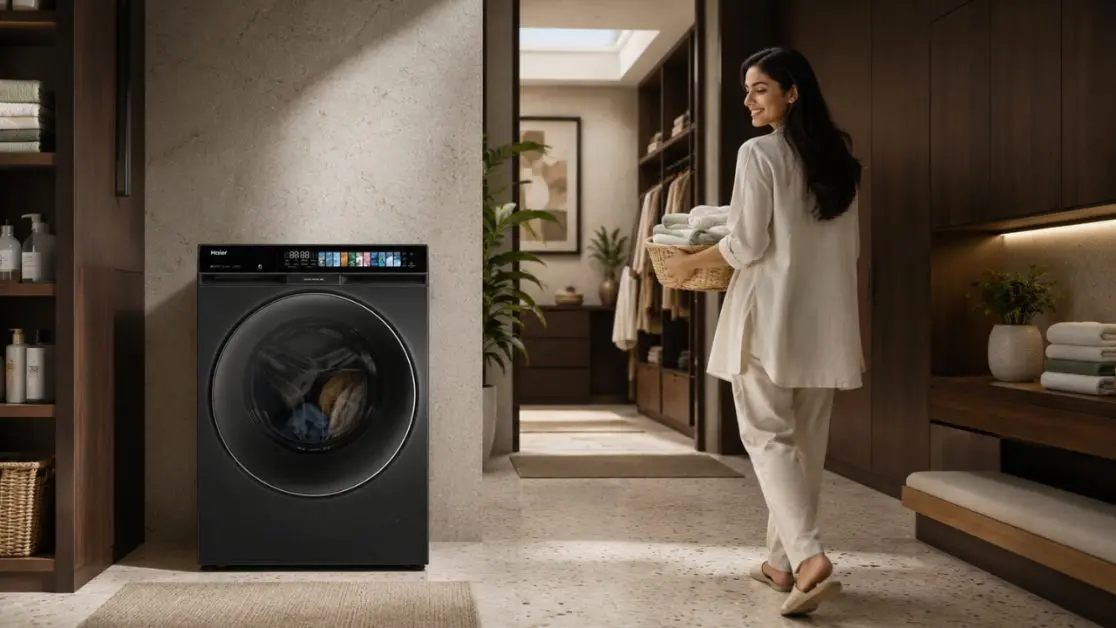
An AI-enabled washing machine uses available load information to make washing decisions more intelligently.
Depending on the model and selected function, the machine may assess factors such as:
- Laundry weight
- Fabric type
- Dirt or soil level
- Programme requirements
- Drum balance and operating conditions
- Detergent requirements
The appliance then adjusts relevant wash settings instead of expecting the user to make every decision manually.
This matters because washing clothes is rarely as straightforward as selecting “Cotton” and pressing Start. Indian wardrobes often bring together sarees, jeans, school uniforms, gymwear, bedsheets, office clothes and delicate garments, sometimes within the same week.
One wash formula cannot treat all of them equally well.
The Real Problem AI Solves: Too Many Small Decisions
Laundry errors are usually not dramatic. They are small, repeated and easy to overlook.
Someone chooses a heavy programme for a lightly soiled load. Another person adds detergent by instinct and uses more than necessary. A delicate garment gets washed with tougher fabrics. A nearly full drum is treated like a half load.
The machine still runs. The clothes still come out. So the mismatch may go unnoticed.
AI-supported washing aims to improve this decision-making process before the cycle settles into its rhythm.
| Everyday Laundry Question | How AI-Supported Washing Helps |
| Which programme should I select? | It can recommend or automatically choose suitable wash settings |
| Is the load light or heavy? | Load sensing helps the machine respond to laundry weight |
| Are the clothes lightly or heavily soiled? | Dirt-level detection can influence the wash parameters |
| How much detergent is required? | Smart dosing can dispense detergent according to the detected load |
| Is the drum operating smoothly? | Intelligent monitoring can support balance and stability |
| What happens if clothes remain inside after washing? | Fresh-air circulation can help maintain freshness after the cycle |
The benefit is simple: fewer assumptions.
One-Touch AI Wash Makes the First Decision Easier
Programme selection is often the first point of confusion.
The Haier 12 Kg F11 Front Load Washer Washing Machine, HW120-DM14F11BKU1, and the Haier 12 Kg F11 Front Load Washer & Dryer Washing Machine, model HWD120-DM14F11BKU1, feature One-Touch AI Wash.
With one touch, the function senses the fabric type, load and dirt level before choosing appropriate wash settings.
That means the user does not have to stand before the panel wondering whether a mixed household load should go under Cotton, Eco, Quick or Smart Wash. The machine takes on more of that decision-making.
This is particularly useful in homes where several family members operate the washing machine. One person may understand every programme. Another may simply need clean clothes without reading a manual each time.
One touch. Less confusion.
AI DBT Works Behind the Scenes
Not all intelligence in a washing machine is visible from the outside.
Haier’s F11 Series also features AI DBT, which monitors the machine’s working status and uses multiple methods to support the balance and stability of the slim washer.
That may sound highly technical, but the household relevance is easy to understand.
During a wash, laundry does not always spread evenly inside the drum. A bulky towel, bedsheet or pair of jeans may collect on one side. The machine must manage this movement while continuing to operate smoothly.
AI-based monitoring helps the appliance respond more intelligently to such operating conditions. This works alongside the Direct Motion Motor, which connects directly to the drum and is designed for smooth, quieter and vibration-controlled performance.
The intelligence is not there to entertain the user. It is there to help the machine behave better.
Smart Dosing Removes the “One Extra Cap” Habit
Detergent measurement is one of the most common weak points in home laundry.
People often assume that more detergent means cleaner clothes. It does not always work that way. Excess detergent can create unnecessary foam and may require more effective rinsing to remove residue.
The F11 Series addresses this with Smart Dosing.
The machine determines the detergent dose according to the laundry weight. Once the compartments are filled, the system can handle dosing across multiple washes rather than requiring manual measurement every time.
This offers two practical advantages:
- The detergent quantity is matched more closely to the load.
- The user does not have to estimate the dose for every cycle.
The washer also allows detergent and softener dosing levels to be adjusted, giving users more control where required.
So, AI does not remove choice. It makes routine choices more manageable.
Different Stains Need Different Treatment
A milk stain is not the same as mud. Coffee behaves differently from oil. Sweat marks on a collar require a different response from dirt on children’s clothes.
The Haier F11 models include six specialised stain-removal modes designed for:
- Sweat
- Coffee
- Milk
- Mud
- Blood
- Oil
With the selected programme, the machine adjusts washing parameters to address the stain more appropriately.
This is where intelligent laundry becomes more meaningful. Rather than treating every mark as generic dirt, the appliance provides dedicated options for common household stains.
Of course, garment care labels and stain age still matter. No machine can reverse every fabric mistake. But starting with a stain-specific programme is far better than selecting settings at random.
AI Works Best When the Hardware Can Support It
Software alone cannot wash clothes.
The intelligence must be supported by the drum, motor, water movement and detergent delivery system. That is why the wider F11 design matters.
SuperDrum-525
The F11 Series uses a 525 mm drum diameter, providing greater room for laundry movement and supporting a more spacious wash environment.
For a 12 kg machine, this is useful when washing larger household loads, bulky fabrics or weekly laundry collections.
Essence Wash
Essence Wash pre-mixes detergent to activate its cleaning action and sprays it directly onto fabrics. Fresh water and centrifugal rinsing then help remove foam residue.
For suitable loads of up to 2.5 kg, the programme can complete a full wash in 39 minutes.
Dual Spray
Dual Spray directs pre-mixed liquid towards the fabrics to support effective soaking, washing and rinsing.
These systems show an important truth: AI can select and optimise, but physical wash engineering must still perform the actual work.
What Happens After the Wash Ends?
Here is a familiar situation.
The cycle finishes, but nobody is available to unload the machine. A meeting runs late. School pickup takes longer. Dinner preparation begins. The clothes remain in the drum.
The F11 Series includes Ultra Fresh Air Technology, designed to maintain freshness for up to 12 hours after the wash cycle.
It uses 360-degree micro-pressure air circulation and refreshes the drum every two minutes, keeping air moving around the washed clothes.
This is a practical response to real household routines. Laundry does not always get removed the moment a cycle ends. Technology should recognise that rather than expecting people to organise their day around the machine.
Washer or Washer-Dryer: Which F11 Model Fits Better?
Both F11 models offer a 12 kg capacity, AI-supported washing, a colourful touch panel, Smart Dosing, Ultra Fresh Air Technology and a Direct Motion Motor.
The main choice depends on what the household needs after washing.
| Model | Best Suited For |
| Haier 12 Kg F11 Front Load Washer Washing Machine, HW120-DM14F11BKU1 | Homes that need a high-capacity washer and already have convenient drying arrangements |
| Haier 12 Kg F11 Front Load Washer & Dryer Washing Machine, HWD120-DM14F11BKU1 | Homes seeking washing and drying functions within one appliance |
The washer-dryer model also includes Wash & Dry, Smart Gentle Dry and Dual Vortex Self-Cleaning for the drying system.
For apartments, monsoon conditions or homes where drying space is limited, a combined washer-dryer may offer added convenience. For households that prefer line drying or already have adequate drying space, the washer model may be the more relevant fit.
A Colour Panel That Makes Intelligence Easier to Use
Advanced features lose value when controls are difficult to understand.
The F11 Series features an AI Colour Full Panel, a colourful touch interface with dedicated programme displays for different fabric and wash requirements.
It gives the machine a premium appearance, yes. More importantly, it makes the available functions easier to identify and operate.
The models also support Wi-Fi connectivity through Haier’s smart ecosystem, allowing users to manage supported washing-machine functions remotely.
That means smart laundry is not limited to what happens inside the drum. It also extends to how the user interacts with the appliance.
The Better Wash Is the One That Adapts
AI cannot fold clothes, separate whites from colours or check the care label on a favourite kurta. Some responsibility will always remain with the user.
What it can do is improve the decisions taking place inside the machine.
It can respond to the load instead of relying on one fixed routine. It can support accurate detergent dosing, simplify programme selection, monitor operating stability and help maintain freshness after washing.
That is the practical appeal of the Haier F11 Series.
The Haier 12 Kg F11 Front Load Washer HW120-DM14F11BKU1 and Haier 12 Kg F11 Front Load Washer & Dryer HWD120-DM14F11BKU1 bring AI-supported washing together with a large 12 kg capacity, Direct Motion Motor, SuperDrum-525, specialised stain programmes, Smart Dosing and Ultra Fresh Air Technology.
For Indian households managing varied fabrics, unpredictable stains and busy daily schedules, that combination offers something more valuable than complexity.
It offers a washing machine that does more of the thinking before it starts washing.
Frequently Asked Questions
What is AI in a washing machine?
AI in a washing machine helps the appliance assess factors such as load weight, fabric type and soil level, then adjust suitable washing settings automatically or recommend them to the user.
How does AI optimise a wash cycle?
AI-supported washing can use information about the laundry load to select or adjust parameters such as wash settings, detergent quantity and operating conditions, reducing the need for manual programme selection.
What is One-Touch AI Wash in Haier F11 washing machines?
One-Touch AI Wash senses factors such as fabric type, load and dirt level and selects appropriate wash settings with a single touch.
How does Smart Dosing work?
Smart Dosing determines the detergent quantity according to the laundry weight and dispenses it automatically, reducing the need to measure detergent for every wash.
Can the Haier F11 Series remove different types of stains?
Yes. The F11 models feature specialised stain-removal modes for sweat, coffee, milk, mud, blood and oil, with washing parameters adjusted for the selected stain type.
What is AI DBT in the Haier F11 Series?
AI DBT monitors the washing machine’s operating status and supports drum balance and stability during operation, particularly when laundry becomes unevenly distributed.