
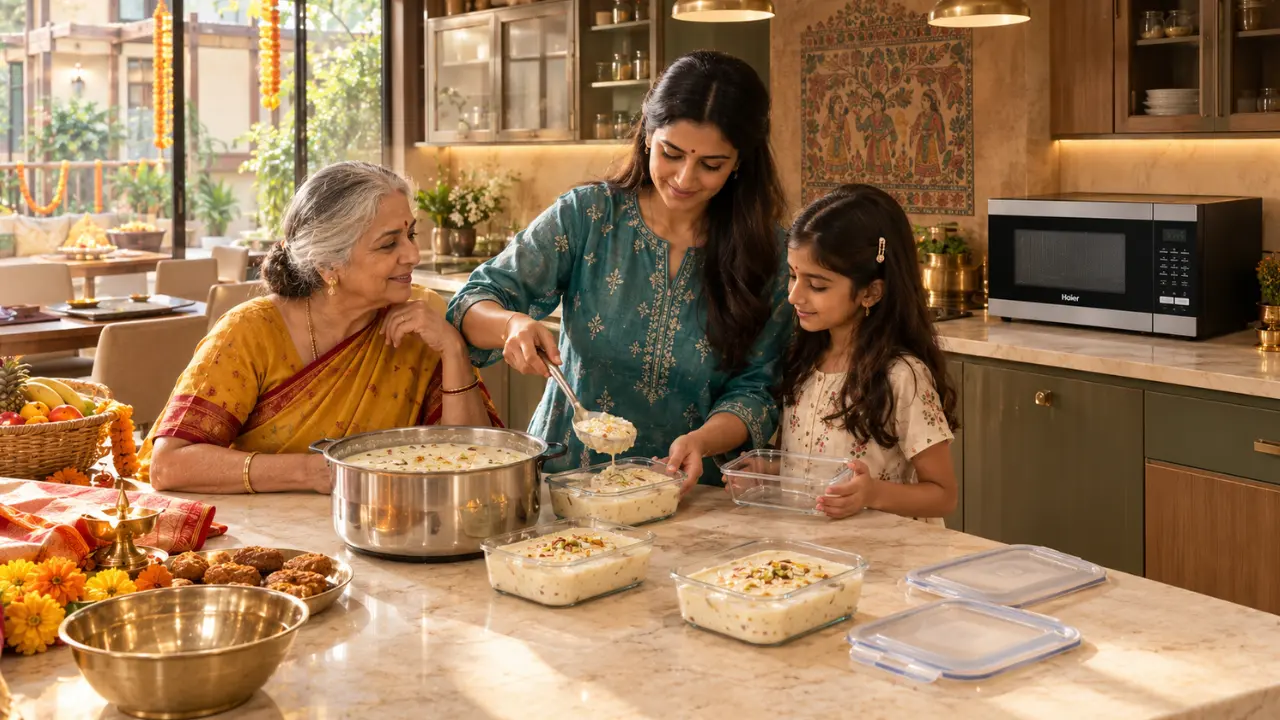

Chhath Puja celebrations may be done, however, there’s a bowl of homemade kheer lingering in the kitchen. Maybe you made a few extra dishes for dinner or had some visitors when you were there. In any case, you’d not want to throw out a delicious dessert, and it was made really well.
However, there’s something to remember. Care must be taken with milk-based sweets such as kheer after they are prepared. Extending their time outside, storing them in inappropriate containers, and repeatedly reheating them can have an impact on their freshness and safety.
So, what to do with leftover kheer after Chhath Puja?
The best way is to chill it quickly and keep it at 4°C or below in a clean covered container and use it soon. By following the correct storage and reheating methods, you can savor your holiday dessert without running unnecessary risks.
What Is the Special Attention That Kheer Deserves After Chhath Puja?
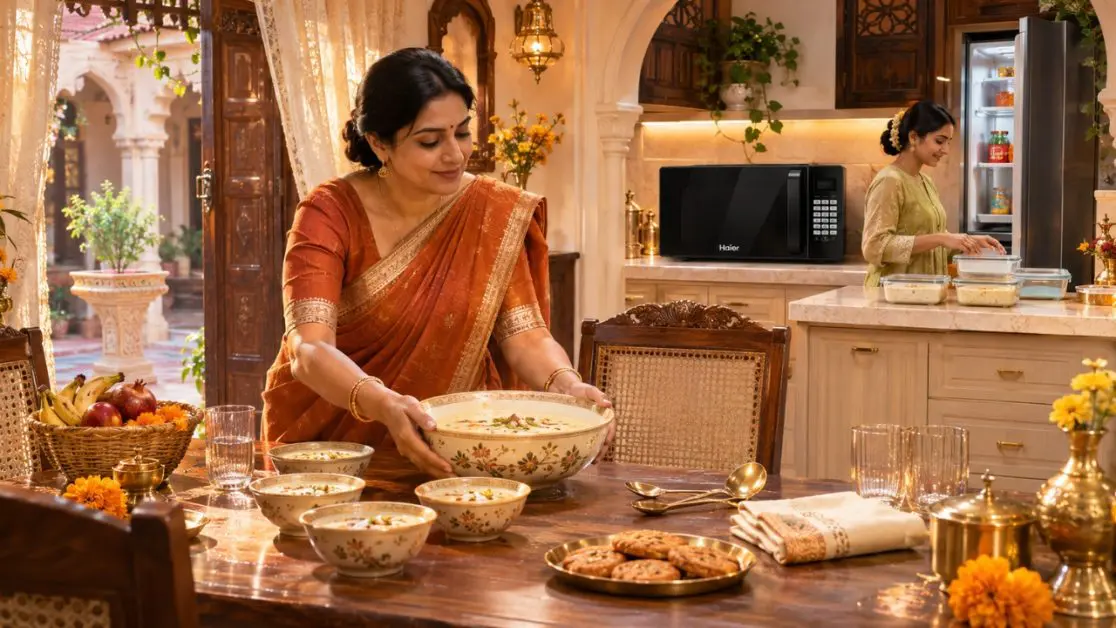
Chhath Puja is an important festival of the Indian religion and is celebrated by many people in the Indian families, especially in the regions of Bihar, Jharkhand and eastern Uttar Pradesh. Families make the traditional offerings with devotion and sometimes homemade sweets are part of the festivities.
Whether made with rice or milk and sugar or with jaggery, Kheer is a favourite dish.
But, it is also very susceptible to improper storage, thanks to its contents.
The moisture and nutrients in milk may help bacteria to grow if the dessert is stored at temperatures which are not safe. Another worry is cooked rice, as some bacteria such as the Bacillus cereus can survive cooking as spores and multiply if the food is left warm and stored for a long time.
And this is the hard part. Not all spoiled food is smelly.
A bowl of kheer could look quite normal despite being stored improperly.
Why Does Leftover Kheer Go Bad Quicker Than Fresh Kheer?
There are a number of common scenarios which can make a product more likely to go bad:
- Allow freshly prepared kheer to remain on the kitchen counter for several hours.
- Leaving dessert uncovered at family parties.
- Reusing spoons for serving and tasting.
- Combining freshly prepared kheer with old leftover kheer.
- Repeatedly heating refrigerated kheer that has been prepared.
These things are simple things that can be easily forgotten when preparing for the holidays. But, paying a little attention to storage can make a big difference.
How Long Does Kheer Last After It’s Taken Out of the Refrigerator?
A common error is to refrigerate the kheer after the kheer is all cold.
That isn’t necessary.
The general guideline for all perishable foods is that they need to be refrigerated no more than two hours after they are cooked or come out of temperature-controlled storage. This window shrinks to 1 hour when the temperature in the surrounding area is over 32°C.
This is important for Indian kitchens since the heat and warm weather can make it uncomfortable to be in a room even after nightfall.
A Simple Way to Store Leftover Kheer
| Situation | Recommended action |
| Kheer has just finished cooking | Break it up into small containers so it cools quickly. |
| After making, Kheer is cooling | Store in the refrigerator within 2 hours or 1 hour if the temperature is above 32°C. |
| Kheer has been immediately put in the refrigerator | Store under refrigeration at 4°C or lower. |
| Kheer has been outside all night | Discard it. |
| The kheer has been given to and heated several times | Do not store if safe times have been exceeded. |
Remember, reheating does not necessarily make improperly stored kheer safe. Other bacterial toxins may not be destroyed by heating.
The Proper Method to Store Leftover Kheer in the Refrigerator

No need for a complicated storage solution. A few good self-employed practices suffice.
Step 1: Divide Kheer into Smaller Containers
Suppose that you have made a big pot of rice kheer for your family after Chhath Puja.
It’s not the most practical way to put the entire hot vessel in the refrigerator. A large amount will take longer because it will take longer to cool at the center.
Rather, split the kheer into separate, shallow food-grade containers.
This will cool the dessert down faster and facilitate easier removal of each serving.
Step 2: Refrigerate Without Unnecessary Delay
Do let the steam out too much while preparing the containers, but don’t leave the kheer on the counter for hours.
The shallow sections can be refrigerated as hot. Don’t stack warm containers too tightly because they will cool faster if there is air circulation.
When the food has cooled down enough, make sure the containers are covered.
Step 3: Keep the Refrigerator at the Correct Temperature
The refrigerator temperature should be 4°C or lower for safe storage.
Don’t think the refrigerator is cold enough just because water bottles feel cold.
Use a refrigerator thermometer to verify the temperature.
In addition, refrain from putting too many items on the shelves of your holiday leftovers. Cold air must be able to flow around packed food.
Step 4: Label Your Containers
This is not essential if you have just one bowl of dessert in the fridge, but it comes in handy if you have multiple dishes on hand.
Label container with “Preparation Date.”
This will save everyone wondering if the kheer had been prepared yesterday or 3 days back.
For How Long Is Kheer Good for Refrigeration?
Homemade ‘kheer’ is best consumed within 2-3 days when properly refrigerated, provided it was properly cooled since the beginning and stored safely.
General leftover guidelines for refrigerated foods may suggest a period of 3-4 days for some cooked foods, but a shorter time is a good rule of thumb to follow when making milk-based desserts at home (especially those made with rice).
The length of time it can be stored is also influenced by the handling history of the food.
For instance, kheer made in a clean container and stored in the refrigerator immediately is not the same as kheer left out on a dining table during a prolonged family feast.
Is It Possible to Freeze Leftover Kheer?
Yes, if it is properly cooled, it can be frozen in a suitable airtight container that is freezer-proof.
However, freezing may affect its texture.
Rice may soften and milk-based mixtures could separate a little after thawing.
For better results:
- Divide kheer into small portions and freeze.
- Create some room for expansion in the container.
- Refrigerate, do not thaw on the kitchen counter.
- Thoroughly stir while reheating.
- Do not repeatedly refreeze and thaw the same food.
Freezing is a process to store food that has been handled safely. It will not undo spoilage that has taken place.
Is It Okay to Reheat Kheer After Chhath Puja in Microwave?

Yes. A microwave oven can be used to reheat refrigerated kheer which can be useful when serving a small quantity of kheer as compared to a full batch.
But reheating of kheer should be done carefully as its thick consistency may lead to uneven heating.
Reheating Kheer Without Overcooking or Drying It Out
Follow these steps:
- Take off just the top bit that you are going to consume.
- Place in a microwave-safe bowl.
- If the kheer has become thick after refrigeration, add some milk to it.
- Cook briefly in the heat, stirring between each heat.
- Repeat until the kheer is steaming hot all the way through, and at the right temperature, 74°C is ideal.
- Let stand for a few seconds, and stir and test again before eating.
Don’t put kheer in a tightly closed container.
When serving cold, it can be served right from the refrigerator as long as it has been stored safely.
Enjoying Festive Reheating Is Made Easier With Haier Microwave Ovens
It’s not always easy to cook from scratch after a hectic festival. Sometimes all you need is a comforting bowl of kheer and a little time with family.
That’s where a versatile microwave oven comes in handy.
Haier India provides convection microwave ovens that come with various features for everyday cooking, reheating and preparing various meals. Features like multiple power settings, easy controls and programmed menus for cooking can make preparing meals easier, depending on the model.
Haier 30L Convection Microwave With In-Built Air Fryer (HIL3001ARSB)
Haier’s 30L convection microwave oven comes with an in-built air fryer for your convenience.
The Haier 30L Convection Microwave With In-Built Air Fryer (HIL3001ARSB) is a microwave with air fryer that provides several cooking functions in a single device.
Its features include:
- Five microwave power settings for various applications.
- 305 preset auto-cook menus.
- Built-in air fryer and 36 separate air fryer menus.
- Oven to turn food on a grill with a motorised rotisserie.
- A cavity made from stainless steel.
- A child lock to help prevent accidental operation.
The microwave and adjustable power levels are important when used on any leftover kheer. Can preheat individual portions and adjust heating and stirring as necessary.
Other common meals can benefit from the additional versatility of the air-frying or rotisserie options.
Haier 28L Convection Microwave Oven With Dual Heating Element (HIL2801DBSJ)
The other choice is Haier 28L Convection Microwave Oven With Dual Heating Element (HIL2801DBSJ).
It comes with an Easy Jog Control, which is user-friendly, and stainless steel cavity and combination cooking features.
Dual heating elements and back convection fan for baking, grilling and roasting. However, the normal microwave mode is the right option to reheat kheer, not the grill or convection mode.
Haier Convection Microwave Oven (25L) – HIL2501CBSH
Another smart option for Indian kitchens is the Haier 25L Convection Microwave Oven (HIL2501CBSH).
It features 305 auto cook menus, a memory function, combination cooking and a stainless steel cavity.
It also features a deodoriser system to get rid of cooking smells and vapours from inside the microwave.
These features are useful for the normal use of the kitchen and can be used when cooking small portions of kheer or any other favourite dish.
It is important to note that microwave reheating and refrigeration have different functions. The microwave will reheat properly stored leftovers; not make them safe if they are spoiled.
How to Check if Leftover Kheer Is Spoiled?
When giving out refrigerated kheer, ensure that there are no visible changes.
Some typical warning signs are:
- A very bad odour.
- Mould or discolouration can be seen.
- Bubbling or fermentation which is not expected.
- A greasy or other abnormal consistency.
These are not a complete safety test, though. Harmful bacteria can cause no physical, smell, taste or appearance changes.
Do not taste anything suspicious to see if it’s safe to eat.
When you can’t remember how long it’s been outside, or if it was refrigerated right away, it’s best to throw it out.
Small Changes That Can Help Minimise Festive Food Waste
There is a lot of food often involved in the preparations for Chhath Puja. Having some idea of what to do with leftovers helps minimise any unnecessary waste.
There are a few simple practices that will make post-festival storage easier:
- Plan accordingly for meal quantities based on family size and guests.
- Store the large quantity in the refrigerator and provide individual servings.
- When taking kheer from the storage use clean utensils.
- Don’t put the uneaten portions of plates back into the food container.
- Ahead of preparing huge quantities of sweets, observe the space available in the refrigerator.
These habits would work for anything beyond Chhath Puja, such as preparing Diwali desserts, mealtime for family get-togethers or weekend snacks.
Serve Your Chhath Puja Kheer the Same Way It Was Prepared
Kheer is not just another sweet dish at the time of Chhath Puja. It’s the familiar taste of family recipes, celebrated and festive traditions.
Keeping it alive begins with common sense in handling food.
Chill foods quickly, keep in clean containers and reheat only what you’ll eat.
If you are looking for an easy-to-use microwave oven for everyday reheating and cooking, consider Haier India convection microwave ovens such as the 30L HIL3001ARSB, 28L HIL2801DBSJ and 25L HIL2501CBSH models.
Proper storage and kitchen accessories can make it easy and fun to savour those favourite holiday foods even after the holidays.
Frequently Asked Questions
Can I eat refrigerated kheer the next day?
Yes. Kheer refrigerated promptly at 4°C or below can generally be eaten the following day. You may serve it cold or reheat it thoroughly.
Can I leave kheer outside overnight during winter?
No. Cooler weather doesn’t guarantee a safe storage temperature. Milk-based kheer should be refrigerated within the recommended time limits.
Why does kheer become thick after refrigeration?
Rice continues absorbing moisture, while the mixture becomes firmer as it cools. Adding a little milk while reheating can help restore a smoother consistency.
Can I reheat kheer twice?
It’s better to reheat only the portion you plan to eat. Repeated cooling and reheating increases handling and temperature-related risks.
Is microwave reheating safe for rice kheer?
Yes, provided the kheer was stored safely. Stir during reheating to reduce cold spots and ensure the dessert becomes hot throughout.