
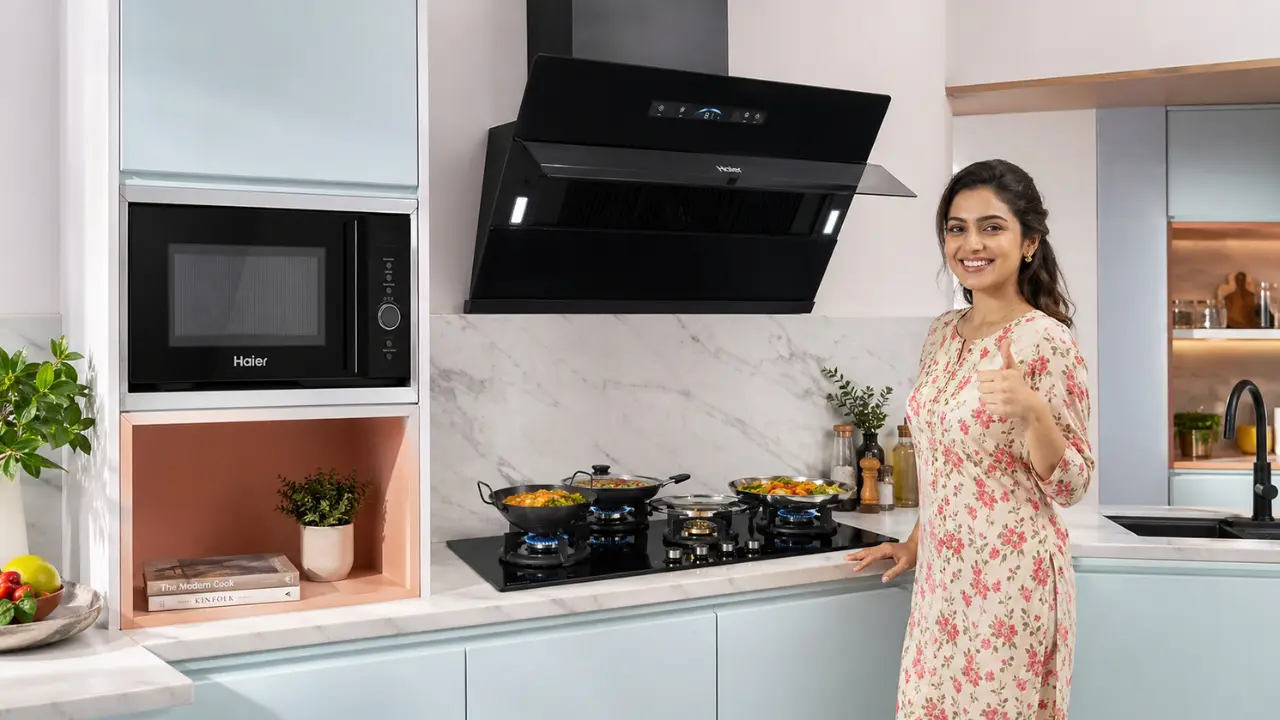

Haier kitchen appliances are really good because they help with the kind of problems we face in our kitchens every day.
They are good at getting things done quickly.
They do not take up a lot of space. Haier kitchen appliances also help us save energy and are easy to use every day.
Haier kitchen appliances have things, like microwaves that cook food fast and chimneys that do not make a lot of smoke.
They also have hobs that can withstand a lot of use. All these things make our daily life a little easier. Our kitchens feel more organized and easy to manage. Haier kitchen appliances make life simpler.
Why does a kitchen feel chaotic even when everything is “there”?
It is 8:15 PM.
One burner is busy with dal. Another with sabzi. Someone is reheating rotis. The kitchen is full. The air is heavier than it should be.
And suddenly, you realize something.
It is not the cooking that feels overwhelming.
It is the system around it.
Modern Indian homes are not short on appliances. They are short on coordination.
That is where the difference begins.
Modern kitchens are not about cooking. They are about flow.
A good kitchen does not just help you cook.
It removes decisions.
It removes waiting.
It removes friction.
Think about it like a well-run store. When everything is placed right, work feels faster without trying harder.
That is what modern kitchen appliances are quietly solving.
What makes Haier kitchen appliances fit into Indian homes so naturally?
They are designed around patterns, not just features.
Patterns like:
- Cooking multiple dishes at once
- Heavy oil and spice usage
- Limited kitchen space in urban homes
- Frequent reheating and batch cooking
- Need for fast cleaning
When appliances align with patterns, they disappear into the routine.
That is when they start working.
1. Speed is not a luxury anymore. It is a baseline expectation.
Time has changed.
Work hours stretch. Commutes get longer. Attention spans shrink.
Cooking still matters. But how long it takes matters more.
Take something as simple as reheating leftovers.
A basic microwave heats food.
A better one understands how different foods behave.
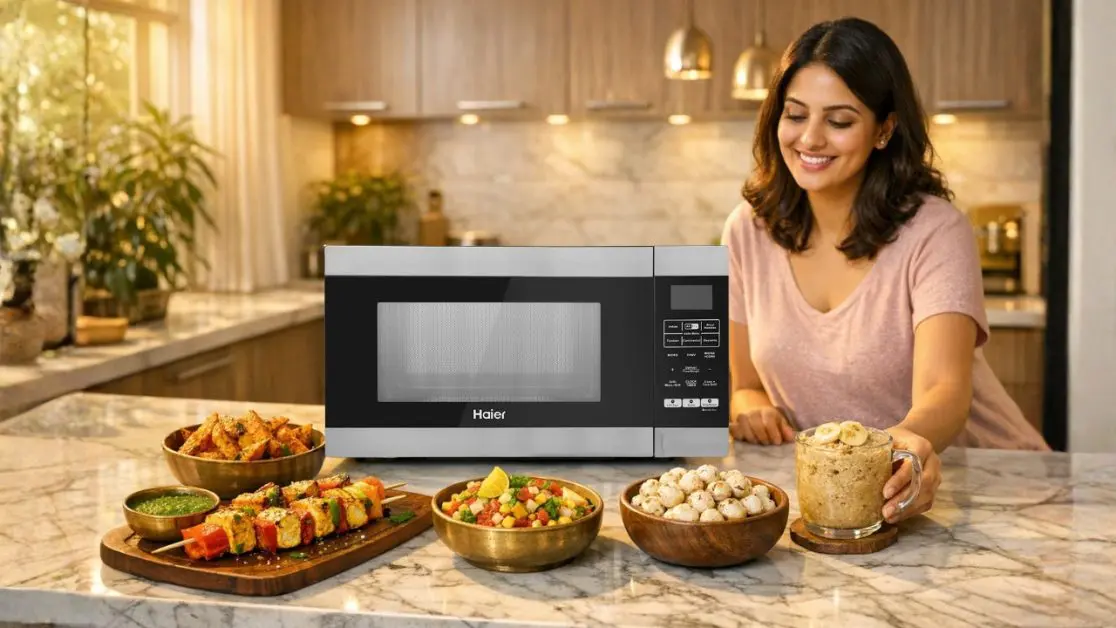
The Haier 23L Solo Microwave Oven (HIL2301MBEJ) does something subtle here.
- Auto cook menus adjust time and power automatically
- 900W magnetron ensures faster heating
- Larger 270 mm turntable fits real Indian plates
The result is simple.
Less guesswork. More consistency.
A good appliance saves time. A great one saves attention.
2. Multi-tasking is the real test of a kitchen
Indian kitchens rarely cook one thing at a time.
Festivals. Family dinners. Weekend experiments.
Everything overlaps.
This is where flexibility matters.
The Haier 20L Grill Microwave (HIL2002GSPB) introduces combination cooking.
- Cooking plus browning
- Cooking plus baking
- Browning plus baking
This sounds like a feature.
But it is actually a system.
Instead of switching appliances or steps, you compress the process.
That is the hidden advantage.
Efficiency is not about doing more. It is about switching less.
3. Smoke-free kitchens change how people feel, not just how they cook
Cooking Indian food means dealing with smoke, oil, and heat.
And most people accept it as normal.
But normal does not mean optimal.
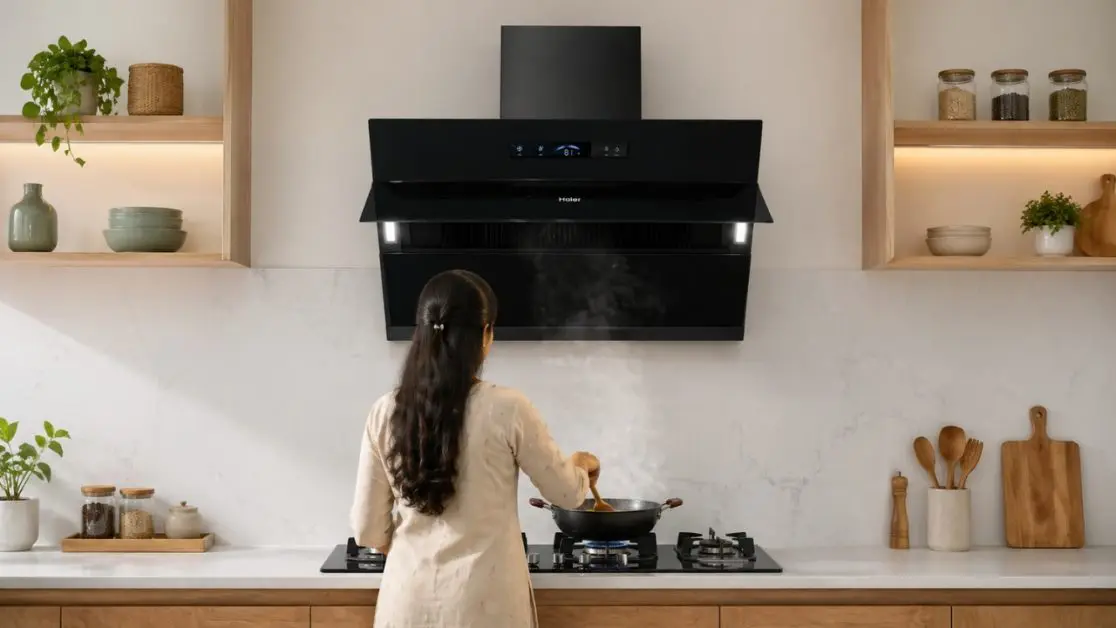
A high-suction chimney changes the experience entirely.
The Haier BLDC Chimney (HIH-C1900-BLDC-IN) is built around this idea.
- 1650 m³/h suction power clears heavy smoke
- Gesture control allows hands-free operation
- Heat auto-clean reduces maintenance
The impact is not just technical.
It is emotional.
The kitchen feels lighter. Cleaner. Easier to stay in.
And when a space feels better, people use it more.
4. Durability is not a feature. It is a long-term cost strategy
Most appliance decisions are made once.
But I lived with it every day.
That is why materials matter more than marketing.
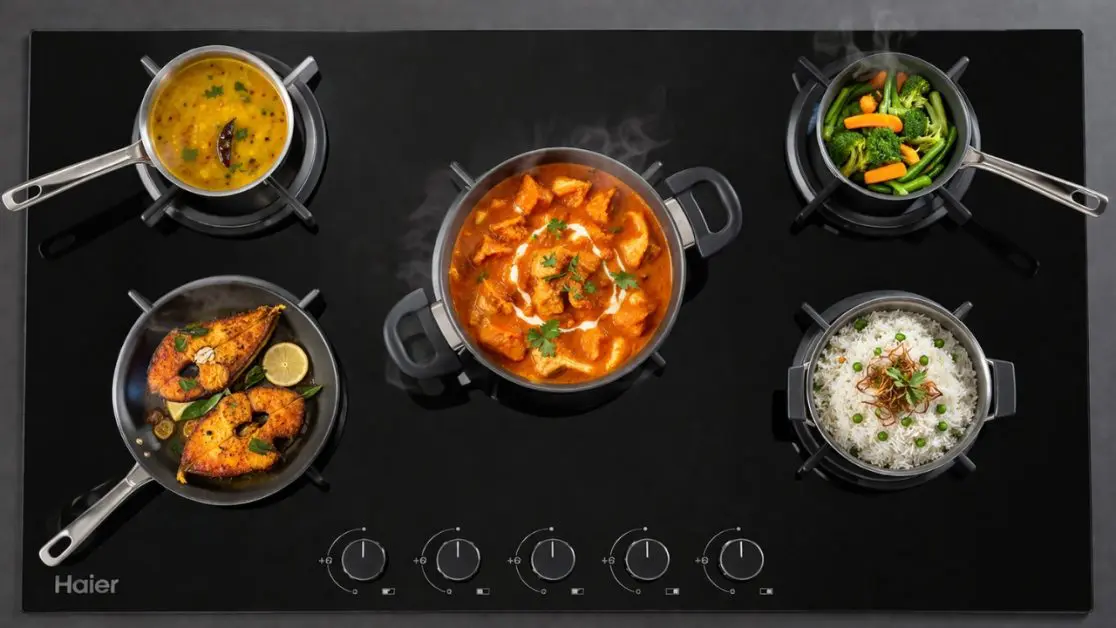
Consider the Haier 5 Burner Hybrid Hob (HIC-Q89576F).
- Brass burners retain heat better and last longer
- Toughened glass handles heavy cookware
- Auto ignition removes the need for external lighters
This is not just about performance.
It is about reducing replacement cycles.
Let’s look at it practically:
| Factor | Lower Quality Appliance | Durable Appliance |
| Initial Cost | Lower | Slightly higher |
| Maintenance | Frequent | Minimal |
| Replacement Cycle | 2 to 3 years | 5 to 8 years |
| Total Cost | Higher over time | Lower over time |
Cheap decisions are expensive decisions in disguise.
5. Control systems define how “smart” an appliance really is
Smart does not mean complex.
Smart means intuitive.
Modern appliances are shifting from buttons to behavior.
Take chimneys again.
Touch and gesture controls remove friction when hands are messy.
Multiple speed settings adapt to cooking intensity.
Cleaning reminders reduces neglect.
This is not about technology.
It is about timing.
The appliance responds when you need it to.
Not when you remember to use it.
Three types of kitchen systems most Indian homes follow
Every home falls into one of these patterns.
1. The Reactive Kitchen
- Appliances are basic
- Cooking depends on manual effort
- Time and energy fluctuate
Cost: Low upfront
Hidden Cost: High daily friction
2. The Upgraded Kitchen
- Appliances solve individual problems
- Microwave for heating, chimney for smoke
- Better but still fragmented
Cost: Moderate
Hidden Cost: Coordination gaps
3. The Integrated Kitchen
- Appliances work together
- Speed, cleanliness, and durability align
- Cooking becomes predictable
Cost: Higher upfront
Hidden Benefit: Time, energy, and mental ease
Most people think they are buying appliances.
They are actually choosing a system.
Why Haier kitchen appliances align with the “integrated kitchen” model
Because they solve across layers.
Not just one problem.
Let’s break it down:
- Speed layer: Fast cooking, auto menus, efficient heating
- Environment layer: High suction chimneys, smoke control
- Durability layer: Brass burners, toughened glass
- Control layer: Gesture, digital, multi-level settings
Each layer reduces a different kind of friction.
Together, they create flow.
Systems beat features every single time.
What does this mean for real homes?
It changes small moments.
Which is where life actually happens.
- Morning tea feels quicker
- Weekend cooking feels less exhausting
- Festival prep feels manageable
- Cleaning feels less like a chore
No single feature does this.
The system does.
The hidden shift: From “appliance buying” to “lifestyle design”
This is the part most people miss.
Buying a kitchen appliance is not a technical decision anymore.
It is a lifestyle decision.
One option is to optimize for price.
The second option is to optimize for features.
The third option is to optimize for how your day feels.
The third option wins.
Every time.
A simple framework to think about your next kitchen upgrade
Ask three questions:
- Does this reduce time or just shift it?
- Does this remove effort or add steps?
- Does this improve consistency or require adjustment?
If the answer aligns across all three, you are choosing right.
Final thought: Good kitchens cook food. Great kitchens create rhythm.
A well-designed kitchen does something invisible.
It turns chaos into flow.
It turns effort into habit.
It turns time spent into time saved.
Haier kitchen appliances fit modern Indian homes not because they are advanced.
But because they understand something deeper.
Life does not get easier when you add more tools.
It gets easier when the tools start working together.
And that is the real upgrade.
Frequently Asked Questions
Why does my kitchen feel chaotic even when I have all the appliances I need?
Because the issue isn’t missing tools it’s lack of coordination. When appliances don’t “flow” together, you spend more time switching, adjusting, and thinking.
Why do I feel mentally tired while cooking, not physically?
Constant small decisions timing, switching burners, and reheating create cognitive load. A well-designed system reduces those micro-decisions.
Are modern kitchens supposed to feel easier or just more equipped?
Easier. More appliances without integration often increase friction instead of reducing it.
What makes an appliance truly ‘smart’?
Not complexity intuitiveness. It should respond naturally to your needs (gesture control, auto settings).
Are touch and gesture controls actually useful?
Yes, especially when your hands are messy they reduce friction during cooking.
Why do some kitchen appliances wear out so quickly?
Lower-quality materials can’t handle heavy Indian cooking patterns.
Is spending more upfront actually worth it?
Yes. Durable appliances reduce maintenance and replacement costs over time.