
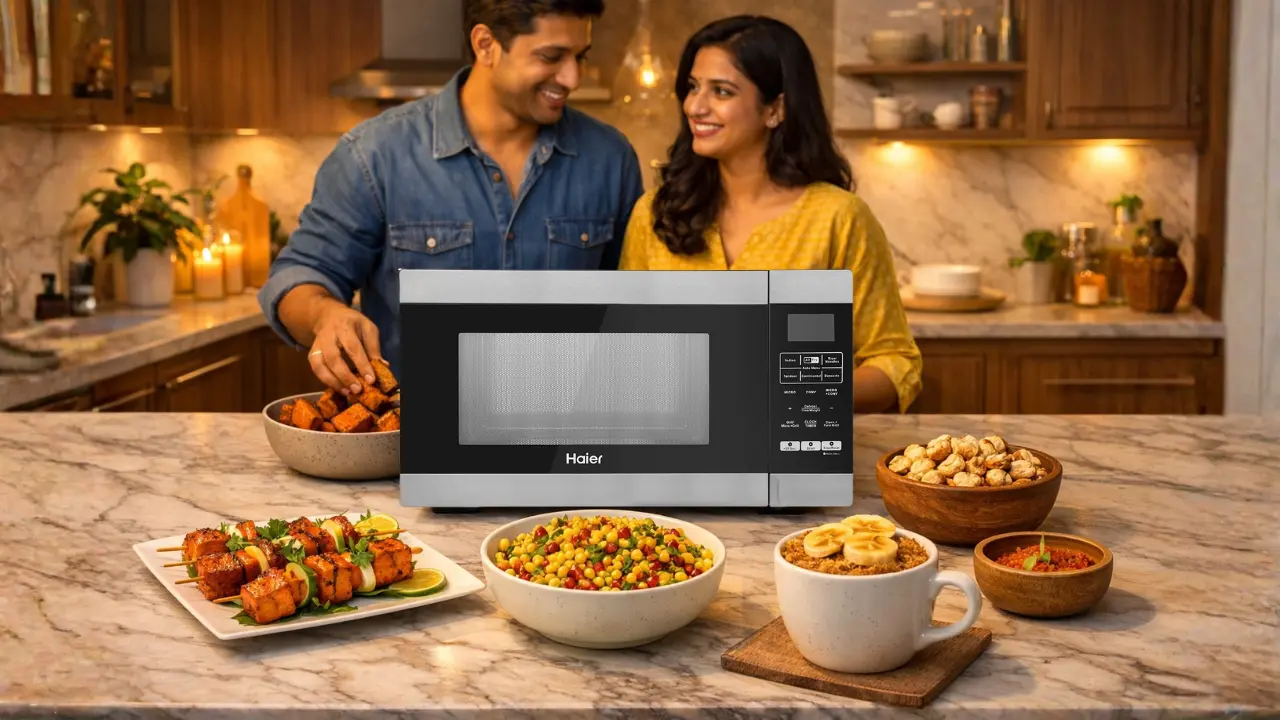

Dual heating reduces cooking time by applying heat from two sources at once, usually microwave energy from within and convection or grill heat from outside.
This simultaneous heat transfer speeds up cooking by up to 30 percent, improves texture, and eliminates the need for multiple cooking steps.
Why does cooking often feel slower than it should?
It is 8:20 pm.
One person wants hot rotis. Someone else wants crispy paneer. The dal is already reheated. The kitchen is active, but the meal is not ready.
The problem is not effort.
It is a sequence.
Most cooking systems work one step at a time. Heat. Wait. Flip. Wait again. Finish.
Time stretches because heat moves in a straight line.
Dual heating changes that.
It turns a line into a system.
What is dual heating and how does it actually work?
Dual heating is simple in idea, powerful in effect.
Instead of one heat source doing all the work, two heat systems operate together.
The two layers of heat
- Microwave heating
- Works from the inside
- Uses electromagnetic waves to excite water molecules
- Heats food rapidly at its core
- Convection or grill heating
- Works from the outside
- Circulates hot air or uses direct radiant heat
- Creates browning, crispness, and texture
When both happen together, something interesting happens.
Time compresses.
Why this matters in real cooking
Think of making paneer tikka.
- Microwave alone cooks it fast, but leaves it soft
- Grill alone gives texture, but takes longer
- Dual heating does both at the same time
That is not convenient.
That is system design.
The hidden system: Heat direction defines cooking time
Cooking is not about temperature.
It is about how heat moves.
Here is the difference:
| Heating Method | Heat Direction | Result | Time Impact |
| Microwave only | Inside out | Fast, but soft texture | Quick, but incomplete |
| Grill only | Outside in | Crispy, but slow | Longer cooking |
| Dual heating | Inside + outside | Fast and crispy | Up to 30% faster |
This is exactly why combination cooking in modern microwaves can reduce cooking time significantly while improving results .
A simple shift.
But a powerful one.
Why dual heating feels faster even when the clock says otherwise
Here is the insight most people miss.
Speed is not just minutes. It is friction.
Dual heating reduces friction at three levels:
1. Less waiting between steps
No switching modes. No reheating after grilling. No second round.
Everything happens in one flow.
2. No compromise between speed and texture
Fast cooking usually sacrifices crispness.
Dual heating removes that trade-off.
3. Fewer manual decisions
Temperature, timing, sequence.
Handled.
Modern systems even automate this through multi-stage cooking, adjusting heat levels automatically for different stages of a dish .
Where dual heating shows up in everyday Indian kitchens
Dual heating is not a feature you notice.
It is a difference you feel.
Common use cases
- Reheating leftovers without drying them out
- Making crispy samosas without deep frying
- Baking cakes faster with even texture
- Cooking rice while maintaining moisture balance
- Grilling paneer or chicken with consistent browning
A quick breakdown
| Dish | Traditional Method | Dual Heating Result |
| Samosa | Deep fry | Crisp outside, low oil |
| Paneer tikka | Grill + wait | Cooked and grilled together |
| Cake | Bake only | Faster, even baking |
| Rice | Boil or steam | Faster heating, controlled moisture |
This is why modern convection microwaves now combine multiple modes in one system.
Not to add features.
To remove delays.
The three ways people approach cooking speed
Most kitchens fall into one of these patterns.
One option is speed-first cooking
- Use microwave only
- Fast results
- Compromised texture
Cost: You eat quickly
Trade-off: Food feels incomplete
The second option is quality-first cooking
- Use OTG or stovetop
- Better taste and texture
- Longer cooking time
Cost: Time and effort
Trade-off: Delayed meals
The third option is system-first cooking
- Use dual heating systems
- Combine speed and texture
- Automate transitions
Cost: Slight learning curve
Benefit: Consistency, speed, ease
This third option is where modern kitchens are moving.
Quietly.
How Haier integrates dual heating into real appliances
This is where things become practical.
Take the Haier 25L Convection Microwave Oven (HIL2501CBSH).
It uses combination cooking, blending microwave, grill, and convection modes to reduce cooking time by up to 30 percent.
It also offers:
- 305 auto cook menus for preset cooking combinations
- Multi-stage cooking that adjusts heat levels automatically
- Oil-free cooking options for healthier meals
These are not features.
They are shortcuts built into the system.
Similarly, larger models like the Haier 30L Convection Microwave with In-Built Air Fryer (HIL3001ARSB) take this further:
- Microwave plus convection plus air fryer in one system
- 36 dedicated air fry menus
- High convection power up to 2500W for faster cooking
The idea is simple.
More heat sources.
Better coordination.
Less waiting.
Dual heating is not about power. It is about coordination
Most people think faster cooking needs higher wattage.
That is only half true.
Power without coordination creates uneven results.
Coordination without power creates slow results.
Dual heating solves both.
It synchronizes:
- Internal heat
- External heat
- Air circulation
- Cooking stages
That is why even a 20L model with proper heat distribution can cook evenly and efficiently .
What does this mean for everyday life?
This is where the bigger pattern reveals itself.
Cooking systems are evolving the same way work systems did.
From manual effort to automated flow.
From step-by-step execution to parallel processing.
From waiting to continuity.
Dual heating is just one example of that shift.
The real takeaway: Speed is a system, not a setting
Here is the one insight worth remembering.
Cooking does not become faster when heat increases.
It becomes faster when heat works together.
Dual heating reduces cooking time because it removes the need to choose between speed and quality.
It collapses multiple steps into one.
It aligns effort with outcome.
So what should you actually look for?
If cooking time matters in your home, look beyond wattage or capacity.
Look for systems that think ahead.
Key decision checklist
- Does the appliance combine multiple heating modes?
- Can it run these modes together, not separately?
- Does it offer preset or auto cooking sequences?
- Does it reduce manual intervention during cooking?
If the answer is yes, you are not buying a microwave.
You are upgrading your kitchen system.
Final thought: The kitchens that feel effortless are not working harder
They are working differently.
They do not rush.
They do not compromise.
They coordinate.
Dual heating is a small technical shift.
But it represents a larger idea.
When systems align, time disappears.
And in a modern Indian home, that might be the most valuable feature of all.
Frequently Asked Questions
Why does cooking feel slow even when I start on time?
Because most kitchens run in sequence heat → wait → flip → wait. Dual heating overlaps these steps, reducing idle time.
I’m cooking multiple dishes at once. Why does everything still get delayed?
Each dish competes for a single heat source. Dual heating lets one dish cook internally and externally at the same time, freeing up workflow.
Should I prioritize speed or taste when I’m short on time?
With traditional methods, you often have to choose. Dual heating removes that trade-off by delivering both simultaneously.
Is buying a higher wattage microwave enough to cook faster?
Not really. Speed improves more from coordinated heat systems than just raw power.
I’m cooking paneer tikka after a long workday. How can I make it both crispy and fast without using multiple appliances?
Use dual heating (microwave + grill) to cook and crisp simultaneously in one cycle.
I usually reheat leftovers at night and they turn dry. What’s the best way to keep them fresh?
Switch to combination mode so food heats evenly and retains moisture.
I don’t have time to manage cooking steps manually. How can I automate my cooking flow?
Choose appliances with multi-stage cooking and auto menus.
I want to reduce cooking time but not compromise on taste. What system should I use?
Dual heating systems are designed exactly for this balance.
I’m tired of switching between stovetop, OTG, and microwave. Can one system replace all?
A convection microwave with dual heating can combine these roles efficiently.