
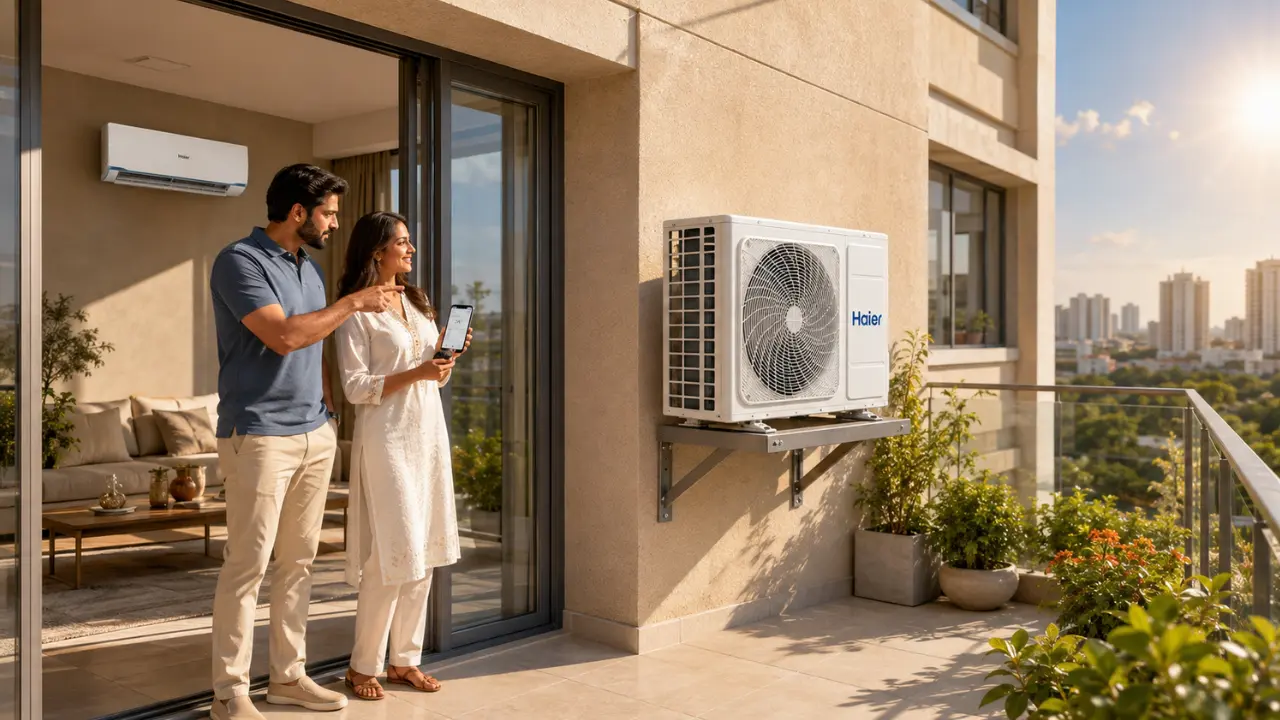

The outdoor unit of an air conditioner rarely gets a comfortable spot.
It may sit on a balcony ledge in Delhi, face the afternoon sun on a terrace in Jaipur, or spend long summer days outside a west-facing apartment in Ahmedabad. Meanwhile, everyone indoors expects one simple result: dependable cooling.
That raises an important question: does direct sunlight affect an outdoor AC unit?
Yes, the surrounding heat conditions matter. But sunlight alone does not decide how well an AC will perform. The outdoor unit’s heat-exchange capability, airflow around it, cleanliness, installation and ability to operate under high ambient temperatures all play a part.
And in India, where summer conditions can become severe, those details deserve attention.
Why the Outdoor Unit Needs to Release Heat
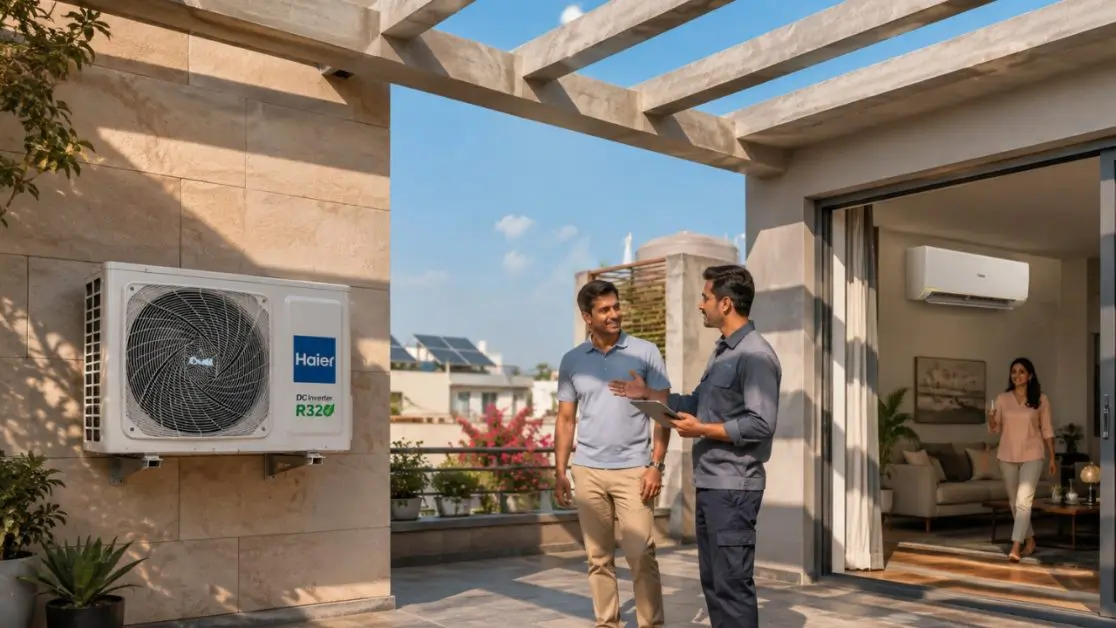
A split AC does more than send cool air into a room. During cooling, heat from indoors ultimately needs to be rejected outdoors.
This is where the outdoor unit becomes important.
Its condenser and fan help transfer heat to the surrounding air. When outdoor conditions become hotter, releasing that heat can become more demanding. Direct solar exposure can also heat the outdoor unit’s casing and contribute to the thermal conditions around it.
This does not mean an outdoor unit should simply be boxed into the shade. That can create another problem altogether: poor ventilation.
A better way to think about outdoor-unit placement is:
- Reduce unnecessary heat exposure where practical.
- Never compromise the airflow required by the unit.
- Keep the surrounding area reasonably clear.
- Follow the manufacturer’s installation requirements.
- Choose an AC designed for demanding ambient conditions when local summers call for it.
The last point becomes especially relevant across many Indian cities.
Sunlight Is Only Part of the Summer Challenge
Imagine an outdoor unit installed on a balcony at 3 pm in peak May.
It isn’t dealing with sunlight in isolation. The surrounding air is hot. Nearby walls and concrete surfaces may also have absorbed heat for hours. Depending on the installation, ventilation around the unit may be restricted.
So, asking only “Is the AC in direct sunlight?” misses part of the picture.
Three factors deserve equal attention.
1. Ambient Temperature
The outdoor unit has to reject heat into the air around it. As ambient temperatures rise, operating conditions become more demanding.
2. Air Circulation
An outdoor unit needs sufficient space to move air. Restricting its intake or exhaust in an attempt to shield it from the sun can work against the purpose.
3. Condition of the Heat-Exchange Surface
Dust and debris around the condenser can interfere with effective heat exchange. In Indian conditions, where dust can accumulate quickly, outdoor-unit cleanliness is therefore not a minor housekeeping matter.
This is one reason thoughtful AC design increasingly looks beyond the indoor unit.
A Sunshade Can Help, but Don’t Turn It Into a Box
Providing shade may help reduce direct solar exposure, provided it is done without obstructing ventilation or interfering with the installation.
A large, tightly enclosed cover around the outdoor unit? Not a good idea.
The unit needs to breathe.
If a protective overhead shade is being considered, it should not interfere with required clearances, servicing access or air movement. Installation requirements vary, so professional installation guidance should take priority over improvised arrangements.
There is another easy mistake worth mentioning: don’t treat plants, storage boxes or balcony furniture as a convenient “natural shade” if they end up crowding the unit.
Shade and ventilation need to work together.
What Should You Look for in an AC for Harsh Indian Summers?
For households experiencing particularly hot summers, outdoor-unit capability deserves almost as much attention as indoor features.
When comparing an AC, look beyond capacity and star rating and consider questions such as:
- What ambient-temperature performance does the manufacturer specify?
- What protection is provided for important components?
- What heat-exchanger materials and protective features are used?
- Is there a mechanism to help manage debris on the outdoor heat exchanger?
- Is the AC engineered for sustained operation in demanding summer conditions?
These questions become especially useful when the outdoor unit cannot be installed in a naturally shaded location.
Where Haier’s Gravity Series Takes a More Purposeful Approach
The Haier (~1.5) 5 Star Morning Mist Gravity Series Heavy Duty AI Smart AC, 5.13KW (HSA19GHD-MAI5NB-I) is designed with high-ambient performance in mind.
According to Haier’s product information, the model is designed to cool at ambient temperatures of up to 60°C. Its specified protection includes Conformal Coating and Hyper PCB, while the AC also features 100% Grooved Copper and Super Anti Corrosion with indoor and outdoor Blue Fins.
That matters to this discussion because a hot outdoor environment is not an unusual edge case for Indian ACs. For many households, it is precisely the environment in which cooling is needed most.
The Gravity Series also offers another outdoor-unit-focused feature: ODU Cyclone Clean. Through intelligent programme control, the outdoor fan runs in reverse after shutdown to help remove debris from the condenser and heat-exchange fins, supporting efficient heat transfer.
There is also the Haier (~1.5) 5 Star Midnight Dream Gravity Series Heavy Duty AI Smart AC, 5.13KW (HSA19GHD-PAI5NB-I), which carries the same high-ambient cooling proposition along with Conformal Coating, Hyper PCB, grooved copper and anti-corrosion features.
High-Ambient Capability Isn’t the Whole Story
An AC still has to deliver comfortable cooling indoors.
The Haier Gravity Series combines its outdoor-focused engineering with HEXA Inverter technology. Haier specifies up to 65% energy savings for the technology, while the product material also highlights 90% cooling capacity at 48°C and stable operation at 60°C.
For faster relief after returning home on a scorching afternoon, the model includes Supersonic Cooling in 10 seconds, based on Haier’s KTS and PKC technology. A 20-metre long air flow is also specified, supported by improvements to the fan, air duct and motor.
Then there is 7-in-1 Intelli Convertible operation, which lets cooling capacity be adjusted between 40% and 110%, with two Intelli modes designed to predict cooling requirements and adjust fan speed.
So the proposition is broader than simply “handling heat”. It is about adapting cooling to different situations inside and outside the home.
Five Practical Habits for an Outdoor AC Unit
Even a well-engineered AC benefits from sensible installation and care.
- Keep airflow unobstructed. Avoid crowding the outdoor unit with objects that restrict ventilation.
- Consider shade intelligently. Where appropriate, protection from direct overhead sunlight may be useful, but it should never block airflow or servicing access.
- Watch for debris. Dust, leaves and other material around the outdoor unit should not be allowed to accumulate unchecked.
- Don’t ignore unusual performance changes. A noticeable decline in cooling or unusual operating behaviour deserves professional assessment rather than guesswork.
- Get installation right from day one. Placement, clearances and mounting should follow the manufacturer’s recommendations. A powerful AC cannot compensate indefinitely for a poor installation environment.
Choosing an AC for the Summer Outside, Not Just the Room Inside
Most AC buying decisions happen indoors. People compare cooling speed, airflow, energy efficiency and smart controls which makes sense.
But part of the machine lives outside.
For Indian households facing intense summer temperatures, it is worth asking how an AC has been designed to deal with that reality. The Haier Gravity Series Heavy Duty AI Smart AC brings together high-ambient cooling capability, outdoor-unit cleaning support, component protection and inverter-driven performance rather than treating outdoor durability as an afterthought.
Sunlight cannot always be avoided. Neither can an Indian summer.
Choosing an AC engineered with those conditions in mind and installing its outdoor unit correctly is the more practical approach.
Frequently Asked Questions
1. Does direct sunlight affect an outdoor AC unit?
Yes. Direct sunlight can heat the outdoor unit and make it harder for the AC system to release heat, potentially reducing cooling efficiency.
2. Will an AC cool less effectively if the outdoor unit is in the sun?
It can. A very hot outdoor environment can increase the workload on the system, particularly during India’s hottest periods.
3. Should I shade my outdoor AC unit?
Providing shade without restricting airflow can be helpful. The unit should remain exposed to plenty of open space so the hot air it releases can escape freely.
4. Can I cover the outdoor unit with a cloth or enclosure?
Not while the AC is running. Covering or enclosing the unit can obstruct airflow and may cause overheating. Any shade structure should allow adequate ventilation.
5. Is it better to install the outdoor unit on a shaded wall?
If practical, yes. A naturally shaded location can reduce exposure to intense sunlight, but good airflow and proper installation clearance are still important.