


The right AC size is not about bigger cooling. It is about balanced cooling.
An air conditioner that is too small keeps running without properly cooling the room. An AC that is too large cools quickly but wastes electricity and often leaves the room feeling uneven or damp.
Square feet matters because cooling is really about matching the machine to the behaviour of the space.
A bedroom at 120 sq. ft. behaves differently from a sunlit living room at 220 sq. ft. A top-floor apartment in Delhi faces different cooling stress than a shaded flat in Bengaluru. The hidden system behind good cooling is not just tonnage. It is context.
That is where most AC buying decisions quietly go wrong.
Why does square footage change everything?
People often buy ACs the same way they buy bigger suitcases. More feels safer.
But cooling systems do not reward excess blindly.
A 2 Ton AC inside a tiny bedroom is like using stadium speakers in a reading room. The power exists. The balance disappears.
Here is what actually happens when the size is wrong:
- The AC cools too slowly
- Electricity bills rise unnecessarily
- Humidity feels uncomfortable
- The compressor works harder
- Cooling becomes inconsistent
An AC is not cooling air alone. It is cooling:
- Sunlight entering windows
- Heat trapped in walls
- Human body heat
- Appliances generating warmth
- Daily Indian routines
Pressure cookers. Gaming consoles. Afternoon sunlight. Four people in one room during IPL season.
Rooms carry behaviour patterns.
And smart cooling starts when the AC understands them.
AC tonnage explained simply
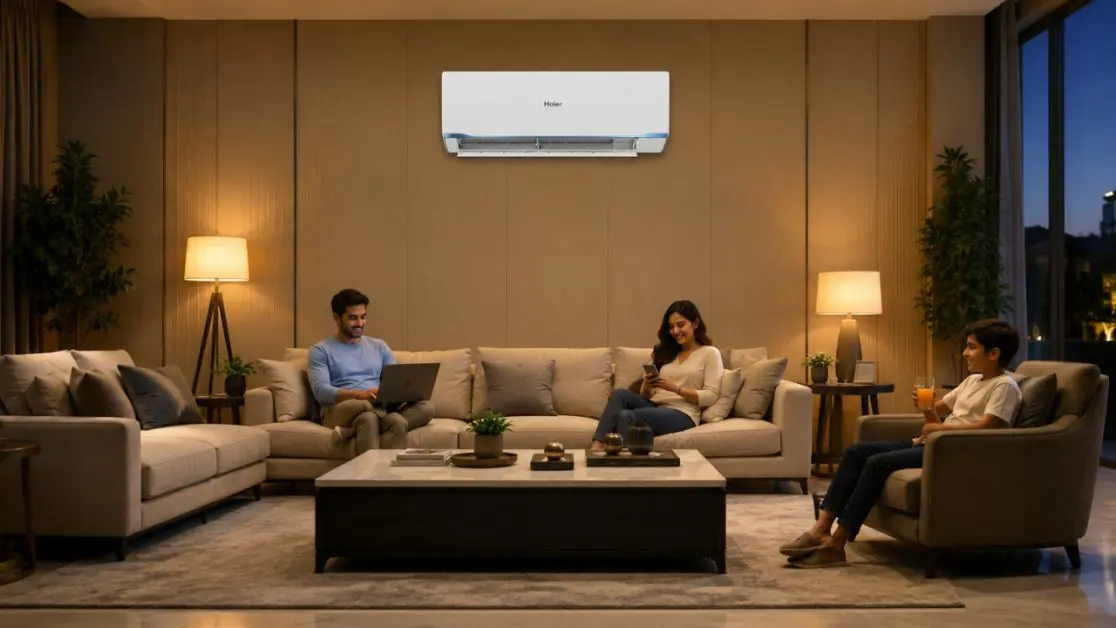
Tonnage confuses many buyers because the word sounds technical.
But the idea is straightforward.
A higher tonnage means higher cooling capacity.
Not physical weight.
Here is the practical breakdown most Indian households can use:
Recommended AC Size by Room Area
| Room Size | Recommended AC Capacity |
| Up to 120 sq. ft. | 1 Ton |
| 120 to 180 sq. ft. | 1.5 Ton |
| 180 to 260 sq. ft. | 1.7 Ton to 2 Ton |
| Above 260 sq. ft. | 2 Ton or higher |
This framework works well for average Indian homes.
But averages hide reality.
A west-facing Mumbai apartment with full glass windows behaves differently from a shaded independent house in Chandigarh.
Cooling is environmental mathematics disguised as home comfort.
A bedroom and a living room are not the same system
This is where many buying guides oversimplify things.
Two rooms can have identical square footage and still require different cooling approaches.
Consider the bedroom
Usually:
- Fewer people
- Lower appliance heat
- Closed doors
- Night-time usage
- Stable temperature patterns
A 1 Ton or 1.5 Ton AC often works perfectly here.
Now compare that with a living room.
The living room behaves differently
Usually:
- More foot traffic
- More sunlight exposure
- Television heat
- Open kitchen airflow
- Frequent door opening
The cooling load increases fast.
That is why larger living rooms often perform better with 1.7 Ton or 2 Ton inverter ACs, especially in Indian summers crossing 45°C.
The room size matters.
But how the room lives matters more.
Sunlight changes AC performance more than most people realise
A shaded room and a sun-facing room can feel like two different cities.
Direct afternoon sunlight adds hidden thermal load continuously.
Especially in:
- Top-floor apartments
- West-facing rooms
- Homes with large glass windows
- Compact urban flats with limited ventilation
One option is buying a larger fixed-capacity AC.
The second option is choosing an inverter AC with flexible cooling adjustment.
The second option usually works smarter.
Because Indian weather is inconsistent.
April heat feels different from July humidity.
A modern inverter system adapts instead of running at one aggressive speed continuously.
That is one reason many homeowners now prefer convertible inverter ACs.
For example, the Haier 1.7 Ton 5 Star Desert Rose Air Conditioner includes a 7-in-1 convertible mode system that adjusts cooling capacity between 40% and 110% based on room conditions and usage patterns.
That flexibility matters in real homes because room conditions rarely stay constant.
The hidden cost of choosing the wrong AC
People usually focus on purchase price.
The bigger cost arrives quietly later.
An undersized AC keeps running continuously.
An oversized AC switches on and off aggressively.
Both situations increase long-term energy waste.
And electricity bills are really behaviour reports.
They reveal whether the system fits the space.
What happens with an undersized AC
- Longer compressor runtime
- Inconsistent cooling
- Higher wear and tear
- Poor sleep quality during peak summer
What happens with an oversized AC
- Uneven cooling
- Excessive humidity
- Higher upfront cost
- More energy spikes
The goal is not maximum tonnage.
The goal is stable thermal balance.
Good cooling feels invisible.
You stop thinking about the AC entirely.
Why inverter ACs make more sense for modern Indian homes
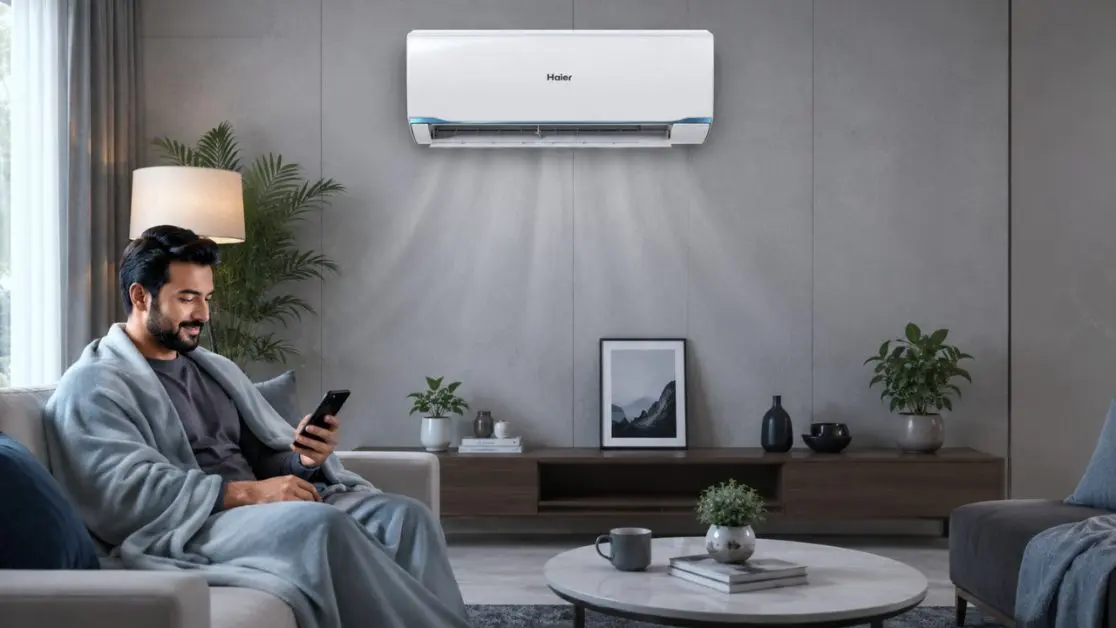
Traditional ACs think in binaries.
Full power. Then stop.
Modern homes need nuance.
People move between rooms. Weather changes hourly. Work-from-home setups increase daytime cooling needs. Smart TVs, laptops, and kitchen appliances all add heat.
This is where inverter systems outperform older fixed-speed cooling.
Benefits of inverter ACs
- Lower electricity consumption
- More stable temperatures
- Reduced noise
- Better long-term efficiency
- Faster cooling response
Some newer AI-powered systems now go further.
The Haier Desert Rose series, for instance, uses AI-powered climate control and AI Human Detection to analyse room conditions and optimise cooling automatically.
That shift matters because cooling is slowly becoming predictive instead of reactive.
The future AC does not just cool rooms.
It learns routines.
How Indian families actually use ACs today
The biggest shift is not technology.
It is behaviour.
Ten years ago, ACs were often used at night only.
Today:
- Remote workers use ACs during the day
- Children stay indoors more during peak heat
- Smart homes stay connected continuously
- Summers last longer
- Heatwaves arrive earlier
Cooling demand has changed structurally.
A family buying an AC today is not buying a luxury product.
They are buying environmental stability.
That is why features like long air throw, faster cooling, and smart energy management now matter more than branding slogans.
The Haier 1.7 Ton 5 Star Gold Desert Rose Air Conditioner, for example, offers 20-metre air throw and Supersonic Cooling in 10 seconds.
Those are not just feature-sheet numbers.
They solve real Indian summer problems.
Especially in larger halls where airflow distribution becomes uneven.
A practical framework for choosing the right AC
Most buyers do not need engineering formulas.
They need decision clarity.
Here is a more useful framework.
Step 1: Measure room size
Calculate approximate square feet.
Length × Width.
Simple.
Step 2: Observe sunlight exposure
Ask:
- Does the room receive direct afternoon sunlight?
- Is it a top-floor room?
- Are windows large?
If yes, increase cooling consideration.
Step 3: Count heat sources
More people and more electronics increase heat.
A gaming setup changes cooling demand.
So does an attached kitchen.
Step 4: Think about usage duration
Occasional cooling and 10-hour daily cooling are different systems.
Heavy usage benefits more from inverter efficiency.
Step 5: Choose flexibility over excess
A convertible inverter AC usually adapts better than blindly oversizing capacity.
Especially in Indian climates where humidity and temperature fluctuate constantly.
The smartest AC decision is rarely the loudest one
People often chase peak numbers.
Biggest tonnage.
Highest power.
But good home design rarely works through extremes.
It works through fit.
The right AC feels like good lighting in a bookstore. You barely notice it when it works properly.
The room simply feels right.
That is the hidden principle behind choosing an AC based on square feet.
Not excess.
Alignment.
And as Indian summers become harsher and homes become more connected, that alignment matters more than ever.
Because comfort is no longer just about temperature.
It is about creating spaces where people can rest, work, think, sleep, and gather without friction.
A well-chosen AC does not dominate a room.
It quietly improves how life moves through it.
Frequently Asked Questions
How do I choose the right AC tonnage based on my room size?
Start with the room’s square footage. As a general rule:
Up to 120 sq. ft. → 1 Ton
120–180 sq. ft. → 1.5 Ton
180–260 sq. ft. → 1.7–2 Ton
Above 260 sq. ft. → 2 Ton+
However, sunlight exposure, occupancy, and appliance heat should also influence your decision.
Is it better to buy a bigger AC just to be safe?
Not usually. An oversized AC can cool too quickly, causing uneven temperatures, excess humidity, and unnecessary electricity consumption.
My room is 150 sq. ft. Should I buy a 1 Ton or 1.5 Ton AC?
For most Indian homes, a 1.5 Ton AC is the safer choice, especially if the room receives sunlight or is occupied for long periods.
How much does sunlight affect AC sizing?
More than most people realize. A west-facing room with large windows can require significantly more cooling capacity than a shaded room of the same size.
Is room size the only factor that determines AC capacity?
No. Heat from people, electronics, kitchens, windows, and local climate all contribute to the cooling load.