
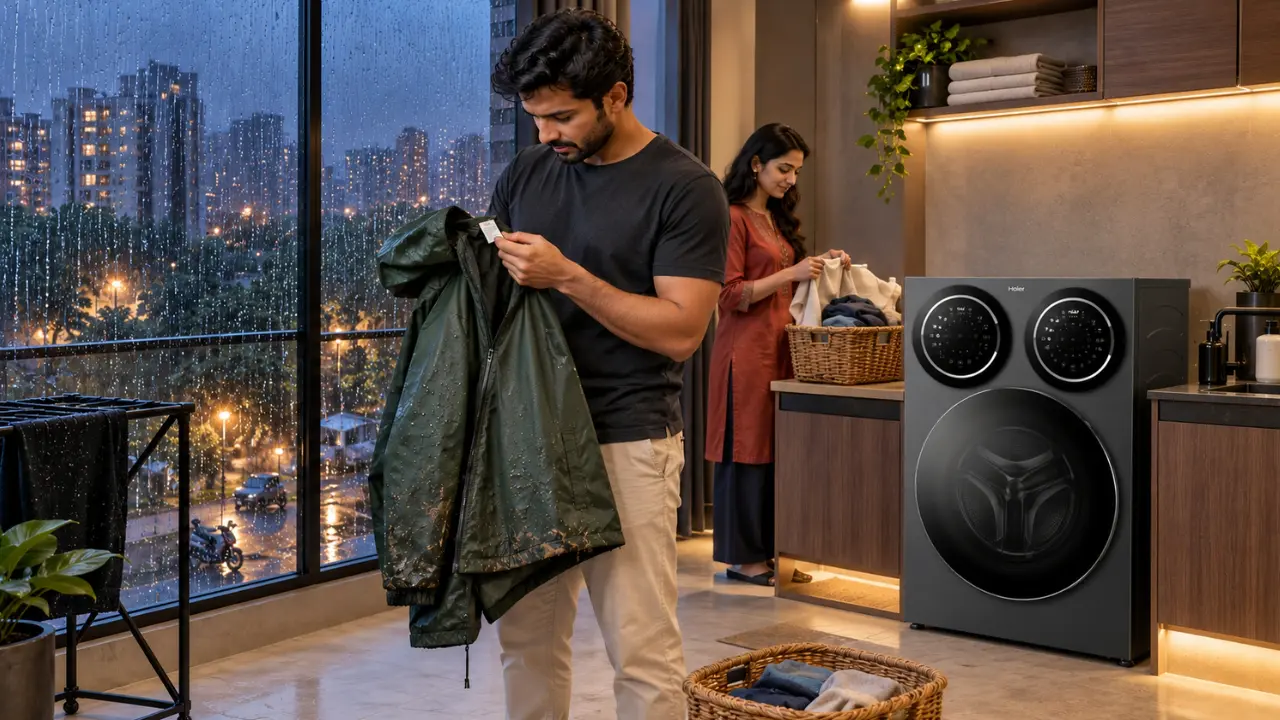

Do you think it is possible to wash a raincoat or waterproof jacket in a washing machine?
That raincoat is from the last rain and has been behind the door to the bathroom. Well, it’s collected some dust, a few muddy splashes and maybe that familiar damp smell. Of course, the washing machine appears to be the most simple answer.
But is there a method to wash a raincoat without the loss of waterproofing?
Yes, there are plenty of raincoats and waterproof jackets that are machine washable, if the care instructions allow. It is crucial to select the correct cycle, detergent and drying process. It’s important to handle waterproof fabrics with extra care compared with regular cotton clothing.
In India, where there’s uncertainty about the monsoons, the daily commute, and when it will rain, it’s important to know how to wash rain gear the right way so it can do its job for as long as possible.
Before you buy a raincoat, try to determine why it is waterproof. Before learning how to purchase a waterproof raincoat, try to figure out why it is waterproof.
There are different materials used for making raincoats. Some require a waterproof treatment; others require special membranes or treatment of the fabric itself.
If you are considering using a washing machine, this difference will make a difference.
Common Types of Raincoat Materials

Polyester raincoats: They are normally used for light-weight rainwear. Depending on the coating and construction, some are machine washable.
Nylon jackets: Lightweight and fast-drying, but some waterproof coatings must be maintained.
PVC raincoats: These will generally not be good for machine washing but are suitable for wiping or light hand washing.
PU coated jackets: These jackets contain a polyurethane coating which can be damaged by harsh detergents, heat or over-rough treatment.
Waterproof membrane jackets: May be machine washed with proper washers and detergents as specified by the manufacturer.
There’s one thing to remember, though: waterproof does not equal water-resistant.
Waterproof garments are made to resist water penetration under certain conditions, and water-resistant garments, otherwise, are made to resist lighter water exposure.
A jacket may also be finished with a durable water-repellent (DWR) treatment that enables rainwater to bead up and run off the jacket.
How to Wash a Raincoat in a Washing Machine Without Causing Damage
If you’re wondering how to wash a raincoat in a washing machine without causing damage, follow this guide.
Take a moment and check your raincoat before adding it to the drum.
With a bit of preparation, damages that could be hard to remedy can be avoided.
Step 1: Check the Washing Instructions
A care label is quite often found inside the jacket close to the side seam or collar.
It should designate if washing with a machine is allowed, the recommended temperature of the water, and if drying is allowed, what are the limitations.
If there is a hand washing only label, do not use a machine.
Step 2: Make the Raincoat
Clear pockets and take off any loose parts.
Then:
- Tie up the main zip and Velcro fasten.
- Release draw strings as needed.
- Brush away dried mud using a soft brush.
- Look for waterproof seams that are torn or loose stitching.
- If there are instructions on the care label to turn the jacket inside out, please do so.
Do not wash rain clothes, clothes with exposed metal articles or heavily soiled clothes.
These can cause undesirable turbulence while washing.
Step 3: Choose a Gentle Wash Programme
Next, choose a Gentle Wash Programme.
For machine washable waterproof jackets, it is best to use a gentle or delicate cycle.
Always use cool water or as directed by the garment label. A few technical waterproof garments will allow washing at 30°C or 40°C, but this should not be taken for granted.
If the manufacturer says to use a low spin speed, do so.
Too much spinning can put undue strain on thin coatings and taped seams.
Step 4: Use a Suitable Cleaning Product
Not all waterproof clothing items can be washed with regular laundry detergent.
Some make-ups may leave behind residues that may have an impact on the water-repellant properties of the fabric.
When the garment manufacturer recommends it, one of the safest options is to use a specialist cleaner, designed for technical outerwear.
Avoid using:
- Fabric softeners
- Chlorine bleach
- Harsh stain removers
- Excessive detergent
- Unapproved washing additives
Repeat the rinse if the instructions for the garment suggest it and there is detergent residue.
Step 5: Dry the Raincoat Properly
The fifth step in drying the Raincoat is to ensure that it is dried properly.
When it is time to wash, take the jacket off quickly.
Do not hang in an enclosed space or in direct sunlight. Observe the directions on the label for direct sunlight and tumble dry.
A few technical jackets will even permit low temperature drying to assist restore the DWR finish. The others are to be air dried.
Do not heat until you have read the instructions from the manufacturer.
How to Wash a Waterproof Jacket Properly?

Cleaning a raincoat with an inappropriate method could leave it looking spotless. It’s usually only when you put it on during the next rain that you notice the problem.
The protection it affords may be influenced by incorrect cleaning.
Common Raincoat Washing Mistakes and Their Possible Consequences
| Washing mistake | Possible consequence |
| Using hot water | Damage on heat-sensitive coatings or adhesives |
| Adding fabric softener | Reduced water-repellent performance |
| Selecting an aggressive cycle | Wear and tear on fabric and seams that goes beyond what is normal. |
| Using harsh bleach | Changes in colour or deterioration of material |
| Excessive tumble-drying heat | Damage to coatings, membranes or seam tape |
| Leaving detergent residue | Reduced fabric performance |
Not all washes are permanent. Rinse or treat with a suitable DWR may restore performance in some instances.
Deteriorated waterproof membranes and coatings are, however, much more difficult to repair.
Are Raincoats Considered as Washing with Regular Clothes?
In theory, some machine washable raincoats can be washed with something that is compatible with light washable clothing.
Nevertheless, most washing is done separately.
Envision loading a light rain jacket with three pairs of jeans, cotton towels and a bed sheet in the machine. The jacket could experience more friction and compression than necessary.
Then, there’s the detergent problem. The fabric in your regular laundry might not be technical waterproof fabric, and so it may not be suitable for the fabric’s cleaning.
If the household launders various types of clothing on a frequent basis, it can be helpful to have more control over each load of laundry.
Haier Triple Drum Washing Machine: A Solution for Laundry Separation
The Haier brand offers a new solution to the laundry challenges of separation. Haier provides a new method of laundry separation.
The Haier Triple Drum Washing Machine (HW120-DM12LC3GNU1) is a unique model that allows for separate washing of various types of clothing.
It has 3 drums which are separately controlled and has a total washing capacity of 12 kg, which is divided as 10 kg + 1 kg + 1 kg.
Key Features of the Haier Triple Drum Washing Machine
- Three-Drum Independent Washing: Independent Direct Motion Motors and controls for each drum.
- Multiple Wash Programmes: There are Silk Wash Programme, Soft and Gentle and other fabric specific Wash Programmes.
- Drum Essence Wash: These pre-mixed detergent and water solutions will provide thick lather for washing a variety of textiles.
- Smart Dosing: Automatically releases detergent and softener.
- Multi-Drum AI Wash: Pre-sets washing programmes according to the load of the washing machine.
- Door-Integrated Touch Panel: For easy access to washing controls.
This model is more applicable to households that have varying laundry needs that need to be separated for washing.
However, with waterproof jackets, the care label is up to the final decision. Use an appropriate programme only when machine washing is allowed; even in automatic dosing programmes, do not use fabric softener.
How Many Times to Wash a Raincoat During the Monsoon?
Not everyone has a set schedule that works for them.
A person who uses a raincoat for a short walk from the parking area to the office might not need to clean it as often as someone who rides a two-wheeler every day in heavy rain and muddy conditions.
Don’t wash after each use, check the condition of the garment.
Consider cleaning it when:
- Any visible dirt or mud builds up.
- Foam and perfumes, which are meant to clean the hands, give them a bad odor.
- The fabric starts to show signs of dirtiness.
- The surface is rendered hydrophobic by contamination and water beads up on it.
- The manufacturer recommended cleaning after prolonged use.
Be sure to let the raincoat dry completely before putting it away between washings.
This is especially helpful during the humid Indian monsoons when wet clothes can get bad smells or mold in the folded clothes inside cupboards.
What If Your Raincoat Loses Its Waterproofing After Washing?

Imagine, you’ve washed off your jacket carefully, dried it and put it on the next time you shower. Water does not form droplets on the outer fabric.
This does not mean that the jacket is ruined?
Not necessarily.
The surface of the DWR treatment could have deteriorated but the waterproof membrane underneath is still ok.
This condition can also be referred to as ‘wetting out’.
Add water repellency to the soil.
Always make sure to consult the garment manufacturer’s recommendations first.
For appropriate materials:
- Re-cleaning with approved technical cleaner.
- Washing thoroughly to wash away detergent residue.
- Re-activating the original DWR finish with manufacturer approved heat treatment.
- When needed, using a spray-on or wash-in waterproofing treatment that is compatible with the substrate.
Keep in mind that reapplying DWR will not fix a broken waterproof membrane or seams that have leaked.
If the jacket is leaking, even with proper care, check to see if the water has damaged it in any way.
Raincoat Washing Mistakes Indian Households Should Avoid
Some of the basic laundry tips that might not be suitable for rainwear need to be rethought.
Overnight soaking: This is usually not necessary and may not work if using coated fabric.
Hard-brushing: Hard brushing will remove protective finishes.
Extra detergent: There is no correlation between the amount of detergent and better cleaning. Technicals may have difficulty letting residue wash away.
Drying in close proximity to high levels of heat: High heaters or other hot surfaces may ruin some waterproof fabrics.
Folding when wet: This can lead to bad odor and even mold during the rainy season.
Regular cleaning and drying steps are often more beneficial than more intensive cleaning on a regular basis for the day to day maintenance.
Make Fabric-Specific Laundry Care Easier With Haier India
Make laundry care easier with Haier India and make it fabric specific.
It is not rare for modern Indian homes to have an odd assortment of laundry to wash: work clothes, children’s uniform, bed linen, delicate clothes and outerwear for the changing seasons.
This isn’t always feasible if all fabrics are treated alike.
The Haier Triple Drum Washing Machine is designed to tackle the problem of laundry separation, with separate washing drums and wash programmes.
It features a 10kg main drum to carry heavier loads for daily use and 2 drum 1kg for smaller loads which need separate washing.
This is a great solution for families that prefer a more efficient laundry system as an alternative to washing various types of clothes in the same drum over and over again.
Discover the Haier Triple Drum Washing Machine and its variety of wash programmes, to find out how it can match your laundry requirements.
Frequently Asked Questions
1. Can I wash a waterproof raincoat in a fully automatic washing machine?
Yes, if the garment’s care label permits machine washing. Use the recommended temperature, suitable detergent and gentle programme. Avoid aggressive spinning and fabric softeners.
2. Which washing machine mode is best for raincoats?
A Gentle or Delicate programme is often suitable for machine-washable raincoats. However, the correct setting depends on the material and manufacturer instructions.
3. Can washing remove the waterproof coating from a jacket?
Improper washing can damage certain waterproof coatings or reduce the effectiveness of water-repellent treatments. Gentle washing with suitable products helps minimise this risk.
4. Can I use normal detergent to wash a raincoat?
It depends on the garment. Some manufacturers permit mild liquid detergent, while others recommend specialist technical cleaners. Avoid fabric softeners and products containing unsuitable additives.
5. Should I spin-dry a waterproof jacket?
Only if the care label allows it. Use the recommended spin setting, typically a gentle or low-speed option for delicate outerwear.
6. Can a Haier washing machine wash waterproof jackets?
A Haier washing machine with suitable gentle wash programmes may be used for waterproof jackets that are labelled machine-washable. The Haier Triple Drum model offers Gentle and other fabric-specific programmes, but these should not be interpreted as dedicated waterproof-jacket settings.
7. How do I know if my raincoat has lost its waterproof protection?
If water stops beading on the surface, the DWR finish may need attention. If water actually penetrates the fabric or seams, the waterproof barrier may be compromised. These are different problems and may require different solutions.