
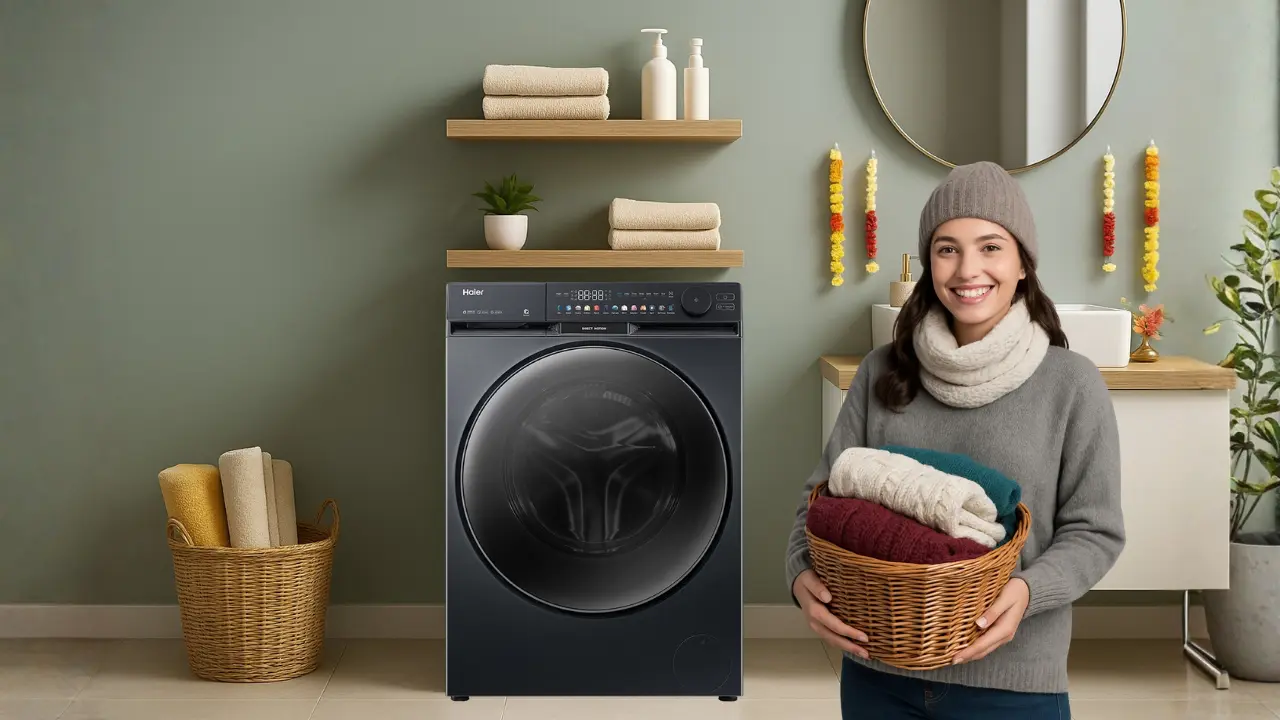

The secret to keeping woollens soft, warm, and timeless isn’t expensive detergents, it’s temperature control, gentle motion, and the right drying method.
A modern washing machine with a Wool or Delicate program, steady spin, and low-heat care can protect natural fibres better than hand-washing ever did.
Why winter laundry feels trickier than it should

There’s something oddly satisfying about the first winter wash.
The scent of stored sweaters meeting fresh detergent. The soft hum of the washing machine against the chill.
But every Indian household knows this dilemma: one wrong spin and that beloved cardigan shrinks to half its size.
It’s not carelessness, it’s chemistry. Wool reacts to heat and friction like chai reacts to over-boiling and it loses its calm. The fibres tighten, curl, and trap less air, which means less warmth.
So the goal isn’t just to wash woollens clean.
It’s to clean them gently enough to keep their warmth alive.
Step one: Rethink the “hand-wash only” myth
For decades, Indian families believed wool should never go near a washing machine.
That made sense when machines were rough, one-speed workhorses. But the machines in our homes today, especially Haier’s new front-load models, are more like textile labs.
They understand fabric. Literally.
The One-Touch AI Wash in the Haier 10 Kg Front Load (HW100-DM14F9BKU1) senses fabric type, dirt level, and load size to choose a precise wash pattern. For wool, that means slower drum rotation, lower water temperature, and a gentle soak that cleans without stress.
Technology has replaced guesswork with intuition.
Why this matters
When a woollen garment is agitated in hot water, its surface scales interlock imagine two Velcro strips pressing together. Once that happens, no amount of conditioner can restore the fluff. A soft AI-controlled cycle avoids that entirely.
Step two: Know your settings like you know your spices
The same way jeera and garam masala need timing, wool demands balance between wash intensity, water temperature, and spin.
Here’s a quick reference chart that makes winter laundry foolproof:
| Setting | Ideal for Woollens | Why It Works |
| Water Temperature | 30–40°C | Prevents fibre shrinkage and dye bleed |
| Spin Speed | 400–800 RPM | Removes water gently without stretching |
| Detergent Type | Liquid, Wool-Safe | Dissolves faster and leaves no residue |
| Drying Method | Air-dry flat, no sunlight | Retains shape and prevents fading |
Even if your machine offers twenty programs, the one that matters most for sweaters, shawls, and socks is labelled Wool, Delicate, or Hand Wash.
Both the Haier 10 Kg and Haier 12 Kg F9 models include these, plus a Pillow Drum Design that cushions the fabric instead of thrashing it. The result is a smooth wash motion that mimics gentle hand kneading minus the backache.
Step three: Pretreat the story, not the stain
Every stain has a story of spilled tea, Holi colour, or toddler tantrum.
Before tossing a sweater in the wash, dab the area with mild liquid detergent and cold water. Avoid scrubbing, friction damages the surface scales of wool.
If the stain is oily or food-based, let the detergent sit for ten minutes. Then let your washing machine’s Steam Care feature (available in Haier’s premium front-loads) handle the rest. Steam loosens particles and odours while keeping fibres springy.
Think of it as yoga for your clothes, gentle, restorative, and surprisingly effective.
Step four: Respect the drying ritual

This is where most woollens lose their character.
Sunlight may feel like a shortcut, but it’s the enemy of elasticity. Heat breaks down lanolin, the natural oil that keeps wool soft and water-repellent.
The right way:
- Roll the garment in a towel to absorb excess moisture.
- Lay it flat on a dry surface and never hang, because hanging stretches the shoulders.
- Flip after a few hours for even drying.
If you’re using a Haier washing machine, you can rely on Night Wash or Low-Spin Mode to remove most water without shaking the fabric. The low noise level (50 dB) even lets you run it after bedtime, a blessing in busy apartments.
Step five: Store smartly between wears
Woollens don’t like neglect. After each wear, let them air out for a few hours before folding.
Store them with cedar blocks or neem leaves instead of naphthalene, they repel insects naturally and leave a clean, earthy scent.
If you’ve worn a sweater but it’s not dirty enough to wash, use Haier’s function. It releases a gentle steam mist that removes odours and wrinkles in minutes, no detergent, no heat, just freshness.
It’s the modern version of hanging clothes out in the winter sun minus the fading.
Why machine care matters as much as fabric care
Wool sheds fine fibres during every wash. If you ignore your machine’s hygiene, those fibres accumulate and cause odours or lint transfer.
That’s why programs like Self-Clean on Haier front-loads are crucial. Run it once every 10–15 washes. It uses hot water and controlled rotation to flush residue out of the drum, no manual scrubbing, no detergent needed.
Clean machines make clean clothes truly clean.
What Haier’s Direct Motion Motor really means for your woollens
Most people hear “motor” and think of power. But in laundry, control is power.
Haier’s Direct Motion Motor connects directly to the drum with no belt, no friction. That means smoother rotation, fewer vibrations, and more precise speed changes during delicate cycles.
When the motor can shift from 60 RPM to 400 RPM with surgical precision, wool stays intact.
That’s how the Haier 12 Kg F9 manages bulky items like blankets without the harsh pull that ordinary machines create.
Quiet, stable, and energy-efficient it’s not just engineering, it’s empathy for fabric.
The bigger picture: Why preserving warmth is about more than clothes
Woollens are not just clothes, they’re memory carriers.
Your grandfather’s shawl, your first college sweater, that winter blanket that’s older than your marriage they hold warmth in more ways than thermal.
Caring for them well is an act of continuity. It’s how homes maintain comfort across generations.
And modern technology, when used thoughtfully, doesn’t replace that care, it extends it.
A well-designed washing machine doesn’t just clean, it protects what warmth means to your family.
Small habits that make a big difference

1. Turn clothes inside out before washing. It reduces pilling.
2. Use mesh laundry bags for smaller items like socks and scarves.
3. Mix loads mindfully wool and denim are never friends.
4. Don’t overload. Wool needs space to float, not fight.
5. Always check labels. “Dry Clean Only” still means what it says.
These aren’t chores, they’re rituals of respect.
The Indian winter rhythm and how smart machines fit in
By November, every region in India has its version of winter.
In Delhi, it’s misty mornings and late-night tea. In Bengaluru, it’s just cool enough for a light jacket. In Shimla or Srinagar, it’s an entire wardrobe shift.
Yet the rhythm of laundry changes everywhere heavier clothes, slower drying, higher energy bills.
That’s where smart washing machines quietly reshape the story.
Haier’s 5-Star Front Load range is designed for this season high efficiency, silent operation, and fabric-specific AI programs that know when gentleness is more valuable than speed.
They make winter washing feel less like work and more like a well-orchestrated routine.
The takeaway
Washing woollens well is part science, part mindfulness.
- Science, because the right temperature, spin, and detergent matter.
- Mindfulness, because warmth isn’t just physical it’s emotional.
Every cycle that preserves a sweater’s softness also preserves the comfort it brings on a cold morning.
When your washing machine understands that as Haier’s new AI-powered models do, laundry becomes less about cleaning and more about caring.
Memorable insight
Warmth isn’t in the fabric, it’s in the way we treat it.
And in 2025, caring for woollens no longer means hand-washing them in the bathroom sink. It means trusting the intelligence inside your home one cycle at a time.