
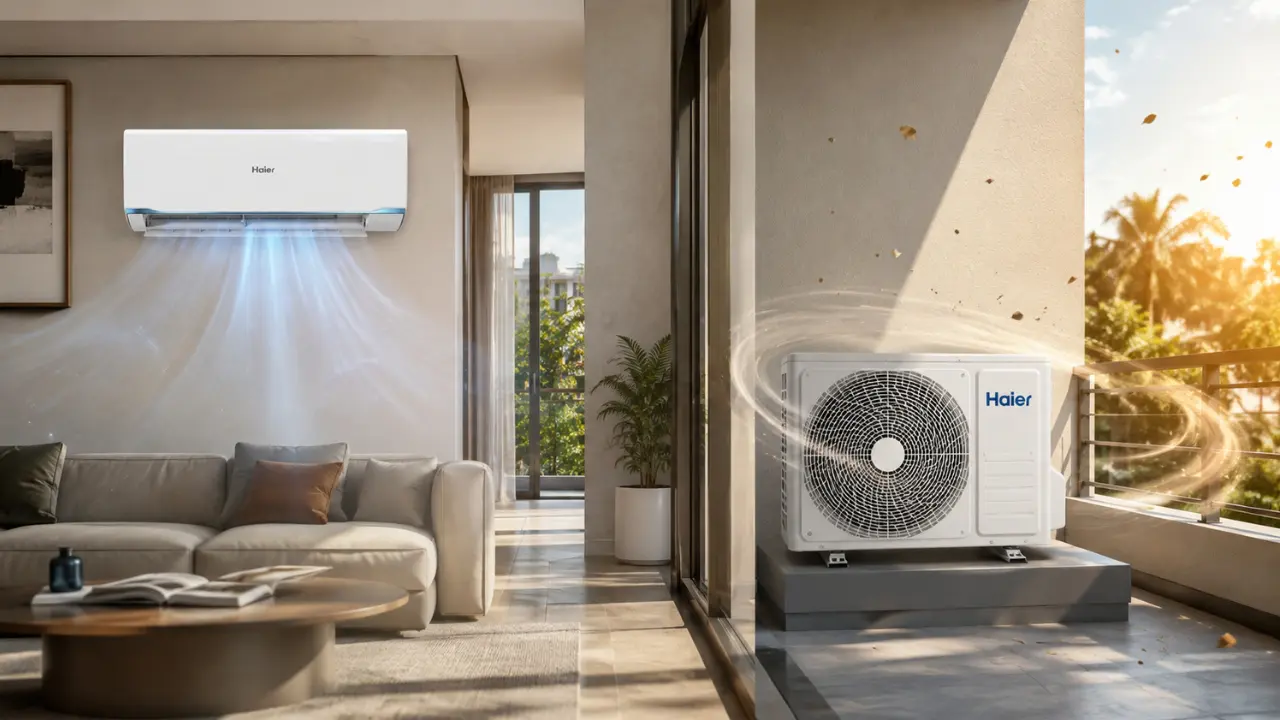

An air conditioner can look perfectly fine from inside the room while its outdoor unit is quietly dealing with dust, heat and changing weather outside. The reverse is possible too: the outdoor unit may be working as expected, while dirt accumulating around the indoor heat-exchange area begins affecting the experience indoors.
That is why AC protection is better understood as a two-unit responsibility.
In a split air conditioner, the indoor unit (IDU) and outdoor unit (ODU) perform different jobs, operate in different environments and face different kinds of stress. Protecting only one side misses half the picture.
Haier’s Desert Rose range takes this broader approach seriously. The Haier 1.7 Ton 5 Star Desert Rose Air Conditioner (HSA20DSD-GAI5NB-I) and Haier 1.7 Ton 5 Star Desert Rose Air Conditioner (HSA20DSD-NAI5NB-I) combine indoor Frost Self Clean with ODU Cyclone Clean, along with anti-corrosion features designed around the demands placed on both sections of a split AC.
First, Why Do Indoor and Outdoor AC Units Need Different Protection?
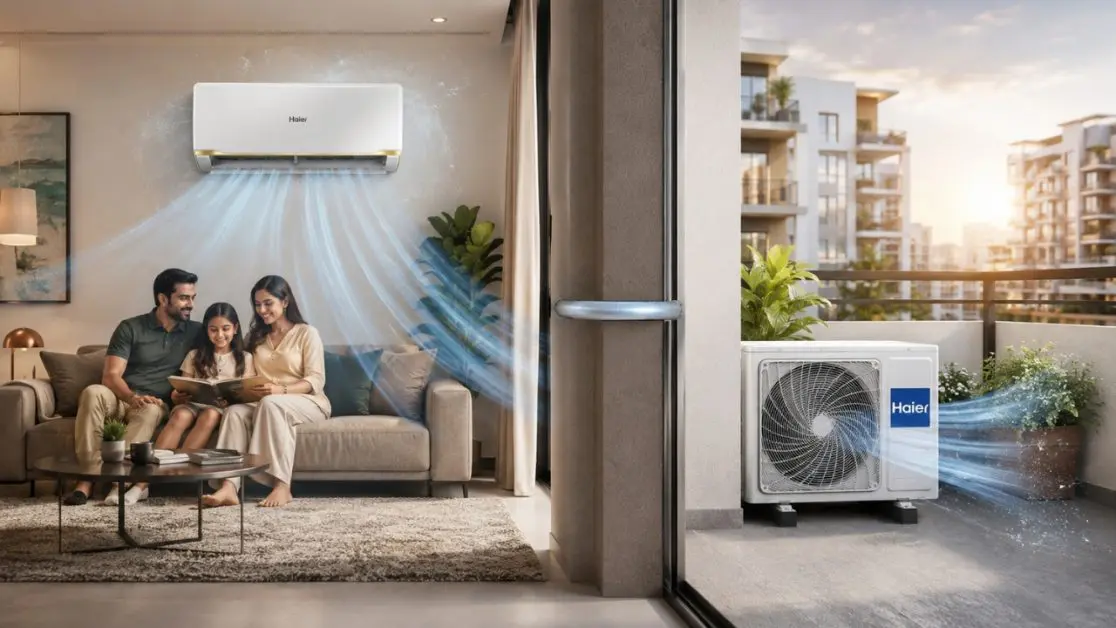
Simple reason: they don’t live the same life.
The indoor unit operates within your home, where dust, airborne particles and moisture around the cooling system can influence cleanliness and airflow. The outdoor unit has a tougher assignment. Depending on its installation, it can be exposed to dust and high ambient temperatures, while its condenser needs to continue exchanging heat effectively.
Here is the distinction at a glance:
| Area | Indoor Unit | Outdoor Unit |
| Main environment | Inside the room | Outside the living space |
| Common concern | Dirt accumulation around indoor AC fins | Debris around condenser and heat-exchange fins |
| Relevant Haier technology | IDU Frost Self Clean | ODU Cyclone Clean |
| Additional protection | Indoor Blue Fins | Outdoor Blue Fins and anti-corrosion features |
| Why it matters | Supports cleaner, fresher operation | Supports efficient heat exchange |
In other words, indoor unit protection is largely about maintaining the part of the system responsible for delivering conditioned air into the room, while outdoor unit protection must account for a considerably harsher operating environment.
Indoor Unit Protection: The Part You See Every Day
The IDU is probably what most people think of when somebody says “AC”. It hangs on the wall, blows cool air and gets the occasional filter clean.
There is more happening behind that front panel, though.
Dirt Does Not Stop at the Filter
During regular operation, airborne contaminants can accumulate around internal surfaces. A filter plays an important role, but keeping the heat-exchange area clean is another part of maintaining the system.
This is where the IDU Frost Self Clean feature in Haier’s Desert Rose models becomes relevant.
The system uses a self-cleaning process in which the indoor AC unit’s evaporator is frozen, helping remove accumulated dirt before the unit delivers clean and fresh air again. Haier specifies that the process takes around 21 minutes, with the AC providing a self-clean notification after 240 hours of operation.
That’s useful because AC cleanliness is easy to forget. You don’t see what is happening inside the unit every time you switch it on.
What Should Buyers Look for on the Indoor Side?
When evaluating indoor-unit protection, consider features that address:
- Build-up around the indoor heat-exchange area
- Regular self-cleaning support
- Protection of cooling fins
- Air filtration
- Ease of maintaining consistent operation
Haier’s Desert Rose models also feature Indoor Blue Fins and a Super Anti-Microbial Filter, adding further layers to the indoor-side design.
Now Step Outside: The ODU Has a Different Problem
This is where AC protection gets interesting.
The outdoor unit is doing essential heat-rejection work while operating outside the comfort of your room. Its condenser and heat-exchange fins therefore need to remain in suitable condition for efficient heat transfer.
And dust or debris settling around these areas is hardly unusual in Indian conditions.
Haier addresses this through ODU Cyclone Clean.
How ODU Cyclone Clean Works
After shutdown, intelligent programme control allows the outdoor fan to operate in reverse. The purpose is to remove debris from the condenser and heat-exchange fins.
That sounds like a small detail. It isn’t.
Keeping these areas clearer supports efficient heat exchange and sustained energy-saving performance. Instead of thinking about outdoor-unit cleaning only when visible dirt becomes obvious, the feature builds a cleaning action into the AC’s operation.
This is a particularly meaningful distinction between basic protection and more considered AC engineering: protection is not simply about putting stronger material around a component. Sometimes it is about designing the appliance to actively manage the conditions that affect it.
Corrosion Protection Deserves Attention Too
Cleaning is one part of outdoor-unit care. Material protection is another.
The Desert Rose range incorporates Super Anti-Corrosion features. Haier specifies Blue Fin coating alongside protective lacquer coating, a high-level cover coating and an anti-corrosive tube plate as part of this protection approach.
The models also use 100% grooved copper and copper heat exchangers.
For an appliance expected to serve through changing Indian seasons, such construction details shouldn’t be treated as an afterthought.
Indoor vs Outdoor Protection: Which Is More Important?
Neither wins this one.
Think of a split AC as one cooling system divided physically into two sections. Focusing entirely on indoor cleanliness while ignoring outdoor heat exchange doesn’t make much sense. Neither does concentrating solely on ODU durability while forgetting what happens inside the indoor unit.
A more useful buying checklist is:
- How does the AC manage indoor-unit cleanliness?
- Does it have a mechanism for dealing with outdoor-unit debris?
- What protection is provided to the heat-exchange fins?
- What materials are used in important cooling components?
- Can the AC maintain cooling under demanding ambient conditions?
That last question becomes especially relevant during an Indian summer.
Protection Has to Work Alongside Performance
A well-protected AC still has to cool the room effectively.
The Haier Desert Rose 1.7 Ton 5 Star models are engineered to cool at ambient temperatures of up to 60°C. Haier attributes this capability to features including specially designed conformal coating and Hyper PCB protection for AC components.
The models additionally bring together HEXA Inverter technology, 10-second Supersonic Cooling through KTS and PKC technology, and up to a 20-metre air flow.
Then there is 7-in-1 Convertible cooling, which allows cooling capacity to be adjusted between 40% and 110%, including Intelli modes that predict cooling requirements and adjust fan speed accordingly.
So protection isn’t sitting in isolation. It forms part of a larger system built around cooling performance, efficiency and adaptability.
Haier’s AI Adds Another Layer to AC Care
Here’s another shift worth noticing: modern AC management is becoming less reactive.
The Desert Rose series uses AI-ATMOX, with AI capabilities spanning comfort, savings and service. Its AI for Service functionality is designed to automatically clean both the indoor and outdoor units to help maintain efficiency, save energy and deliver clean, odour-free air.
The same models offer AI Human Detection, AI ECO functionality and electricity monitoring. Haier states that its AI for Savings can deliver up to 56% energy savings by monitoring energy use and automatically shifting to AI ECO mode to reduce wastage.
Users can also control compatible functions through the Hai Smart App, alongside voice control through Alexa and Google Assistant.
That combination changes the role of protection slightly. It is no longer purely physical; intelligent monitoring and automated cleaning can also become part of how the appliance looks after its performance.
What Makes the Desert Rose Approach Different?
A buyer could easily focus on tonnage, star rating and cooling speed and stop there. Those specifications matter, obviously. But an AC is expected to operate season after season, and what happens inside the unit and outside on the condenser matters as well.
The Haier 1.7 Ton 5 Star Desert Rose Air Conditioner (HSA20DSD-GAI5NB-I) and Haier 1.7 Ton 5 Star Desert Rose Air Conditioner (HSA20DSD-NAI5NB-I) bring the two sides together:
- IDU Frost Self Clean for indoor-unit cleaning
- ODU Cyclone Clean for removing outdoor condenser debris
- Super Anti-Corrosion protection
- Indoor and Outdoor Blue Fins
- Hyper and Stronger PCB
- 100% grooved copper
- Cooling capability at ambient temperatures up to 60°C
- AI-powered service and energy-management functions
- HEXA Inverter technology
The two models also offer the same 1.7 Ton capacity, 5 Star rating and 5.65 ISEER specification, with their visible styling differentiated by Gold Deco and Blue Deco strips respectively.
Better AC Ownership Starts Beyond the Remote
The coolest temperature on the remote doesn’t tell you much about how an AC is designed to handle dust, debris or demanding operating conditions over time.
Look deeper.
For Indian households evaluating a new split AC, indoor and outdoor unit protection should be considered together. The IDU influences what happens inside the room; the ODU performs critical heat-exchange work outside it. Both deserve attention.
Haier’s Desert Rose series reflects that whole-system thinking by combining Frost Self Clean indoors, Cyclone Clean outdoors, anti-corrosion measures and AI-led service functionality with powerful cooling technologies.
Because good air-conditioning isn’t only about how quickly a room becomes cool. It is also about how intelligently the entire system is designed to keep doing its job.
Frequently Asked Questions
1. Why do both the indoor and outdoor units of an AC need protection?
Both units perform different functions and face different operating conditions. The indoor unit needs protection against dirt and build-up around internal components, while the outdoor unit must cope with debris, heat and environmental exposure. Protecting both helps support efficient cooling and dependable operation.
2. What is IDU Frost Self Clean in Haier Desert Rose ACs?
IDU Frost Self Clean is designed to clean the indoor unit’s evaporator through a frost-based cleaning process. In the Haier Desert Rose models, the self-clean cycle takes around 21 minutes, and the AC provides a notification after 240 hours of operation to prompt self-cleaning.
3. How does ODU Cyclone Clean protect the outdoor unit?
Haier’s ODU Cyclone Clean uses intelligent programme control to run the outdoor fan in reverse after shutdown. This helps remove debris from the condenser and heat-exchange fins, supporting efficient heat transfer and sustained energy-saving performance.
4. Do Haier Desert Rose ACs have anti-corrosion protection?
Yes. The Haier Desert Rose models feature Super Anti-Corrosion protection with Indoor and Outdoor Blue Fins. The product information also highlights protective lacquer coating, high-level cover coating and an anti-corrosive tube plate as part of the outdoor-unit protection design.
5. Can Haier Desert Rose ACs operate during extreme Indian summers?
The Haier 1.7 Ton 5 Star Desert Rose models are designed to provide cooling at ambient temperatures of up to 60°C. Haier uses features including conformal coating and Hyper PCB protection to help safeguard AC components under demanding conditions.
6. Which Haier Desert Rose models offer indoor and outdoor unit cleaning?
Both the Haier 1.7 Ton 5 Star Desert Rose Air Conditioner (HSA20DSD-GAI5NB-I) and the Haier 1.7 Ton 5 Star Desert Rose Air Conditioner (HSA20DSD-NAI5NB-I) feature IDU Frost Self Clean and ODU Cyclone Clean technologies.