
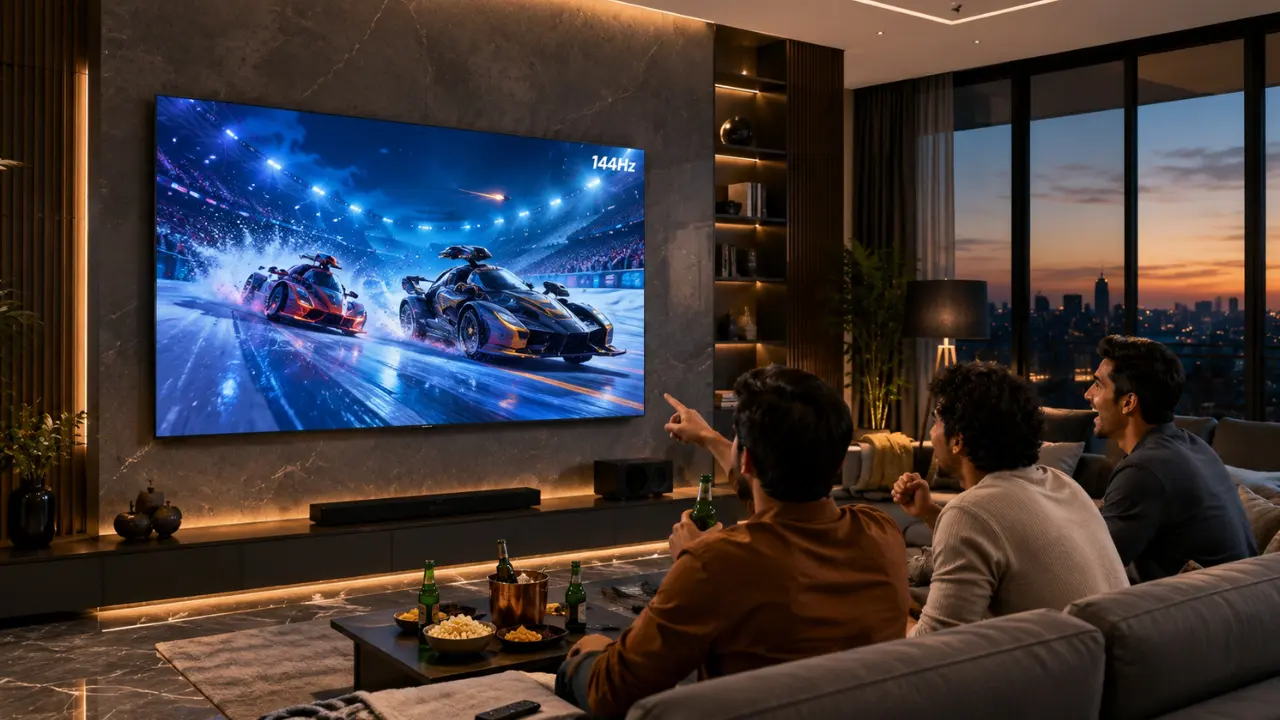

There’s a moment every sports fan knows.
The ball leaves the bowler’s hand. A football curls towards the top corner.Badminton smash is extremely fast and you almost cannot see it. Everyone is silent for a moment, as that one frame may be the difference-maker.
Now imagine that very moment with the screen a bit darker on one side of it than the other. Or in a cricket ground the grass is not really green all the way It feels off. You may not be aware of the technical term for it, but your eyes can tell.
This is when the uniformity of the pictures subtly becomes one of the most crucial features of a TV, particularly if you’re watching live games all Weekend.
It isn’t about Brighter Colours. It’s About Consistency.
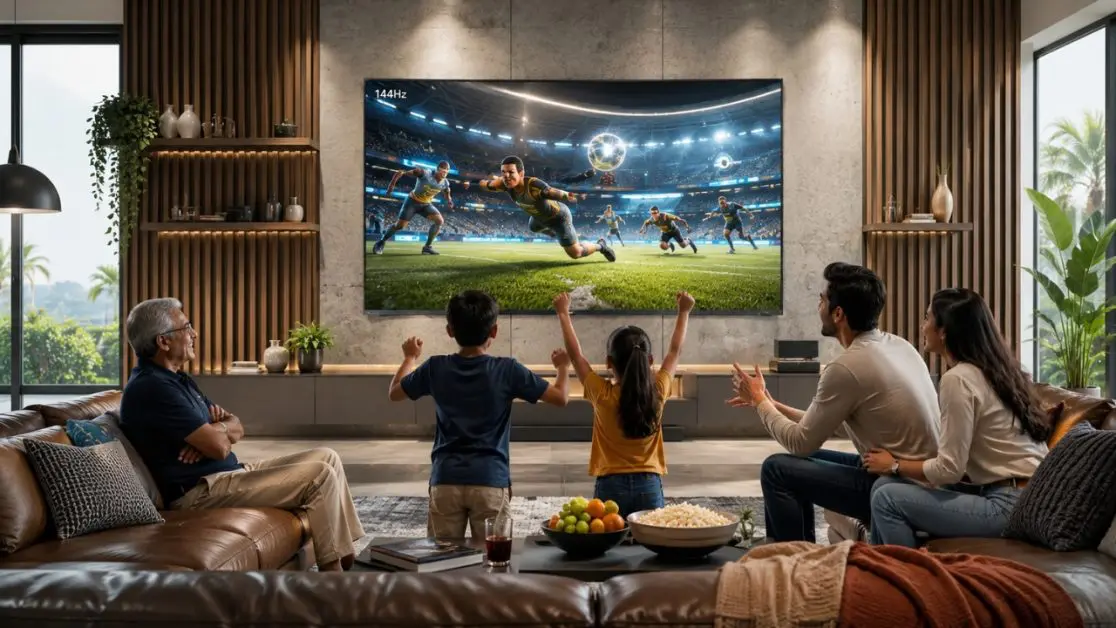
It is a common misconception to think that sports look better due to a higher brightness or colour of their television.
Not necessarily.
Even with all the bright colors, if the brightness is not uniform throughout the screen, large-scale scenes can be inconsistent. These inconsistencies are easier to spot during sports events than during film or TV viewing, which is when the camera is in constant motion and zooms from long to close shots across the vast playing surface.
Think about:
Think about:
- A cricket outfield under floodlights
- The lush green surface of a football stadium
- A tennis court viewed from above
- A Formula 1 race with long sweeping camera movements
These scenes contain large areas of similar colour. If the display cannot maintain uniform brightness and colour from corner to corner, patches, darker areas, or uneven illumination may become visible.
For sports lovers, that distraction never really goes away.
Why Sports Put More Pressure on a TV Than Movies
Here’s something interesting.
Movies constantly change locations, lighting conditions and camera angles. Dark scenes follow bright scenes. Close-ups replace landscapes.
Sports don’t.
A football match might stay on the same pitch for two uninterrupted hours. Cricket broadcasts spend innings after innings showing the same outfield from multiple angles. Hockey, kabaddi and even athletics rely heavily on wide shots where uniformity is constantly being tested.
That’s exactly why display quality matters differently for sports.
Sports viewing demands:
- Even brightness across the entire screen
- Consistent colour reproduction
- Smooth handling of fast movement
- Accurate contrast during changing lighting conditions
- Stable picture quality from kickoff to the final whistle
Miss one of these, and the viewing experience begins to feel less natural.
Signs Your TV May Lack Picture Uniformity
Interestingly, many people blame the broadcast quality when the television is actually the reason behind the issue.
Here are some common signs.
| What You Notice | What It Could Mean |
| Grass appears darker on one side | Uneven panel brightness |
| Sky looks patchy during day matches | Poor picture uniformity |
| Camera pans seem inconsistent | Combined motion and panel limitations |
| Stadium lights create uneven glow | Contrast inconsistency |
| White jerseys look slightly different across the screen | Colour uniformity variation |
These issues may sound minor on paper.
During a three-hour IPL game? They become surprisingly noticeable.
Why Large Screens Make Uniformity Even More Important
Bigger televisions create a more immersive viewing experience. That’s one of the biggest reasons Indian households are moving towards 164 cm (65), 189 cm (75) and even 215 cm (85) televisions for dedicated entertainment spaces.
But there’s another side to that story.
As screen size increases, maintaining consistent brightness and colour across every inch becomes more technically demanding.
A display that looks acceptable at a smaller size may reveal imperfections much more clearly on a larger panel.
That’s why advanced display engineering plays such an important role in premium televisions.
The Technology Working Behind the Scenes
Most viewers never think about what’s happening inside the TV while they’re cheering for their favourite team.
And honestly, why would they?
Still, modern picture processing does far more than simply display a broadcast.
Some advanced televisions intelligently analyse scenes in real time to optimise multiple aspects of image quality simultaneously.
These adjustments may include:
- Brightness balancing
- Contrast refinement
- Colour optimisation
- Motion enhancement
- Scene-by-scene HDR processing
Instead of forcing one fixed setting across every broadcast, the television continuously adapts to different viewing conditions.
The result is a picture that feels balanced rather than artificially enhanced.
What Makes the Haier New M70 Series Stand Out
For sports enthusiasts who value a consistently immersive viewing experience, the Haier New M70 Series Mini LED AI Smart Google TV with Gemini has been designed with technologies that directly support picture consistency and motion performance. The series is available in 139 cm (55), 164 cm (65), 189 cm (75), and 215 cm (85) screen sizes, allowing different room sizes and viewing preferences to be accommodated.
Rather than relying on a single display feature, multiple technologies work together.
Mini LED Precision
The Mini LED display technology is designed to optimize every scene with intelligent light control, helping deliver improved contrast, vivid highlights and deeper blacks. On large stadium shots or evening matches under floodlights, this contributes to a more balanced visual presentation.
AI Picture Quality
Live sports rarely maintain identical lighting throughout a match.
Cloud cover changes.
Day turns into evening.
Floodlights come on.
The M70 Series uses AI Picture Quality to intelligently optimize brightness, contrast, colour and clarity in real time according to the content being displayed, helping the picture remain balanced across changing scenes.
HDR10+ with Wide Colour Gamut
Sports broadcasts today are increasingly produced with richer visual detail.
Support for HDR10+, along with a Wide Colour Gamut covering 93% of the cinema-grade DCI-P3 colour space, helps reproduce vibrant yet natural-looking colours while improving scene-by-scene contrast. Whether it’s the deep blue of a night sky or the rich green of a cricket outfield, colours appear more lifelike without looking exaggerated.
MEMC for Smoother Action
Perhaps the biggest challenge during sports is motion.
Fast bowling deliveries.
Football counter-attacks.
Tennis rallies.
Formula 1 overtakes.
The inclusion of MEMC (Motion Estimation and Motion Compensation) helps reduce motion blur and judder, making rapid on-screen movement appear smoother during fast-paced action. Combined with Gaming 120Hz, it also supports a more fluid experience for users who enjoy sports games on compatible consoles.
The Viewing Experience Doesn’t Stop at the Picture
Here’s something people often overlook.
The visuals may grab your attention first, but sports are just as much about sound. Think of the roar after a six clears the boundary rope, the chants echoing through a packed football stadium, or the commentator’s voice rising during a nail-biting finish. If the audio feels flat, some of that excitement disappears.
That’s why display and sound should work together instead of competing for attention.
The Haier New M70 Series Mini LED AI Smart Google TV with Gemini complements its visual performance with a 50W speaker system and a 2.1-channel setup featuring an inbuilt subwoofer, creating richer, fuller audio. Support for Dolby Atmos further enhances the sense of space, making live sporting moments feel more immersive inside your living room.
A Quick Checklist Before Buying a TV for Sports
If sports are one of the main reasons you’re upgrading your television, don’t get carried away by screen size alone. A few display technologies can make a noticeable difference over the long run.
Prioritise these features
| Feature | Why It Matters During Sports |
| Mini LED display | Helps improve light control, contrast and picture consistency |
| AI Picture Quality | Optimises brightness, contrast and colour in real time |
| MEMC | Reduces blur during fast-moving action |
| HDR10+ | Enhances scene-by-scene detail and contrast |
| Wide Colour Gamut | Produces richer, more natural-looking colours |
| Dolby Vision | Improves depth and realism across different scenes |
| Dolby Atmos with 2.1 Channel Audio | Creates a more immersive stadium-like sound experience |
| Gaming 120Hz | Supports smoother visuals for compatible games and fast action content |
Notice something?
None of these features work in isolation. Together, they help create a viewing experience that remains consistent from the opening whistle to the final celebration.
Why AI Is Becoming More Relevant During Live Sports
Sports broadcasts are unpredictable.
One minute the match is being played under bright afternoon sunlight. A few overs later, clouds roll in. Then the floodlights take over. Camera angles change constantly. Close-ups are followed by wide aerial shots.
Older televisions often apply one fixed picture setting throughout.
Modern AI-powered televisions take a more dynamic approach.
The Haier New M70 Series uses AI Picture Quality to intelligently adjust brightness, colour, contrast and clarity according to the content being displayed. Instead of forcing viewers to tweak settings every time the lighting changes, the television continuously works in the background to optimize the picture.
It’s one of those features you rarely think about while watching. Which, ironically, is exactly the point.
More Than Match Day: A TV That Adapts to Everyday Entertainment
Let’s be honest most televisions don’t spend all day showing cricket or football.
One evening it’s an IPL fixture.
The next day someone is binge-watching a series. Later, the kids might stream animated films, and by the weekend, someone has connected a gaming console.
A good television should adapt to all of it without feeling like it’s been designed for just one type of content.
The Haier New M70 Series combines its display capabilities with everyday smart features such as:
- Google TV with Gemini integration
- Hands-Free Voice Control
- Chromecast Built-in
- 2GB RAM and 32GB internal storage for smoother app performance
- Bluetooth 5.1 connectivity
- HDMI 2.1 eARC support for compatible audio systems
These features help make the television equally practical for everyday entertainment, not just live sports.
Choosing the Right Screen Size for Your Space
The “best” television isn’t always the biggest one.
It should also suit your room layout and viewing distance.
The Haier New M70 Series offers multiple size options, making it easier to choose a display that complements different living spaces.
Available screen sizes
- 139 cm (55) – Model: 55M70UHMINI LED
- 164 cm (65) – Model: 65M70UHMINI LED
- 189 cm (75) – Model: 75M70UHMINI LED
- 215 cm (85) – Model: 85M70UHMINI LED
Across the range, viewers benefit from the same focus on AI-powered picture optimisation, HDR support, immersive sound and smart entertainment features, while selecting the screen size that best matches their home.
When Every Frame Counts
Ask any passionate sports fan about their favourite match, and they’ll probably remember a single frame.
The winning six.
A diving save.
A last-second three-pointer.
A photo finish.
So this is a moment that should be captured without any brightness or colour inconsistencies that could be distracting or any motion blur.
Uniformity may never be seen in headline specs that folks talk about with friends. But it subconsciously molds nearly every minute of the viewing experience, particularly when watching live sports, where vast fields, fast moving cameras and varying lighting conditions constantly challenge a TV’s display.
If you’re considering upgrading your home entertainment system, take a look at resolution and beyond. Mini LED technology, along with AI Picture Quality, HDR10+, Wide Colour Gamut, MEMC and Dolby Vision are all integrated into the TV to provide a well-rounded viewing experience.
These technologies are combined in this top-tier package, enhanced by the immersive Dolby Atmos audio system, a 50W 2.1-channel audio system with an inbuilt subwoofer, and smart connectivity that suits today’s homes. When it comes to television that moves with the action, rather than just for this season, it’s one built to deliver every pass, rally, tackle and boundary.
Frequently Asked Questions
What does picture uniformity mean on a TV?
Picture uniformity describes how consistently a television displays brightness and colour across the entire screen. A uniform display should not look noticeably darker, brighter, warmer, or cooler in one area than another.
Why does picture uniformity matter more for sports?
Sports broadcasts frequently show large areas of similar colour, such as a football pitch, cricket outfield, tennis court, or sky. Uneven brightness and colour are easier to notice in these wide, continuous shots.
Should I prioritise uniformity or peak brightness for sports?
Both matter, but brightness alone cannot compensate for an uneven screen. A slightly less bright television with better consistency may look more natural during long matches.
Is a high refresh rate more important than picture uniformity?
They solve different problems. A high refresh rate can improve motion smoothness, while uniformity keeps brightness and colour consistent across the panel. Sports fans benefit from both.
Does resolution tell me whether a TV will look good for sports?
No. Resolution affects detail, but sports performance also depends on uniformity, motion handling, contrast, colour accuracy, brightness, processing, and broadcast quality.
What TV features should I prioritise if I mainly watch cricket and football?
Look for good panel uniformity, effective motion processing, strong brightness control, natural colour reproduction, HDR support, a high refresh rate, and clear audio.