
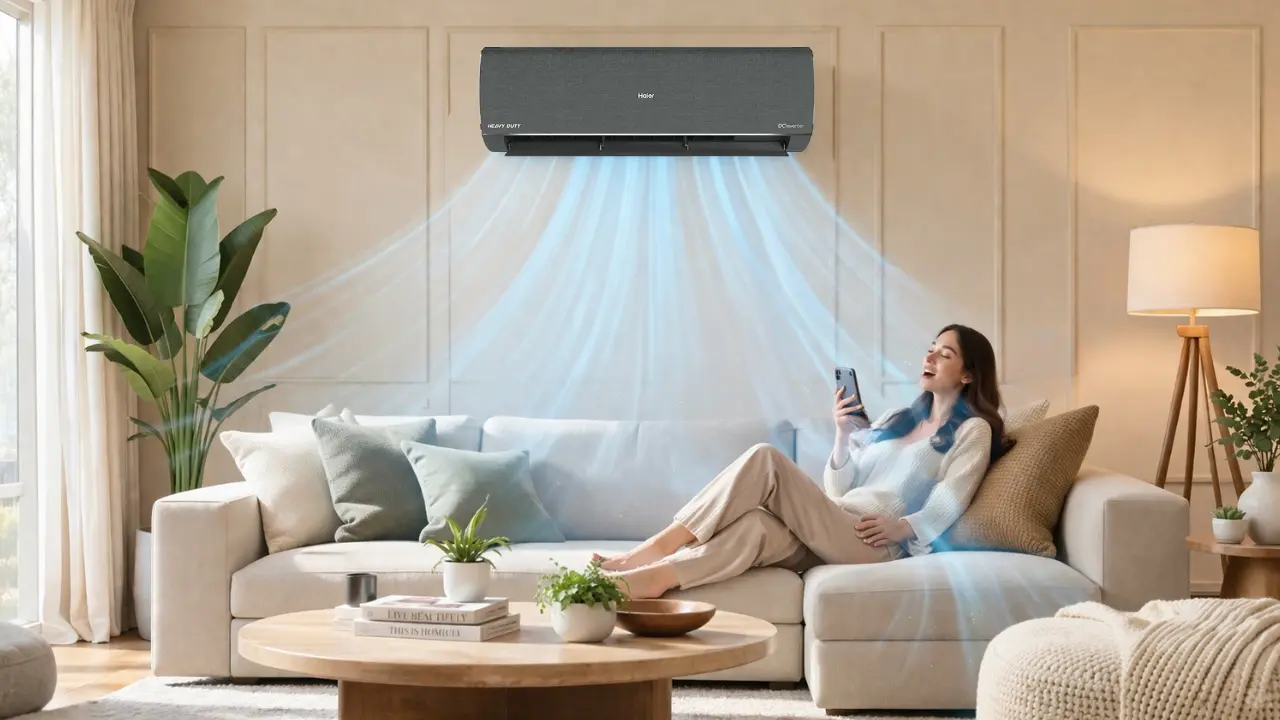

Smart air movement helps people relax by distributing cool air intelligently, adjusting airflow based on human presence, room layout, and environmental conditions.
Instead of blasting cold air randomly, modern technology guides airflow where it is actually needed. The result is simple, faster comfort, lower energy use, and living spaces that feel naturally calm.
Comfort rarely begins with temperature.
It begins with air.
Walk into a quiet living room after a long day. The lights are soft. The sofa invites you to sink in. But something still feels slightly uncomfortable.
The air is heavy.
You switch on the AC. Cold air rushes out. Within minutes the room cools.
But something interesting happens.
One corner feels too cold.
Another corner still feels warm.
The room is cool.
But the comfort feels uneven.
This is the quiet problem most homes never notice.
Cooling is not only about temperature.
It is about how air moves.
And once you see that technology, relaxation begins to make more sense.
Why Air Movement Quietly Shapes Relaxation
Relaxation is not a switch. It is a chain reaction.
Air affects skin temperature.
Skin temperature affects heart rate.
Heart rate affects how calm the body feels.
In simple terms:
A room at 24°C with poor air movement can feel uncomfortable.
A room at 26°C with balanced airflow can feel perfectly pleasant.
The difference is not the number on the thermostat.
The difference is air distribution.
Think of air like music in a theatre.
A single loud speaker does not create a cinematic experience.
Sound must spread evenly across the hall.
Air behaves the same way.
When airflow spreads intelligently, the body relaxes faster.
The Three Hidden Problems in Traditional Cooling
Most households assume an AC cools the room evenly.
In reality, traditional cooling technology follows a simpler pattern.
Air blows in one direction.
Cold pockets form near the AC.
Warm pockets remain elsewhere.
That creates three invisible comfort problems.
1. Uneven Cooling Zones
Cold air gathers near the AC unit.
The sofa area may feel cool.
But the dining table or study desk stays warmer.
This forces people to reduce temperature settings further, increasing electricity use.
2. Energy Waste
Cooling an entire room constantly is inefficient when people occupy only a small area.
Imagine cooling a stadium when only a few seats are occupied.
The technology works harder than necessary.
3. Delayed Comfort
Traditional ACs cool the air first.
But relaxation depends on when cool air reaches the human body.
A room can technically cool down before a person actually feels comfortable.
And that delay matters.
Because the body notices airflow before it notices temperature.
The Smart Shift: Airflow That Understands the Room
Modern climate technology approaches comfort differently.
Instead of cooling everything equally, they focus on precision.
The air moves where people are.
Air adjusts to room layout.
Air changes direction as activity changes.
This shift creates a new idea.
Smart air movement.
Technologies like AI climate control analyze temperature, environmental conditions, and user behavior to adjust cooling dynamically for comfort and energy savings.
In simple terms, the technology learns.
It observes.
And then it adapts.
Three Ways Smart Air Movement Changes Relaxation
Smart airflow technology typically works through three coordinated mechanisms.
Each one solves a different comfort problem.
1. Pre-cooling
One option is Pre-cooling.
Instead of waiting for someone to switch on the AC, the technology anticipates arrival.
Advanced AI models can detect when users approach home and start cooling automatically.
In some technology, geolocation triggers pre-cooling when the user enters a defined distance from the house.
The benefit is immediate comfort.
| Feature | Benefit | Cost |
| AI Pre Cooling | Room cools before arrival | Requires smart connectivity |
| Automated timing | No manual scheduling | Slight setup during installation |
The result is simple.
You walk into a comfortable room.
No waiting.
No adjustment.
2. Targeted Airflow
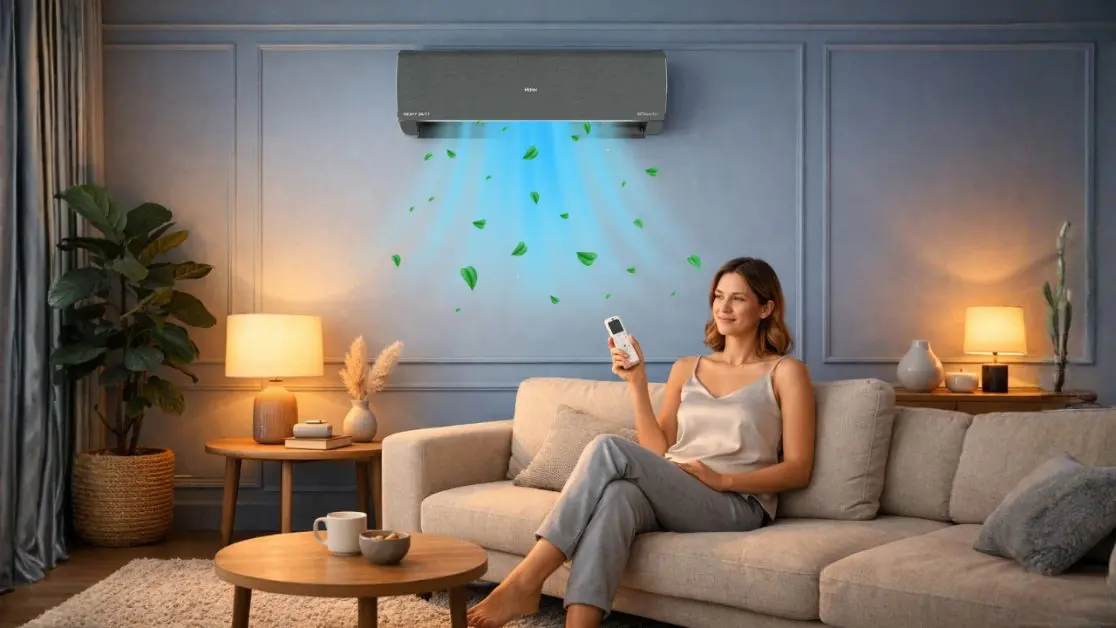
The second option is targeted cooling.
Traditional technology cools the entire room equally.
Smart technology guides air toward the occupied area.
If someone sits on the sofa, airflow shifts toward that zone.
Target cooling delivers air exactly where it is needed instead of cooling empty spaces, improving efficiency and comfort.
The benefit becomes clear immediately.
| Approach | Airflow Pattern | Comfort Speed |
| Traditional Cooling | Whole room equally | Moderate |
| Target Cooling | Direct airflow to people | Faster |
Less wasted cooling.
More immediate comfort.
And lower energy consumption.
3. Adaptive Climate Control
The third option is AI climate adaptation.
Indoor comfort changes constantly.
Morning sunlight warms one side of the room.
Cooking increases humidity.
Even the number of people in a room affects temperature.
Advanced AI technology now analyzes environmental conditions and user behavior to adjust cooling automatically.
This creates an important shift.
People stop adjusting the AC.
The AC adjusts itself.
Why Relaxation Depends on Air, Not Just Cooling
Consider three common moments inside Indian homes.
Evening Wind Down
You return from work.
The body is tired. The mind is still running.
Fast, balanced airflow helps the body cool gradually.
The result feels calmer than sudden cold blasts.
Family Movie Night
Four people sit across the room.
If airflow stays fixed in one direction, someone feels cold while someone else feels warm.
Smart air distribution solves this quietly.
Sleep
Sleep quality improves when temperature remains stable.
But airflow stability matters just as much.
Consistent, gentle air movement prevents sudden temperature changes that interrupt deep sleep cycles.
The insight is simple.
Comfort is not about cold air. It is about balanced air.
The Energy Side of Smart Air Movement
Comfort often raises another question.
Does smarter cooling increase electricity bills?
Surprisingly, the opposite happens.
When airflow becomes precise, cooling becomes efficient.
Consider these energy effects:
| Smart Cooling Feature | Impact on Electricity |
| AI Eco 2.0 Modes | Adjust compressor output dynamically |
| Human Presence Detection | Reduces cooling when room is empty |
| Target Airflow | Avoids cooling unused spaces |
Some technologies even track electricity consumption visually through mobile apps, allowing users to monitor energy use in real time.
The lesson is clear.
Efficiency improves when technology understands behavior.
A Quiet Technology That Works in the Background
The best technology often disappears.
You do not notice it working.
You simply notice that the room feels comfortable.
That philosophy shapes many modern appliances today.
For example, Haier’s AI Atmox platform integrates climate learning, Pre-cooling, and targeted airflow to create balanced indoor environments without constant manual control.
The technology studies patterns.
How long the cooling runs.
Which modes people prefer.
How environmental conditions change.
Over time, it builds a personalized comfort profile.
And then it adjusts automatically.
No instructions required.
Designing Homes Around Comfort technology
Smart air movement also changes how people design homes.
Instead of placing furniture around air vents, airflow adapts to the space.
That gives homeowners more flexibility.
Some emerging patterns include:
- Sofas placed away from AC walls
- Work desks positioned near windows
- Larger open living spaces
When airflow becomes intelligent, room layout becomes freer.
Technology quietly removes constraints.
The Real Meaning of Relaxation
Relaxation is rarely dramatic.
It is subtle.
The room feels calm.
The air feels light.
The temperature feels balanced.
And your body stops thinking about the environment.
That is the goal of smart air movement.
Not stronger cooling.
Not colder air.
Just the right air in the right place at the right time.
Because the most advanced comfort technology is not the one you control constantly.
It is the one that quietly understands you.
And let the room take care of itself.
Frequently Asked Questions
Why does my room feel uncomfortable even when my AC shows the right temperature?
Because comfort depends on airflow, not just temperature. If cool air isn’t reaching you evenly, some areas stay warm while others get too cold.
Do I actually need “smart air movement,” or is it just marketing?
If you’ve ever adjusted your AC multiple times in one evening, you’re already experiencing the problem: it solves uneven cooling and delayed comfort.
Should I lower the temperature or improve airflow for better comfort?
Improving airflow is often more effective. A well-balanced 26°C room can feel better than a poorly circulated 24°C room.
Why do I keep changing AC settings but still don’t feel relaxed?
Because your body reacts to how air moves across your skin, not just the number on the display.
Is it normal that one part of my room feels colder than another?
Yes, this is one of the biggest limitations of traditional AC systems with fixed airflow direction.
How does my AC know where I am in the room?
Some systems use sensors or AI-based detection to track human presence and direct airflow accordingly.
Can my AC really start cooling before I reach home?
Yes. Features like geolocation-based pre-cooling trigger the AC when you’re nearby.
What is AI climate control actually doing in my AC?
It learns your habits, monitors environmental changes, and adjusts cooling automatically without manual input.
Will I still need to adjust settings manually with a smart AC?
Much less. Over time, the system builds a comfort profile and self-adjusts.
Does smart airflow work in large or oddly shaped rooms?
Yes, that’s where it helps most by adapting airflow direction instead of relying on fixed patterns.