
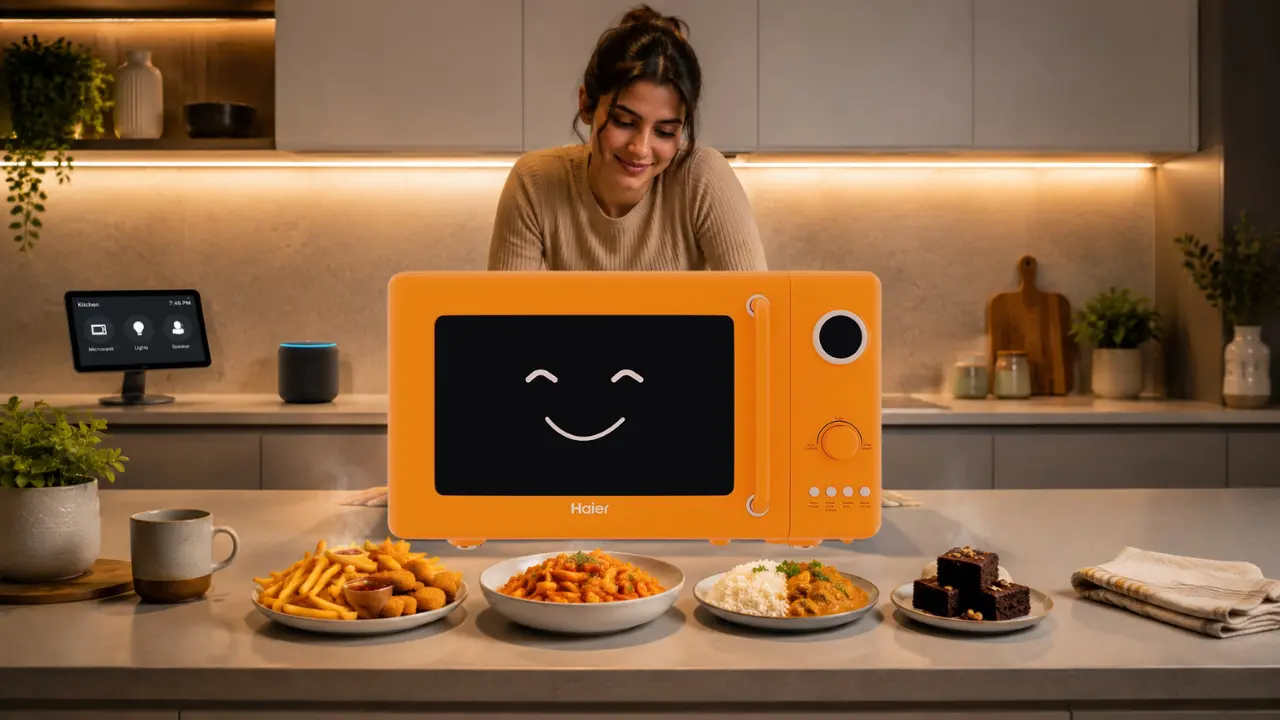

Smart kitchen design trends are shifting from how kitchens look to how they think.
Today’s kitchens are built around reducing effort, saving time, and adapting to real life.
From intelligent appliances to space-saving layouts, the focus is simple. Less friction. More flow. A kitchen that quietly works with you, not against you.
Why does a modern kitchen still feel chaotic?
It is 8:30 PM.
Dinner is half done. The phone rings. Someone forgets the gas is still on. Something spills.
The kitchen is not broken.
The system is.
Most Indian kitchens are designed for tasks. Not for people living through those tasks. That gap creates friction.
The shift is clear:
From cooking space to decision system.
Trend 1: Kitchens are becoming decision-free zones
The biggest change is invisible.
It is not about adding more appliances.
It is about removing decisions.
Three ways this shows up in real homes
- Preset cooking systems
Appliances now decide time and power for you.
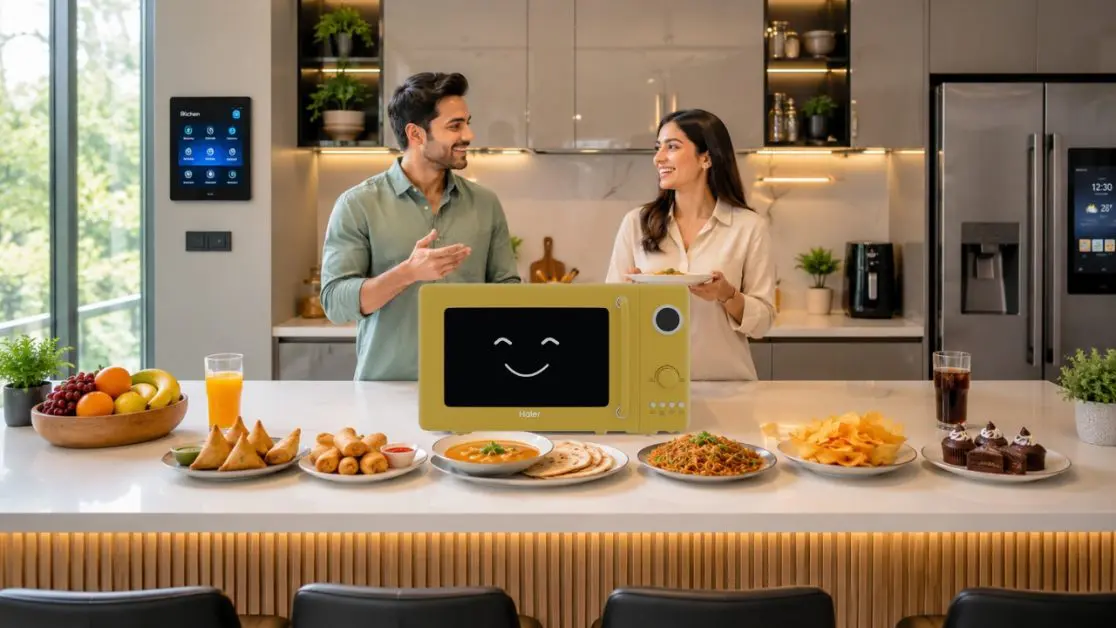
For example, the Haier Vogue 20L Yellow Solo Microwave Oven With Auto Cook Menus Digital Display (HIL20V1MYPD) comes with preset programs that simplify everyday meals
Cost: Slight learning curve
Benefit: Consistent results without guesswork - One-touch operations
Instant start removes steps. Press once. It begins.
Cost: Less manual control
Benefit: Saves time during busy evenings - Smart sequencing
Appliances work in rhythm. Cook. Reheat. Serve.
Insight:
The best system is the one you don’t have to think about.
Trend 2: Design is no longer neutral. It is expressive
Walk into older kitchens.
Everything looks safe. Neutral. Predictable.
Now look at modern homes.
Colour is back.
Why this matters
Because kitchens are now visible.
They are part of the living space.
What’s changing
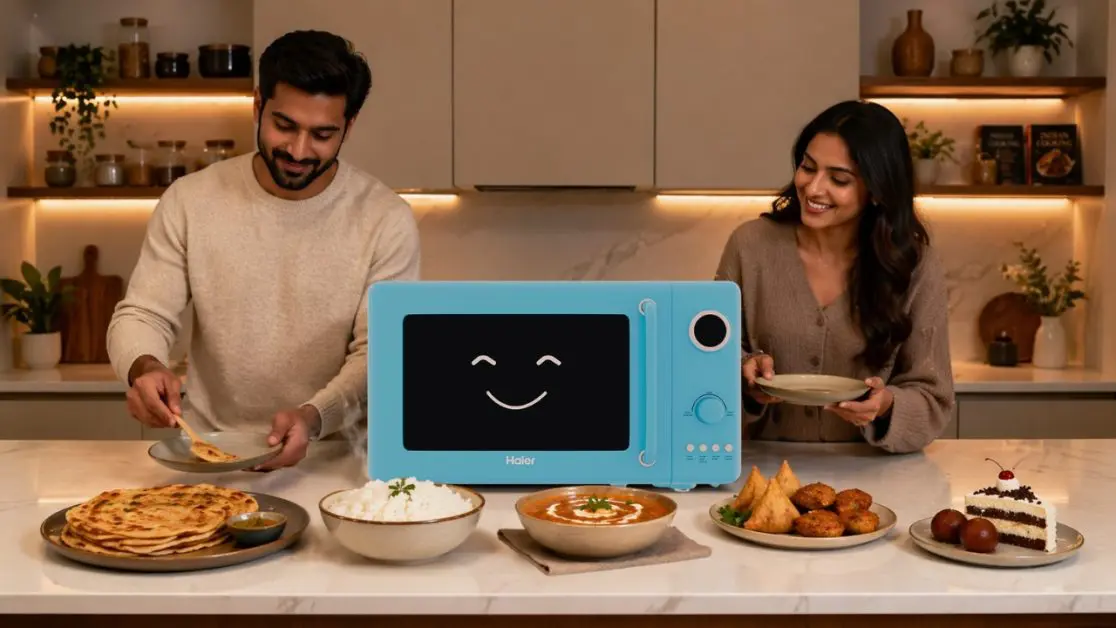
- Bold appliance colours like Yellow yellow, peach, and blueberry
- Playful design elements like smiley glass doors
- Finishes that feel personal, not industrial
Models like the Haier Vogue 20L Orange Solo Microwave Oven With Auto Cook Menus Digital Display (HIL20V1MOPD) and Haier Vogue 20L Blueberry Solo Microwave Oven With Auto Cook Menus Digital Display (HIL20V1MBPD) reflect this shift toward expressive kitchen design
Cost vs Benefit
| Choice | Cost | Benefit |
| Neutral kitchen | Safe, timeless | Lacks personality |
| Expressive kitchen | Needs planning | Feels alive and unique |
Aphorism:
A kitchen that reflects your personality gets used more.
Trend 3: Small kitchens are becoming smarter, not bigger
Space is limited in most Indian homes.
But here is the truth.
Space does not limit functionality. Poor design does.
Three layout strategies that work
- Vertical storage
Use height. Not width. - Multi-use counters
Prep. Cook. Serve on the same surface. - Compact appliances
Smaller footprint. Same performance.
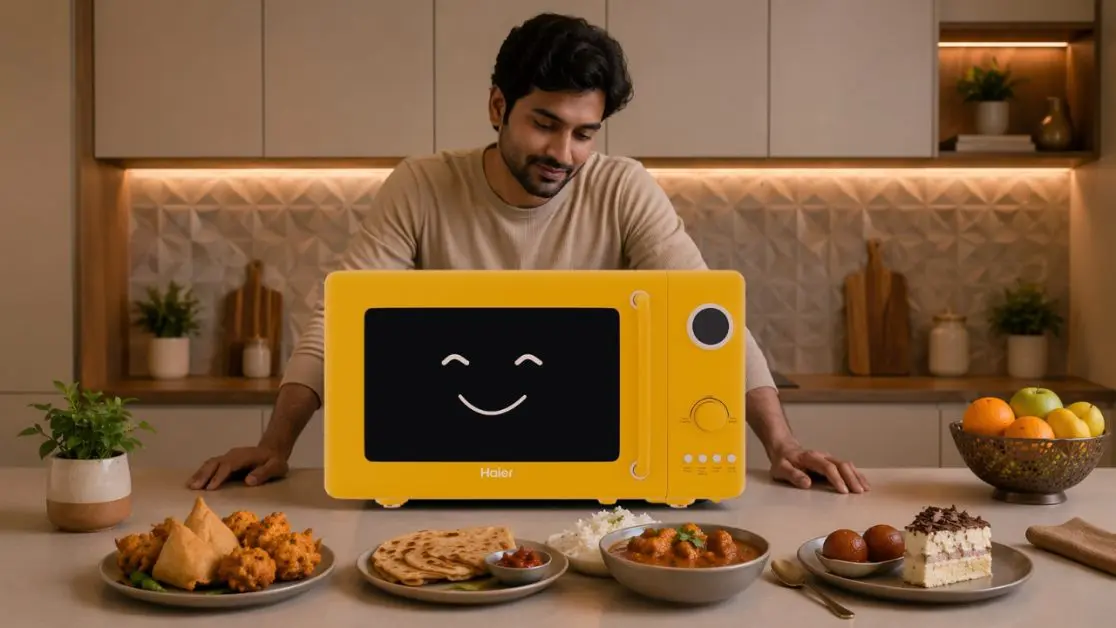
For instance, a 20L appliance like the Haier Vogue series fits compact kitchens while handling daily cooking, reheating, and defrosting.
Cost vs Benefit
- Compact systems save space but need planning
- Large layouts waste usable area
Insight:
Efficiency beats size every single time.
Trend 4: Speed is becoming a design principle
Time is a real luxury.
Why speed matters
- Dual-income households
- Late working hours
- Unpredictable schedules
Where speed shows up
- Instant heating functions
- Quick defrosting
- Pre-programmed cooking
Features like instant start in the Haier Vogue 20L series allow immediate heating at the press of a button
Insight:
The faster the system responds, the calmer the kitchen feels.
Trend 5: The rise of intuitive controls
Most appliances expect you to learn them.
Smart kitchens reverse that.
They learn from you.
What this looks like
- Jog dial controls instead of complex panels
- Simple digital displays
- Minimal, clear interface
For example, the jog dial system in Haier Vogue microwave models allows quick selection of time and power without confusion
Who this helps
- Busy professionals
- Parents multitasking
- Elderly users
Aphorism:
Ease of use is the new luxury.
Trend 6: Kitchens are becoming emotionally intelligent
A kitchen changes how you feel.
Two contrasting experiences
Cluttered kitchen
You delay cooking.
Clean, intuitive kitchen
You enjoy cooking.
Design elements driving this
- Warm lighting
- Clean surfaces
- Friendly appliance design
- Thoughtful layout
Even small design choices like cheerful appliance aesthetics improve the experience.
Insight:
Good design reduces resistance. Great design removes it.
Trend 7: The kitchen is becoming a connected system
Not just appliances.
A system.
What this includes
- App-controlled devices
- Energy tracking
- Smart coordination between appliances
Why it matters
- Saves electricity
- Reduces effort
- Improves consistency
Cost vs Benefit
| Feature | Cost | Benefit |
| Smart connectivity | Higher upfront cost | Long-term efficiency |
| Traditional setup | Lower cost | More manual effort |
Insight:
A connected kitchen is about coordination, not complexity.
Trend 8: Cleaning is built into the design
Cleaning is the hidden work.
Smart kitchens reduce it.
What’s changing
- Smooth, stain-resistant surfaces
- Easy-clean appliance interiors
- Minimal joints and edges
Impact
Less effort.
Less time.
More usage.
Insight:
If cleaning is hard, usage drops.
Trend 9: Flexibility is the new standard
No two days look the same.
Your kitchen should adapt.
Three modes every kitchen supports
- Quick mode
Fast reheating, minimal effort - Daily mode
Balanced cooking - Occasion mode
High-volume preparation
A smart kitchen handles all three without stress.
How to think about your own smart kitchen
You do not need everything.
You need what works.
Three approaches
One option is: Start small
Upgrade to an appliance like the Haier Vogue 20L Yellow Solo Microwave Oven With Auto Cook Menus I Digital Display (HIL20V1MYPD).
The second option: Improve layout
Fix flow before adding features.
The third option: Build a system
Combine appliances and design into one experience.
The bigger insight
Smart kitchen design trends are not about technology.
They are about removing friction from everyday life.
Cooking stays.
Cleaning stays.
But effort is reduced.
Final thought
You do not need a perfect kitchen.
You need a kitchen that works perfectly for your life.
Because the future of kitchen design is not about adding more.
It is about removing what slows you down.
Less effort.
Less thinking.
More living.
Frequently Asked Questions
Why does my modern kitchen still feel chaotic even after adding new appliances?
Because appliances alone do not fix workflow. A smart kitchen needs better sequencing, easy access, simple controls, and fewer decisions during cooking.
I feel tired before I even start cooking. Can smart kitchen design help?
Yes. Preset cooking menus, one-touch heating, compact layouts, and clear storage zones reduce the mental effort of planning, cooking, and cleaning.
What smart kitchen feature saves the most everyday effort?
Auto cook presets are very useful because they reduce guesswork around time, power, and cooking settings.
I come home late from work. What should I upgrade first in my kitchen?
Start with fast-use appliances like a microwave with instant start, auto menus, and simple digital controls before changing the entire kitchen layout.
I have a small Indian kitchen. Can it still be smart?
Yes. Smart design is more about layout than size. Vertical storage, multi-use counters, and compact appliances can make a small kitchen work better.
Should I buy bigger appliances for better performance?
Not always. A compact 20L microwave can handle daily reheating, defrosting, and simple cooking while saving counter space.