
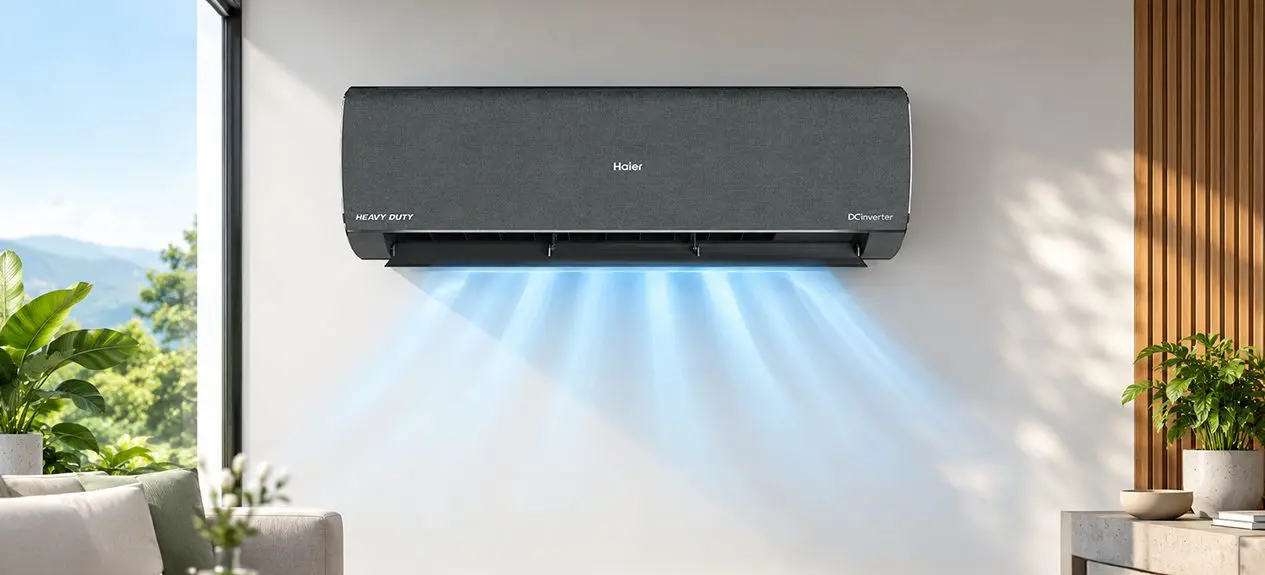

When buying a new air conditioner, most people naturally look at tonnage, star rating, cooling speed and inverter technology first. The refrigerant usually gets much less attention, even though it is an important part of the cooling system and often appears clearly in the product specifications.
Terms like R32, R410A and R22 can make AC refrigerant types seem more technical than they really need to be. A little context around these names can make it easier to understand what you are actually comparing before you choose an AC.
Before getting into R32 and how it compares with other refrigerants, it helps to first understand what the refrigerant actually does inside an AC.
What Refrigerant Really Does Inside Your AC
AC uses refrigerant as a heat-carrying medium inside the system. The indoor unit takes the heat from the room and passes it through the AC system to release the heat outside. This cycle repeats until the room has reached the set temperature.
The refrigerant is, therefore, such an important part of the cooling cycle. It is useful to go beyond the name alone when comparing AC refrigerant types and consider things like environmental impact, safety classification and whether the refrigerant is suited to the AC design.
Why Has R32 Become Common in New Air Conditioners?
For air conditioners, the choice of refrigerant is now a much bigger design consideration. R32 is often in the conversation for a multitude of reasons, with newer systems balancing performance, environmental impact and long-term use. For buyers asking “What is R32 gas in AC?”, understanding why it is increasingly used helps put the refrigerant specification into context.
- Reduced Global Warming Potential (GWP). R32 has a GWP 3 times lower than R410A. This has a lower potential impact on climate if the refrigerant leaks into the atmosphere.
- No ozone depletion potential. R32 is not harmful to the ozone layer and is a far better option than older refrigerants like R22.
- It performs well in modern AC systems. R32 has thermodynamic properties that make it work well in air conditioners designed for it. But true energy efficiency is still a function of the entire air conditioner, not just the refrigerant.
- Related to the transition to newer refrigerants. R32 is one of the more common options in newer residential ACs as older and higher impact refrigerants are phased down or replaced.
There has been a surge in the demand of R32
Read through: Why some air conditioners use R-32 refrigerant for eco-friendly cooling
R32 vs R410A: What Is the Difference for a Buyer?
The names alone do not help much when you see two refrigerants on different AC specs. Comparing air conditioners side by side makes it easier to see the practical differences between R32 and R410A and what these differences mean.
| Point of Comparison | R32 | R410A |
| Refrigerant composition | A single-component refrigerant, also known as difluoromethane. | A blend made from R32 and R125 in a 50:50 ratio by mass. |
| Global warming potential | Lower GWP. The commonly used AR4 value is 675. | Higher GWP. The commonly used AR4 value is 2,088. |
| Ozone-depletion potential | Zero. R32 is an HFC and does not contain chlorine. | Zero. R410A is also made from HFC refrigerants. |
| Safety classification | A2L, lower toxicity and lower flammability | A1, lower toxicity with no flame propagation |
| What it means when buying an AC | Commonly seen in newer residential ACs and has a lower climate impact than R410A if released. | Still used in many existing systems, but has a considerably higher GWP than R32. |
R32 vs R22: Why the Older Refrigerant Is Being Left Behind
Looking beyond environmental ratings, R32 vs R22 also reveals some important differences in how an AC system needs to be designed and operated. These are worth knowing because changing the refrigerant can affect everything from the required charge to the compressor and other components.
- R32 can do more with a smaller refrigerant charge. R32 has a higher refrigerating effect than R22. UNEP technical research indicates that an R32 room AC can require roughly 70% of the refrigerant charge of an equivalent R22 system.
- The two operate at different pressures. At 25°C, R32 has a higher saturation pressure than R22, about 1.69 MPa versus 1.04 MPa. This means the compressor, piping and other parts of an R32 AC are engineered around different operating conditions.
- R32 can support more compact system design. Its higher refrigerating capacity allows manufacturers to optimise compressors and heat exchangers differently. In systems designed specifically around R32, this can help reduce the amount of refrigerant and, in some cases, the size of certain components.
- There can be an efficiency advantage in a properly designed system. R32 has strong heat-transfer and thermodynamic properties. Research and manufacturer testing have shown that R32 systems can achieve higher energy efficiency than comparable older refrigerant systems, though the actual electricity use still depends on the complete AC design and operating conditions.
Is R32 Refrigerant Safe to Use at Home?
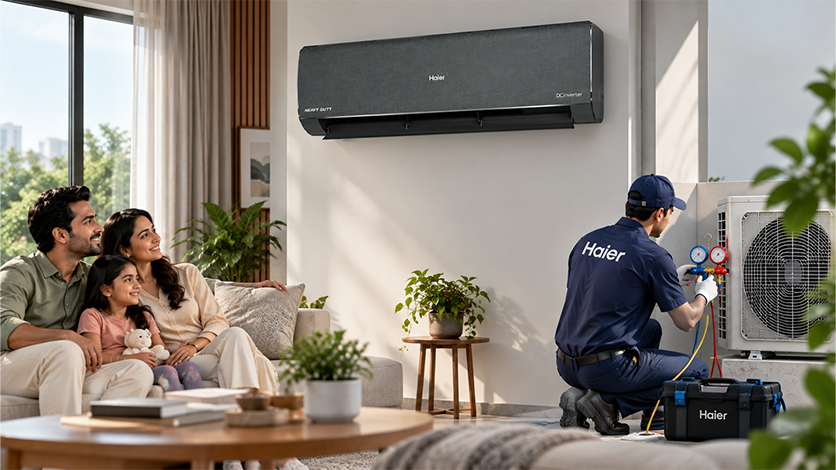
R32 is safe for residential use when designed and installed properly for it. It is classified as A2L, which means it is slightly flammable and less toxic. The refrigerant stays inside the sealed system during normal operation, so there is no regular exposure to it.
The main precautions are during installation and servicing or recharging of the AC. Any R32 inverter AC work should be performed by trained technicians following the correct safety procedures for the refrigerant.
What Should You Check When Buying an R32 Inverter AC?
Once the basic specifications are in place, it is worth looking at the details that can actually change how the AC feels to use every day. It also helps to understand “What is an inverter R32?” when you see the wording on a product page: it generally refers to an inverter air conditioner that uses R32 refrigerant, rather than a separate type of refrigerant.
- Check cooling performance at high outdoor temperatures. If you live in a region with very hot summers, look at the operating-temperature range and how much cooling capacity the AC can maintain as the outdoor temperature rises.
- Look at airflow and air distribution. Check air throw, swing directions and fan-speed options. A good R32 inverter AC should be able to spread cooled air comfortably across the room rather than concentrating it in one area.
- Pay attention to indoor noise levels. Noise can matter just as much as cooling, especially in bedrooms and study spaces. Compare the indoor-unit dB(A) figures at lower fan speeds instead of relying only on terms such as “quiet” or “silent.
- Read the warranty terms beyond the headline number. Check what is covered under the comprehensive warranty, compressor warranty and other component warranties, along with any conditions attached to them.
Where R32 Fits into Haier’s Current AC Range
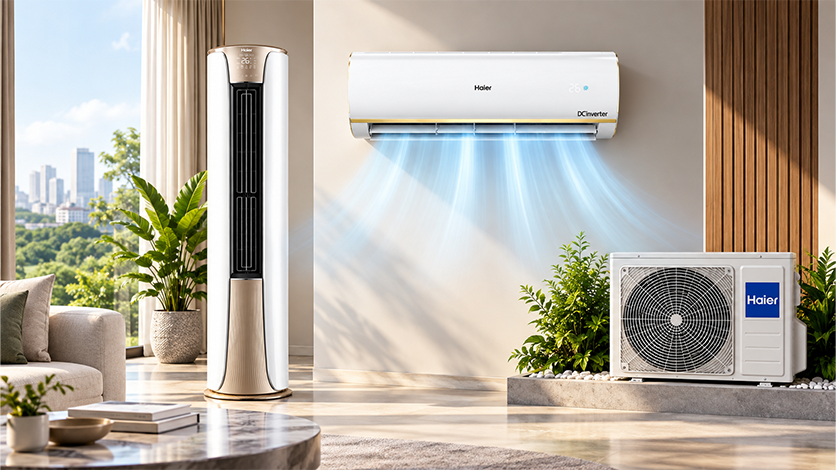
R32 is found in several models in Haier’s current AC range. It is used in different formats, efficiency levels, capacities and operating styles, which gives buyers more flexibility while comparing the rest of the specifications.
1> The Spartan AI Tower AC shows R32 in a higher-capacity setup
We use R32 across different AC formats, including wall-mounted split ACs and our Spartan AI Tower AC. The Spartan model combines R32 refrigerant with 6,400 W rated cooling capacity and a 3-star energy rating, showing how R32 also fits into larger tower-style cooling systems.
2> The Kinouchi Heavy Duty AI Series gives you more choice
Our Kinouchi Heavy Duty AI Series includes several R32 models across 3-star, 4-star and 5-star configurations. These models also vary in cooling capacity and ISEER, giving you room to compare efficiency and performance within the same broader series without changing the refrigerant type.
3> R32 covers different cooling requirements
We also use R32 across a wide range of cooling capacities. Our CleanCool Plus range includes models with rated cooling capacities of 3,400 W and 3,900 W, while selected Desert Rose Super Duty AI models go up to 7,200 W. This gives you the flexibility to consider an R32 AC for both smaller rooms and spaces with higher cooling requirements.
4> R32 also fits into hot & cold ACs
R32 is not limited to cooling-only air conditioners in our range. Our Hot & Cold AI model also uses R32 and offers 5,000 W rated cooling along with 5,200 W heating capacity, making it suitable for both summer cooling and colder-weather comfort.
Conclusion
R32 has become a familiar name in newer air conditioners because it offers zero ozone-depletion potential and a lower global warming potential than refrigerants such as R410A. For buyers, that makes it a useful specification to understand rather than something to simply overlook on the product sheet.
At the same time, the refrigerant should not decide the purchase on its own. Room size, cooling capacity, star rating, inverter technology, airflow, noise levels and service support matter just as much in everyday use. If you are considering an R32 inverter AC, compare the complete set of specifications and choose a model that fits both your space and your cooling needs.
FAQs
What is R32 gas for AC?
R32 is a refrigerant used in many modern air conditioners to transfer heat from the inside of the room to the outside. It doesn’t contribute to ozone depletion and has a lower global warming potential than R410A, which is part of why it’s become common in newer ACs.
Which gas is used in AC?
Different ACs use different refrigerants. There is no one gas that is used in all models. R32 is now common in newer residential air conditioners, while refrigerants like R410A remain in a lot of existing systems. Make sure you check product specs before buying.
What is the difference between R32 and R410A?
R32 is a single-component refrigerant, while R410A is a blend of refrigerants. R32 has a much lower global warming potential than R410A. The refrigerant alone does not determine the efficiency of an AC, so other specifications should be compared too.
Is R32 better than R22?
R32 is the clear winner in environmental terms, having no ozone-depletion potential. R22 is an older HCFC refrigerant that destroys the ozone layer and is being phased out. That’s why R32 is more relevant when considering newer residential ACs.
Is R32 refrigerant safe?
R32 is classified as an A2L refrigerant, meaning it is mildly flammable and slightly toxic. The ACs developed for R32 take these characteristics into account. Installation, refrigerant charging and repairs should still be performed by trained technicians with the appropriate equipment.
Why do new ACs use R32 gas?
R32 has zero ozone depletion potential (ODP) and lower global warming potential (GWP) than R410A. It also works well with modern air-conditioning systems, which is why you will find it across many newer inverter AC ranges.
Which refrigerant should I look for when buying an AC?
R32 is a popular choice for newer residential AC units, but it shouldn’t be your only consideration. Also compare the tonnage of the AC, ISEER or star rating, inverter technology, cooling performance and noise level, warranty and service support before you buy.