

You bought an inverter AC hoping for efficient cooling and a noticeable decrease in your electricity bill. But after a couple of weeks of regular use, the bill might still be looking a lot higher than you would have thought. This can be confusing, especially since inverter ACs are supposed to adjust the compressor speed and use power more efficiently than fixed-speed models.
But inverter technology alone will not be able to control your overall electricity consumption. The AC power consumption depends on temperature settings, room size, insulation, maintenance, weather conditions and daily running hours.
Therefore, let’s have an understanding of when your inverter AC actually saves you some money. So that you are clear with the basics.
Understand When an Inverter AC Actually Saves Electricity
An inverter AC does not operate at the same power level throughout the day. It varies the compressor speed to match the cooling needs of the room. Here is how you can be in the upper hand with inverter AC power consumption:
- When the AC capacity is right for the room size. A correctly sized AC reaches the right temperature without running at full power for too long. An undersized unit might work harder and use more electricity.
- Temperature is set at a reasonable level. The AC is set at about 24-26 degrees Celsius, which makes the compressor slow down once the room is comfortable. At very low settings, it can be kept running at a higher speed.
- When the room is sealed well. Close doors, windows and curtains to prevent cool air from leaking out. This reduces the cooling load and helps the inverter compressor run more smoothly.
- Filters and coils should be clean. Clean filters improve airflow and help the air conditioner cool the room faster. Dust buildup can affect performance and cause the unit to run longer than it needs to.
- When the AC is running for extended periods. Inverter ACs are more efficient in continuous, stable running. Turning the unit on and off a lot will stop it from going into a lower power mode.
Find Out What Is Making Your AC Use More Electricity
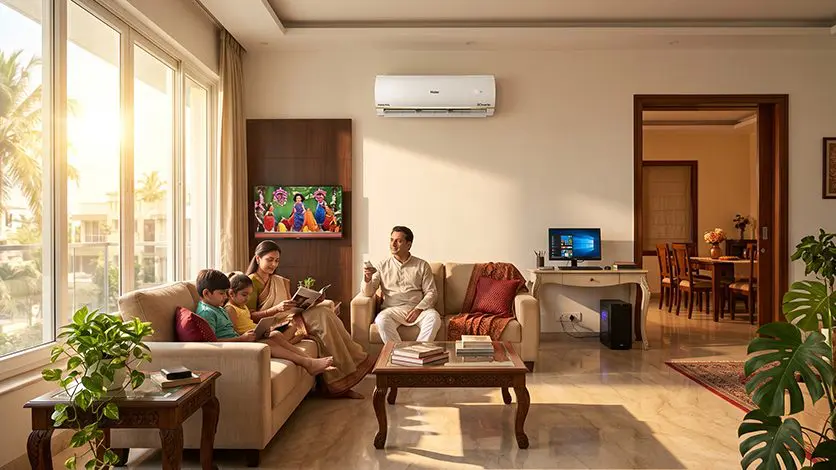
It’s not always the temperature setting or the number of hours it runs that makes an inverter AC consume more power than it should. Sometimes small details inside the room or the way the AC is being operated keep adding to its cooling load. Pay close attention to the following:
- Your room is warming faster than the AC can cool it
The room can quickly get hot if there are big glass windows, direct afternoon sun, hot outside walls, and poor roof insulation. Electronics that generate heat (televisions, gaming systems and computers) also increase the load on the AC. This causes the compressor to work harder even after the room begins to cool.
- The AC is cooling an area larger than it should
An open doorway, connecting passageway or open-plan design will allow the AC to cool adjoining spaces along with the main room. The unit may appear to be working normally, but is actually moving more air than it was selected for.
- Powerful cooling modes are being used too often
If you need instant relief from extreme heat, then Turbo, Power or High-Cool modes can help. However, prolonged usage can cause the compressor to run at a higher capacity. Once the room is comfortable, switching to Auto, Eco or moderate cooling mode can help eliminate unnecessary energy use.
- The cool air isn’t breezing evenly around the room
Furniture, curtain or wardrobe near the indoor unit may block the flow of the air. If the louvre direction is wrong, it could also leave certain areas warm, and you could end up lowering the temperature further. Good airflow and direction of air help the room cool more evenly without the AC working any harder.
- Installation/sensor issues causing cooling cycle to take too long
Improper refrigerant charging, poorly insulated copper piping, improper placement or malfunction of the outdoor unit or a temperature sensor can affect performance. The AC doesn’t sense or hold the selected temperature properly and may continue to run. These hidden causes can be identified with a professional inspection.
(Curious about the integration of AI in modern ACs for electricity saving?
Read through Does Human Detection in ACs Really Save Electricity? A Guide to AI Eco Modes)
Simple Ways to Check Your Inverter AC Power Consumption
Several appliances contribute to the monthly bill alone that are hard to guess. To understand your inverter AC power consumption properly, watch for the following:
- Look at the annual energy consumption shown on the BEE label. The label provides an estimate of annual consumption under standard test conditions.
- Compare the electricity meter readings before and after usage. Take a reading of the meter before you switch on the AC and check it after a certain number of hours.
- Get a dedicated energy monitor. A good AC energy monitoring device can tell you how many units the appliance consumes in a day or week.
- Monitor operating hours and cooling conditions. Write down outdoor temperature, thermostat setting, number of people in the room and approx running time.
- Calculate the operating cost. Multiply your units used by your local electricity rate. Also, tariff slabs are important to consider because the cost per unit increases once your household crosses a certain limit of consumption.
Follow These Practical Tips to Lower Your AC Electricity Bill
With a few tweaks to your AC usage, you can save unnecessary power use without sacrificing comfort. These practices help the unit to cool more efficiently and avoid having to work harder than necessary:
- Select the correct mode. Use Cool Mode when it’s hot and Dry Mode when it’s humid or rainy. Matching the mode to the weather prevents unnecessary cooling.
- Don’t cool an empty room. Do not run the air conditioning in an empty room. If you’re going to be out for any length of time, turn it off.
- Reduce activities that produce heat. The room gets warmer from cooking, ironing and some of the appliances. Try to avoid using them when the AC is on.
- Keep the air moving. The indoor unit must not be blocked by curtains, furniture or other objects. And, be sure to leave plenty of space around the outdoor unit.
- See changes in cooling. Slow cooling, strange noises or an unexpected increase in electricity usage could spell trouble.
How Haier Features Can Help Reduce Your AC Electricity Bill?
Some models of Haier ACs are equipped with features that help to match the cooling to the real conditions of the room and facilitate the management of electricity consumption:
- Change your cooling levels to suit your needs with the Intelli-Convertible 7-in-1: Rather than running the AC at its highest capacity all day, select from various cooling levels (weather and room occupancy dependent).
- Let AI ECO take care of cooling automatically: AI ECO detects the cooling needs of the room and automatically cycles between appropriate capacity levels.
- Electricity Monitoring: Monitor your Electricity Consumption with the Haismart App on select connected models, and get AC consumption in kWh and estimated cost in INR.
- Climate Control for even more personalised cooling: This feature studies your usage habits whilst sensing indoor and outdoor temperature, humidity and changing room conditions.
- Human detection to cut empty-room cooling: Available on select Haier models, this feature detects if anyone is in the room. The AC can shift to 40% capacity after 15 minutes of inactivity and turn off after 30 minutes.
Conclusion
A high electricity bill doesn’t mean your inverter AC is inefficient. Room size, temperature settings, heat coming into the space, blocked airflow, poor maintenance and daily usage can all make the compressor work harder than expected.
Reduce AC electricity bill costs by choosing the right cooling mode, setting the temperature between 24°C and 26°C, not cooling empty rooms and tracking the actual power consumption. There are more thoughtful ways to manage cooling, with features such as Haier’s Intelli-Convertible modes, AI ECO, electricity monitoring and human detection.
FAQs
What are the most common reasons an inverter AC consumes more electricity than expected?
Common reasons are low temperature settings, long running hours, dirty filters, poor insulation and an incorrectly sized AC. Open doors, direct sunlight and little air movement can also increase the cooling load and make the compressor work harder.
Does an inverter AC always save electricity compared to a non-inverter AC?
Not all the time. A regular Inverter AC is more efficient as it changes the compressor speed instead of switching it ON and OFF again and again. But real savings depend on room size, use, maintenance and temperature settings.
Can setting the temperature too low increase your inverter AC’s electricity consumption?
Yes, at a very low setting the compressor works harder and longer. A more comfortable and energy efficient temperature is often around 24°C to 26°C rather than 18°C or 20°C.
Do higher outdoor temperatures reduce the efficiency of an inverter AC?
Yes, if it is very hot outside, the AC has to remove more heat to reach the indoor temperature you have selected. This makes more work for the compressor, and can increase electricity use, even with an inverter model