
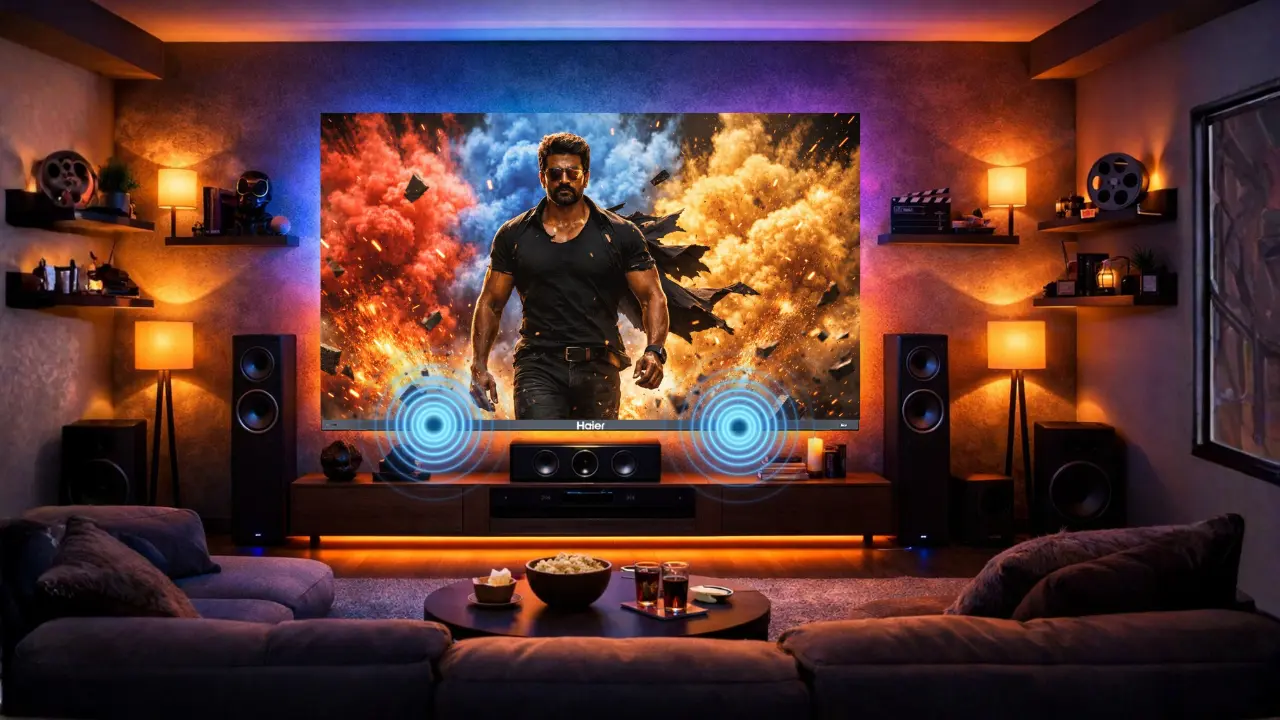

Immersive audio that matches big screen visuals means sound that expands with the picture, moves with the action, and fills your room with the same intensity you see on screen. When the screen gets bigger, the sound must grow deeper, wider, and smarter.
A massive 215cm (85) display showing a packed cricket stadium deserves more than thin stereo output.
A 254cm (100) QD Mini LED screen playing a cinematic war scene needs sound that carries weight.
Big visuals without immersive audio feel like watching fireworks behind glass. You see the sparkle. You miss the impact.
In modern Indian homes, where the TV anchors living rooms, weekend gatherings, and post work downtime, this balance matters more than ever.
Why Big Screens Instantly Expose Weak Sound?
Picture quality has evolved rapidly.
Mini LED panels now offer hundreds of local dimming zones. Dolby Vision enhances contrast frame by frame. HDR10 sharpens dynamic range. Motion technologies like MEMC reduce blur in sports.
But if the sound remains flat, the illusion collapses.
Here is the invisible pattern:
- Bigger screen increases visual immersion
- Visual immersion increases emotional expectation
- Emotional expectation demands layered sound
According to Dolby’s published insights on immersive audio adoption, spatial formats like Dolby Atmos significantly enhance perceived realism compared to stereo sound. When audio surrounds you, the brain processes it as real space.
The flat sound on a giant screen feels disconnected.
Immersive audio restores alignment.
What Immersive Audio Actually Means in Daily Life
Immersive audio is not about louder speakers.
It is about spatial precision.
It is about separation between dialogue and background.
It is about depth.
Consider this comparison:
| Standard TV Audio | Immersive Audio |
| Two channel stereo | Multi channel sound field |
| Limited bass | Dedicated woofer support |
| Dialogue blends into music | Clear vocal separation |
| Sound stays in front | Sound wraps around you |
In Indian homes where ceiling fans run, kitchens stay open, and conversations overlap, dialogue clarity is not optional. It is essential.
Immersive audio that matches big screen visuals reduces constant volume adjustments.
Less remote fiddling. More watching.
Sound by KEF: Engineering That Matches the Screen
Speaker design shapes experience.
The Haier M80F Mini LED 215cm (85) Google TV Sound By KEF (H85M80FUX) integrates KEF’s high fidelity speaker tuning directly into the television chassis .
KEF brings over six decades of speaker engineering expertise. The focus is clarity, balanced frequency response, and controlled bass.
On the 215cm (85) model, key features include:
- 2.1 Channel Woofer 50W Sound
- Dolby Atmos for three dimensional spatial audio
- Sound by KEF integration for enhanced clarity and bass precision
The audio power output of 50W is not just a number. It ensures that the bass feels grounded rather than hollow.
The picture expands horizontally.
Audio expands dimensionally.
That is the match.
Visual Scale and Audio Scale Must Evolve Together
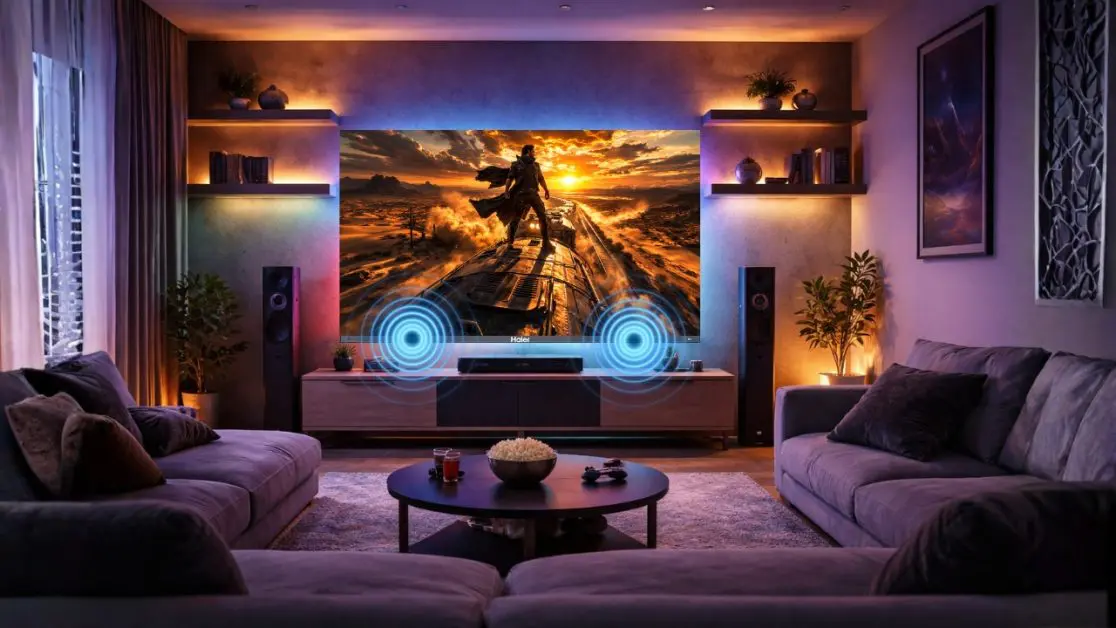
The Haier M80F Mini LED 215cm (85) Google TV Sound By KEF (H85M80FUX) features 360 local dimming zones for deeper blacks and stronger contrast .
More dimming zones increase perceived depth.
Increased visual depth raises expectations for audio depth.
This is systems thinking.
When Mini LED enhances contrast and Dolby Vision optimizes brightness scene by scene , immersive audio ensures the emotional tone keeps up.
On a larger scale, the Haier M96 Series 254cm (100) QD Mini LED AI Smart Google TV elevates immersion further with a 6.2.2 channel speaker configuration and 90W output .
Six main channels. Two bass units. Two height channels.
That configuration creates a layered sound field that mirrors the cinematic scale of a 254cm (100) display.
Large visuals require proportional audio architecture.
Anything less feels incomplete.
Three Real World Moments Where Immersive Audio Changes Everything
1. Cricket Night with Family
One option is basic stereo. Commentary and crowd merge together.
The second option is Dolby Atmos on the Haier M80F Mini LED 215cm (85) Google TV | Sound By KEF (H85M80FUX). Commentary remains crisp. Crowd noise surrounds. Bat impact feels sharp.
Cost: Investing in a model with 2.1 channel woofer support.
Benefit: The living room feels like a stadium, not a background TV.
2. Late Night OTT Sessions

Google TV integration offers curated content recommendations and access to 10,000 plus apps.
But content discovery is only half the experience.
Immersive audio ensures dialogue clarity even at moderate volume.
Cost: Choosing integrated KEF tuned sound instead of adding external speakers later.
Benefit: Clean setup, no extra wiring, balanced audio.
3. Console Gaming
The 215cm (85) M80F supports DLG 120Hz and HDMI 2.1 eARC .
Fast visuals demand responsive sound cues.
Footsteps, engine revs, and environmental effects must feel directional.
Cost: Premium panel with immersive audio and modern connectivity.
Benefit: Competitive responsiveness and cinematic depth.
In every case, immersive audio that matches big screen visuals enhances not just entertainment, but atmosphere.
The Hidden Costs of Ignoring Audio
Many buyers focus on inches and resolution.
The resolution here is 3840 x 2160 Ultra HD .
Mini LED brightness and contrast receive attention.
Audio quietly becomes secondary.
The consequences show up later:
- Dialogue strain
- Volume fluctuations
- Additional soundbars
- Extra cables and clutter
The Haier M80F Mini LED 215cm (85) Google TV Sound By KEF (H85M80FUX) integrates audio engineering into the core system.
It reduces dependency on external hardware.
It simplifies living room design.
Integrated solutions feel intentional.
Immersive Audio Is Emotional Infrastructure

Picture quality shapes what you see.
Sound quality shapes what you feel.
When rain falls in a scene, immersive audio places droplets around you. When a character whispers, dialogue stays distinct from background score.
This separation builds realism.
Realism builds connection.
Industry data from global streaming growth reports shows that average daily viewing hours increased significantly post 2020. As content consumption rose, expectations shifted. Viewers now seek cinema level immersion at home.
Immersive audio that matches big screen visuals meets that expectation directly.
It is not about louder sound.
It is about coherent experience.
Choosing the Right Level of Immersion for Your Home
Not every home needs 254cm (100).
Not every viewer needs 6.2.2 channel output.
Here is a practical framework:
- For mid sized rooms and regular OTT usage, 2.1 channel 50W audio like in the Haier M80F Mini LED 215cm (85) Google TV | Sound By KEF (H85M80FUX) balances performance and simplicity.
- For larger rooms and cinema focused setups, a 6.2.2 channel system like in the Haier M96 Series 254cm (100) QD Mini LED AI Smart Google TV scales audio proportionally.
- For gaming heavy users, HDMI 2.1 eARC, Dolby Atmos, and smooth refresh rate technologies align sound with motion.
Screen size and sound scale must align.
Balance creates immersion.
Immersion creates memory.
The Bigger Principle
Homes today are hybrid spaces.
They are workplaces, theatres, gaming arenas, and family lounges.
Technology that reduces friction quietly improves quality of life.
Immersive audio that matches big screen visuals is not a feature upgrade.
It is emotional alignment.
When picture and sound operate in sync, you stop noticing technology.
You start noticing moments.
And moments are what modern homes are built around.
Frequently Asked Questions
Why does my big TV look amazing but sound weak?
Because visual tech (Mini LED, HDR, Dolby Vision) has advanced faster than standard speaker systems. Large visuals raise emotional expectations that flat stereo cannot meet.
Why do I keep increasing volume during dialogue scenes?
Poor channel separation blends dialogue with background music. Immersive audio separates frequencies for clarity.
Does immersive audio help in noisy Indian homes?
Yes. Clear vocal tuning helps dialogue cut through ceiling fans, kitchen noise, and conversations.
What does 2.1 channel actually mean for me?
Two main speakers + one woofer = better bass depth and clearer separation than stereo alone.
Why does my big TV look amazing but sound weak?
Because visual tech (Mini LED, HDR, Dolby Vision) has advanced faster than standard speaker systems. Large visuals raise emotional expectations that flat stereo cannot meet.
Why do I keep increasing volume during dialogue scenes?
Poor channel separation blends dialogue with background music. Immersive audio separates frequencies for clarity.
Does immersive audio help in noisy Indian homes?
Yes. Clear vocal tuning helps dialogue cut through ceiling fans, kitchen noise, and conversations.
What does 2.1 channel actually mean for me?
Two main speakers + one woofer = better bass depth and clearer separation than stereo alone.
What does 6.2.2 channel audio mean in simple terms?
Six primary channels, two bass units, two height channels creating layered, surround sound with vertical dimension.
Is 90W output necessary?
For large rooms and cinema-style setups, yes. It scales proportionally with a 254cm (100″) display.
Is this overkill for regular OTT watching?
For casual viewing, possibly. For cinematic immersion, it is absolutely worth it.