
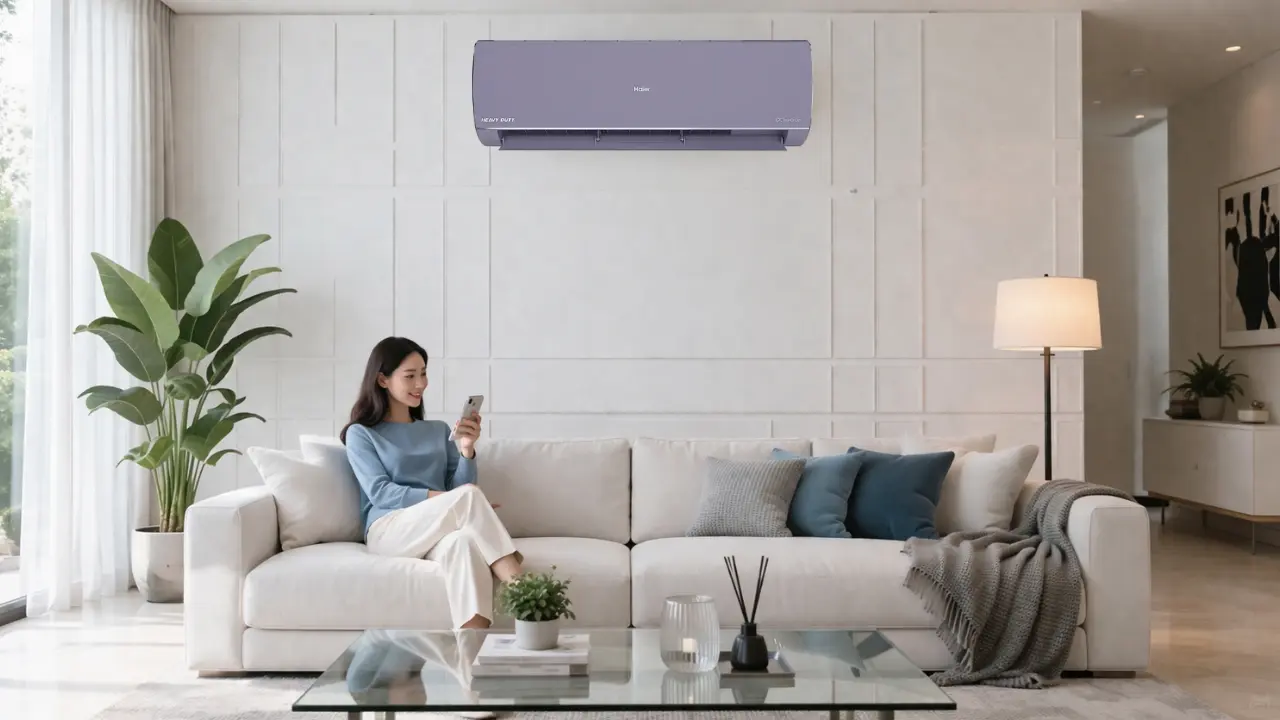

Yes your room can pre-cool before you walk in
We’re starting to see AI enabled air conditioners that predict when you’ll be arriving home and begin cooling the room before you walk in.
The beauty is this. You walk into your room and it’s already comfortable. No waiting. No fuss. No needing to adjust settings. Instant comfort.
It’s a small change. But it’s indicative of how smart homes are quietly eradicating friction.
The moment every Indian summer creates.
Picture a typical weekday evening in May.
You step out of the car after a long commute.
The road still radiates heat from the afternoon sun.
Your shirt sticks slightly to your back.
You unlock the door and walk into the house.
And the first thing you feel is this.
Warm air.
Not unbearable. But not comfortable either.
So the ritual begins.
Switch on the AC.
Wait five minutes.
Sometimes ten.
Only then does the room start feeling right.
This small waiting period exists in millions of homes across India.
And it reveals an interesting truth.
Cooling has always been reactive.
You enter first.
The cooling begins later.
Smart homes are quietly reversing that sequence.
What if cooling started before you even reached home
Sounds simple doesn’t it?
Rather than responding to you, the technology anticipates you.
That’s how AI enabled climate control works today.
Leading edge air conditioners already incorporate location awareness and behavioural learning to predict when you’re coming home.
As the technology detects you entering a predefined geofence area, your AC will automatically start pre-cooling so the room is perfectly comfortable when you walk in.
No timers.
No need to press any buttons.
Just anticipation.
Think about the difference this creates.
| Traditional Cooling | Predictive Cooling |
| AC starts after you enter | AC starts before you arrive |
| Waiting period of 5–10 minutes | Instant comfort |
| Manual switching required | Automatic operation |
| Often runs longer than needed | Runs only when needed |
The technology changes the sequence.
And sequence changes experience.
The invisible technology behind smart cooling
Smart cooling works because multiple small technologies cooperate.
Each one solves a different problem.
1. Behaviour learning
AI technology tracks usage patterns.
What time do you usually return home?
How long the AC runs.
Which temperature you prefer.
Over time, the technology builds a personalized cooling profile based on real usage data.
The machine learns the rhythm of your home.
2. Location awareness
Some AI air conditioners use geofencing technology.
When your phone enters a defined radius around your home, the technology understands something simple.
You are almost there.
That signal becomes the trigger for pre-cooling.
3. Environmental analysis
Temperature alone does not define comfort.
Humidity.
Room size.
Outdoor heat.
Sunlight exposure.
AI climate technology analyzes these environmental conditions and adjusts cooling automatically to maintain comfort while reducing energy waste.
The goal is balance.
Comfort without unnecessary power consumption.
Three ways homes usually handle cooling
Not every home approaches cooling the same way.
Most households fall into one of three patterns.
Option one: Manual cooling
This is the most common method.
You enter the room.
You switch on the AC.
Cooling begins.
Cost:
- Lower appliance complexity
- No automation setup required
Trade-off:
- Waiting time before comfort
- Often higher power usage due to overcooling
Option two: Timer-based cooling
Some households schedule their AC.
For example:
- Start at 7:30 pm
- Stop at midnight
This solves the waiting problem partially.
Cost:
- Cooling runs even if nobody is home
- Less flexible during unpredictable schedules
Timers assume routine.
But modern life rarely follows strict timing.
Option three: Pre-cooling
AI-powered cooling works differently.
Instead of waiting or scheduling, the technology anticipates.
It detects behaviour patterns and location signals to activate cooling exactly when needed.
Benefits include:
- Instant comfort on arrival
- Reduced electricity waste
- Less manual interaction
- Consistent indoor climate
This is why pre-cooling is becoming the default expectation in smart homes.
Comfort is not only about temperature
People often assume cooling means lowering the temperature.
But comfort is more complex than that.
Consider two rooms.
Both show 24°C on the thermostat.
One feels pleasant.
The other feels stuffy.
Why?
Because comfort depends on multiple variables.
- Airflow direction
- Humidity levels
- Room occupancy
- Sunlight exposure
AI climate technology now adjusts these variables dynamically. For example, targeted airflow can direct cool air exactly where people are sitting rather than cooling the entire room unnecessarily.
That small shift makes cooling feel faster and more natural.
Energy efficiency changes when technology think ahead
Cooling early sounds like it might consume more power.
But the opposite is often true.
When technology anticipates usage, they operate more efficiently.
Here is why.
Reactive cooling problem
When an AC starts in a hot room:
- Compressor runs at maximum load
- Temperature drops quickly
- Energy spike occurs
Predictive cooling advantage
When cooling starts gradually:
- Temperature stabilises earlier
- Compressor load reduces
- Power usage becomes smoother
Some AI-enabled air conditioners also monitor electricity consumption directly, displaying real-time usage and helping households manage energy targets.
In other words, comfort and savings begin aligning.
Small examples reveal the bigger shift
Look at a few everyday moments.
The working professional
Someone leaves the office at 6:15 pm.
Traffic usually takes 30 minutes.
The AC senses the return journey and prepares the room quietly.
No hot apartment.
Just instant comfort.
Parents returning from school pickup
Children enter the house tired after a long day.
The room already feels calm and cool.
Sometimes the best technology is the one nobody notices.
Weekend movie night
Friends arrive.
The room already feels comfortable.
Nobody asks, “Switch on the AC.”
The environment simply works.
What AI climate technology are really solving
At first glance, predictive cooling feels like a luxury.
But it actually solves a deeper design problem.
Waiting.
Most household technology still depends on manual action.
Lights.
Fans.
ACs.
Water heaters.
The user activates them.
The technology responds.
Smart homes reverse the direction.
The technology observes patterns.
The environment adjusts automatically.
One small change in logic.
A completely different experience.
Where this technology is already evolving
Modern AI-powered air conditioners now combine several capabilities into a single ecotechnology.
Here are some examples of features that represent this shift.
| Smart Feature | What It Does |
| AI Pre-Cooling | Starts cooling before you arrive |
| AI Climate Control | Adjusts cooling based on environment |
| AI Target Cooling | Directs airflow where needed |
| AI Eco 2.0 Mode | Optimizes energy consumption |
| Electricity monitoring 2.0 | Tracks usage and costs |
Haier’s AI-Atmox platform is one example of this direction, integrating predictive cooling, energy monitoring, and automated climate adjustment into a unified technology.
The goal is not just cooling.
It is intelligent climate management.
The quiet future of everyday living
Technology often improves life in dramatic ways.
Faster phones.
Bigger screens.
More powerful engines.
But the most meaningful upgrades are quieter.
A room that cools itself before you arrive.
A kitchen appliance that simplifies dinner on a busy weekday.
A washing machine that adjusts cycles automatically.
These changes rarely feel dramatic.
They feel natural.
That is the real signal of progress.
The bigger insight
Smart homes are not about adding more technology.
They are about removing effort.
The best technology does not demand attention.
They anticipate needs.
Cooling the room before you arrive is a small example.
But it reveals a powerful principle.
The future of comfort is predictive, not reactive.
And once people experience that shift, waiting for the room to cool will start feeling like an old habit from another era.
Frequently Asked Questions
Do I really need an AI AC or is this just marketing hype?
AI ACs go beyond basic cooling by learning your habits and automating comfort. If you value convenience, energy efficiency, and less manual control, it’s genuinely useful not just hype.
I already have an AC. Should I upgrade just for pre-cooling?
If your current AC works fine, upgrading only makes sense if waiting time, energy bills, or manual switching frustrate you regularly.
Is predictive cooling actually useful in Indian summers or just a luxury feature?
In peak Indian summers, pre-cooling can significantly improve comfort especially after long commutes making it more practical than it sounds.
Will I lose control if everything becomes automatic?
No. You can still override settings anytime. AI just reduces the need for constant adjustments.
I have an unpredictable schedule. Will AI cooling still work for me?
Yes. Unlike timers, AI adapts to changing routines using behavioral patterns and location signals.
How does my AC know when I’m coming home?
It uses geofencing (location tracking via your phone) and learned behavior patterns.
Does it track my daily routine? Is that safe?
It tracks usage patterns locally or via secure apps. Always check privacy settings and permissions.
Can it adjust based on humidity and not just temperature?
Yes. Advanced systems factor in humidity, airflow, and room conditions for better comfort.
What is AI Target Cooling and does it really make a difference?
It directs airflow where people are sitting, making cooling feel faster and more efficient.
Is this like smart assistants (Alexa/Google Home)?
Similar idea, but focused on climate. Some ACs can integrate with assistants for voice control.
What makes platforms like Haier India’s AI systems different?
They combine predictive cooling, energy monitoring, and adaptive climate control into one ecosystem.