
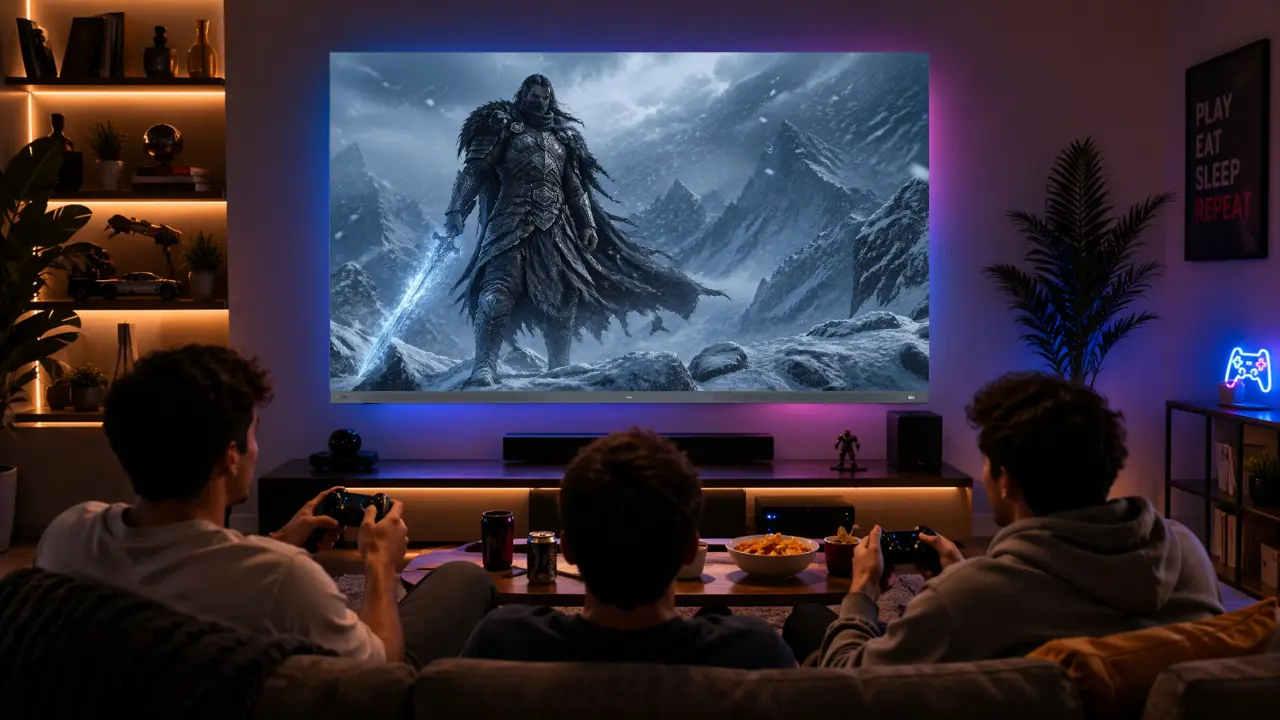

A high refresh rate enhances gaming experience by making motion smoother, reducing blur, and improving responsiveness. It allows every frame to appear more clearly, helping players react faster, track movement better, and feel more immersed.
In fast-paced games, higher refresh rates often mean the difference between seeing action and keeping up with it.
Why does gaming sometimes feel “laggy” even on a good TV?
Picture this.
You are playing a late-night FIFA match after work. The room is quiet. The stakes feel real. You press pass, but the ball seems to move a fraction late.
Not enough to complain. Enough to lose.
This is where most people misunderstand performance.
They blame internet speed. They blame the console. They blame the game.
But often, the real bottleneck is something simpler.
The screen cannot keep up with the action.
What is the refresh rate, really?
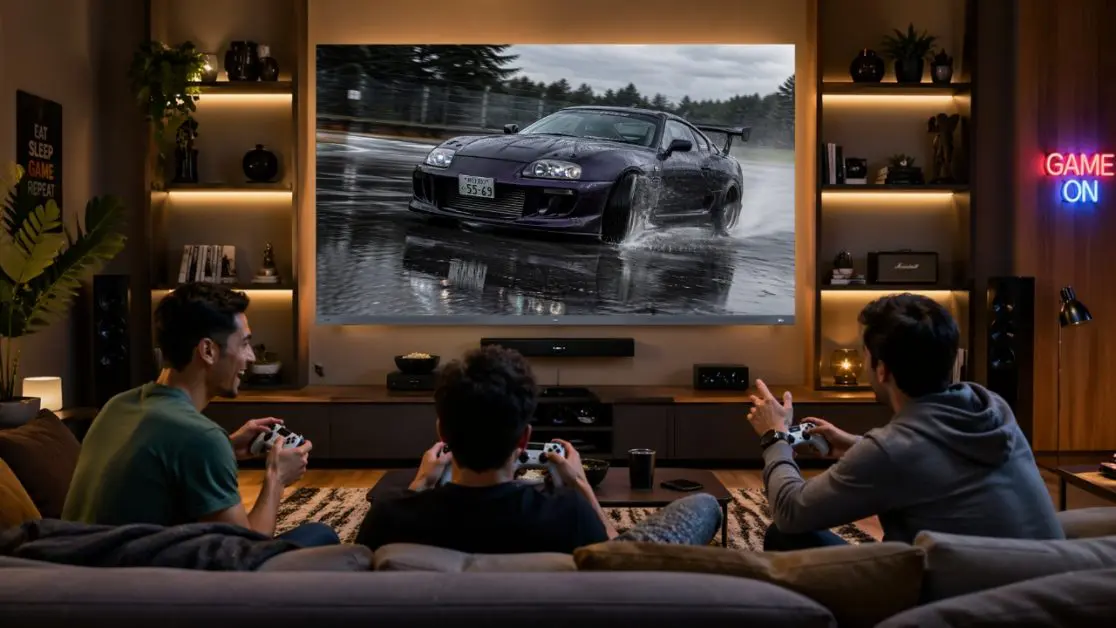
A screen does not show motion.
It shows frames. One after another. Very quickly.
Refresh rate is simply how many times the screen updates every second.
- 60Hz means 60 updates per second
- 120Hz means 120 updates per second
- 144Hz means 144 updates per second
Now here is the insight.
Smoothness is not about speed. It is about continuity.
The more frames your screen shows, the more continuous motion feels.
Less guessing. Less blur. More clarity.
Why higher refresh rate feels instantly different
You do not need to be a gamer to notice this.
Scroll your phone. Then switch to a slower device.
The difference is immediate.
Gaming works the same way. Just more intense.
What actually changes when the refresh rate increases?
- Motion becomes fluid instead of jumpy
- Fast scenes stay sharp instead of blurry
- Input feels instant instead of delayed
- Tracking moving objects becomes easier
This is not about luxury.
It is about control.
The hidden system: How motion clarity changes decisions

Most people think gaming is about graphics.
It is not.
It is about information timing.
In a racing game, you need to see the turn early.
In a shooter, you need to track movement precisely.
In cricket games, you need to judge timing frame by frame.
Lower refresh rate hides information.
Higher refresh rate reveals it.
Better visibility leads to better decisions. Better decisions lead to better outcomes.
That is the system.
60Hz vs 120Hz vs 144Hz: What actually changes?
Here is a simple breakdown that most buying guides complicate unnecessarily.
| Refresh Rate | What You Experience | Best For |
| 60Hz | Basic smoothness, visible blur in fast motion | Casual gaming, OTT content |
| 120Hz | Noticeably smoother, reduced blur | Console gaming, sports viewing |
| 144Hz | Ultra-smooth, sharper motion tracking | Competitive gaming |
Now connect this to real life.
- Watching IPL highlights on 60Hz feels fine
- Watching a live match on 120Hz feels immersive
- Playing a fast shooter on 144Hz feels responsive
Different uses. Different expectations.
Why gamers care about milliseconds, not megapixels
Resolution tells you how sharp the image is.
Refresh rate tells you how fast the image updates.
And in gaming, speed wins.
A 4K TV with low refresh rate looks beautiful.
A high refresh rate TV feels powerful.
This is why modern TVs like the Haier Mini LED range focus on both.
For example, the Haier New M92 Series 164cm (65) QD-Mini LED AI Smart Google TV (H65M92FUX) offers a 144Hz refresh rate, specifically designed to reduce motion blur in fast-paced content.
That is not a spec sheet number.
That is a gameplay advantage.
What makes high refresh rate even more powerful
The refresh rate alone is not enough.
It works best when combined with other systems.
Think of it like traffic flow. Smooth roads are not enough without signals.
1. Variable Refresh Rate (VRR)
Matches screen refresh rate with game output.
Result: No screen tearing. No stutter.
2. AMD FreeSync Premium Pro
Synchronizes GPU and display.
Result: Smooth gameplay even when frame rates fluctuate
3. Auto Low Latency Mode (ALLM)
Automatically switches to game mode.
Result: Faster response time.
4. Game Mode Optimization
Reduces processing delay.
Result: Immediate action response.
When these systems work together, gaming stops feeling like watching.
It starts feeling like participating.
The Indian living room is evolving into a gaming zone
This is not just about gamers.
This is about how homes are changing.
Earlier, TVs were passive.
Now they are interactive.
- Weekdays: OTT streaming
- Weekends: Cricket marathons
- Nights: Gaming sessions
The same screen does everything.
And expectations rise with usage.
A TV that handles movies well but struggles with motion feels incomplete.
A TV that handles motion well adapts to everything.
How high refresh rate improves everyday experiences beyond gaming
Here is where things get interesting.
High refresh rate is not only for gamers.
It improves everything that moves.
1. Sports feel more real
Fast ball movement. Player tracking. Crowd motion.
With higher refresh rates, nothing blurs.
2. Action movies feel cinematic
Explosions. chases. camera pans.
Everything stays sharp.
3. Eye strain reduces
Flicker-free visuals reduce fatigue during long sessions
4. Scrolling and UI feel smoother
Even basic navigation feels premium.
This is why once you experience higher refresh rates, going back feels uncomfortable.
What should you actually choose? A simple decision framework
Most people overthink this.
You do not need to.
Use this simple system.
One option is: Casual usage
- OTT, YouTube, occasional gaming
- Go for 60Hz or 120Hz
Cost: Lower
Benefit: Good enough for everyday use
The second option: Balanced usage
- Gaming + sports + streaming
- Go for 120Hz or 144Hz
Cost: Moderate
Benefit: Noticeable upgrade in smoothness
The third option: Performance-first
- Competitive gaming, high-end consoles
- Go for 144Hz with VRR and HDMI 2.1
Cost: Higher
Benefit: Faster reactions, better gameplay
Why bigger screens amplify the effect
Here is something people rarely talk about.
The bigger the screen, the more important the refresh rate becomes.
On a 32 screen, blur is less noticeable.
On a 75 screen, it becomes obvious.
On a 254cm (100) screen, it becomes unavoidable.
That is why large-screen TVs like the Haier New M96 Series 254cm (100) QD-Mini LED AI Smart Google TV (H100M96FUX) combine big displays with high refresh rates and advanced gaming features.
Because scale amplifies everything.
Clarity. Blur. Experience.
The psychology of smooth motion
This is where it gets subtle.
Your brain notices inconsistency more than quality.
Even if resolution is slightly lower, smooth motion feels better.
Why?
Because the brain prefers continuity.
Smoothness builds trust. Jitter breaks immersion.
That is why a high refresh rate does not just improve visuals.
It improves perception.
The one insight that changes how you choose a TV
Most people ask:
“Is this TV good for gaming?”
The better question is:
“Can this TV keep up with how fast I play?”
That shift changes everything.
Because gaming is not static.
It is dynamic. Fast. unpredictable.
And your screen needs to match that rhythm.
What this means for modern Indian homes
We are moving from passive viewing to active interaction.
From watching to engaging.
From content to control.
A high refresh rate is not just a gaming feature.
It is a future-ready feature.
It prepares your home for how entertainment is evolving.
The final thought
You do not notice the refresh rate when it works.
You only notice it when it fails.
That is the paradox.
Great technology disappears into experience.
And a high refresh rate does exactly that.
It removes friction.
It sharpens moments.
It lets you focus on what matters.
The game. The goal. The moment.
Everything else fades away.
Frequently Asked Questions
I mostly watch OTT and play occasionally. Do I really need 120Hz or 144Hz?
If gaming is occasional, 60Hz or 120Hz is enough. You’ll notice smoother motion at 120Hz, especially in sports and casual gaming, but 144Hz is more beneficial for frequent or competitive play.
I feel confused between 120Hz and 144Hz. Will I even notice the difference?
Yes, but it depends on usage. The jump from 60Hz → 120Hz is very noticeable. The jump from 120Hz → 144Hz is subtler and mostly noticeable in fast-paced competitive games.
Should I prioritize resolution (4K) or refresh rate for gaming?
For gaming, refresh rate matters more for performance and responsiveness. 4K improves visual sharpness, but higher refresh rate improves how the game feels.
My game feels laggy even on a good TV. What am I missing?
It’s often not the internet or console, it’s the refresh rate. A lower refresh rate creates slight delays and motion blur, making gameplay feel less responsive.
I pressed a button but the action felt delayed. Is that input lag or refresh rate?
It could be both. Refresh rate affects how quickly frames appear, while input lag affects how fast your action registers. High refresh rate + Game Mode reduces both issues.
Does higher refresh rate reduce motion blur in fast games?
Yes. More frames per second mean less blur between movements, making fast scenes sharper and easier to track.
Is high refresh rate only useful for shooters and racing games?
No. It benefits all motion-heavy content sports games, cricket simulations, even camera pans in story-based games.
Do I need HDMI 2.1 for high refresh rate gaming?
Yes, if you want 120Hz or 144Hz at higher resolutions (like 4K). HDMI 2.1 enables that bandwidth.