
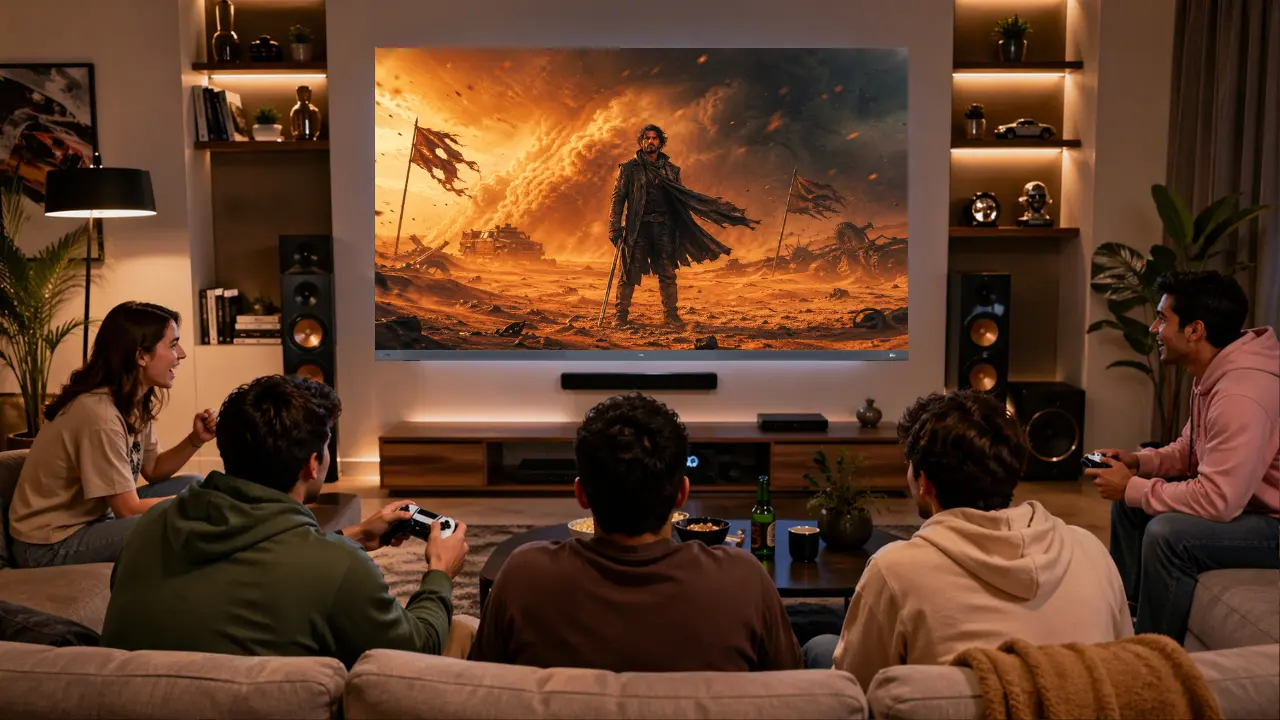

Gamers prefer 120Hz and above TVs because they deliver smoother motion, faster response, and lower input lag.
This means sharper visuals, quicker reactions, and a real competitive edge. In simple terms, higher refresh rates turn gameplay from watchable to playable.
The moment that changes everything.
It is 11:30 pm.
You are in the middle of a match. One move decides everything. You press the button.
But the screen reacts a fraction late.
You lose.
Not because you were slower.
Because your screen was.
This is where the refresh rate stops being technical and becomes personal.
What does 120Hz actually mean in real life?
Most people hear “120Hz” and think it is just a number.
It is not.
It is how often your screen updates every second.
- 60Hz TV updates 60 times per second
- 120Hz TV updates 120 times per second
- Advanced gaming TVs push even higher in game modes
That difference is visible instantly.
What changes immediately
- Motion becomes fluid instead of jumpy
- Fast scenes stay sharp instead of blurred
- Controls feel immediate instead of delayed
A simple truth:
Gaming is not about graphics. It is about timing.
And timing depends on the refresh rate.
Why 60Hz feels fine until it does not
Most Indian households still use 60Hz TVs.
For movies, it works.
For daily viewing, it works.
But gaming is different.
Gaming demands precision.
Here is how the difference plays out:
| Experience Factor | 60Hz TV | 120Hz+ TV |
| Motion clarity | Noticeable blur | Crisp motion |
| Input response | Slight delay | Near instant |
| Competitive play | Limited | High performance |
| Eye comfort | Fatigue over time | Smooth and easy |
The shift is subtle but powerful.
At 60Hz, you react to the screen.
At 120Hz, the screen reacts to you.
The hidden system behind smoother gameplay
Most people think the refresh rate alone solves everything.
It does not.
Gaming performance is a system.
The 3-part system that gamers actually experience
1. Refresh Rate
More frames per second. Less blur.
2. Variable Refresh Rate (VRR)
Syncs TV refresh rate with the console. Eliminates screen tearing.
3. Auto Low Latency Mode (ALLM)
Reduces input lag automatically during gameplay.
When these work together, the experience feels seamless.
This is why TVs like the Haier New M92 Series 164cm (65) QD Mini LED AI Smart Google TV (H65M92FUX) integrate features like 144Hz refresh rate, VRR, ALLM, and AMD FreeSync Premium Pro for smoother, tear-free gameplay.
Smooth gaming is not one feature. It is a coordinated system.
Why Indian gamers are upgrading faster than expected
Walk into a modern Indian home today.
You will notice something.
- A console connected to the TV
- A laptop plugged in for gaming
- Friends watching, reacting, sharing the moment
Gaming is no longer solo. It is social.
And that changes expectations.
Three types of gamers in today’s homes
One option is the casual gamer
Weekend FIFA or racing games
Needs smoother visuals
120Hz improves enjoyment instantly
The second option is the competitive gamer
Plays FPS or battle royale games
Needs fast reactions
120Hz is essential
The third option is the hybrid user
Works, streams, and games on the same screen
Needs performance and immersion
Different users. Same outcome.
Higher refresh rate is becoming the new baseline.
What happens inside a 120Hz gaming TV
A good gaming TV does more than refresh faster.
It processes smarter.
Modern TVs like the Haier New M92 Series 189cm (75) QD Mini LED Smart AI Google TV (H75M92FUX) use AI-powered processors to analyse scenes in real time, improving motion clarity, contrast, and depth.
What this means for gaming
- Fast-moving scenes stay sharp
- Dark areas reveal hidden details
- Bright scenes maintain balance
This is where gaming meets cinematic experience.
You are not just playing.
You are immersed.
The difference you feel, not just see
Specs explain.
Experience is convincing.
What gamers notice instantly
- Faster response to inputs
- Better control in racing and FPS games
- Natural camera movement
- Less eye strain during long sessions
And something interesting happens.
You stop noticing the TV.
Because it stops slowing you down.
The cost-benefit decision every buyer faces
Let’s simplify the decision.
Option 1: Stay with 60Hz TVs
- Lower upfront cost
- Good for casual viewing
- Limited gaming performance
Option 2: Upgrade to 120Hz TVs
- Moderate investment
- Better gaming and sports experience
- Future-ready
Option 3: Choose advanced gaming TVs (120Hz+)
- Premium investment
- Features like VRR, ALLM, AI processing
- Best for serious gamers
The trade-off is clear.
Pay once for performance, or adjust every day.
Why 120Hz TVs are future-ready
This is not just about today’s games.
It is about what comes next.
What is changing
- Next-gen consoles support 120Hz gameplay
- Streaming platforms are evolving
- Cloud gaming is growing
- Sports broadcasting is becoming smoother
Buying a 60Hz TV today limits tomorrow’s experience.
Buying 120Hz prepares you for it.
Beyond gaming: Why the whole home benefits
This is where most people underestimate the impact.
A gaming TV improves everything.
Where 120Hz makes a difference
- Cricket looks smoother
- Action movies feel more real
- Animations feel fluid
- Navigation feels faster
Premium models like the Haier New M96 Series 254cm (100) QD Mini LED AI Smart Google TV (H100M96FUX) combine 144Hz refresh rates with AI optimization and immersive audio systems for a complete home entertainment upgrade.
One upgrade.
Multiple benefits.
The deeper insight most people miss
This is not just about gaming.
It is about removing friction.
A slow screen adds delay.
A fast screen removes it.
And modern homes are moving toward faster, smoother systems everywhere.
- Faster cooling
- Faster cooking
- Faster connectivity
- Faster entertainment
The TV becomes part of that system.
So, why do gamers really prefer 120Hz and above TVs?
Because they remove delays.
Because they reward precision.
Because they match human reaction speed.
And once that gap disappears, something shifts.
You stop reacting. You start anticipating.
The final takeaway
Most buying decisions compare features.
This one compares experience.
Here is the simplest way to see it:
- 60Hz shows you the game
- 120Hz lets you play it
- 144Hz and above helps you stay ahead
And in a world where speed defines outcomes, that difference matters.
Quietly. Consistently. Every frame.
Frequently Asked Questions
I mostly play on weekends. Do I really need a 120Hz TV or is 60Hz enough for me?
If your gaming is casual, 60Hz works. But even occasional gaming feels noticeably smoother on 120Hz especially in sports and racing games. It’s less about need and more about experience.
I’m confused between saving money and getting better performance. What should I prioritize?
If gaming matters to you at all, performance wins long-term. A cheaper 60Hz TV saves money upfront but costs you experience every time you play.
Will I regret buying a 60Hz TV if I upgrade my console later?
Very likely. New consoles like PlayStation 5 and Xbox Series X support 120Hz gaming. Your TV could become the bottleneck.
Is 120Hz just hype, or is it something I’ll actually feel instantly?
You’ll feel it immediately. The difference isn’t subtle in fast-paced games, it’s the difference between reacting late and reacting on time.
Will pushing my TV at 120Hz all the time wear it out faster?
No. Modern TVs are designed to handle their rated refresh rates without affecting lifespan.
Is higher refresh rate only useful for competitive gamers?
Competitive players need it. Casual players enjoy it. Everyone benefits just at different levels.
I play FPS games. How much difference will 120Hz actually make in my reaction time?
It reduces perceived delay significantly. You see and react milliseconds faster which is often the difference between winning and losing.
Is 144Hz overkill, or should I just stick with 120Hz?
120Hz is already a big leap. 144Hz and above adds refinement ideal if you want the absolute smoothest experience.
What does AMD FreeSync actually do for my gaming experience?
AMD FreeSync synchronizes your TV and GPU output, eliminating stutter and tearing especially useful in fast-action scenes.
Are smart TVs with AI processing actually better for gaming?
Yes. TVs like the Haier M92 Series 65-inch QD Mini LED TV use AI to enhance motion clarity and contrast in real time.
I use my TV for work, Netflix, and gaming. Does 120Hz help beyond gaming?
Absolutely. Scrolling feels smoother, sports look cleaner, and movies feel more lifelike.