
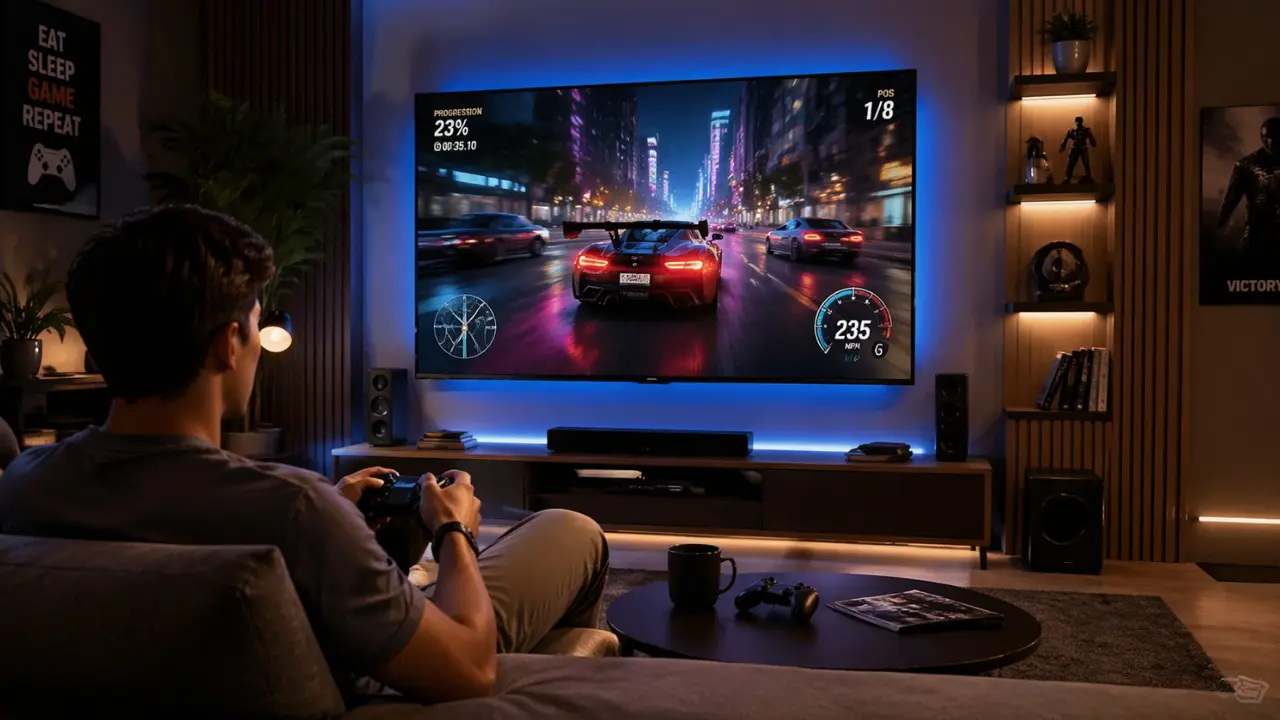

The best TV for gaming and sports is one that delivers high refresh rates, low input lag, strong motion clarity, and immersive sound.
Look for 120Hz or higher panels, HDMI 2.1 support, VRR, and Dolby Vision. These are not just features. They are what turn watching into experiencing.
What actually matters when you choose a TV for gaming and sports?
Walk into a living room during an IPL match.
One person tracks every ball.
Another is mid-game on a console.
Someone else is casually watching highlights.
Same screen. Different expectations.
And that’s where most TV decisions fail.
People buy based on resolution.
But what they actually need is responsiveness.
A great TV for gaming and sports is not about how sharp it looks. It’s about how fast it reacts.
The hidden system: Motion defines everything
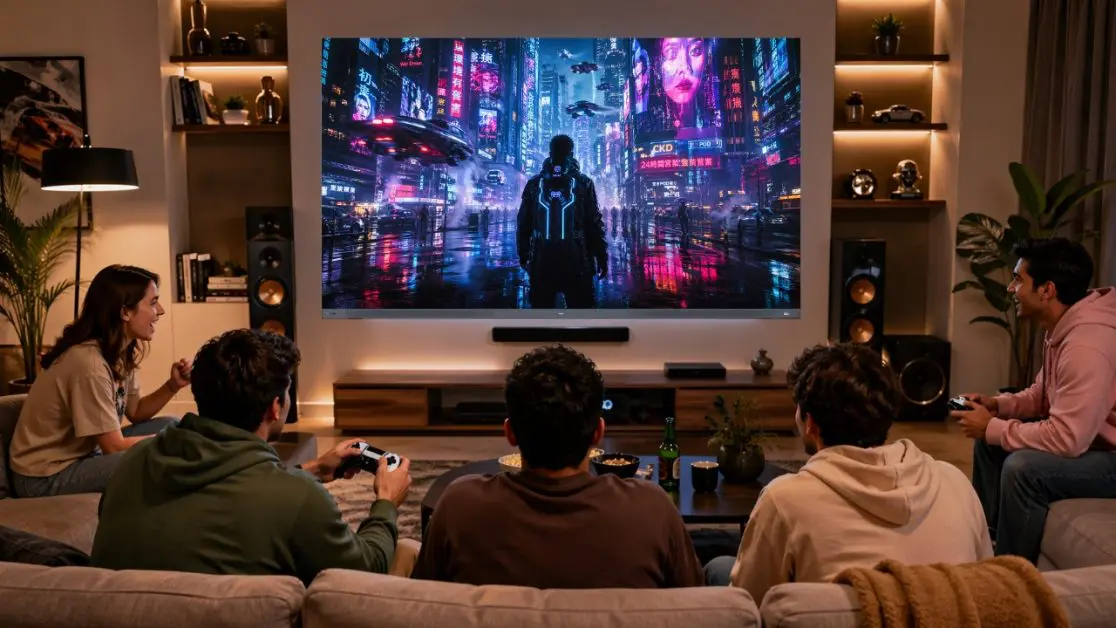
Why motion clarity matters more than 4K
A 4K TV looks impressive in a showroom.
But gaming and sports are not static.
- A fast bowler releases the ball in milliseconds
- A racing game renders frames in real time
- A football pass changes direction instantly
If your TV cannot keep up, the experience breaks.
What to prioritise for smooth motion
| Feature | What it does | Why it matters |
| 120Hz to 144Hz refresh rate | Faster frame updates | Smooth gameplay and sports |
| MEMC | Inserts extra frames | Reduces motion blur |
| DLG / motion tech | Improves clarity | Better tracking of fast action |
For example, the Haier M80F Mini LED 189cm (75) Google TV | Sound by KEF (H75M80FUX) offers DLG 120Hz specifically which works only in gaming scenarios and motion-enhancing technologies designed specifically for fast-paced content.
Clarity is not about pixels. It’s about timing.
Gaming TVs are about control, not visuals
Why responsiveness changes everything
In gaming, delay feels personal.
You press a button.
The screen responds late.
That gap decides outcomes.
Three types of gaming TV experiences
One option is basic TVs
- 60Hz panels
- No gaming optimisation
- Lower cost
- Noticeable lag
The second option is smart TVs with basic enhancements
- Some motion smoothing
- Limited gaming features
- Works for casual gaming
The third option is performance-driven gaming TVs
- HDMI 2.1
- VRR and ALLM
- FreeSync Premium support
- High refresh rate panels
The Haier New M92 Series 164cm (65) QD-Mini LED AI Smart Google TV (H65M92FUX) includes AMD FreeSync Premium Pro, VRR, and ALLM for smoother, tear-free gameplay.
A gaming TV doesn’t just display action. It keeps pace with it.
Sports viewing is about immersion, not size
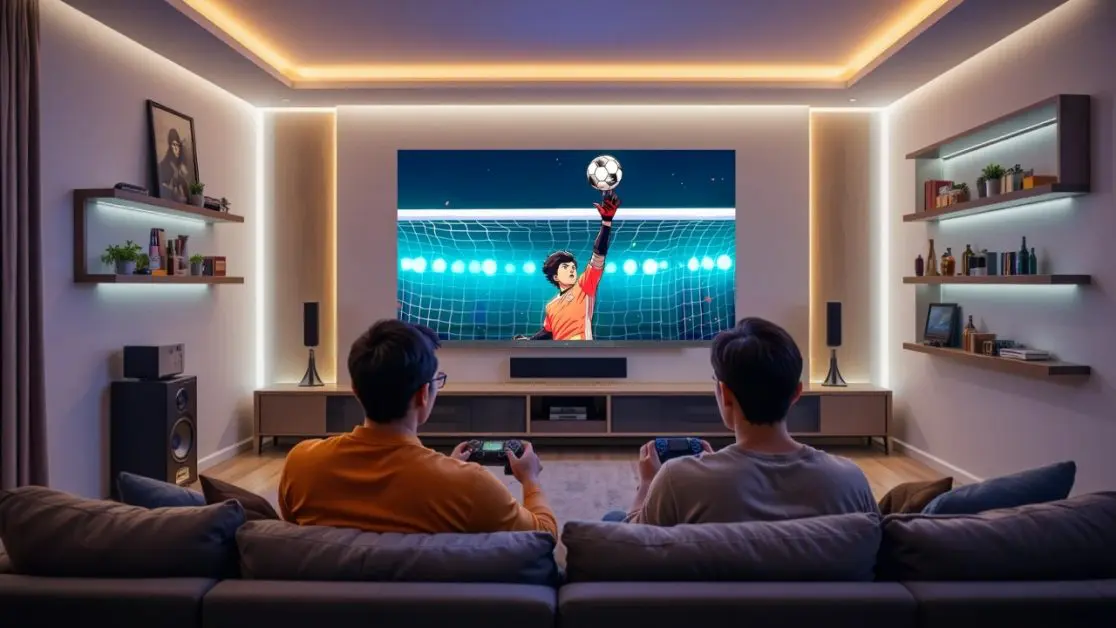
Why live matches feel different on the right TV
Think about a last-over finish.
You’re not just watching. You’re reacting.
The crowd noise rises.
The camera follows the ball.
Every frame matters.
What creates that stadium-like experience
- Wide viewing angles so everyone gets a clear view
- High brightness for daytime matches
- Deep contrast for night matches
- Balanced motion handling
Mini LED panels play a critical role here.
They offer better contrast and brightness control, making sports look sharper and more lifelike. The Haier M80F Mini LED 215cm (85) Google TV | Sound by KEF (H85M80FUX) delivers this through advanced Mini LED display technology and enhanced dimming zones.
Immersion is not about screen size alone. It’s about how real the moment feels.
Sound is the most underrated upgrade
Why audio defines the atmosphere
Close your eyes during a match.
You still feel it.
That’s the sound.
What to look for in audio performance
- Dolby Atmos support
- 2.1 channel speakers or subwoofer
- Tuned sound systems
The Haier M80F series integrates KEF-tuned audio and Dolby Atmos, delivering richer, room-filling sound that complements fast visuals.
Good sound turns watching into presence.
Display technology: Keep it simple
What actually matters in panels
You don’t need to decode every term.
You need to understand outcomes.
Three display choices that matter
One option is LED
- Affordable
- Basic contrast
- Works for general use
The second option is QLED
- Brighter colours
- Better vibrancy
- Suitable for mixed viewing
The third option is QD-Mini LED
- Deeper blacks
- Higher brightness
- Better control of highlights
The Haier New M92 Series 189cm (75) QD-Mini LED Smart AI Google TV (H75M92FUX) combines AI picture processing, HDR10+, and advanced dimming zones to enhance depth and detail in every scene.
Better panels don’t just improve visuals. They reduce visual fatigue.
Smart features shape everyday usage
Why software matters as much as hardware
Today’s TV is not just for cable.
It’s a central screen for everything.
What to prioritise in smart TVs
- Google TV interface
- Built-in Chromecast
- Voice control
- App ecosystem
Haier TVs come with Google TV, offering personalized recommendations and easy access to streaming platforms.
A smart TV should simplify choices, not complicate them.
Screen size is a function of distance
Why most homes choose smaller than they should
A TV that feels big in a store feels average at home.
Distance changes perception.
A simple size guide
| Room size | Recommended TV size |
| Compact room | 43 to 55 |
| Standard living room | 55 to 65 |
| Large living room | 75 and above |
Larger screens, especially 75 and above, create a more immersive experience for both gaming and sports.
The decision framework that actually works
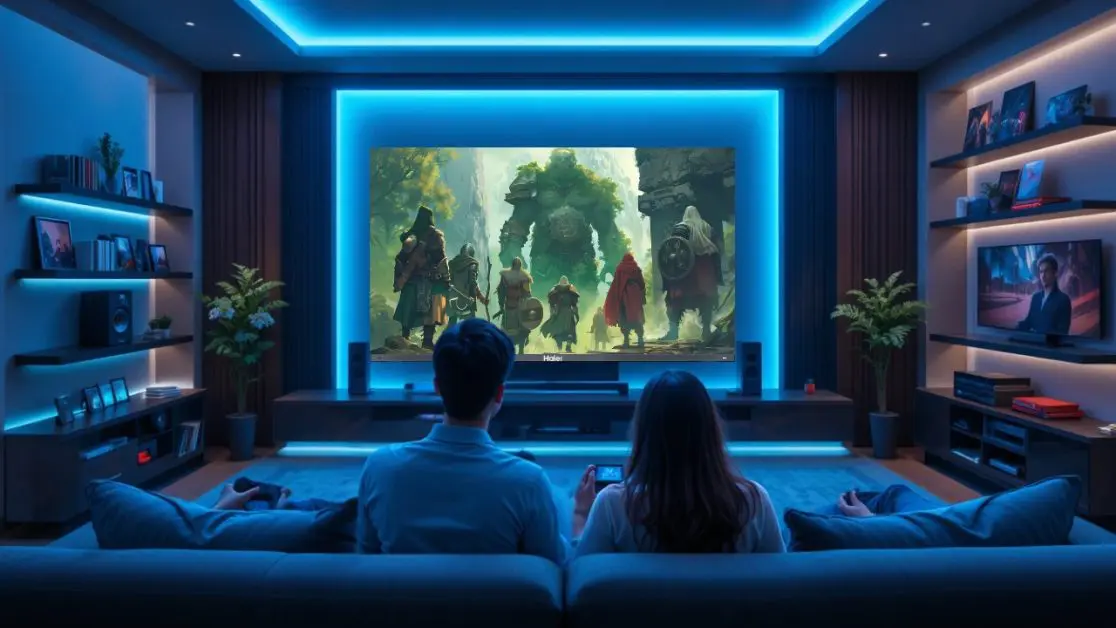
Don’t buy a TV. Choose your primary use
Every buyer falls into one of three categories.
Three real-world scenarios
1. Sports-first households
- Prioritise brightness and motion clarity
- Go for Mini LED and 120Hz
2. Gaming-focused users
- Prioritise responsiveness and latency
- Look for HDMI 2.1, VRR, 144Hz
3. Balanced usage homes
- Prioritise all-round performance
- Choose strong audio, smart features, and stable motion
What this really means
Most people optimize for price.
But the real metric is experience per hour.
You will spend hundreds of hours on this screen.
Late-night matches. Weekend gaming. Family movie time.
A TV is not a product. It’s a daily environment.
The final insight
People think they are choosing between brands.
They are actually choosing between experiences.
- A delayed screen vs an instant response
- A flat image vs a lifelike moment
- Background noise vs immersive sound
The best TV for gaming and sports doesn’t just show action.
It moves with it.
Frequently Asked Questions
I’m overwhelmed by specs. What really matters when I choose a TV for gaming and sports?
Focus on motion and responsiveness, not just resolution. A 4K TV won’t feel smooth if it has low refresh rates or high input lag. Prioritise:
120Hz+ refresh rate
HDMI 2.1
VRR (Variable Refresh Rate)
Low input lag
These directly impact how fluid gameplay and sports look.
Should I prioritise 4K resolution or refresh rate for my usage?
If you watch sports or play games, the refresh rate matters more than 4K. Motion clarity determines whether you can track fast action smoothly.
Why does sports look blurry on my current TV even though it’s 4K?
Because motion handling is weak. A 60Hz panel can’t keep up with fast-moving objects, causing blur during cricket, football, or racing scenes.
Does higher refresh rate actually improve gaming performance?
Yes. A 120Hz or 144Hz panel reduces motion blur and improves responsiveness, making gameplay smoother and more competitive.
Will a better processor improve my experience?
Yes. AI picture processing improves:
Motion clarity
Upscaling quality
Scene transitions
This matters especially for sports and streaming.
Why do TVs feel smaller at home than in stores?
Because viewing distance changes perception. At home, you sit farther away, making screens feel smaller.
Why does sound matter so much for live matches?
Sound creates atmospheric crowd noise, commentary, and ambient effects make you feel present in the moment.