
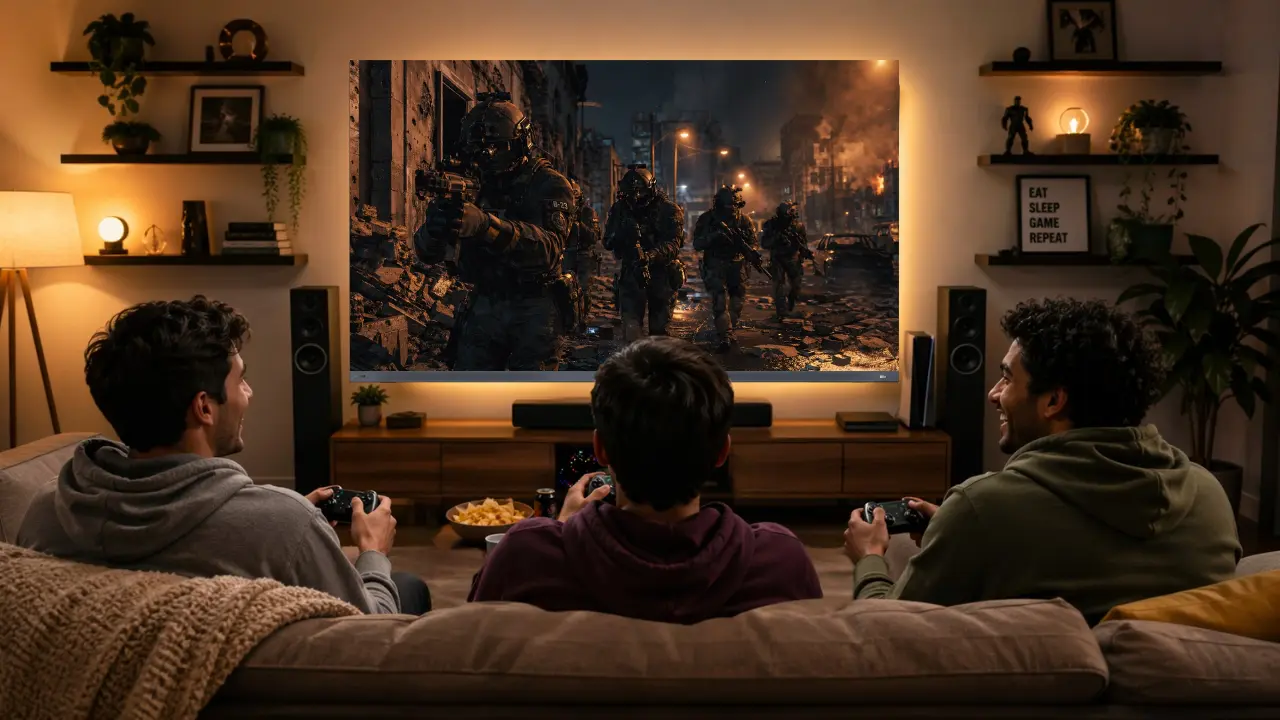

The right gaming TV is not about size or price. It’s about speed, sync, and how intelligently the screen responds.
A great gaming TV delivers three things without compromise: high refresh rate, low latency, and adaptive synchronisation. Everything else builds on this foundation. If your screen cannot keep up with your reflexes, nothing else matters.
Why do most TVs feel off for gaming, even if they look premium?
Picture this.
Late evening.
You finally sit down after a long day.
Controller in hand.
The game looks stunning. But something feels delayed.
You press. The action follows… slightly late.
Fast motion blurs. Shadows lose detail.
You cannot explain it.
But you can feel it.
Gaming TVs are not about better visuals. They are about eliminating delay between intent and action.
That’s the invisible system at play.
What actually defines a gaming TV today?
A gaming TV is not just a display. It is a real-time response system.
Here’s the core stack that makes it work:
| Feature | What It Does | Why It Matters |
| Refresh Rate (120Hz, 144Hz) | Updates frames faster | Smooth gameplay |
| Low Input Lag | Reduces delay | Faster reactions |
| VRR | Matches frame output | No tearing |
| ALLM | Auto game mode | No manual switching |
| HDMI 2.1 | High bandwidth | Supports next-gen consoles |
Anything below this baseline starts to feel outdated.
1. Refresh rate defines how fluid your game feels
Motion clarity is performance, not decoration.
A 60Hz screen shows 60 frames per second.
A 144Hz screen shows more than double.
That difference is not subtle.
- Racing feels controlled
- FPS becomes sharper
- Motion blur reduces significantly
For example, the Haier New M92 Series 164cm (65) QD Mini LED AI Smart Google TV (H65M92FUX) offers a 144Hz refresh rate designed for high-speed content
Here’s the insight most people miss:
Higher refresh rate does not just look smoother. It lets you react sooner.
2. Low latency is the silent deal-breaker
Latency is delayed.
And delay kills momentum.
Let’s simplify:
- Above 80ms feels sluggish
- Around 40ms is playable
- Below 20ms feels instant
Modern gaming TVs use ALLM to switch automatically into low-latency mode.
No menus. No setup.
Low latency turns gameplay from reactive to instinctive.
3. VRR and AMD FreeSync make gameplay seamless
Ever seen that horizontal split on screen during fast motion?
That’s tearing.
It happens when the console and TV are out of sync.
Variable Refresh Rate (VRR) fixes this in real time.
Premium TVs like the Haier New M92 Series 189cm (75) QD Mini LED Smart AI Google TV (H75M92FUX) include AMD FreeSync Premium Pro for:
- Tear-free visuals
- Smooth transitions
- Stable frame pacing
When sync improves, immersion follows.
4. Picture quality is about precision, not just brightness
Most buyers chase 4K and HDR.
Gamers need something deeper.
Control.
Look for:
- Mini LED with local dimming zones
- HDR10+ and Dolby Vision IQ
- High brightness for clarity
The Haier New M96 Series 254cm (100) QD Mini LED AI Smart Google TV (H100M96FUX) features thousands of dimming zones and high brightness levels for enhanced contrast control
This means:
- Dark scenes stay detailed
- Highlights remain sharp
- Visual depth improves
Gaming is not about brighter screens. It’s about smarter light control.
5. AI processing is what separates good from exceptional
Two TVs can show the same resolution.
One still looks better.
Why?
Processing intelligence.
The AI Ultra Sense Processor in Haier TVs recognises scenes and adjusts:
- Contrast
- Colour
- Motion
- Depth
This happens in real time.
AI does not add features. It removes visual errors before you notice them.
6. Audio turns gameplay into an experience
Visuals attract.
Sound immerses.
Look for:
- Dolby Atmos
- Multi-channel speakers
- Dedicated subwoofers
For instance, advanced setups like the H100M96FUX include multi-layered sound systems that create a spatial audio field
This results in:
- Directional sound awareness
- Richer environments
- Better in-game cues
You don’t just see the game. You feel it around you.
7. Connectivity decides how future-ready your TV is
Gaming is evolving fast.
Your TV needs to keep up.
Essential connectivity includes:
- HDMI 2.1
- Bluetooth 5.2
- High-speed WiFi
Without HDMI 2.1, you miss:
- 4K at 120Hz
- VRR support
- Faster response rates
Connectivity is not about today’s console. It’s about tomorrow’s upgrade.
8. Smart ecosystem is no longer optional
Today’s Indian homes expect more from a TV.
It is not just for gaming.
It’s where:
- OTT streaming happens
- Voice control simplifies navigation
- Smart devices connect
Google TV platforms bring:
- Personalised recommendations
- Seamless app switching
- Voice-enabled control
The TV becomes the center of your digital life. Not just your entertainment.
How to choose based on your gaming style
Different gamers. Different priorities.
One option is casual gaming
- Story-driven titles
- Weekend play
Focus on:
- Good HDR
- Smooth display
- Smart features
The second option is competitive gaming
- FPS and racing
- Quick reflex gameplay
Focus on:
- 144Hz refresh rate
- Low latency
- VRR and FreeSync
The third option is immersive gaming
- Open-world exploration
- Cinematic storytelling
Focus on:
- Large screen size
- Mini LED technology
- Dolby Vision and Atmos
What most people get wrong when buying a gaming TV
They optimize for size.
And ignore performance.
Here’s what that leads to:
| Mistake | Outcome |
| Bigger screen only | Lag ruins experience |
| Ignoring refresh rate | Motion feels choppy |
| Skipping VRR | Screen tearing |
| Weak audio | Low immersion |
A gaming TV is a system. Not a single feature.
Where Haier gaming TVs stand today
There’s a clear shift in how Indian households choose TVs.
It’s no longer about watching.
It’s about experiencing.
Models like:
- Haier New M92 Series 164cm (65) QD Mini LED AI Smart Google TV (H65M92FUX)
- Haier New M92 Series 189cm (75) QD Mini LED Smart AI Google TV (H75M92FUX)
- Haier New M96 Series 254cm (100) QD Mini LED AI Smart Google TV (H100M96FUX)
bring together:
- High refresh rates
- AI-powered optimisation
- Premium audio systems
- Advanced gaming features
into one cohesive system.
You can explore them here:
The one insight that changes how you choose
People think better TVs mean better visuals.
That’s incomplete.
Better TVs reduce friction.
- Less delay
- Less blur
- Less effort
More flow.
And that is what modern gaming demands.
Technology that disappears.
Experience that stays.
Choose for that.
Everything else follows.
Frequently Asked Questions
I’m overwhelmed with specs. What actually matters in a gaming TV?
You only need to focus on three core things: high refresh rate (120Hz+), low input lag (below 20ms), and VRR support. Everything else enhances the experience, but these define it.
Should I prioritise size or performance for gaming?
Performance wins. A bigger screen with lag feels worse than a smaller screen that responds instantly.
Is a 4K TV enough for gaming, or am I missing something?
4K alone isn’t enough. Without high refresh rate and low latency, 4K just looks sharp but feels slow.
Why does my expensive TV still feel slow while gaming?
Because premium pictures ≠ fast response. Without low input lag and ALLM, even high-end TVs feel delayed.
I feel a slight delay when I press buttons. Is that normal?
Yes on regular TVs. No on gaming TVs. That delay is input lag, and it breaks immersion.
Why does motion blur bother me more during games than movies?
Games are interactive. Your brain expects instant response. Blur disrupts your control, not just visuals.
Should I sacrifice picture quality for faster performance?
No. Modern TVs (like Mini LED models) deliver both fast response and precise lighting control.
Is a higher refresh rate always better?
Up to 144Hz, yes especially for FPS and racing games. Beyond that, gains are minimal unless you’re a pro gamer.
Does VRR really make a difference or is it just marketing?
It’s very real. VRR eliminates screen tearing and keeps motion smooth when frame rates fluctuate.
What does AI actually do in a gaming TV?
It adjusts contrast, colour, and motion in real time to reduce visual errors and improve clarity.
Is Google TV useful for gamers or just for streaming?
Both. It centralises apps, supports voice control, and integrates your entertainment ecosystem.
Do smart features slow down gaming performance?
No, not if the TV has ALLM. It automatically switches to game mode when needed.