
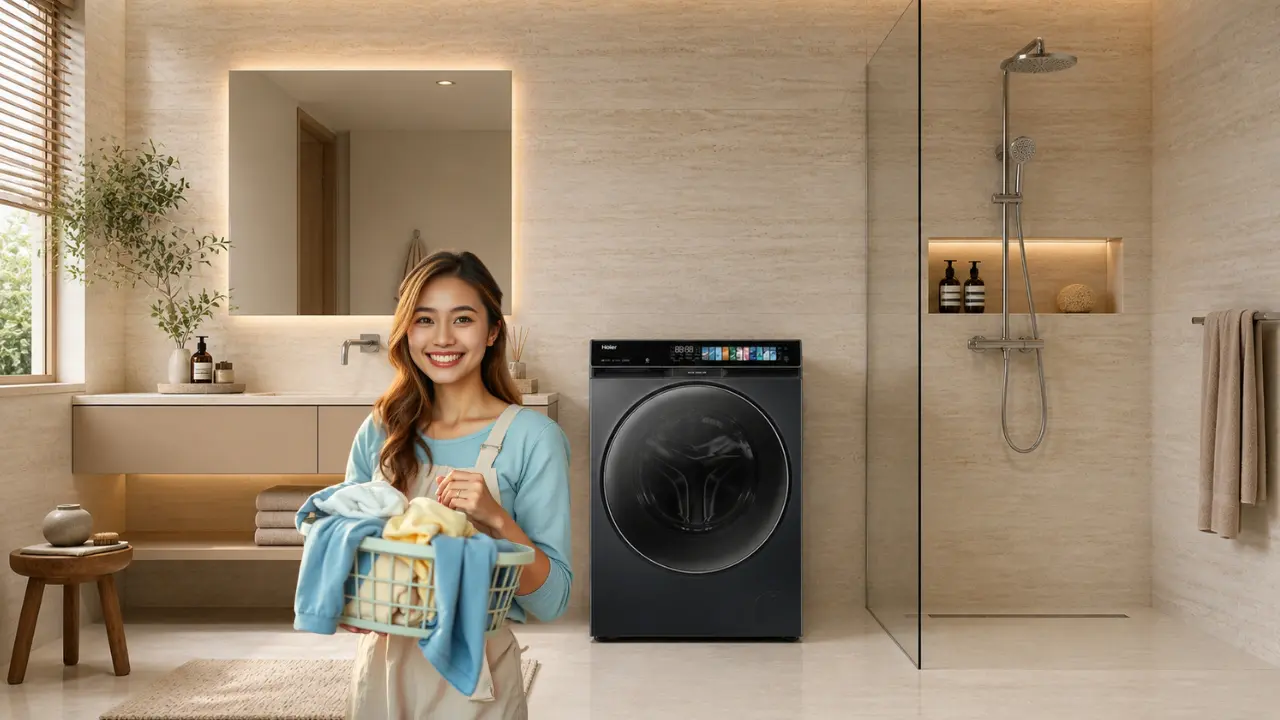

Front load washing machines develop a damp smell because moisture gets trapped inside the drum, rubber gasket, and detergent drawer.
This creates the perfect environment for bacteria and mould to grow, especially in humid Indian homes where airflow is limited.
It starts with a familiar moment.
You pull out freshly washed clothes.
They look clean.
They feel clean.
But something feels… off.
A faint smell. Damp. Slightly sour. Like clothes that never fully dried during the monsoon.
And suddenly, the entire point of washing feels defeated.
This isn’t a rare problem. In fact, studies suggest that over 60 percent* Front load washing machine users experience odor issues within the first year. In India, with high humidity in cities like Mumbai and Chennai, this number climbs even higher.
The machine meant to clean becomes the source of discomfort.
Not because it fails.
But because it follows its design too well.
Front load machines are efficient. That’s also the problem
Front load washing machines are built for efficiency.
They use less water.
They clean better.
They consume less energy.
But efficiency comes with a hidden trade-off.
Less water means less rinsing.
Sealed doors mean less airflow.
Faster cycles mean less natural drying.
The result is simple.
A closed, damp environment where residue slowly builds up.
Efficiency without ventilation creates stagnation.
Where exactly does the smell come from?
The smell is not random. It has a pattern.
It builds layer by layer, like dust in a forgotten corner.
The three hidden zones where odor lives
- The rubber gasket
That thick ring around the door traps water after every wash.
Add lint and detergent residue. It becomes a perfect breeding space. - The detergent drawer
Liquid detergent leaves behind a sticky film.
Over time, bacteria settle and grow. - The drum interior
Even stainless steel holds microscopic moisture.
Without drying, this becomes a long-term problem.
Studies show that bacteria can begin forming within 24 to 48 hours in moist environments.
So the smell is not about one bad wash.
It is about what stays behind after every wash.
The real culprit is not dirt. It’s leftover moisture.
Most people blame dirty clothes.
But that is not the core issue.
The real problem is what does not leave the machine.
- Residual water
- Detergent buildup
- Fabric softener film
Think of a towel left folded in a humid bathroom.
It was clean once.
But without air, it changes.
The same system applies here.
Clean does not stay clean without circulation.
Why this problem feels worse in Indian homes
Climate plays a silent role.
India’s indoor humidity often crosses 70 percent during monsoon months.
That changes everything.
- Clothes dry slower
- Machines stay damp longer
- Utility spaces have limited ventilation
A front load washing machine in a closed balcony or bathroom becomes a moisture trap.
Especially in compact urban homes.
The environment completes the problem the machine begins.
So what can you actually do about it?
There isn’t just one solution.
There are three clear paths. Each comes with its own cost and benefit.
Option 1: Change your usage habits
This is the simplest fix.
- Keep the door slightly open after every wash
- Wipe the gasket dry
- Run a hot wash cycle weekly
- Avoid excess detergent
Cost: Zero
Effort: High consistency
Benefit: Reduces odor if done regularly
The challenge is simple.
Consistency is hard to maintain.
Option 2: Use cleaning cycles and maintenance routines
Modern machines offer drum clean cycles.
These help remove buildup at regular intervals.
- High temperature removes residue
- Cleaning cycles reduce bacteria
- Monthly maintenance keeps odor in control
Cost: Low
Effort: Moderate
Benefit: Periodic deep cleaning
But here is the limitation.
Cleaning once a month does not fix daily moisture buildup.
It treats the result. Not the cause.
Option 3: Choose machines designed to prevent damp smell
This is where design changes the outcome.
Some washing machines are now built to solve the root issue.
Take the Haier 12 Kg F11 Front Load Washer Washing Machine (HW120-DM14F11BKU1) and the Haier 12 Kg F11 Front Load Washer and Dryer Washing Machine (HWD120-DM14F11BKU1).
These models introduce Ultra Fresh Air Technology, which keeps the drum ventilated for up to 12 hours after the wash cycle
Instead of trapping moisture, the machine actively removes it.
- 360 degree micro pressure air circulation
- Drum refreshed every 2 minutes
- Continuous airflow even after the cycle ends
This changes the system completely.
From passive drying
To active freshness
Cost: Higher upfront investment
Effort: Minimal
Benefit: Prevents odor at the source
A simple comparison that clarifies everything
| Approach | Effort Required | Effectiveness | Long Term Outcome |
| Manual habits | High | Moderate | Depends on consistency |
| Cleaning cycles | Medium | Moderate to High | Temporary relief |
| Built-in freshness technology | Low | High | Continuous prevention |
The bigger insight most people miss
This is not just about washing machines.
It is about how modern homes operate.
We design for efficiency.
We reduce airflow.
We optimize for speed.
We forget long-term behaviour.
And then systems start responding.
The damp smell is not a failure.
It is feedback.
Every closed system needs a way to breathe.
What this means for how you choose appliances
Most people look at features.
Capacity. Spin speed. Energy ratings.
All important.
But one question matters more over time.
What happens after the wash cycle ends?
- Does the machine dry itself?
- Does it prevent moisture buildup?
- Does it adapt to humid environments?
Because appliances are not occasional tools.
They are daily systems.
A small shift that changes everyday life
Imagine this.
You run a wash late at night.
You forget to take clothes out.
Morning comes.
No smell. No dampness. No rewash.
Just fresh clothes.
That is not just convenience.
That is friction removed from daily life.
The one insight worth remembering
Front load washing machines do not create bad smells.
They allow moisture to stay.
And anything that stays damp long enough will start to smell.
So the real shift is simple.
Do not focus on removing the smell.
Focus on removing the moisture.
Get that right, and the problem disappears before it begins.
Frequently Asked Questions
I’m buying a new washing machine. How do I make sure I don’t face this smell issue later?
Look beyond basic specs like capacity and spin speed. Focus on what happens after the wash cycle: does the machine ventilate itself or trap moisture? Machines with built-in airflow or drying systems prevent odor at the source instead of relying on maintenance.
I feel overwhelmed when comparing washing machines. What actually matters long-term?
Long-term hygiene matters more than short-term performance. A machine that prevents moisture buildup saves you from repeated cleaning, rewashing clothes, and odor issues.
Should I spend more money upfront to avoid this problem?
If you value convenience and consistency, yes. Manual habits cost nothing but require discipline. Advanced machines cost more but remove the burden entirely.
Are there washing machines that actually prevent this smell automatically?
Yes. Some modern machines use airflow systems to keep the drum dry after each cycle, preventing moisture buildup entirely.
What is ‘Ultra Fresh Air Technology’ and does it really work?
It circulates air inside the drum for hours after the wash cycle, actively removing moisture instead of letting it sit.
I often forget to take clothes out. Can a machine solve that problem?
Advanced machines can keep the drum ventilated, so even if clothes sit overnight, they stay fresh.