
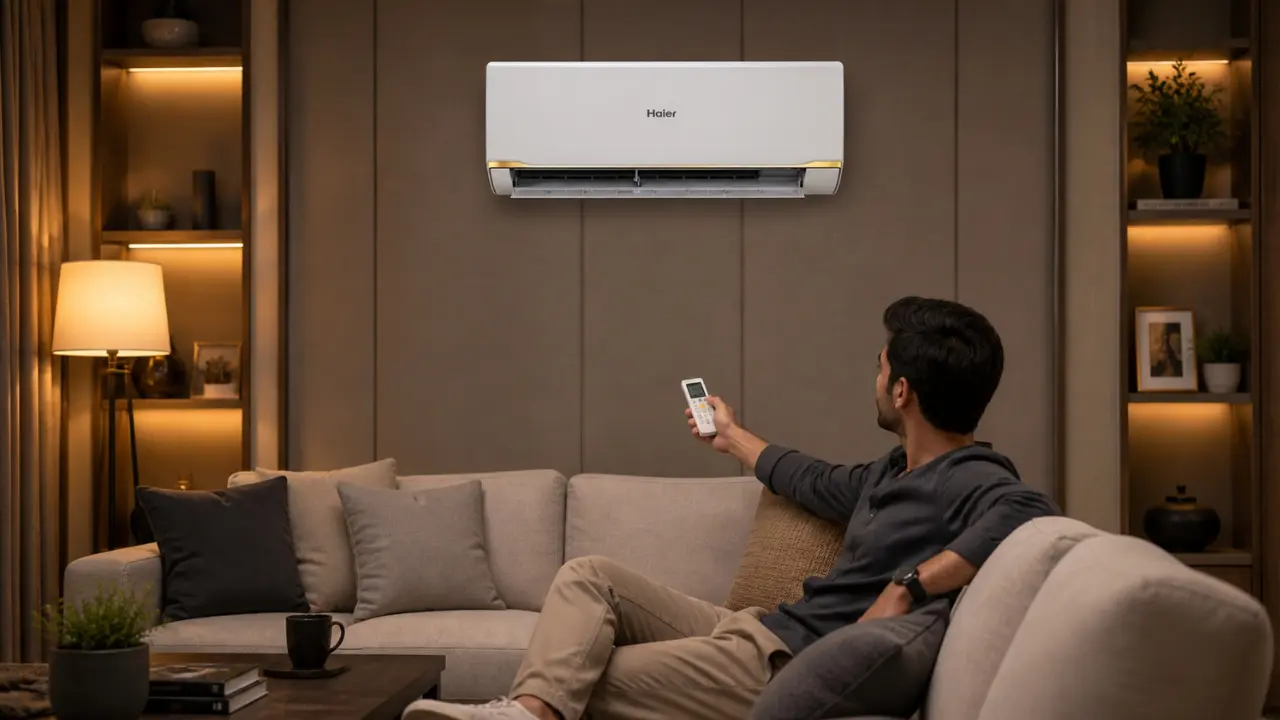

AI in air conditioners learns user behaviour by observing patterns like temperature preferences, usage timing, occupancy, and environmental conditions.
Over time, it uses this data to predict your needs, optimise cooling automatically, and reduce energy waste. The result is simple. The AC stops waiting for instructions and starts understanding you.
The 10:45 PM moment that explains everything.
It is late.
You walk into your room after a long day. The air feels heavy. You switch on the AC. Adjust the temperature. Lower the fan.
Three decisions. Every night.
Now imagine this.
The AC already knows.
It cools the room before you enter. It sets the temperature you prefer. It slows down when you fall asleep.
No buttons. No thinking.
Just comfort.
That shift is not about features. It is about learning.
AI in ACs Is Not About Cooling. It Is About Patterns
Most people believe an air conditioner works on commands.
Set temperature. Choose mode. Done.
That is the old system.
The new system observes.
It tracks:
- What time you switch it on
- Which temperature you settle on
- How often you change settings
- How long the AC runs
Over time, these are no longer actions.
They become patterns.
And patterns are predictable.
A smart AC does not wait for instructions. It recognises habits.
How AI Learns User Behaviour Step by Step
1. It Watches Without Interrupting
AI systems begin quietly.
They collect behavioural signals such as:
- Temperature changes
- Mode switches
- Fan speed adjustments
- Daily usage timing
In models like the Haier 1.8 Ton 5 Star Desert Rose Air Conditioner (HSA20DSD-NAI5NB-I), AI-powered systems continuously analyse your environment and usage habits to deliver smarter comfort
Insight:
Learning starts with observation, not interference.
2. It Connects Behaviour With Environment
Preferences do not exist in isolation.
They change with context.
AI connects behaviour with:
- Outdoor temperature
- Indoor humidity
- Room occupancy
- Time of day
For example:
- You prefer 24°C at night during peak summer
- But 26°C early morning when the air cools naturally
Same user. Different conditions.
System truth:
Comfort is not fixed. It adapts to context.
3. It Builds a Predictive Model
After enough data, the system starts predicting.
It anticipates:
- When you will switch on the AC
- What settings you will choose
- How long you will use it
Features like AI Human Detection in the Haier 1.8 Ton 5 Star Desert Rose Air Conditioner (HSA20DSD-NAI5NB-I) ensure cooling only happens when someone is present, eliminating unnecessary energy use
A simple truth:
Prediction reduces effort. Anticipation removes it.
4. It Adjusts in Real Time
Learning is not static.
It evolves constantly.
If:
- The room fills up
- The outside temperature spikes
- Your routine shifts
The system adapts instantly.
For example, AI systems automatically shift to energy-saving modes when consumption rises, helping reduce power usage significantly
Three Ways People Experience AI Learning in ACs
Different lifestyles create different learning patterns.
One option is: The Routine User
- Fixed schedule
- Same temperature daily
Outcome:
The AC becomes predictable. It runs without intervention.
The second option is: The Flexible User
- Adjusts temperature frequently
- Uses multiple modes
Outcome:
The system learns ranges instead of fixed settings.
The third option is: The Efficiency-Focused User
- Uses eco modes
- Switches off frequently
Outcome:
The AC prioritises energy savings and optimised cycles.
Insight:
AI does not change your behaviour. It reflects it.
What Exactly Does AI Track and Learn?
Here is a simple breakdown:
| Behaviour Signal | What It Means | AI Response |
| Temperature changes | Comfort preference | Sets default temperature |
| Usage timing | Daily routine | Pre-cools room |
| Fan speed changes | Airflow comfort | Adjusts airflow automatically |
| Presence detection | Occupancy awareness | Stops cooling empty rooms |
| Energy spikes | High consumption | Switches to eco mode |
The Hidden System Most People Miss
An AI AC solves three problems simultaneously:
1. Comfort Optimisation
Maintains consistent cooling without constant input.
2. Energy Efficiency
Reduces wastage by aligning cooling with real usage.
3. Decision Reduction
Eliminates repetitive choices.
Most appliances solve one.
AI systems solve all three.
Aphorism:
The smartest machine is the one that asks the least from you.
Why This Matters in Indian Homes
Indian homes are dynamic environments.
- Summers cross 45 to 50 degrees
- Multiple people share spaces
- Usage patterns shift daily
A static AC struggles here.
An adaptive system thrives.
Models like the Haier 1.8 Ton 5 Star Gold Desert Rose Air Conditioner (HSA20DSD-GAI5NB-I) are built to handle extreme conditions while continuously optimising performance through AI-driven learning
That matters.
Because comfort in India is not optional.
It is essential.
Where Haier’s AI Approach Feels Different
Some ACs react.
Others learn.
Haier’s AI systems, powered by advanced platforms like AI Atmox, combine:
- Behaviour tracking
- Environmental sensing
- Predictive intelligence
This creates a loop:
Observe → Learn → Predict → Optimise
Add features like:
- Convertible cooling from 40 percent to 110 percent capacity
- Smart app and voice control
- Self-cleaning for sustained efficiency
And the AC becomes more than a device.
It becomes a system.
Costs and Benefits of AI Learning in ACs
Benefits
- Minimal manual adjustments
- Consistent comfort
- Lower electricity consumption
- Smarter long-term performance
Costs
- Higher upfront investment
- Initial learning phase
- Reliance on smart systems
Trade-off insight:
You pay once for intelligence. You benefit every day from convenience.
The Bigger Shift: From Control to Trust
Earlier, appliances needed control.
Now, they build trust.
You stop adjusting settings.
The system takes over.
And slowly, the effort disappears.
So What Changes for You?
You stop thinking about temperature.
You start experiencing comfort.
You stop evaluating features.
You start noticing ease.
And that is the real transformation.
The One Insight That Stays
The future of cooling is not faster machines. It is a smarter understanding.
When an air conditioner learns how you live, it becomes part of your routine.
And once that happens, comfort stops being something you manage.
It becomes something that simply exists.
Frequently Asked Questions
Why do I have to adjust my AC settings every single night?
Because traditional ACs rely entirely on manual input. AI-powered ACs reduce this repetition by learning your habits like your preferred temperature at night and automating those decisions over time.
Can my AC really learn my routine, or is that just marketing?
It can. AI systems track patterns like when you turn the AC on, what temperature you choose, and how long you use it. Over time, it builds a predictive model to automate those choices.
Will an AI AC start cooling my room before I even enter?
Yes if it has learned your routine. For example, if you usually turn it on at 10:45 PM, it may begin pre-cooling just before that time.
I’m tired after work. Can my AC just “know” what I want?
That’s the goal. AI reduces decision fatigue by anticipating your preferences, so you don’t have to think about settings every day.
Do I still need a remote if my AC has AI?
Not always. Many AI ACs support app and voice control via platforms like Google Home or Amazon Alexa, reducing the need for manual input.
What makes Haier’s AI ACs different from others?
Models like the Haier 1.8 Ton 5 Star Desert Rose Air Conditioner (HSA20DSD-NAI5NB-I) use platforms like AI Atmox to combine behaviour tracking, environmental sensing, and predictive intelligence for more personalised cooling.
Can I still override the AI if I want?
Absolutely. You can always manually adjust settings and the AI will learn from those changes too.