
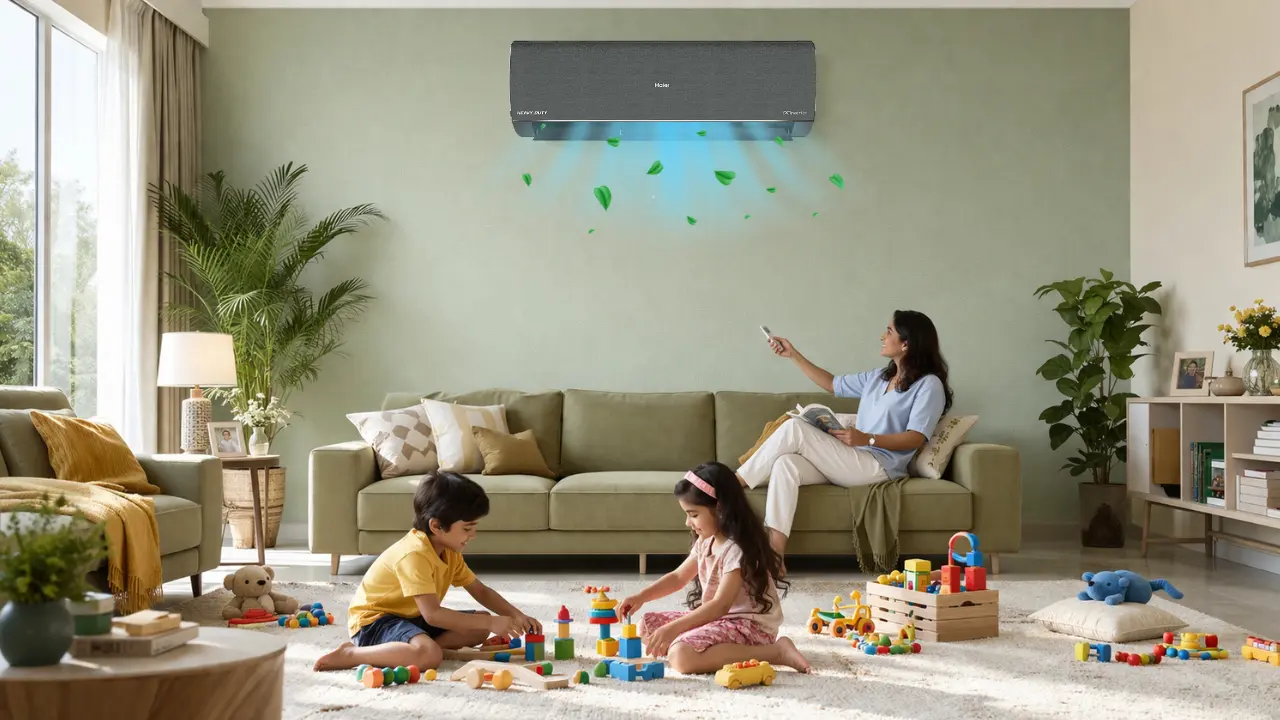

AI air conditioners are the backbone of modern smart homes because they do more than cool a room.
They observe, learn, adapt, and optimize comfort, energy use, and air quality in real time. In a connected home, the AC stops being a machine and becomes a decision-maker.
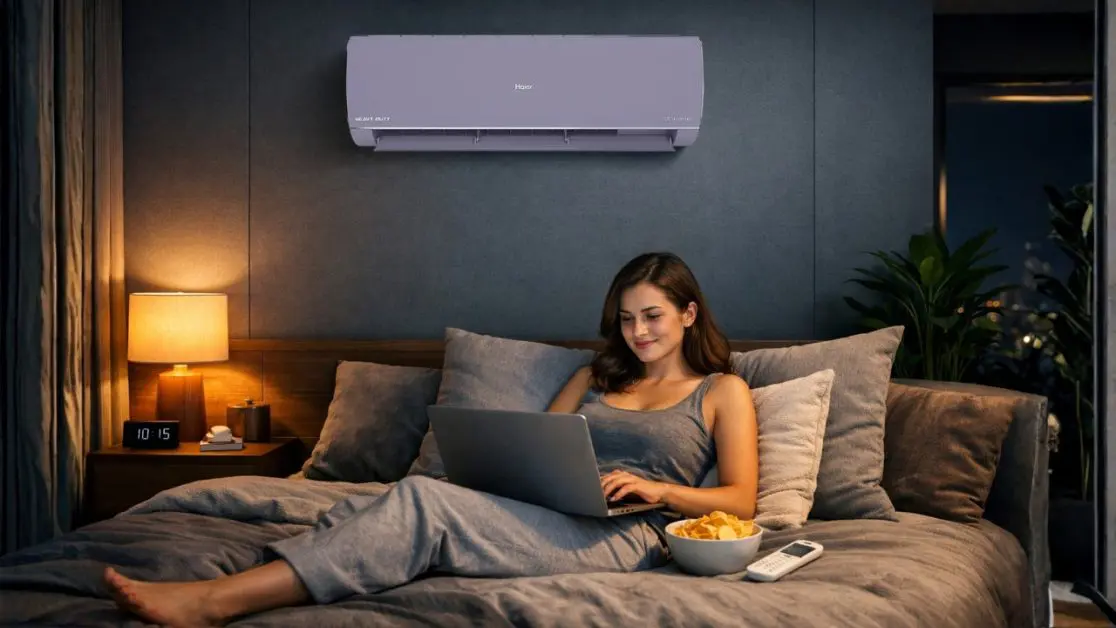
The 9:45 PM moment that explains smart homes.
You walk into your bedroom.
The lights dim slightly. The fan slows down. The AC adjusts before you even reach the remote.
No commands. No settings. No friction.
Just comfort.
This is not automation.
This is anticipation.
Smart homes are not about controlling devices. They are about removing decisions.
And AI air conditioners sit right at the centre of that shift.
What Is a Smart Home, Really?
Most people imagine a smart home as a collection of connected devices.
That is incomplete.
A smart home is a system that learns patterns and reduces effort.
The three layers of a true smart home:
- Connectivity
Devices talk to each other. Phones control appliances. - Automation
Pre-set routines run without manual input. - Intelligence
Systems learn behaviour and make decisions independently.
Most homes today sit between stage one and two.
AI air conditioners push homes into stage three.
That is where things change.
Why Air Conditioners Define the Smart Home Experience
Not every appliance runs all day.
An AC does.
Not every appliance impacts your body.
An AC does.
Temperature affects sleep, productivity, mood, and even health.
That makes the AC a high-frequency decision system.
And high-frequency systems benefit the most from intelligence.
A simple insight:
The more often you interact with something, the more valuable automation becomes.
How AI Air Conditioners Actually Work
AI in air conditioners is not a buzzword. It is a system of continuous inputs and outputs.
What an AI AC observes:
- Room temperature changes
- Outdoor weather conditions
- Time of day
- User preferences over time
- Energy consumption patterns
For example, systems like Haier 1.6 Ton 5 Star Gravity AI Air Conditioner (HSA19GHD-WAI5NB-I) analyse real-time conditions and usage habits to deliver adaptive cooling without manual intervention
This is not control.
This is learning.
The Three Jobs of an AI Air Conditioner

Most people think ACs have one job.
Cooling.
That is outdated thinking.
1. Comfort Management
An AI AC adjusts temperature based on usage patterns.
- Afternoon heat spike
- Evening relaxation
- Night-time sleep
It adapts without instructions.
Comfort becomes continuous, not reactive.
2. Energy Intelligence
Electricity bills are no longer a surprise.
AI systems track consumption and optimize usage.
- Detects overuse
- Switches to energy-saving modes
- Reduces wastage automatically
Advanced AI systems can deliver up to 56% energy savings by shifting to eco modes intelligently
That is not just efficiency.
That is awareness built into the appliance.
3. Self-Maintenance and Longevity
Maintenance used to be reactive.
Now it is proactive.
- Indoor and outdoor units clean themselves
- Dust and debris removal improves performance
- Efficiency stays consistent over time
Features like ODU Cyclone Clean reverse fan motion post Switchoff to remove debris from the condenser
The implication is simple:
The machine takes care of itself so you do not have to.
Three Ways People Use Smart ACs Today
Not every home uses AI the same way.
The difference lies in intent.
One option is: Manual-first homes
- Remote control usage
- Fixed temperature settings
- Limited automation
Cost: Low effort to start
Trade-off: High long-term inefficiency
The second option: Scheduled automation homes
- Timers for sleep and wake cycles
- Pre-set cooling patterns
Cost: Setup time required
Benefit: Predictable comfort
The third option: AI-driven homes
- Behaviour-based cooling
- Real-time adjustments
- Energy monitoring
Cost: Slightly higher upfront investment
Benefit: Maximum comfort with minimum thinking
Most modern Indian homes are moving from option two to three.
Because life is getting busier.
Why This Shift Matters in Indian Homes
Indian households are not static.
They are dynamic systems.
- Multiple people sharing spaces
- Frequent temperature changes
- Long summers and extreme heat
An AC that does not adapt becomes a friction point.
An AI AC becomes a stabiliser.
Consider this:
- Cooling performance at temperatures as high as 60°C ensures reliability during peak Indian summers
- 20 metre air throw distributes cooling across larger living spaces
- Convertible modes allow capacity adjustments from 40% to 110%
These capabilities are built into models like Haier 1.6 Ton 5 Star Gravity AI Series Heavy Duty AC, Model (HSA19GHD-SAI5NB-I)
This is not feature stacking.
This is designing for real life.
What Most People Get Wrong About Smart Homes
They focus on control.
Apps. Voice commands. Remote access.
But control is not the goal.
Reduction is.
Less effort. Less thinking. Less friction.
A smart home works when you forget it exists.
And AI air conditioners quietly move homes in that direction.
The Invisible System Behind Comfort
Think of your home like a theatre.
Lights. Sound. Temperature. Seating.
If everything works, you will enjoy the movie.
If something fails, you notice instantly.
The AC is the background system that defines the experience.
AI ensures that background never breaks.
What to Look for in an AI Air Conditioner
Not all smart ACs are equal.
Here is a simple decision framework.
Core capabilities checklist
- Adaptive cooling based on usage patterns
- Energy monitoring and optimisation
- Self-cleaning and maintenance features
- Smart connectivity with app and voice control
- Convertible cooling capacity
Advanced intelligence features
- Real-time weather analysis
- Habit learning algorithms
- Long air throw for larger rooms
- High ambient cooling capability
For example, models like Haier 1.6 Ton 5 Star Gravity AI Series Heavy Duty AC, 2026 Model (HSA19GHD-DAI5NB-I) bring these systems together into one intelligent platform
The goal is not more features.
The goal is fewer decisions.
The Real Benefit Is Not Cooling. It Is Time
Every small decision takes mental energy.
Set temperature. Adjust fan speed. Monitor usage.
AI removes these micro-decisions.
Over a day, it feels small.
Over a year, it compounds.
A simple truth:
Smart homes do not save time in hours. They save time in moments.
And those moments add up.
Where This Is All Heading
Smart homes are not a trend.
They are a transition.
From:
- Manual control to intelligent systems
- Reactive comfort to predictive comfort
- Devices to ecosystems
AI air conditioners are leading that transition.
Because they sit at the intersection of comfort, energy, and daily life.
The One Insight That Changes Everything
People do not want smarter devices.
They want simpler lives.
And the best technology does not announce itself.
It disappears into everyday routines.
So, What Does This Mean for Your Home?
You have three choices.
- Continue managing your environment manually
- Automate parts of it with schedules
- Let your home learn and adapt over time
Each choice has a cost.
Each choice has a benefit.
But only one reduces effort as life gets busier.
The future of homes is not about adding more devices.
It is about building systems that think, so you do not have to.
Frequently Asked Questions
I’m tired of constantly adjusting my AC. Shouldn’t it just know what I want by now?
That’s exactly what AI air conditioners are built for. Instead of reacting to your commands, they learn your habits like when you prefer cooler nights or slightly warmer afternoons and automatically adjust settings. Over time, the need to “manage” your AC disappears.
Why does managing my room temperature feel like a small but constant mental load?
Because it is a repetitive micro-decision. AI ACs eliminate this by automating temperature, fan speed, and modes based on patterns, reducing cognitive load throughout the day.
I don’t want more apps and controls. Will a smart AC make things more complicated?
Ironically, a good AI AC reduces reliance on apps. While controls exist, the goal is less interaction, not more. The smarter the system, the less you need to use your phone.
I sometimes feel my room gets uneven cooling can I actually fix that?
Yes. AI ACs use sensors and airflow optimization (like long air throw) to distribute cooling evenly, adapting based on room size and layout.
I left my AC running all night. Does it adjust itself or just keep wasting energy?
AI systems detect stable conditions and shift into energy-saving modes automatically, maintaining comfort without unnecessary power use.
My AC starts smelling after a few weeks. Will AI help with that?
Many AI ACs include self-cleaning features that remove dust and moisture buildup, preventing odor and maintaining air quality.
What makes an AI AC different from a normal inverter AC?
Inverter ACs adjust power. AI ACs decide when and how to adjust based on learned behavior, weather, and usage patterns.
Will my AC actually learn my habits, or is that just marketing?
In systems like those from Haier, machine learning tracks your temperature preferences, usage timing, and environmental changes to build a behavioral model over time.
Can my AC really predict what I need before I touch the remote?
Yes, this is called anticipatory cooling. It uses historical patterns (like your 9:45 PM routine) to pre-adjust settings before you even enter the room.