
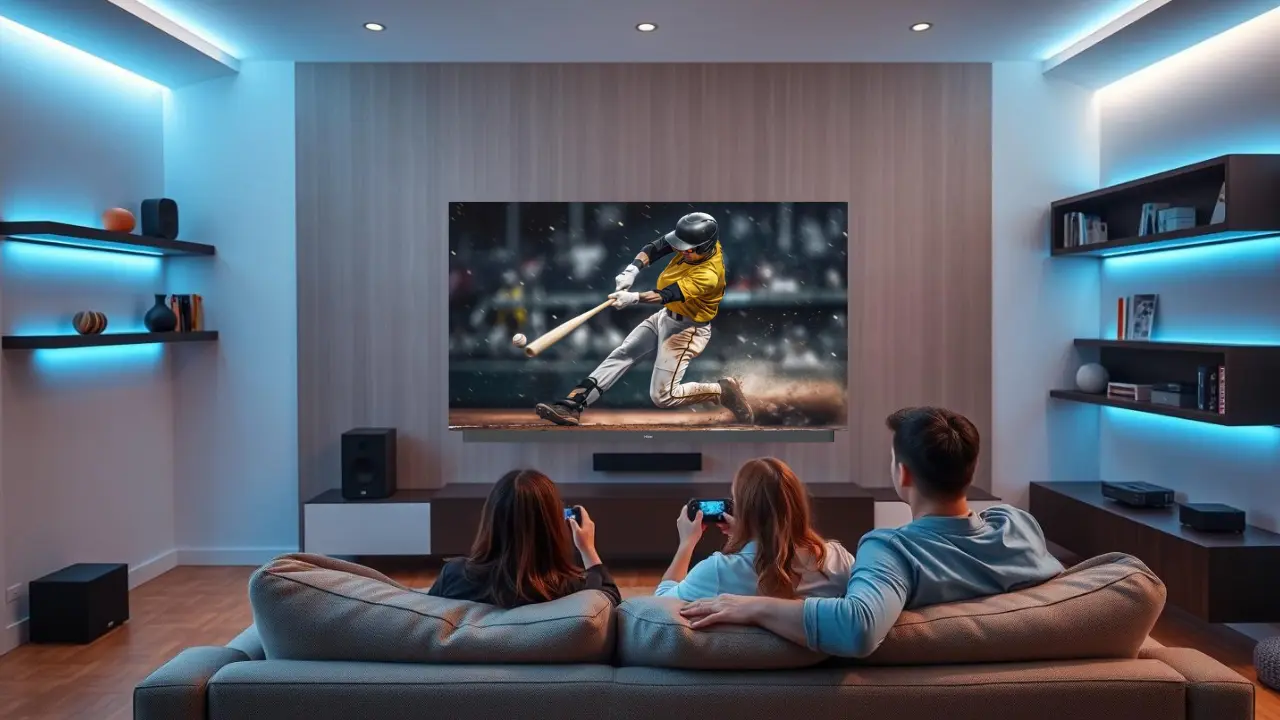

If you want smoother sports, sharper gaming, and zero motion blur, the best Haier TVs with 120Hz and above refresh rates are the Haier S90 QLED 254cm (100), the M92 Series (164cm (65) and 189cm (75), and the flagship M96 Series 254cm (100).
They combine 144Hz panels with AI processing, Dolby Vision IQ, and gaming features like VRR and FreeSync for a fluid, cinematic experience.
Why does the refresh rate suddenly matter so much?
Picture this.
It’s the last over of an IPL match. The ball is racing toward the boundary. Everyone leans forward.
And the screen… stutters.
That moment tells you everything.
A TV doesn’t just show content. It decides how that moment feels.
A 60Hz screen shows 60 frames per second. A 120Hz or 144Hz screen doubles that. The result is not just smoother motion. It’s more information per second.
- Fast action becomes readable
- Camera pans stop blurring
- Gaming feels responsive, not delayed
Higher refresh rate is not a feature. It’s a filter for reality.
What changes when you move from 60Hz to 120Hz or 144Hz?
Let’s make it practical.
1. Sports feel real, not replayed
Football, cricket, racing. These are not static visuals.
A 144Hz panel reduces motion blur and ghosting, making fast scenes clearer. On models like the Haier S90 QLED, this is paired with MEMC and AI processing for smoother frame interpolation.
Result: You follow the ball, not the blur.
2. Gaming becomes responsive, not frustrating
If you’ve ever missed a shot in a racing or FPS game, you know the cost of lag.
Haier TVs with 120Hz and above support:
- VRR (Variable Refresh Rate)
- ALLM (Auto Low Latency Mode)
- AMD FreeSync Premium Pro
These sync the TV’s refresh rate with your console or GPU for tear-free gameplay.
Result: Your input matches the screen. Instantly.
3. OTT content looks more cinematic
Even regular shows benefit.
AI processors detect scenes and adjust motion, contrast, and brightness in real time. The M92 Series uses an AI Ultra Sense Processor for scene recognition and dynamic tuning.
Result: Less noise. More depth. Better immersion.
Best Haier TVs with 120Hz and Above Refresh Rate
Let’s break this down into real choices. Not specs. Decisions.
1. Haier S90 QLED 254cm (100) Google TV Ultrasense AI (H100S90FUX)
Who is it for?
Large living rooms. Movie nights. Gaming setups that feel like theatres.
What makes it stand out?
- 144Hz refresh rate for ultra-smooth motion
- AI Ultra Sense Processor co-developed with MediaTek
- Dolby Vision IQ + HDR10+ for dynamic picture tuning
- KEF-tuned Dolby Atmos audio with 2.1 channel sound
- AMD FreeSync Premium Pro for gaming
The system at work
This TV is not just a screen. It’s an AI Center.
It integrates:
- Visual intelligence
- Sound optimisation
- Gaming responsiveness
All in one layer.
Insight: When hardware and AI work together, performance stops being noticeable. It just feels right.
2. Haier M92 Series 164cm (65) QD-Mini LED AI Smart Google TV (H65M92FUX)
Who is it for?
Urban apartments. Balanced users. People who want premium performance without going oversized.
What makes it stand out?
- 144Hz refresh rate with gaming boost up to 240Hz
- QD Mini LED display with deep blacks and high brightness
- AI Ambient Sense adjusts brightness based on room lighting
- 2.1 channel KEF audio with Dolby Atmos
- Google TV with personalised recommendations
The system at work
This TV adapter.
- Bright room? It boosts brightness
- Dark room? It softens tones
- Fast scene? It enhances motion
Insight: A smart TV should not ask you to adjust settings. It should learn your room.
3. Haier M92 Series 189cm (75) QD-Mini LED Smart AI Google TV (H75M92FUX)
Who is it for?
Families. Shared spaces. Weekend binge-watchers.
What makes it stand out?
- 144Hz panel with gaming acceleration up to 240Hz
- Higher dimming zones for better contrast
- Dolby Vision IQ for adaptive HDR
- VRR, ALLM, and FreeSync for gaming stability
- 189cm (75) size for immersive viewing
The system at work
This is where scale meets intelligence.
Bigger screen plus better dimming means:
- Brighter highlights
- Deeper shadows
- More realistic contrast
Insight: Size alone doesn’t create immersion. Control over light does.
4. Haier M96 Series 254cm (100) QD-Mini LED AI Smart Google TV (H100M96FUX)
Who is it for?
People who want the best. No compromises.
What makes it stand out?
- 144Hz refresh rate with ultra-high brightness
- Over 2000+ dimming zones for precise light control
- 6.2.2 channel audio system for true surround sound
- Dolby Vision IQ + HDR10+
- AI-powered picture and motion optimisation
The system at work
This is where everything scales.
- More zones
- More brightness
- More audio channels
Each layer improves the other.
Insight: Premium is not about one feature. It’s about everything working at a higher level together.
How to choose the right 120Hz Haier TV
Not everyone needs the biggest screen. Or the most expensive model.
Option 1: The balanced choice
- Go for the M92 164cm (65)
- Cost-effective
- High refresh rate + AI features
Best for: Daily OTT, casual gaming, compact homes
Option 2: The family upgrade
- Choose the M92 189cm (75)
- Bigger screen, better immersion
Best for: Shared viewing, sports, movie nights
Option 3: The theatre experience
- Pick the S90 QLED 254cm (100)
Best for: Premium living rooms, gaming setups
Option 4: The no-compromise flagship
- Go for the M96 254cm (100)
Best for: High-end buyers who want top-tier performance
What most people get wrong about refresh rate
They chase numbers.
240Hz. 144Hz. 120Hz.
But here’s the truth.
Refresh rate without processing is like a fast car without steering.
What matters is the system:
- AI processors for scene detection
- MEMC for motion smoothing
- VRR for gaming stability
- HDR formats for contrast
Haier TVs combine all of these.
That’s the difference between a spec and an experience.
The hidden system behind smoother screens
Think of a high refresh rate TV like a well-run kitchen.
- The refresh rate is the speed
- The AI processor is the chef
- The dimming zones are the ingredients
- The audio system is the plating
If one fails, the experience breaks.
If all work together, you don’t notice the system. You enjoy the result.
So what should you really optimize for?
Not just refresh rate.
Optimise for:
- Consistency in motion
- Clarity in fast scenes
- Responsiveness in gaming
- Adaptability to your room
Because in the end, you are not buying a TV.
You are designing how your evenings feel.
The one insight to remember
A good TV show’s content. A great TV removes friction from watching it.
That’s what 120Hz and above refresh rate TVs do.
They don’t just make things faster.
They make everything feel effortless.
And once you notice that difference, there’s no going back.
Frequently Asked Questions
I’m confused between all these models. What’s the simplest way to choose?
Think less about specs and more about how you’ll actually use the TV and your room size.
Go for Haier M92 164cm (65) QD Mini LED TV if you want a strong balance of value and performance
Choose Haier M92 189cm (75) QD Mini LED TV for family viewing and a bigger shared experience
Pick Haier S90 254cm (100) QLED TV if you want a theatre-like setup at home
Go all-in with Haier M96 254cm (100) QD Mini LED TV if budget isn’t a concern
Focus on room size + viewing habits, not just technical specs.
Do I really need 120Hz or am I overthinking it?
It depends on what you watch.
If you watch sports, play games, or notice motion blur → you’ll benefit from 120Hz immediately
If you mostly watch slow-paced content → 60Hz is fine, but upgrading will still feel smoother
Once you experience 120Hz, going back often feels noticeably worse.
Will I actually notice 120Hz in daily use?
Yes but it’s subtle rather than flashy.
You’ll feel:
Smoother motion in cricket and football
Less blur during fast camera pans
More stable, natural visuals overall
It’s less wow and more this just feels right.
I mostly watch OTT does refresh rate even matter?
Surprisingly, yes.
Even though most OTT content is 24fps, TVs with higher refresh rates use AI + motion processing (MEMC) to:
Reduce judder
Smooth transitions
Make visuals feel more cinematic
So the experience still improves.
What does AI processing in these TVs actually do?
AI isn’t just a buzzword it actively improves picture quality in real time by handling:
Scene recognition
Motion smoothing
Brightness adjustment
Contrast tuning
For example, Haier S90 254cm (100) QLED TV uses AI Ultra Sense to optimize visuals dynamically.
Is Dolby Vision IQ really useful or just marketing?
It’s genuinely useful especially in rooms with changing lighting.
Dolby Vision IQ adjusts HDR brightness based on your room’s lighting, so:
You don’t need to manually tweak settings
Dark scenes stay visible during the day
Bright scenes don’t feel overexposed at night
It’s one of those features you don’t think about but appreciate over time.