
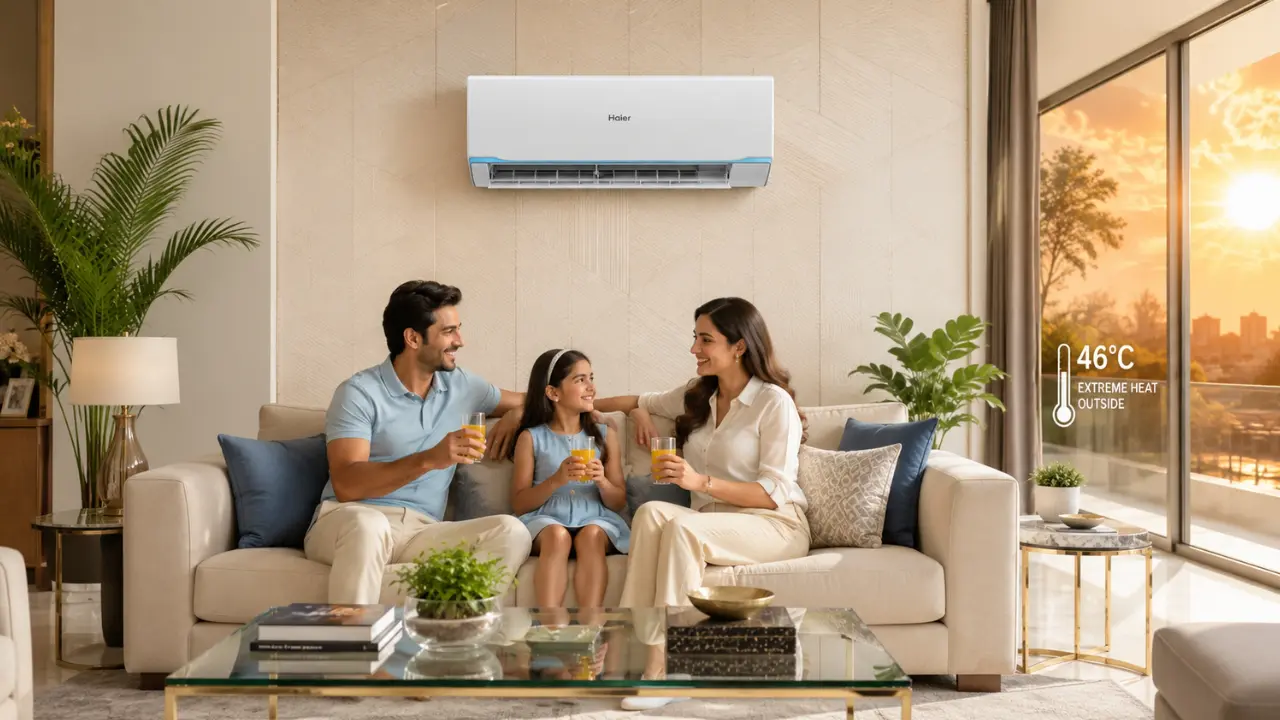

True tonnage advantage means your AC delivers the cooling capacity it promises, even when Indian summers become extreme.
A higher “paper tonnage” means nothing if the AC struggles at 48°C, cools unevenly, or slows down after an hour. Haier’s approach focuses on sustained cooling performance, faster airflow, heavy-duty operation, and intelligent capacity management designed for real Indian homes.
A summer evening reveals the truth about tonnage.
It is 6:45 PM in May.
The sun has been hitting the balcony glass since afternoon. Someone just came home from traffic. The kitchen is still warm from cooking. Ceiling fans are spinning at full speed.
The AC turns on.
Now comes the real test.
Not the brochure test.
Not the showroom demo.
The real test.
How fast does the room cool?
Does the cooling reach the corner near the dining table?
Does the AC become weak after an hour?
Does the room feel comfortable when five people sit together during IPL season?
This is where “true tonnage” starts mattering.
Because cooling capacity is not just a number printed beside a star rating. It is a system. And systems reveal themselves under pressure.
Most people misunderstand what tonnage actually means
The word “tonnage” sounds industrial. Almost mechanical.
But in daily life, tonnage simply means this:
How much heat your AC can remove from the room.
That is it.
A 1.5 ton AC is expected to handle a certain cooling load. But here is the hidden problem:
Not every 1.5 ton AC behaves like a true 1.5 ton AC in Indian conditions.
Especially during:
- Peak afternoon heat
- Top-floor apartments
- West-facing rooms
- Humid monsoon evenings
- Living rooms with constant movement
- Homes with large windows and electronics
This is why two ACs with the same tonnage label can feel completely different.
One cools steadily.
The other keeps running but never feels “enough.”
Cooling on paper and cooling in reality are not always the same thing.
The hidden system behind “true tonnage”
Most buyers compare:
- Price
- Star rating
- Tonnage number
But the real cooling system depends on five deeper factors.
| Factor | Why It Matters |
| Sustained cooling capacity | Prevents performance drop during extreme heat |
| Compressor efficiency | Maintains stable operation under pressure |
| Air throw distance | Ensures cooling reaches across the room |
| Intelligent load adjustment | Adapts cooling based on occupancy and heat |
| Ambient temperature handling | Keeps cooling stable during Indian summers |
Miss one, and the experience changes.
This is where Haier’s heavy-duty AC design becomes interesting.
The company focuses heavily on maintaining high cooling performance even during extreme temperatures, including stable cooling at up to 60°C ambient conditions.
That sounds technical.
But the lived experience is simple.
The room cools when you actually need it most.
Indian homes do not have “standard” cooling conditions
Most AC testing environments are controlled.
Indian homes are not.
A Gurgaon apartment in June behaves differently from a Bengaluru rental flat. A Mumbai bedroom faces humidity. A Jaipur living room faces dry heat. A compact studio traps heat differently from a duplex.
And modern homes create new heat loads every year:
- Bigger TVs
- More appliances
- Closed-window work-from-home setups
- Open kitchens
- Continuous Wi-Fi and electronics
- Longer AC usage hours
The cooling requirement has changed.
But many people still buy ACs using decade-old assumptions.
That creates the mismatch.
Why “Heavy Duty” changes the conversation
A normal AC performs well under moderate conditions.
A heavy-duty AC is built for stress.
That distinction matters.
Haier’s Gravity AI Series positions itself around this exact idea. Models like the Haier 1.6 Ton 5 Star Gravity AI Air Conditioner (HSA19GHD-WAI5NB-I) and the Haier (1.6) 5 Star Moonstone Grey Gravity AI Series Heavy Duty AC, 5.12kW, 2026 Model (HSA19GHD-SAI5NB-I) focus on maintaining cooling performance under higher ambient temperatures with features like HEXA Inverter technology, long air throw, and intelligent cooling optimisation.
That matters more than people realise.
Because the problem in Indian summers is rarely “starting cooling.”
The real challenge is maintaining cooling consistency.
Fast cooling is not about comfort alone
People think fast cooling is a luxury feature.
It is not.
It is a behavioural feature.
Imagine:
- Returning home after commuting in 42°C heat
- A child coming back from school
- Guests arriving suddenly
- Power cuts ending after an hour
In these moments, waiting 25 minutes for comfort feels exhausting.
Haier’s Supersonic Cooling technology claims cooling in 10 seconds using KTS and PKC technology.
The technical details matter less than the emotional outcome.
Relief changes mood.
A cooler room changes how families interact.
Temperature quietly shapes behaviour inside homes.
The airflow problem nobody talks about
Here is another hidden issue.
Many ACs cool near the unit well.
But rooms are not lived near the wall.
People sit on sofas. Work at desks. Sleep near the windows. Walk into kitchens. Children play on floors.
Uneven airflow creates “half-comfort.”
One side feels cold. The other feels warm.
That is not tonnage failure alone. It is an airflow design failure.
Haier’s Gravity AI models mention up to 20-metre long air throw with improved fan systems and better air duct design.
Again, this sounds technical.
But the real benefit is practical:
- Cooling reaches deeper spaces
- Larger living rooms feel balanced
- Air circulation becomes more consistent
- Cooling stabilises faster
Good airflow makes tonnage usable.
Without airflow, capacity gets trapped near the wall.
Convertible cooling changes how modern homes use electricity
Indian homes no longer use ACs the same way.
Some people:
- Run ACs all night
- Use them only during peak heat
- Keep them on during work calls
- Switch between occupancy levels constantly
Fixed cooling behaviour wastes energy.
That is why convertible modes matter.
Haier’s 7-in-1 Intelli Convertible system allows cooling capacity adjustments between 40% to 110% based on room conditions and usage patterns.
This creates three major advantages:
1. Lower energy waste during lighter usage
A bedroom at midnight does not need maximum cooling.
2. Higher performance during crowded conditions
Living rooms during gatherings need more aggressive cooling.
3. Better long-term efficiency
The system adapts instead of running at one constant intensity.
Modern cooling is becoming adaptive.
Not fixed.
AI in ACs is becoming invisible infrastructure
The best smart technology disappears into daily life.
Nobody wants to “manage” their AC every hour.
People want:
- Stable sleep
- Lower bills
- Comfortable evenings
- Fewer maintenance headaches
That is why AI-driven climate systems are becoming important.
Haier’s AI-ATMOX platform focuses on analysing indoor conditions, weather, and user habits to optimise comfort and energy savings.
The interesting shift is this:
Old ACs reacted.
New ACs anticipate.
That changes the relationship between humans and appliances.
The appliance stops feeling mechanical.
It starts feeling responsive.
The real cost of weak tonnage
People often underestimate this.
Weak cooling creates hidden costs:
- Longer runtime
- Higher electricity bills
- More compressor stress
- Uneven comfort
- Poor sleep quality
- Increased humidity discomfort
An AC struggling constantly is like a bike permanently stuck in second gear.
It keeps moving.
But inefficiently.
That is why true tonnage advantage is not about “more power.”
It is about appropriate sustained power.
Cooling at 60°C sounds extreme until Indian summers arrive
Every year, Indian summers break new records.
Top-floor apartments become heat chambers.
Outdoor units face direct sun exposure.
Heat retention inside buildings increases.
Haier’s heavy-duty AC range highlights stable cooling operation even at 60°C ambient temperatures with specialised conformal coating and Hyper PCB protection systems.
That matters because modern summers are no longer “normal weather.”
They are stress tests for infrastructure.
Homes now need appliances designed for environmental volatility.
Not average conditions.
Quiet cooling is part of true comfort
People chase tonnage.
But forget the sound.
An AC that cools well but disrupts sleep creates another kind of discomfort.
The best cooling systems become background systems.
Present. But unobtrusive.
Some Gravity AI Series materials highlight quieter airflow systems and inverter optimisation for lower noise operation.
Because real comfort is layered:
- Temperature comfort
- Noise comfort
- Air quality comfort
- Energy comfort
Homes do not experience these separately.
They experience them together.
The future of AC buying is shifting from “specs” to “behaviour”
This is the bigger pattern.
Earlier, people bought appliances based on:
- Size
- Brand
- Wattage
- Price
Now the conversation is changing toward:
- Adaptability
- Real-world performance
- Intelligence
- Environmental response
- Long-term comfort
That shift is important.
Because modern Indian homes are becoming dynamic systems.
Remote work changed room usage.
Heatwaves changed cooling expectations.
Smaller apartments changed airflow needs.
Energy bills changed buying psychology.
The AC is no longer just a seasonal appliance.
It is becoming year-round lifestyle infrastructure.
What true tonnage really teaches us
Here is the deeper insight.
Most people think appliances succeed through features.
They do not.
They succeed through consistency under pressure.
A refrigerator matters during power fluctuations.
A washing machine matters during heavy laundry weekends.
And an AC matters most during unbearable heat.
That is when engineering reveals itself.
True tonnage advantage is ultimately about trust.
The trust that when the city outside feels exhausting, the room inside will still feel calm.
And increasingly, that calm is becoming one of the most valuable luxuries modern homes can offer.
Frequently Asked Questions
What does “true tonnage” actually mean in an AC?
True tonnage means the AC delivers its promised cooling performance consistently in real Indian conditions not just under laboratory testing. It reflects how effectively the AC removes heat during extreme summer temperatures, crowded rooms, humidity, and long usage hours.
Why do two 1.5 ton ACs feel completely different?
Because tonnage on paper is only one part of cooling performance. Real-world cooling also depends on:
Compressor strength
Air throw distance
Ambient temperature handling
Cooling consistency
Intelligent load management
One AC may cool steadily at 48–50°C, while another may struggle after continuous operation.
Is higher tonnage always better for Indian homes?
Not necessarily. Oversized ACs can waste electricity and cool unevenly. The better approach is choosing an AC with sustained cooling performance and adaptive capacity management for your room conditions.
Why does my AC cool well initially but struggle later?
This usually happens when the system cannot maintain cooling under prolonged heat stress. Weak compressors, poor airflow, or limited ambient temperature tolerance can reduce cooling efficiency over time.
Why does my top-floor apartment stay hot even with AC?
Top floors absorb and retain more heat from direct roof exposure. During peak summer, the cooling load becomes much higher than standard room assumptions.
I feel cool near the AC but warm elsewhere in the room. What causes this?
That is usually an airflow distribution issue rather than pure tonnage failure. Good long-distance air throw is critical for balanced room cooling.