


Ceiling height changes how much air an AC needs to cool. A room with a higher ceiling holds more air volume, which means a standard tonnage calculation based only on square feet often becomes inaccurate. A 1.5-ton AC that works perfectly in an 8-foot room may struggle in a 12-foot room with the same floor area.
That is the hidden system most AC buying guides ignore.
And in modern Indian homes, it matters more than ever.
Double-height living rooms. Open-plan apartments. False ceilings. Skylights. Large windows. Studio layouts.
Today, air conditioners are not cooling rooms anymore. They are cooling volumes of lifestyle.
Most people calculate AC tonnage incorrectly.
Walk into an electronics store and ask for an AC recommendation.
The first question is usually:
“How many square feet is your room?”
Useful question.
Incomplete answer.
Because a room is not a flat rectangle. It is a box filled with air.
A 150 sq. ft bedroom with an 8-foot ceiling contains far less air than a 150 sq. ft room with a 12-foot ceiling.
More air means:
- More cooling load
- Longer compressor cycles
- Higher electricity usage
- Slower temperature stabilisation
Cooling is physics pretending to be comfortable.
Why ceiling height changes cooling performance
Here is the simple principle:
Higher ceilings increase room volume. Increased volume increases heat load.
That affects:
- Cooling speed
- Air circulation
- Humidity control
- Energy efficiency
- Compressor stress
A standard Indian bedroom usually has ceilings between 9 and 10 feet.
But many modern homes now push beyond that:
- Luxury apartments: 10.5 to 12 feet
- Villas: 12 to 18 feet
- Duplex living rooms: double-height ceilings
- Studio apartments: exposed industrial ceilings
The AC now has to manage not just floor space, but vertical air movement too.
Hot air rises.
Cool air sinks.
That sounds simple until you realise what happens at midnight.
The lower part of the room feels comfortable.
The upper section traps heat.
The AC keeps working harder to balance temperature.
The result?
A room that feels “almost cool” but never fully comfortable.
A bigger room is not always the problem. Vertical space is.
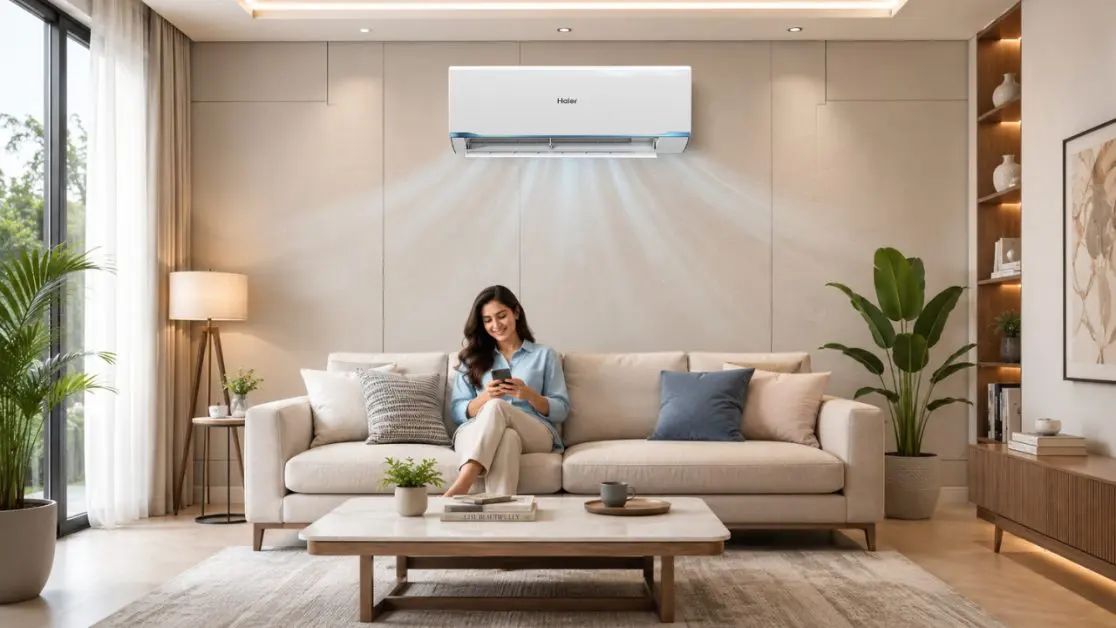
People often blame poor cooling on the weather.
Sometimes the real issue is architecture.
A simple example
Let us compare two rooms:
Room A
- 150 sq. ft
- 8-foot ceiling
Room B
- 150 sq. ft
- 12-foot ceiling
Room B contains 50% more air volume.
That changes everything.
The second room may require:
- Higher tonnage
- Faster airflow
- Better air flow
- Stronger compressor efficiency
This is where conventional AC buying advice breaks down.
Most online calculators still optimize for older apartment layouts.
Modern Indian homes have evolved faster than AC assumptions.
The invisible role of air flow
Tonnage alone does not solve high ceilings.
Air distribution matters too.
A weak airflow system in a tall room creates uneven cooling pockets.
One corner feels cold.
Another feels warm.
The sofa area is comfortable.
The dining section feels humid.
That inconsistency creates the illusion that the AC is underperforming.
Sometimes it is not underpowered.
It is under-distributed.
This is where features like long air flow become important in practical Indian homes.
For example, the Haier 1.6 Ton 5 Star Gravity AI Air Conditioner includes up to 20-metre long air flow with improved fan and air duct design.
That matters more in taller spaces than most buyers realise.
Because cooling is not just about creating cold air.
It is about moving it intelligently.
How to estimate AC tonnage based on ceiling height
There is no universal formula because sunlight, insulation, occupancy, and windows also matter.
But there is a practical framework.
For standard ceiling heights (8 to 10 feet)
Typical guideline:
- Up to 120 sq. ft: 1 ton
- 120 to 180 sq. ft: 1.5 ton
- 180 to 250 sq. ft: 2 ton
This works reasonably well.
For higher ceilings (10 to 12 feet)
You usually need:
- Additional cooling margin
- Better airflow
- Higher inverter efficiency
One option is upgrading the tonnage slightly.
The second option is choosing an AC with smarter airflow and convertible capacity.
The third option is combining both.
Because oversizing blindly creates another problem.
Why oversized ACs can also fail
Most people think:
“More tonnage means better cooling.”
Not always.
An oversized AC cools quickly but may not run long enough to remove humidity properly.
That creates a room that feels:
- Cold
- Damp
- Sticky
Comfort is not temperature alone.
Comfort is temperature plus moisture balance.
Especially during Indian monsoons.
A properly sized inverter AC adapts cooling dynamically instead of operating at full blast constantly.
That flexibility matters in homes where occupancy changes throughout the day.
The rise of intelligent cooling systems

Traditional ACs operate like switches.
On.
Off.
Maximum.
Minimum.
Modern homes require systems that adapt continuously.
That is why AI-driven climate systems are becoming more relevant.
The Haier Gravity AI Series, powered by AI-ATMOX, analyses indoor conditions, usage habits, and weather patterns to optimize cooling automatically.
That becomes useful in rooms with:
- Variable occupancy
- Taller ceilings
- Open kitchen layouts
- Sun-facing glass walls
Because the cooling load keeps changing.
And static systems struggle inside dynamic spaces.
False ceilings change AC behaviour too
This is where things get interesting.
False ceilings reduce effective room height.
Which can improve cooling efficiency.
But only if designed correctly.
A well-designed false ceiling can:
- Reduce cooling load
- Improve air circulation
- Lower energy consumption
- Stabilise room temperature faster
A poorly designed false ceiling can:
- Trap hot air
- Restrict airflow
- Create uneven cooling zones
Design decisions affect appliance performance more than people think.
An AC does not operate in isolation.
It operates inside a system.
Walls.
Curtains.
Glass.
Ceiling height.
Sunlight.
Furniture placement.
Everything participates.
Why inverter technology matters more in tall rooms
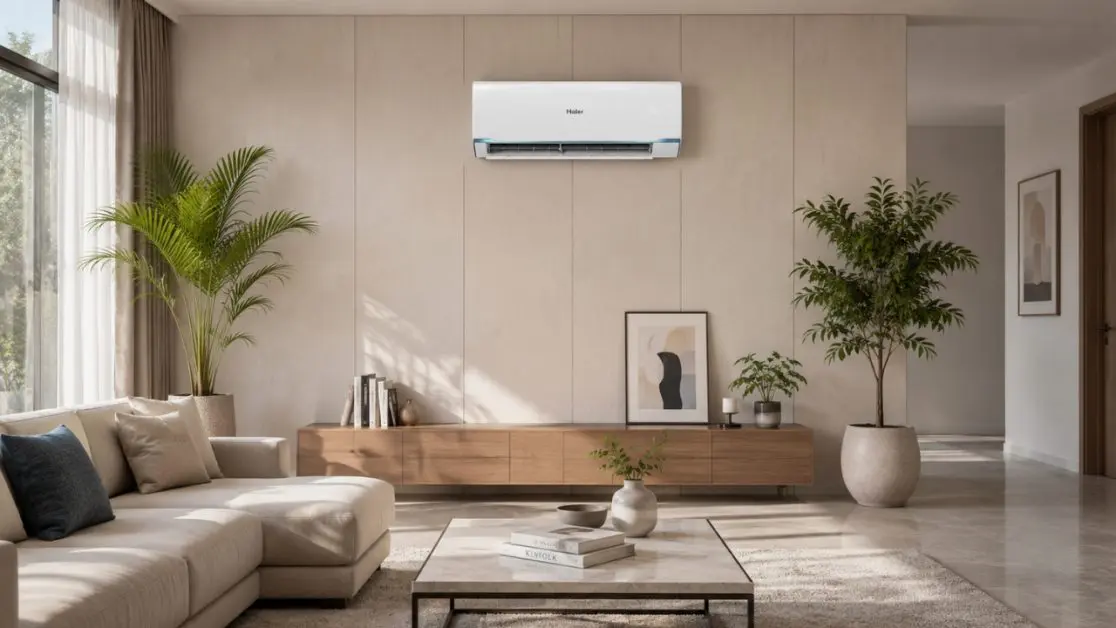
Higher ceilings increase cooling fluctuations.
Especially in Indian summers where outdoor temperatures cross 45°C in many cities.
An inverter compressor adjusts output continuously instead of repeatedly stopping and restarting.
That creates:
- Better efficiency
- More stable temperatures
- Lower power spikes
- Quieter operation
Haier’s HEXA Inverter technology is designed to optimize cooling performance while saving energy. The system claims up to 65% energy savings under suitable conditions.
More importantly, inverter systems handle variable heat loads better.
And high ceilings create exactly that kind of variable load.
The luxury-home cooling problem nobody discusses
Tall ceilings look beautiful.
They also create thermal complexity.
A double-height living room may require:
- Multiple airflow directions
- Strategic AC placement
- Zonal cooling logic
- Higher-capacity systems
This is why some luxury homes feel oddly uncomfortable despite expensive interiors.
The design focused on aesthetics.
Not thermal behaviour.
Good cooling is invisible.
You only notice it when it fails.
What Indian buyers should actually evaluate before choosing AC tonnage
Instead of asking only:
“What is my room size?”
Ask:
“What kind of room is this?”
Checklist that matters more than people realise
- Ceiling height
- Window exposure
- Floor level
- Sun direction
- Open vs closed layout
- Number of occupants
- Appliance heat generation
- Kitchen proximity
A top-floor west-facing room with 11-foot ceilings behaves differently from a shaded 9-foot bedroom.
Same square footage.
Completely different cooling requirement.
That is the hidden pattern.
Smart cooling is becoming architectural
Earlier, people designed rooms first and installed ACs later.
Now the two decisions are interconnected.
Because cooling performance affects:
- Sleep quality
- Energy bills
- Productivity
- Indoor comfort
- Appliance longevity
And ceiling height sits quietly at the centre of that system.
The future of air conditioning is not brute-force cooling.
It is adaptive cooling.
Cooling that understands how homes actually behave.
That is why features like AI climate control, long air flow, convertible tonnage modes, and intelligent energy monitoring are becoming more relevant in Indian households. The Haier Gravity AI Series includes AI-based comfort optimisation, 7-in-1 convertible cooling, and smart monitoring features designed for changing indoor conditions.
Because modern homes are no longer static boxes.
They breathe differently.
Heat differently.
Live differently.
And the AC industry is finally beginning to respond to that reality.
Frequently Asked Questions
Does ceiling height really affect AC tonnage?
Yes. Ceiling height directly impacts the volume of air that must be cooled. Even if two rooms have the same floor area, the room with the higher ceiling contains more air and may require greater cooling capacity.
Why does my AC struggle even though my room size matches the recommended tonnage?
Most AC tonnage recommendations are based primarily on floor area. However, factors such as ceiling height, sunlight exposure, large windows, occupancy levels, insulation quality, and open floor plans can significantly increase the cooling load.
Should I buy a bigger AC if my room has a 12-foot ceiling?
Not necessarily. While a slightly higher-capacity unit may help in some cases, overall comfort also depends on airflow design, air flow distance, insulation, and the efficiency of the AC system, especially with inverter models.
Why does my room feel almost cool but never fully comfortable?
Rooms with high ceilings often experience temperature stratification. Cool air tends to settle near the floor while warmer air remains higher up, creating uneven comfort levels throughout the space.
Does hot air rising affect AC efficiency?
Yes. Because warm air naturally rises, rooms with taller ceilings can develop larger temperature differences between floor and ceiling levels. This may cause the AC to run longer to maintain a comfortable temperature.
Why are some areas of my room cooler than others?
Uneven airflow distribution can create hot and cold spots within a room. In larger spaces or rooms with higher ceilings, proper air circulation and adequate air flow become especially important for consistent cooling.