
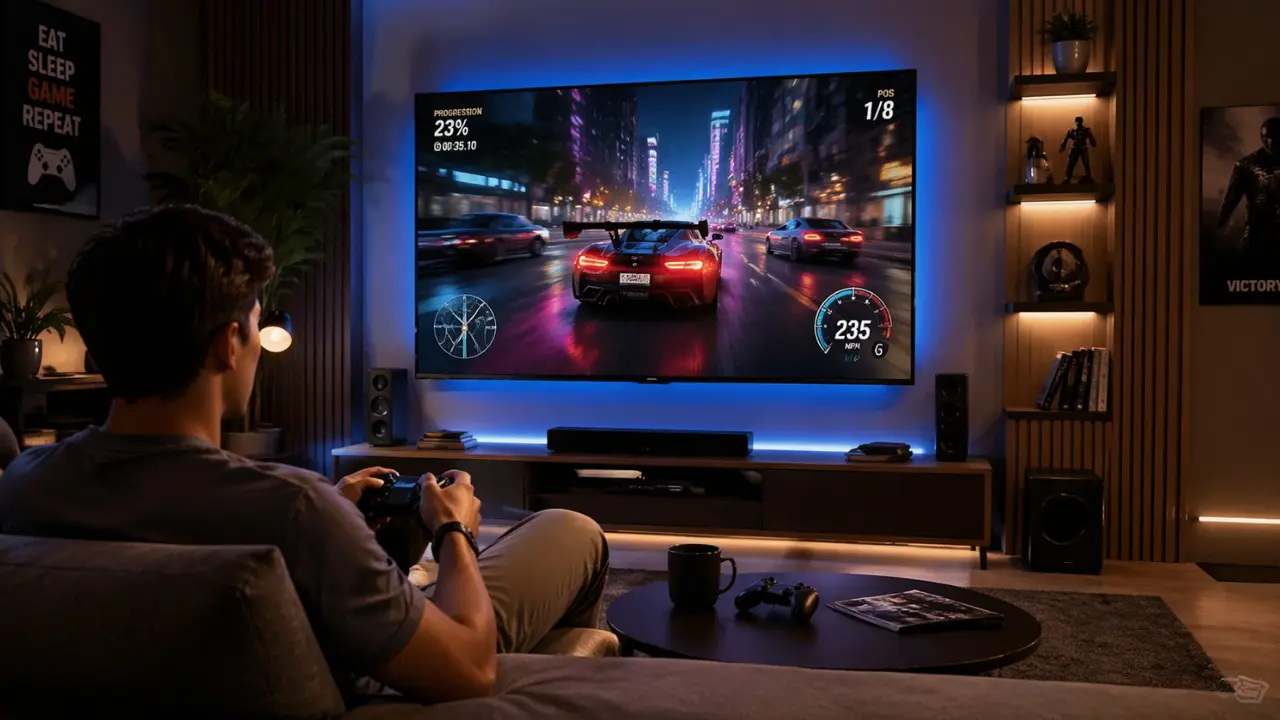

Larger screens make gaming feel more real because they reduce visual compromise.
A bigger TV does not just “look better.” It changes how you react, notice movement, hear detail, and emotionally experience a game. Larger screens expand immersion, improve spatial awareness, reduce visual strain during long sessions, and turn casual gaming into a shared social experience that feels cinematic rather than confined.
Gaming used to be private.
One chair. One controller. One small screen pushed against a wall.
Today, gaming has become something else entirely.
Friends gather for FIFA tournaments after dinner. Parents try motion games with children on weekends. Couples stream racing simulators like they are interactive movies. Even solo gaming has shifted. People want immersion now, not just entertainment.
And somewhere in the middle of this shift, screen size quietly became one of the biggest factors shaping the experience.
Not because bigger automatically means better.
Because bigger changes how your brain processes the game.
A small screen shows the game. A large screen pulls you inside it.
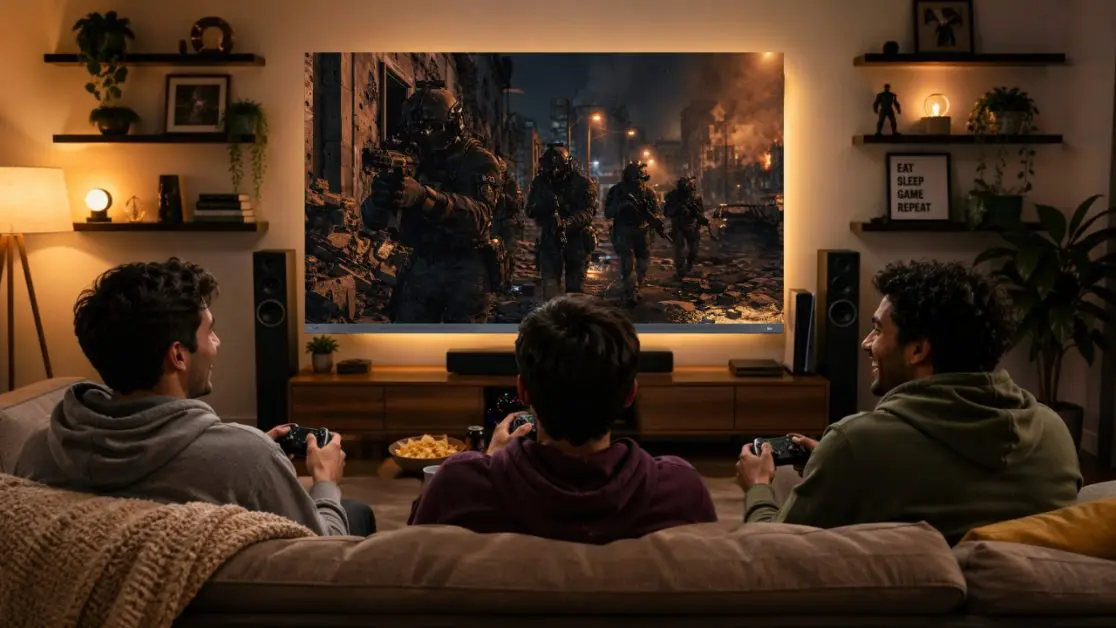
Imagine playing an open-world game on a compact screen.
You see the character. You follow the mission. It works.
Now imagine the same game stretched across an 215cm (85) or 1254cm (100) display.
Suddenly:
- Landscapes feel massive
- Motion feels faster
- Details become easier to track
- Peripheral movement becomes visible
- Audio feels physically connected to visuals
The game stops feeling like content.
It starts feeling like an environment.
That difference matters because gaming is built on reaction and immersion.
The more believable the environment feels, the more emotionally invested the player becomes.
This is why cinemas feel different from phones.
Scale changes attention.
Bigger screens are not about size alone.
They are about presence.
Gaming is a sensory system, not just a visual activity
Most people think gaming quality depends on graphics.
That is incomplete thinking.
Gaming experience depends on five systems working together:
- Visual scale
- Motion smoothness
- Sound positioning
- Input responsiveness
- Environmental immersion
If one system breaks, the illusion breaks.
This is why gamers notice lag instantly. Or motion blur. Or poor sound staging.
The brain is constantly stitching signals together.
Larger screens help because they strengthen multiple systems at once.
Motion becomes easier to follow
Fast-paced games demand rapid eye tracking.
Racing games. Shooter games. Sports simulations.
On smaller displays, motion compresses. Your eyes work harder to separate movement from background detail.
Larger screens reduce that compression.
Features like 144Hz refresh rate and VRR support become more noticeable on big displays because motion occupies more physical viewing space. The Haier S90 QLED 254cm (100) Google TV includes a 144Hz refresh rate, AMD FreeSync Premium Pro, VRR, and ALLM gaming support.
That combination matters.
Because smooth gaming is not a luxury anymore.
It is readable.
The hidden advantage of larger gaming screens: reaction confidence
Here is something most buyers underestimate.
Large screens do not just improve visuals.
They reduce hesitation.
When details are clearer:
- You spot opponents earlier
- Racing lines become easier to judge
- Menus feel easier to navigate
- Text becomes more readable from distance
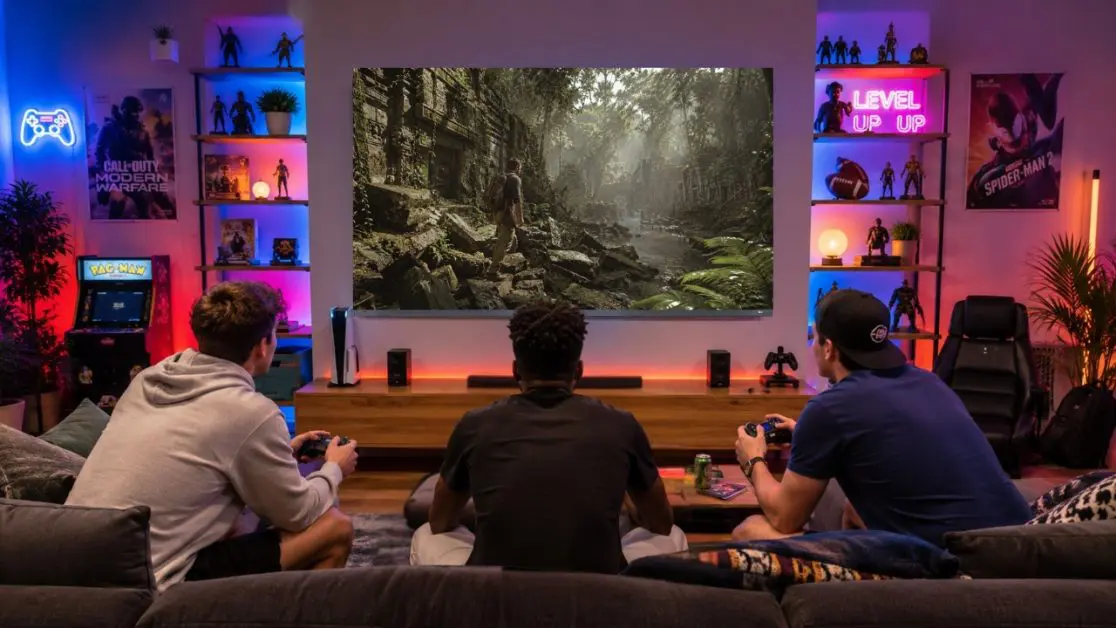
- Split-screen multiplayer becomes practical again
That last point matters more than people realize.
Modern Indian homes increasingly use TVs as shared entertainment hubs. Gaming is no longer isolated to bedrooms or desks. Living rooms have become multi-purpose media spaces.
And larger displays support that transition naturally.
Why multiplayer gaming works better on larger screens
Think about cricket nights in India.
Nobody wants to watch an IPL final crowded around a laptop.
Gaming follows the same principle.
Scale creates participation.
On larger screens:
- Everyone sees the action clearly
- Couch co-op feels comfortable
- Motion visibility improves across seating angles
- Group gaming becomes social rather than technical
The Haier M80F Mini LED 215cm (85) Google TV includes wide viewing support, Mini LED technology, Dolby Vision, and Sound by KEF audio integration.
Those features matter because gaming is increasingly blending with home entertainment.
The screen is no longer just a gaming device.
It is becoming the center of shared downtime.
Large screens expose weak technology faster
This is the part many people miss.
A large screen can also make bad technology look worse.
Low refresh rates become obvious.
Poor contrast becomes distracting.
A weak sound feels empty.
That is why gaming TVs today are not defined by size alone.
They are defined by how intelligently they manage scale.
Three systems matter most for large-screen gaming
1. Refresh rate
A large display with slow refresh creates visible blur.
That is why high refresh matters.
The Haier New M96 Series 254cm (100) QD-Mini LED AI Smart Google TV supports 144Hz refresh rate and gaming up to 240Hz in Game Mode.
Fast refresh reduces motion breakup during:
- Racing sequences
- Competitive shooters
- Sports gameplay
- Camera pans
Smoothness is not aesthetics.
Smoothness is control.
2. Contrast and brightness
Large screens need strong contrast management.
Otherwise dark scenes flatten.
Mini LED and QD-Mini LED systems improve depth by controlling dimming zones more precisely. The M96 Series includes 2160 dimming zones and HDR10+ support.
This matters especially in story-driven games.
Shadow detail changes gameplay visibility.
3. Sound staging
Large visuals need proportional sound.
Otherwise the brain senses imbalance.
The M96 Series includes Sound by KEF with a 6.2.2 channel speaker system and Dolby Atmos support.
Good gaming audio does something subtle.
It tells you where danger exists before you see it.
Gaming fatigue is real. Screen quality changes it.
Many people assume bigger screens cause eye strain.
Poor screens cause eye strain.
There is a difference.
Modern large displays increasingly include systems that adapt to ambient lighting and reduce flicker. The Haier M96 Series includes Dolby Vision IQ, AI Ambient Sense, Flicker-Free technology, and TÜV Rheinland-certified low blue light support.
That matters during long sessions.
Especially in Indian homes where gaming often happens late at night after work, after traffic, after long commutes.
Comfort becomes part of performance.
A tiring screen shortens engagement.
An adaptive screen extends it naturally.
The future of gaming is not personal. It is environmentally friendly.
This is the larger shift happening quietly.
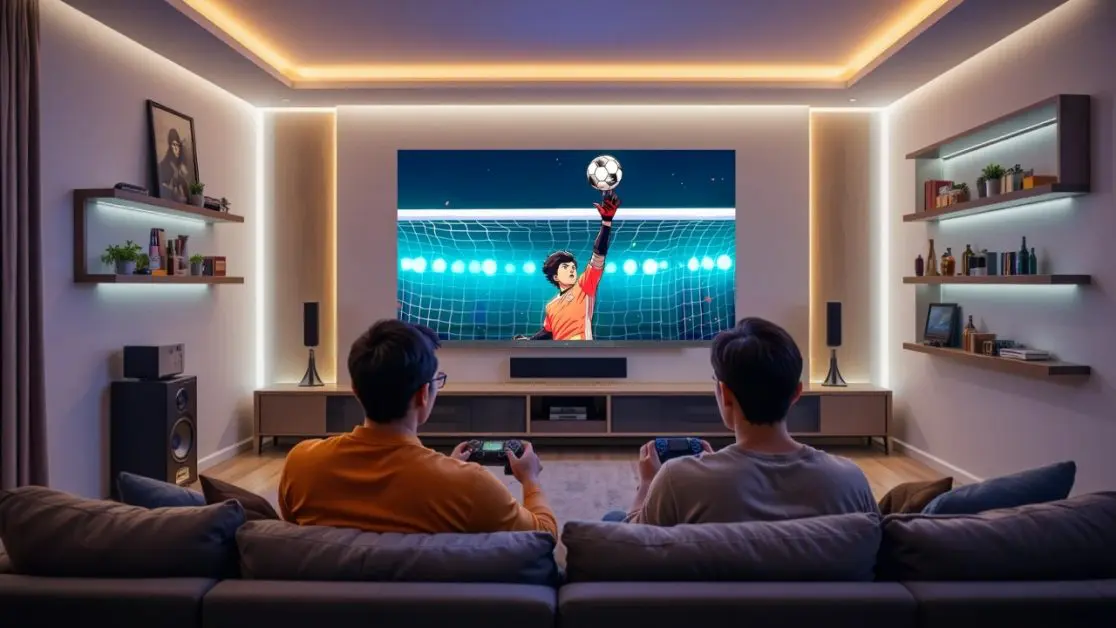
Gaming setups are moving away from isolated desk culture toward integrated living spaces.
One screen now handles:
- Gaming
- OTT streaming
- Sports nights
- Music sessions
- Family movie time
- Casual YouTube browsing
The device is becoming an infrastructure.
Not hardware.
That is why features like Google TV integration, hands-free voice control, Wi-Fi 6, AI processing, and multi-device connectivity matter more today. The Haier S90 QLED and M96 Series both integrate AI-powered visual optimization and gaming-focused technologies.
People are no longer buying “a TV for gaming.”
They are building flexible entertainment systems for modern homes.
Bigger screens also change emotional memory
Think about the gaming moments people remember.
Last-minute goals.
Boss fights.
Victory celebrations.
Shared laughter during chaotic multiplayer rounds.
Memory forms around intensity.
And intensity depends on immersion.
Large displays amplify emotional scale.
A 1254cm (100) screen does not just display a football stadium.
It recreates the atmosphere.
That is why gaming on larger screens often feels more memorable, even when the game itself stays unchanged.
The hardware changes perception.
And perception shapes memory.
The smartest gaming setups remove friction
That is the hidden principle behind all good technology.
Not more buttons.
Not more complexity.
Less friction.
The best gaming setup is the one that disappears once the game begins.
Fast refresh rates.
Responsive visuals.
Clear sound.
Adaptive brightness.
Low latency.
Smooth connectivity.
These are not specs anymore.
They are invisible systems that protect immersion.
And larger screens magnify every one of those systems, for better or worse.
Which means one thing becomes clear very quickly:
A large screen alone does not improve gaming.
A well-designed large screen does.
That is the difference modern households are beginning to notice.
Not just bigger entertainment.
Better experiences.
Because the future of gaming is not about watching a screen.
It is about stepping into a space that responds to you.
Frequently Asked Questions
Should I buy a large TV mainly for gaming or for overall entertainment?
A large gaming-ready TV works best when it supports multiple uses: gaming, OTT streaming, sports, movies, music, and family viewing.
I already have a smaller screen. Why should I upgrade for gaming?
A larger screen helps you notice movement, read text, track details, and feel more emotionally involved in the game.
I want a bigger TV for gaming, but will it actually improve my experience?
Yes, if the TV also has a strong refresh rate, low latency, good contrast, and responsive gaming features. A large screen improves immersion, but the technology behind it decides performance.
Will a bigger screen cause more eye strain during long gaming sessions?
Not by itself. Poor brightness, flicker, weak contrast, and harsh blue light usually cause strain. Adaptive brightness and low-blue-light features help.
I play late at night after work. Does screen quality matter?
Yes. Features like ambient light adjustment, flicker-free viewing, and better contrast can make long sessions more comfortable.
Will bad graphics look worse on a larger TV?
Yes. Large screens expose weak resolution, poor contrast, motion blur, and low refresh rates more clearly.