
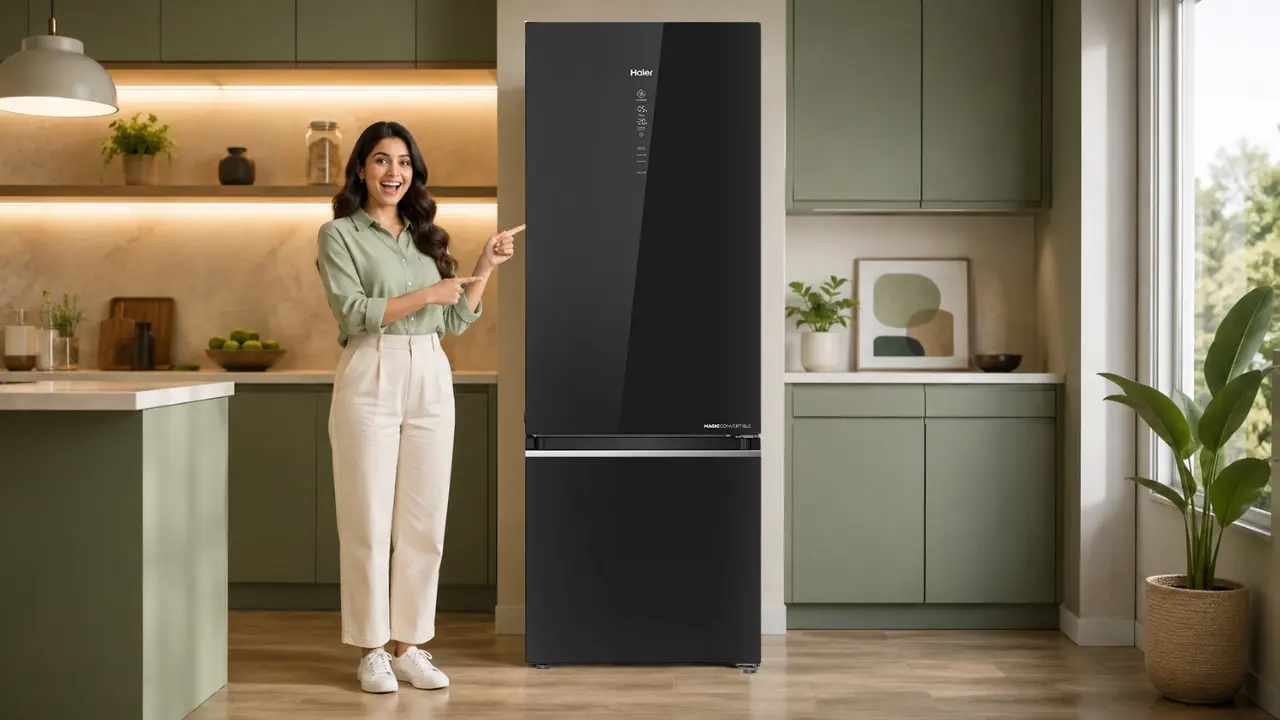

Bottom mounted refrigerators save energy differently than most people realise
Energy efficiency in bottom mounted refrigerators is not only about star ratings or electricity bills. It is about how people actually use refrigerators every day.
Most Indian households open the refrigerator section far more often than the freezer. Bottom mounted refrigerators place fresh food at eye level, reduce unnecessary cold-air loss, improve airflow management, and increasingly use inverter-driven cooling systems that optimize power consumption intelligently.
A refrigerator does not waste electricity all at once.
It leaks efficiency slowly.
One unnecessary door opening at a time.
One overloaded vegetable compartment at a time.
One badly managed airflow cycle at a time.
That is the hidden system most people never see.
And that is exactly why bottom mounted refrigerators are becoming more relevant in modern Indian homes.
The refrigerator section matters more than the freezer
Walk into most kitchens at 8 PM.
Someone opens the fridge for water.
Someone checks leftovers.
Someone grabs vegetables for dinner.
Someone hunts for chocolate hidden behind the curd bowls.
Very few people open the freezer repeatedly throughout the day.
That behavioural pattern changes everything.
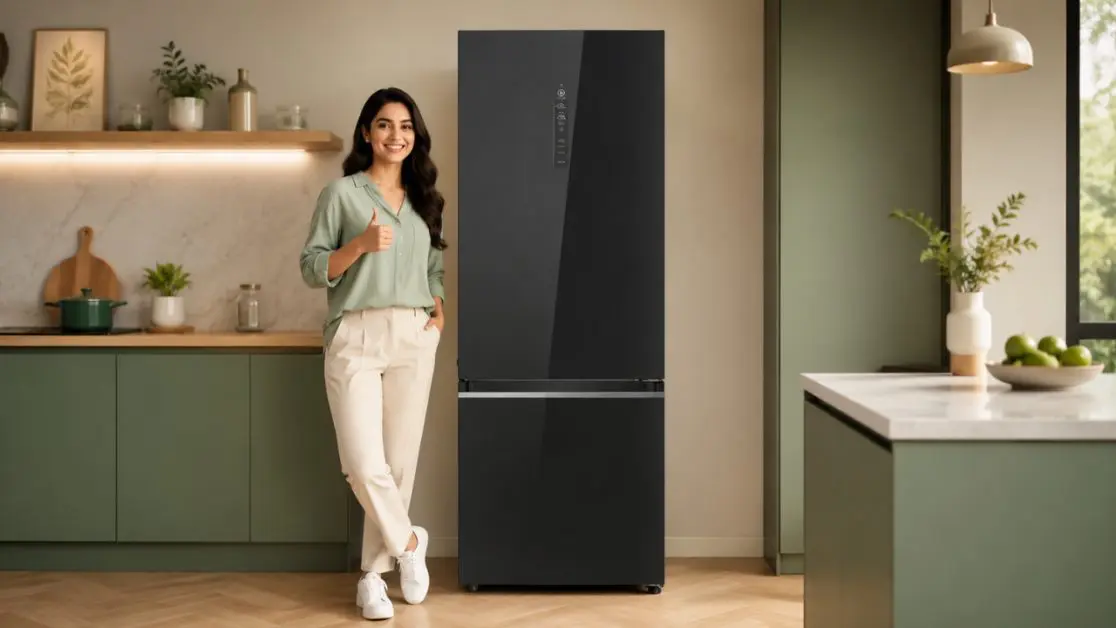
Traditional top freezer refrigerators force users to bend frequently and open the upper freezer section even when they only need daily essentials. Bottom mounted refrigerators reverse this logic completely.
Fresh food moves upward.
The freezer moves downward.
Convenience improves. But something else improves quietly too.
Energy efficiency.
Because efficient appliances are often built around human behaviour, not just mechanical engineering.
Why repeated door openings affect refrigerator efficiency
Cold air behaves differently from what most households assume.
Every time the refrigerator door opens:
- Cold air escapes
- Warm air enters
- The compressor works harder
- Cooling cycles increase
- Power consumption rises
Now multiply that by 40 to 70 daily door openings in a busy household.
The numbers add up faster than people realise.
Bottom mounted refrigerators reduce this friction because the frequently accessed section sits naturally at standing height. Users spend less time searching. Less time bending. Less time leaving the door open while deciding what to take out.
Tiny behavioural improvements create meaningful energy savings over years.
That is how efficient systems work.
Not through dramatic changes.
Through reduced friction.
The hidden role of inverter technology in energy efficiency
Older refrigerators work like old ceiling fans.
Full speed or nothing.
The compressor turns on aggressively, cools intensely, shuts off, then repeats the cycle again and again. That stop-start pattern consumes more electricity and creates inconsistent cooling.
Modern bottom mounted refrigerators increasingly use inverter compressors instead.
The difference is significant.
An inverter compressor adjusts cooling dynamically based on:
- Internal temperature
- Frequency of door openings
- Seasonal heat
- Food load
- Humidity levels
Instead of restarting repeatedly, the compressor runs steadily at optimised speeds.
Less stress.
Less fluctuation.
Lower energy consumption.
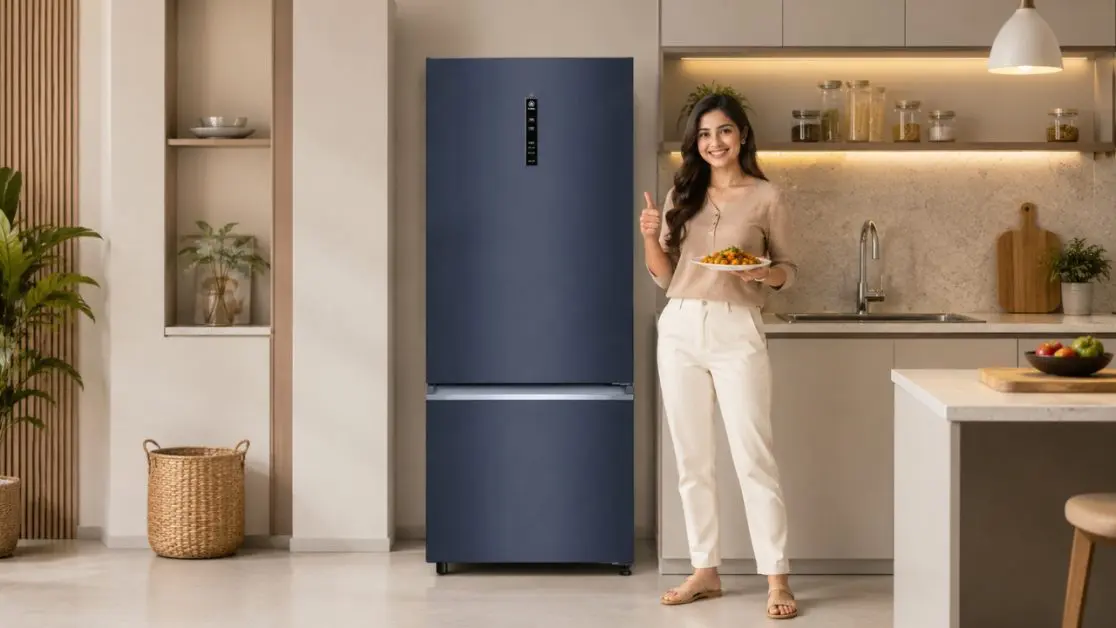
Haier’s Bottom Mounted Refrigerators like the Haier 445L 2 Star Graphite Black Bottom Mount Refrigerator (HRB-4952BGKA-P) and Haier 445L 2 Star Black Glass Bottom Mount Refrigerator (HRB-4952CKGA-P) feature Triple Inverter and Dual Fan Technology designed to maintain freshness while improving energy efficiency.
That matters particularly in Indian summers.
Because refrigerators in India do not operate inside controlled European climates. They survive:
- 45°C summer heat
- Frequent power fluctuations
- High humidity
- Continuous usage during festivals and gatherings
Efficiency must survive real life.
Not laboratory conditions.
Energy efficiency is increasingly about heat management
Most people think refrigerators create cold.
Technically, refrigerators remove heat.
That distinction changes how energy efficiency works.
The better a refrigerator manages heat transfer, airflow circulation, and compressor workload, the less electricity it consumes over time.
This is where modern cooling systems become important.
Triple inverter systems reduce unnecessary power spikes
Triple inverter systems optimise three major components:
- Compressor operation
- Fan motor performance
- Internal airflow regulation
The result is smoother cooling cycles and reduced energy spikes during heavy usage.
Haier’s Triple Inverter Technology in its BMR range is specifically positioned around maintaining freshness while saving energy.
That balance matters because modern households demand contradictory things simultaneously:
- Faster cooling
- Bigger storage
- Lower electricity bills
- Quieter operation
Efficient systems solve contradictions.
That is what good engineering actually does.
Large refrigerators are not automatically inefficient
This is one of the biggest misconceptions in Indian appliance buying.
People assume:
“A smaller fridge means lower electricity consumption.”
Not always.
A poorly optimised small refrigerator can consume more power than a well-designed larger inverter refrigerator.
Because efficiency depends on system design, not just size.
A large refrigerator with:
- Better airflow
- Stable compressor cycles
- Frost-free cooling
- Intelligent sensors
- Better insulation
often performs more efficiently over long-term usage than older compact models constantly running at maximum load.
For growing families, this becomes even more important.
Overstuffed refrigerators lose efficiency quickly.
Airflow gets blocked.
Cooling becomes uneven.
Compressor workload increases.
Food spoilage rises.
Buying slightly larger capacity often reduces waste and improves cooling consistency.
The hidden cost of small refrigerators is not electricity.
It is an inefficiency created by overflow.
Modern Indian kitchens are changing refrigerator behaviour
Kitchens today behave differently than they did ten years ago.
Food storage patterns changed.
People prepare meals more.
Online grocery ordering increased bulk buying.
Frozen snacks became routine.
Weekend cooking became common for working professionals.
Fresh produce storage increased significantly in urban households.
That shift quietly favours bottom mounted refrigerators.
Why?
Because vegetable compartments now matter more than ever.
The Haier BMR range includes a 2X Bigger Vegetable Box designed for higher fresh produce storage.
That sounds like a convenience feature.
But it is also an efficiency feature.
Because organised storage reduces:
- Door opening time
- Cooling loss
- Forgotten food waste
- Uneven airflow blockage
A refrigerator becomes more efficient when households use it more intentionally.
Design shapes behaviour.
Behaviour shapes energy usage.
Stabilizer-free operation matters more than people think
India’s power conditions remain unpredictable in many cities.
Voltage fluctuations damage compressors slowly over time.
And damaged compressors become energy inefficient long before they fail completely.
This is why stabilizer-free operation matters.
Not because stabilizers disappeared.
Because modern refrigerators now integrate smarter voltage management internally.
Haier’s Bottom Mounted Refrigerators include stabilizer-free operation designed to protect against voltage fluctuations while improving energy efficiency.
This matters particularly for:
- Tier 2 and Tier 3 cities
- Areas with summer voltage drops
- Homes using inverters frequently
- Regions facing monsoon power instability
The smartest appliances today are not just feature-rich.
They are infrastructure-aware.
They understand the environment they operate inside.
The freezer location changes human ergonomics too
There is another layer people rarely discuss.
Energy efficiency is not only electrical.
It is physical.
Bottom mounted refrigerators reduce bending significantly because daily-use items remain accessible at eye level. Haier calls this “Jhukna Mat,” highlighting up to 90% reduced bending.
At first, that sounds like comfort marketing.
But ergonomics changes usage patterns.
People organise food better when shelves are easier to access.
They waste less food.
They close doors faster.
They clean compartments more consistently.
Good ergonomics quietly improve appliance efficiency.
A badly designed system creates invisible resistance.
And resistance always costs energy somewhere.
Energy-efficient refrigerators save more than electricity
This is the bigger shift happening inside Indian homes.
People no longer evaluate refrigerators only on cooling.
They evaluate:
- Food freshness
- Kitchen aesthetics
- Convenience
- Noise levels
- Storage flexibility
- Backup during power cuts
- Long-term operating cost
That is why features like home inverter connectivity matter increasingly today.
Haier’s BMR refrigerators can connect automatically with home inverters to maintain cooling during power cuts.
In Indian summers, that changes daily life.
Milk survives.
Vegetables stay fresh.
Frozen items remain stable.
Less spoilage means less waste.
And waste is energy too.
People forget that.
Every spoiled vegetable represents:
- Farming energy
- Transportation energy
- Refrigeration energy
- Household spending
Energy efficiency is larger than electricity bills.
It is resource efficient.
What buyers should actually look for in an energy-efficient BMR
One option is chasing only star ratings.
That works partially.
The second option is evaluating the full cooling ecosystem.
That works better.
Here is what actually matters:
Look beyond only star labels
Check for:
- Inverter compressor technology
- Frost-free cooling
- Multi-airflow systems
- Stabilizer-free operation
- Vegetable storage optimisation
- Smart airflow design
- Home inverter compatibility
Evaluate household behaviour honestly
A solo professional has different needs than:
- A joint family
- Parents with school-going children
- Frequent hosts
- Festival-heavy households
Energy efficiency depends on fit.
Not just specifications.
Think long-term, not showroom-first
The cheapest refrigerator often becomes expensive later through:
- Higher electricity bills
- Food spoilage
- Maintenance
- Poor cooling consistency
Appliances reveal their real cost slowly.
The future of refrigerator efficiency is behavioural intelligence
The next phase of refrigerator innovation is not bigger compressors.
It is a smarter system.
Systems that understand:
- Usage timing
- Cooling behaviour
- Seasonal patterns
- Food storage habits
- Energy optimisation automatically
The refrigerator is quietly evolving from a storage box into a responsive household system.
And bottom mounted refrigerators sit at the centre of that shift because they align with how modern households already behave.
That is the real insight here.
The best appliances do not force behavioural change.
They adapt to human behaviour naturally.
And when technology aligns with daily life instead of interrupting it, efficiency stops feeling technical.
It simply feels effortless.
For modern Indian homes, that may be the most important upgrade of all.
Frequently Asked Questions
Should I buy a bottom mounted refrigerator if I rarely use my freezer?
Yes. Bottom mounted refrigerators are designed around the reality that most households access fresh food far more often than frozen items. Keeping the refrigerator section at eye level improves convenience and can reduce the amount of time the door stays open, helping maintain cooling efficiency.
Is a larger refrigerator always less energy-efficient than a smaller one?
Not necessarily. A well-designed larger refrigerator with inverter technology, good insulation, and optimized airflow can consume less electricity over time than an older or poorly designed smaller model that runs constantly.
Are star ratings enough to judge refrigerator efficiency?
No. Star ratings are useful, but buyers should also evaluate inverter compressors, airflow systems, frost-free cooling, stabilizer-free operation, storage design, and how well the refrigerator matches their household habits.
Does opening the refrigerator door frequently increase electricity consumption?
Yes. Every door opening allows cold air to escape and warm air to enter. The compressor then works harder to restore the target temperature.
Can refrigerator organization affect energy efficiency?
Absolutely. Organized shelves reduce the time spent searching for items, allowing users to close the door faster and maintain internal temperatures more effectively.
Why do vegetable compartments matter for efficiency?
Larger, better-organized vegetable compartments help prevent overcrowding and improve airflow. They also reduce food waste by making produce easier to see and access.