
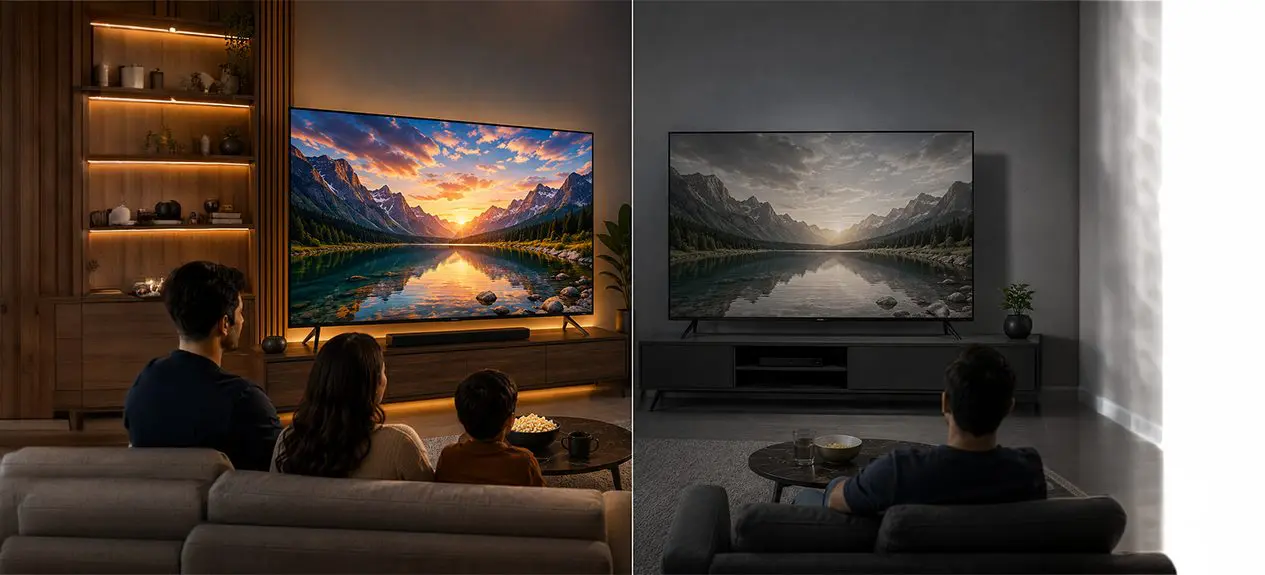

A few years ago, simply having internet access was enough to make a television “smart.” You could stream movies, watch YouTube, and download apps without plugging in extra devices. Today, that’s become the standard. Now, a new term is appearing alongside smart TVs: AI TV.
At first glance, they seem almost identical. Both connect to Wi-Fi, run streaming apps, and support voice commands. So why are more brands introducing AI TVs, and is there really a difference?
The answer isn’t that an AI TV does completely different things. Instead, it changes how those things happen. Rather than waiting for you to adjust picture settings, switch sound modes, or search endlessly for content, it starts doing much of that work on its own.
This guide explains what AI TV is, how it compares with a smart TV, and which one is better suited to your home.
What is a Smart TV?
A smart TV is simply a television that connects to the internet and runs apps without needing an external streaming device. Instead of relying on a separate streaming stick or set-top box, everything is built into the television itself.
A modern smart TV offers:
- Access to streaming platforms like Netflix, Prime Video and YouTube
- Built-in Wi-Fi connectivity
- Voice search and app support
- Screen casting from compatible phones and tablets
- Regular software updates that add features over time
The Haier A7 HDR10 80cm (32″) Linux Smart TV brings together streaming apps, smart connectivity and an easy-to-use interface, making it well suited to bedrooms, guest rooms and everyday viewing.
Planning to buy a Smart TV? Understanding screen size, display technology, refresh rate and connectivity can make the decision much easier.
Read this blog: The Complete Smart TV Buying Guide: Everything You Need to Know Before Purchasing a TV.
What is an AI TV?
An AI TV starts with everything a smart TV already offers, then also uses artificial intelligence to improve the viewing experience automatically.
Rather than asking you to keep changing settings yourself, it analyses what’s playing on screen and automatically adjusts the viewing experience in real time. A football match, a movie and a nature documentary all demand different picture settings, and an AI TV can recognise those differences automatically.
Depending on the model, AI TV features can include:
- Automatic picture optimisation for different scenes
- AI-powered sound adjustments
- Intelligent upscaling for lower-resolution content
- Personalised content recommendations
- Gaming optimisation
- Smarter voice interactions
An AI TV recognises different types of content and fine-tunes picture and sound accordingly.
Across Haier’s premium television range, artificial intelligence is powered by technologies like Ultrasense AI, which brings together AI processing across visuals, sound, gaming and entertainment, and the AI Ultra Sense Processor, co-developed with MediaTek. It continuously analyses scenes to optimise colour, contrast, clarity and motion while you watch, helping every type of content look more natural without constant manual adjustments.
Models like the Haier New M70 Series Mini LED AI Smart Google TV, New P96 Series QD-Mini LED AI Smart Google TV, and New P7 Pro Series HQLED AI Smart Google TV combine these AI capabilities together with premium display technologies for a more adaptive viewing experience.
Curious how AI is changing the way televisions respond to what you’re watching?
Read this blog: AI Powered TVs and the Rise of Voice-First Entertainment
AI TV vs Smart TV: What’s the Difference?
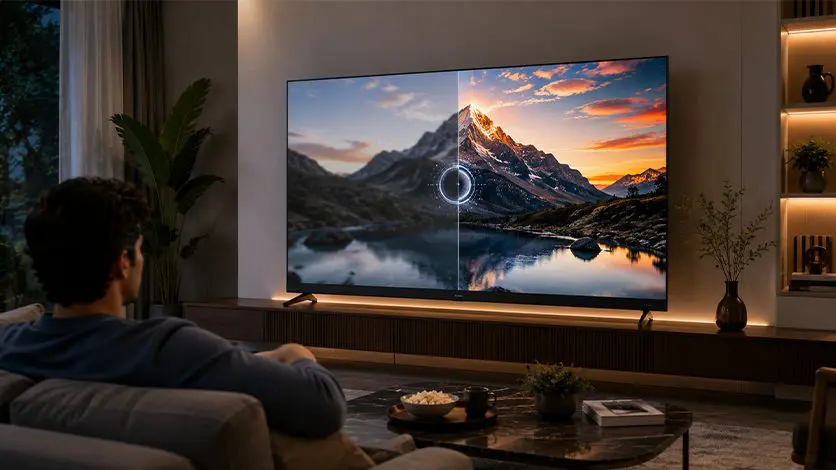
Rather than thinking of them as competing products, think of AI TV as the next step in the evolution of Smart TVs. Every AI TV is a Smart TV, but not every Smart TV includes AI-powered optimisation.
| Feature | Smart TV | AI TV |
| Internet connectivity | ✓ | ✓ |
| Streaming apps | ✓ | ✓ |
| Voice control | Basic voice commands | More natural conversations with AI assistants such as Google Gemini on supported Google TV models |
| Picture settings | Manual adjustment | AI adjusts automatically scene by scene |
| Sound optimisation | Preset sound modes | AI adapts sound in real time |
| Gaming performance | Standard | AI-enhanced gaming optimisation on supported models |
| Content recommendations | Basic | Personalised based on viewing habits |
| Everyday experience | User-controlled | AI-assisted and adaptive |
The biggest difference between Google TV and Android TV is software, but the difference between a Smart TV and an AI TV is that AI TV is built on the foundation of a smart TV by making everyday viewing more intelligent.
Which One Fits Your Home Better?
If your TV is mainly used for streaming shows and regular television, a Smart TV covers the essentials well. But if movies, gaming, sports, and voice control are part of everyday viewing, an AI TV offers a more seamless experience by adapting automatically.
Go for a Smart TV if:
- You mostly stream movies and shows.
- You’d rather keep the viewing experience simple.
- You don’t mind adjusting settings yourself now and then.
Go for an AI TV if:
- You want the picture and sound to optimise automatically.
- Voice control matters to you.
- Gaming, sport and HDR content are a regular part of your viewing.
- You’d want the TV to adapt on its own, without manual adjustments.
Finding the Right Haier TV for Your Viewing Needs
Once you know whether a Smart TV or an AI TV suits your home better, the next step is picking a model that actually has what you need. Haier’s TV range covers everything from smart entertainment to AI-powered viewing that keeps adjusting picture, sound and performance.
1. For everyday streaming and entertainment
If you’re looking for OTT content, live TV and YouTube through a simple, easy-to-use interface, the Haier A7 HDR10 80cm (32″) Linux Smart TV delivers built-in streaming apps, HDR10 support and a straightforward Smart TV experience that suits everyday viewing well.
2. For AI-powered picture optimisation
The Haier New P7 Pro Series HQLED AI Smart Google TV automatically adjusts brightness, contrast, colour and clarity through its AI Picture Quality feature, so different types of content look their best without you ever touching the picture settings.
3. For movies, gaming and premium entertainment
The Haier New M70 Series MiniLED AI Smart Google TV takes things further with the AI Center MAX and AI Ultra Sense Processor, developed with MediaTek. Together, they intelligently optimise picture, sound, gaming and entertainment in real time through advanced scene recognition.
4. For the most advanced AI TV experience
The New M96 Series QD-Mini LED AI Smart Google TV combines AI-powered picture optimisation with hands-free voice control, making it easier to search for content, control compatible smart home devices and manage entertainment without reaching for the remote.
Whether you’re looking for a Smart TV or an AI TV that continuously fine-tunes the viewing experience, Haier’s complete television range includes models across HD, 4K UHD, QLED, Mini LED and OLED, making it easier to find a TV that matches your home, viewing habits and budget.
Looking Beyond Streaming: How AI Is Changing Television
For years, the biggest improvement in TVs was giving people access to more apps and streaming services. AI is shifting the focus from what you can watch to how the TV helps you watch it.
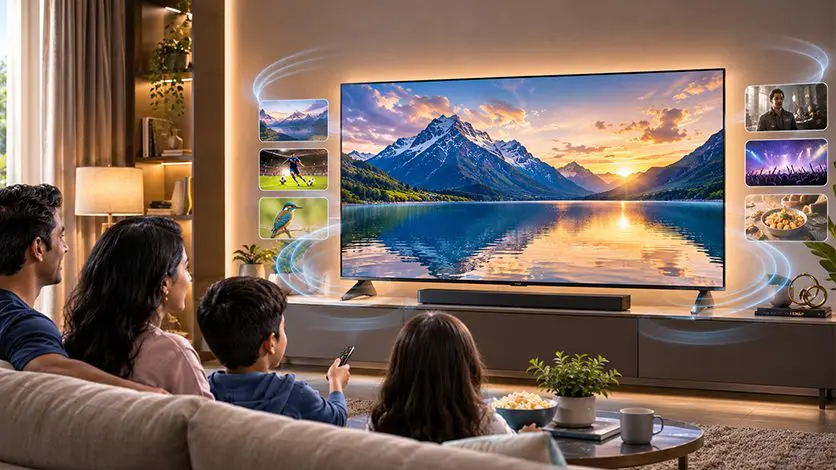
Instead of relying on fixed settings, AI-powered TVs can recognise what you’re watching and adjust picture and sound in real time. A live cricket match, an animated film and a dark thriller all ask very different things from a screen, and AI optimises for each one instead of leaving you to do it manually every time you switch.
Voice interaction has also become a lot more natural. Instead of digging through menus, you can simply search for content, control compatible smart home devices, or ask a question, all with a simple voice command. Over time, AI is making televisions feel less like display screens and more like connected entertainment hubs that respond to the way people actually use them.
Want to see how voice control is becoming a bigger part of home entertainment?
Read this blog: AI Powered TVs and the Rise of Voice-First Entertainment.
Conclusion
A Smart TV and an AI TV may look similar on the outside, but they deliver very different experiences over time. A Smart TV gives you internet-connected entertainment and access to streaming apps. An AI TV builds on that foundation by understanding what’s playing and continuously improving picture, sound and overall performance without asking you to adjust settings manually.
At Haier, AI isn’t treated as a single feature. It’s integrated across picture processing, gaming, sound, voice control and smart home connectivity to make everyday viewing feel smoother and more personalised. Whether you’re choosing your first Smart TV or upgrading to an AI-powered model, understanding AI TV vs Smart TV makes it much easier to invest in a television that will continue feeling smarter long after it’s been switched on.
FAQs
What is the difference between Smart TV and AI TV?
A Smart TV gives you internet access, apps and streaming services. An AI TV builds on those features by using artificial intelligence to optimise picture, sound and other settings automatically.
Which is better: Smart TV or AI TV?
It depends on your needs. A Smart TV is ideal for everyday streaming, while an AI TV offers a more personalised viewing experience with intelligent picture, sound and voice features.
Can an AI TV work without the internet?
Yes, you can still watch cable TV, HDMI devices or downloaded content, though AI features that rely on cloud services or online updates may be limited.
Can an AI TV learn my viewing preferences?
Yes, many AI TVs can personalise content recommendations and optimise settings based on your viewing habits and the type of content you’re watching.
Is an AI TV more expensive than a Smart TV?
Generally, yes. AI TVs usually include more advanced processors and intelligent features, which place them in a higher price segment than standard Smart TVs.
How does AI upscaling work on a TV?
AI upscaling analyses lower-resolution content and intelligently enhances detail, sharpness and clarity, making it look closer to 4K quality on compatible TVs.