

Monsoon weather can be a bit tricky. Rain cools the temperature down but the added humidity can make your room feel sticky, stuffy and uncomfortable. You might feel damp bedsheets, floors take longer to dry, and even a moderately cool room will feel warmer.
This is where AC dry mode can make a visible difference. However, Dry Mode is not always the right choice. On hotter, humid days, Cool Mode may work better.
Now, let’s get to know about the dry mode in a little bit of depth. So that you can make the right/ideal decision depending on the state of your surroundings.
Use AC Dry Mode to Manage Excess Monsoon Humidity
AC Dry Mode is designed to reduce excess moisture in the room rather than cool it as quickly as possible. When you switch it on, the AC draws humid air across its cold evaporator coil. The moisture in the air condenses to form water droplets, which are drained away through the drain pipe. This is why the dehumidifier mode in an AC can make a sticky or clammy room feel much fresher.
Dry mode, unlike Cool Mode, operates the compressor and fan at a more controlled level to prioritise humidity removal. It is best used on cloudy days, rainy evenings or mild monsoon weather when the room is humid but not too hot. Since its main purpose is moisture control, it may not deliver the strong cooling you need on warmer days.
Find Out Why Your Room Still Feels Sticky During the Monsoon
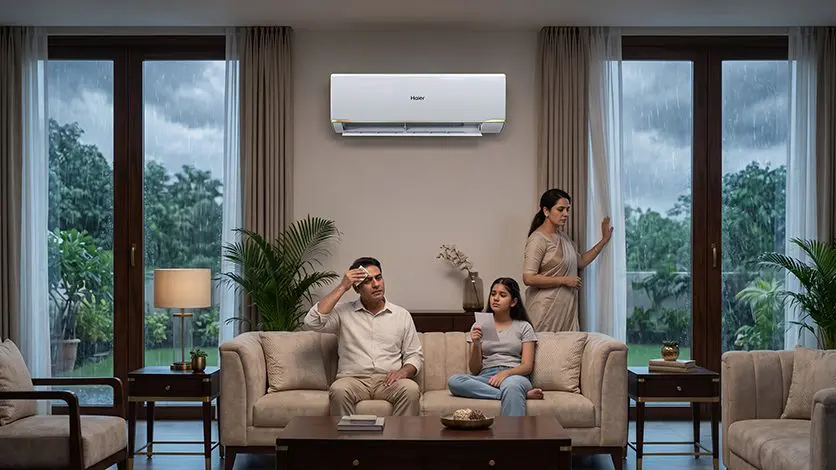
Rainy days can cool you down but they can also make your room feel strangely clammy. That’s because too much moisture can impact your skin, the air in your home, and even the surfaces around you. Here’s why:
- The monsoon brings more humidity as the surrounding air holds more water vapour.
- Your body cools itself by sweating, but in humid weather, sweat stays on your skin instead of evaporating quickly.
- Even if the room isn’t very hot, high humidity can make it feel warm, heavy and stuffy.
- Bedsheets, curtains, walls and floors may feel damp because they absorb moisture from the air.
- Simply lowering the temperature may make the room feel clammy. The right AC humidity control setting can make the space feel more comfortable and less humid.
(Our units adapt to seasonal change through AI integration. Curious?
Read How AI-Integrated ACs Adapt to Seasonal Temperature Changes)
Choose Between Dry Mode and Cool Mode Based on Your Room
The choice between Dry Mode and Cool Mode depends on what is making the room uncomfortable. Following are the basic points of differentiation for your easy understanding:
| Point of comparison | Dry mode | Cool mode |
| Sole purpose | Reduces excess moisture in the room | Lowers the room temperature |
| Ideally used when | The weather is mild, but the room feels sticky or damp | The room feels hot and humid |
| Level of cooling | Provides mild cooling while controlling humidity | Provides stronger and faster cooling |
| Temperature control | Adjustment may be limited with some AC models | You can usually select and control the desired temperature |
| Operation of the Compressor | Runs at intervals to remove moisture without overcooling | Runs more actively to reach and maintain the selected temperature |
| Consumption of electricity | Consumes less power when strong cooling is not required | Consumes more power because it provides continuous temperature control |
| Comfort during monsoon | Useful on cloudy days, rainy evenings and humid nights | Better for warm afternoons or rooms that remain hot after rainfall |
| When to avoid it | When the room is very hot and needs quick cooling | When the temperature is already comfortable, and only humidity is causing discomfort |
Follow These to Make the Best Out of AC Dry Mode During Hot & Humid
Dry Mode can be very useful during the monsoon, but only when you use it the right way. These simple steps will help your AC reduce humidity and keep the room comfortable:
- Close all doors and windows: By leaving the windows open, you are constantly letting humid air from outside in, making it harder for the AC to regulate moisture levels.
- Use it when the room feels humid, not super hot: Dry Mode is best used when the air feels sticky but the temperature is already comfortable. Switch to Cool Mode when you need more aggressive/rapid cooling.
- Clean the AC filters regularly: Dust-clogged filters can restrict airflow and reduce the AC’s efficiency.
- Inspect the drainage system: The AC’s drain pipe takes air moisture out of the house. If you notice water leaks, bad odours, poor airflow or improper drainage, book a service.
- Do not use in place of a dehumidifier: Dry Mode is good enough to tackle normal monsoon humidity but may not be enough for rooms with severe dampness, water seepage or mould.
Allow Haier AC Features to Handle Changing Monsoon Conditions

The monsoon weather can make rooms feel unpleasant and uncomfortable. But Haier ACs are designed to maintain a more comfortable indoor environment with changing weather conditions during the day. Here are five ways they can make you more comfortable in the rainy season:
- Responsive at different humidity levels
Haier ACs feature AI Climate Control, which senses indoor and outdoor temperature, humidity and overall room conditions. It then self adjusts the performance, which is a handy feature during monsoon when weather can change from warm to cool and sticky in matter of hours.
- Helps to remove the excess moisture out of the room
Some Haier AC units also have a dehumidifying function. This is useful for alleviating that damp, clammy feeling that can be so common on rainy days. Dry mode, this is a comfort setting when the room is humid but not too hot.
- Supports cleaner operation of indoor unit
IDU Frost Self-Clean is a feature for cleaning the indoor unit where dust and moisture can collect over time. This is particularly useful in the humid months, but filters and drainage pipes still need to be regularly checked and cleaned.
- Helps keep the outdoor unit cleaner
The AI ODU Cyclone Clean feature reverses the outdoor-unit fan to blow dust and debris off the condenser when the AC unit is turned off. A clean condenser helps in better heat exchange and helps the AC to maintain efficient cooling.
- Resists corrosion from moisture
To help guard against rust, Haier puts an anti-corrosion coating on the condenser and evaporator coils. Its Blue Fin hydrophilic technology helps the condensed water to spread out into smaller droplets and flow more smoothly to the water collection tray.
Conclusion
Use Dry Mode if your room feels sticky or damp, but not very hot. Switch to Cool Mode for faster, stronger cooling.
For better results, keep the room closed, clean the filters and check the drainage system regularly. Doesn’t matter if monsoon conditions change, Haier ACs can also help maintain comfort. The simplest approach is to select the mode according to the room feel and not just the outside weather.
FAQs
What is AC Dry Mode and how does it work?
The AC Dry Mode is meant to remove excess moisture from the air in your home. The ac blows air over the evaporator coil, which is cold, and the air gets humid. The cold evaporator coil of the AC condenses it into water and drains it out the pipe.
Does AC Dry Mode reduce humidity without cooling the room too much?
Yes, Dry Mode is more about removing humidity and not about quickly lowering the room temperature. It will cool down a bit, but for the most part just makes the room feel fresher without being too cold.
Dry Mode vs Cool Mode: Which AC mode is better during the rainy season?
Use Dry Mode when it feels humid or sticky but not very hot in the room. If the room is hot and humid, choose Cool Mode. You’ll have better temperature control, but it will also dehumidify a bit.
Does using Dry Mode save electricity compared to Cool Mode?
Dry Mode may use less electricity when strong cooling is not needed. However, the actual consumption will depend on the AC model, humidity level, room size, selected settings and running time, so the savings are not guaranteed in every situation.
When should you avoid using Dry Mode on your air conditioner?
Do not use Dry Mode when the room is very hot and requires fast cooling. It should also not be used as a sole solution for water seepage, visible mould or severe dampness, as these need to be dealt with separately.
Can Dry Mode replace a dehumidifier during the monsoon?
Dry mode is usually okay for normal monsoon humidity. However, it may not be able to replace a dedicated dehumidifier in very damp rooms as a dehumidifier is designed to capture and extract moisture without acting as a room air conditioner.