
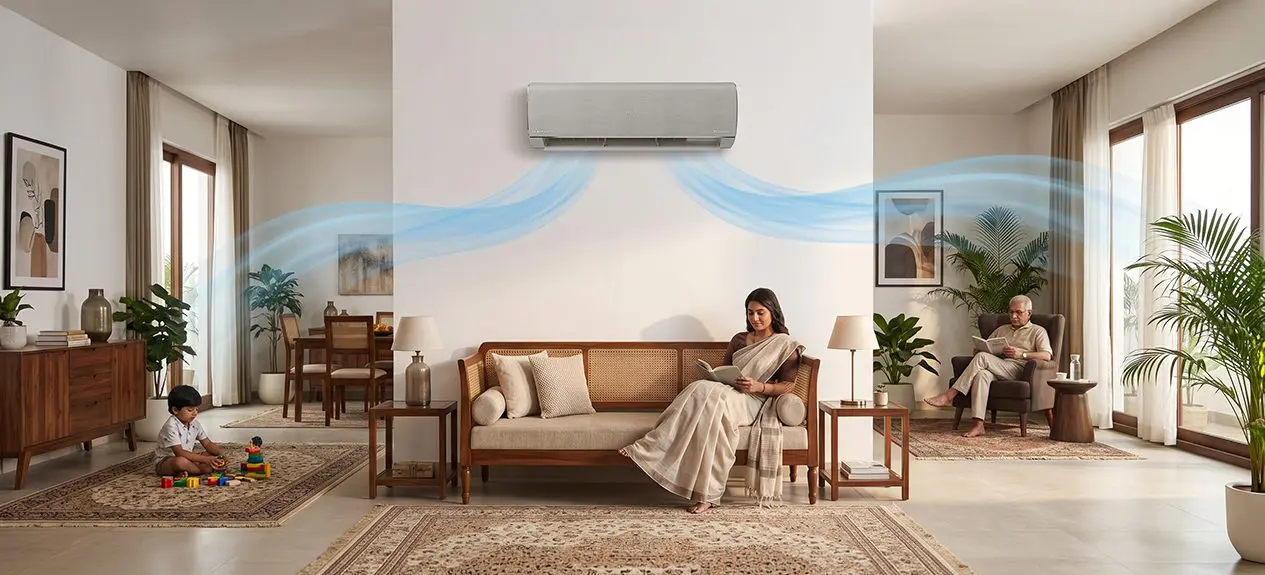

You know how the spot right under your AC unit is always nice and cool, but the far side of the room can still feel kind of warm? This does not necessarily mean the AC does not have cooling capability.
This is where air flow in an AC comes into play. It is the distance that cool air can travel after leaving the indoor unit. This can make a big difference, especially in large rooms, long living spaces, or rooms with uneven layouts.
Now, let’s help you understand what air flow actually refers to in an AC (in depth), so that you are not misled or face any type of confusion.
Understand What Air Flow Really Means in an AC
Air flow is the distance that cooled air can travel from the indoor unit out into a room. It decides whether the airflow is concentrated on the AC or spread further away, such as on a bed, sofa or work desk. In large or spacious rooms, where the cooling needs to reach beyond the immediate vicinity of the unit, a longer air flow can be particularly useful.
But air flow is not the same as air flow volume or air circulation. Airflow volume is the amount of air the AC moves in a given time, while air circulation is how evenly that air spreads throughout the room. The three need to work together to cool down properly. The AC must be able to move enough air, push it far enough and distribute it in the right direction to avoid hot and too cold spots.
Learn What Affects Your AC’s Airflow Distance

One feature doesn’t just allow cool air to travel a certain distance. The answer depends on the internal design of the AC, the fan speed, the installation location, and even the way your room is set up. The main factors affecting the AC airflow distance are:
- Indoor fan speed and motor performance: The indoor fan blows the cool air into the room. You want a good motor and a higher fan speed to push the air more.
- Fan blade and air duct design: The smoothness of airflow through the AC is affected by the design of the fan blade, air outlet, and internal duct.
- Direction of airflow and louvre position: The direction of the air is controlled by the louvres (up, down, left or right). Directing airflow from the right AC in the proper way allows the cool air to reach the required part of the room.
- AC placement and room layout: Wardrobe, curtain, partition or big furniture can block the airflow. Ideally, the indoor unit should be facing the main occupied space with a clear line of sight.
- Filter condition and regular maintenance: Dusty filters restrict the amount of air passing through the unit. This could reduce air flow and also lower the AC air circulation.
Searching for reliable ACs lately?
Decide amongst Haier’s range of AC models to suit your style and home
Match the AC Air Flow to Your Room
The shape of the room, placement of the furniture, seating arrangement, and location of the AC play an important role in proper air flow. In some applications, a longer distance for AC airflow can be an advantage. But this is not the case with all rooms. Here are the things to be sure of:
- Consider the length of the room: Moderate air flow may be fine for a short bedroom or study. Longer living rooms require stronger air flow to get the cool air to the end of the room.
- Consider where people usually sit/sleep: If the bed, sofa or work desk is located far from the indoor unit, a longer air flow can help deliver cooling directly to the occupied area.
- Note the shape of the space: Square rooms are typically easier to keep evenly cool. Better swing control with adequate air flow may be required for L-shaped rooms, narrow layouts and spaces with corners.
- Note any furniture or partitions that are blocking the air: Wardrobes, tall cabinets, curtains and room dividers can block airflow. In those cases, the proper placement of the AC could be as important as the air-flow distance listed.
- Match air flow with the correct AC capacity: Air flow is not a substitute for the wrong tonnage. The AC should be sized to have the right amount of cooling capacity for the room, and its airflow features help to distribute that cooling more effectively.
Choose the Right Air flow for Comfortable Cooling through Haier

Air flow is important, but don’t let it be the only thing you decide on. Compare the following points to your room size, layout and everyday cooling needs before you buy:
Up to 20-metre airflow for greater reach
Select Haier split AC models offer airflow of up to 20 metres. This can be useful in long living rooms, larger bedrooms or spaces where the seating area is far from the indoor unit.
Four-way swing for wider air distribution
Four-way swing moves the louvres vertically and horizontally instead of sending air towards one fixed spot. This helps cooled air reach different sides of the room and reduces the chances of one area feeling too cold while another remains warm.
AI Target Cooling for focused comfort
Available on select Haier models, AI Target Cooling lets users choose a specific cooling area through the Hai Smart App. The AC then directs airflow towards that selected zone, which can be helpful when you want faster comfort around a sofa, bed or work desk.
Model-specific air-circulation rates and fan levels
Along with air-flow distance, check the AC’s air-circulation rating in CMH and the number of available fan speeds. The Haier Andromeda model offers air circulation of up to 1,400 CMH with multiple indoor fan levels. These controls allow you to use stronger airflow for quicker reach and gentler airflow once the room feels comfortable.
Vertical airflow for suitable room layouts
Haier’s Spartan AI Tower AC includes vertical airflow, which sends cooled air across the room from a floor-standing unit. This format can suit spaces where wall-mounted airflow may be blocked or where cooling needs to reach people across a larger open area.
(To make an ideal final decision,
also read Understanding BTU and Cooling Capacity: Choosing the Right AC for Your Space)
Conclusion
Air circulation in AC determines the rate and uniformity of cooling in ACs. But more airflow distance doesn’t always mean more comfort. Fan speed, louvre direction, air-circulation rate, room layout, filter condition, and the correct tonnage all play a role.
Before you buy, be sure to compare these features with the size of your room and how you plan to seat. The cooler air will get further with the right balance, reducing warm pockets and providing more consistent cooling throughout the space.
FAQs
What is AC air flow?
AC air flow is the distance the cooled air travels after leaving the indoor unit. A longer air flow helps the cool air reach beds, sofas, desks and other areas further away from the AC.
Why is air flow important when buying an air conditioner?
Air flow affects how evenly and quickly the room feels cool. If the air flow doesn’t go far enough, you may feel cold near the AC but still be warm in the far corners of the room. Fan speed settings and 4-way swing features can also help the air circulate better.
What is the difference between AC air flow, airflow and cooling capacity?
Air flow is the distance the air travels. Airflow is the volume of air the AC moves, typically measured in CMH. The cooling capacity, usually measured in tonnes, indicates how much heat the AC can take out of the room. All three should work together to provide comfortable and even cooling.
Can poor AC installation reduce the air flow?
Yes, if the indoor unit faces a wall, wardrobe, curtain or partition, the air flow may get blocked. Even the placement of the AC in the corner or at an inappropriate height can impact how well the air spreads. Correct placement with an unobstructed airflow path helps the AC produce better air flow and circulation.