
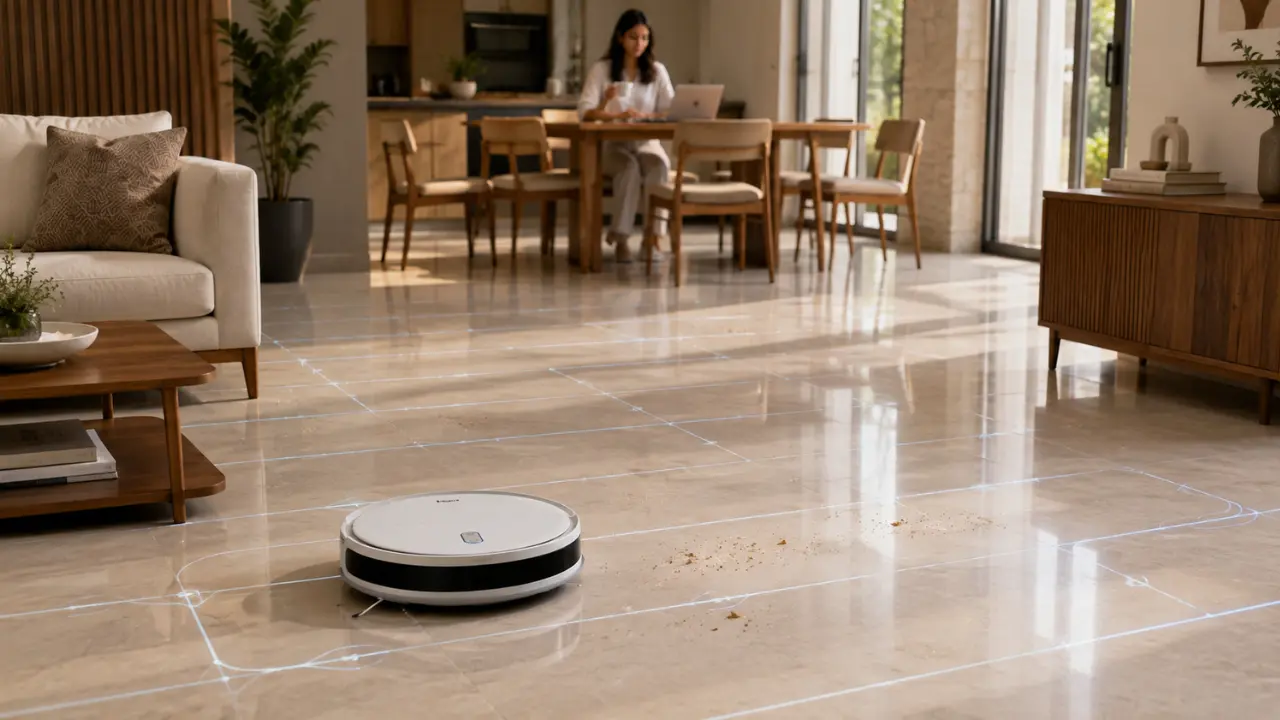

A robot vacuum is able to navigate a room, collect dust and return to the charging base. However, a moveable cleaning appliance isn’t necessarily very smart.
The real question is that is the robot aware of what areas it has cleaned and what areas it has not?
This is where random cleaning and smart mapping are seen. Random-navigation robots are robots that have their responses to their environment programmed by the order that they come into contact with it. The mapping-based robots have taken a more organized approach, learning about the layout and planning their movements, and then moving accordingly.
It can make a lot more difference for Indian homes with furniture, multiple rooms, various floor surface areas, and lots of dusty items you commonly use in your home.
Random Cleaning: It Moves, But Does It Have a Plan?
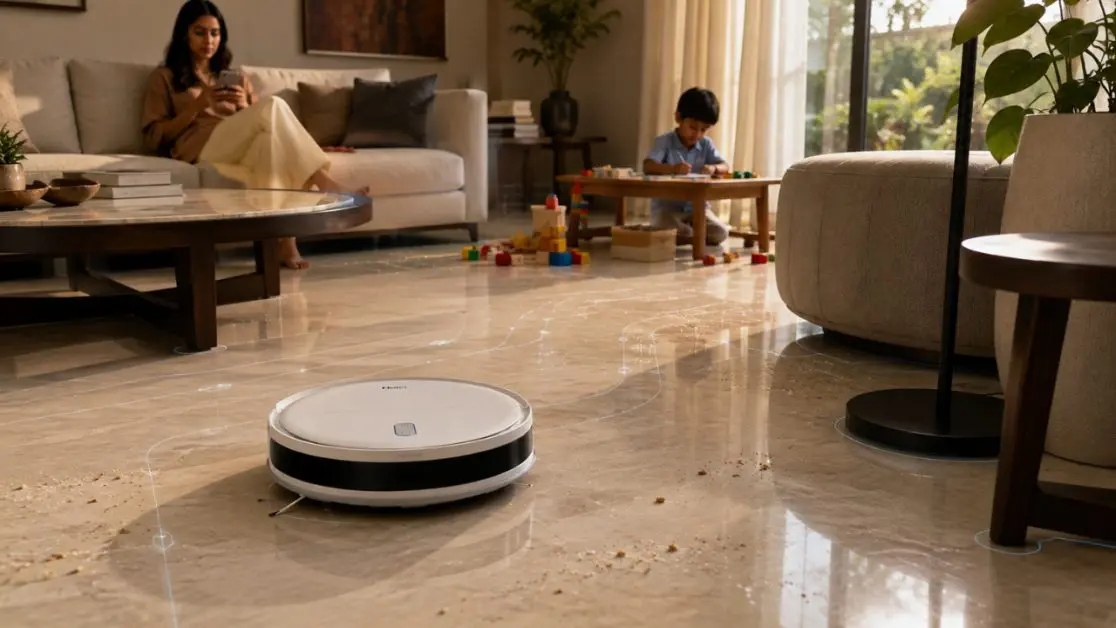
Picture someone cleaning a living room without remembering where they have already swept. They clean one corner, wander towards the sofa, return to the same corner and eventually reach another part of the room.
The floor may still get cleaned. The route, however, is hardly efficient.
Random cleaning works on a somewhat similar principle. A robot travels until its sensors detect an obstacle or boundary, changes direction and continues.
This approach can work reasonably well in smaller, uncomplicated spaces. Give the robot enough time and it may cover much of the accessible floor.
The limitation becomes clearer when the layout gets complicated.
A dining table with six chairs. A passage connecting three bedrooms. A sofa breaking up the living area. Perhaps a carpet sitting between tiled sections.
Suddenly, simply moving around is not the same thing as cleaning systematically.
Smart Mapping Changes the Job From Wandering to Navigating
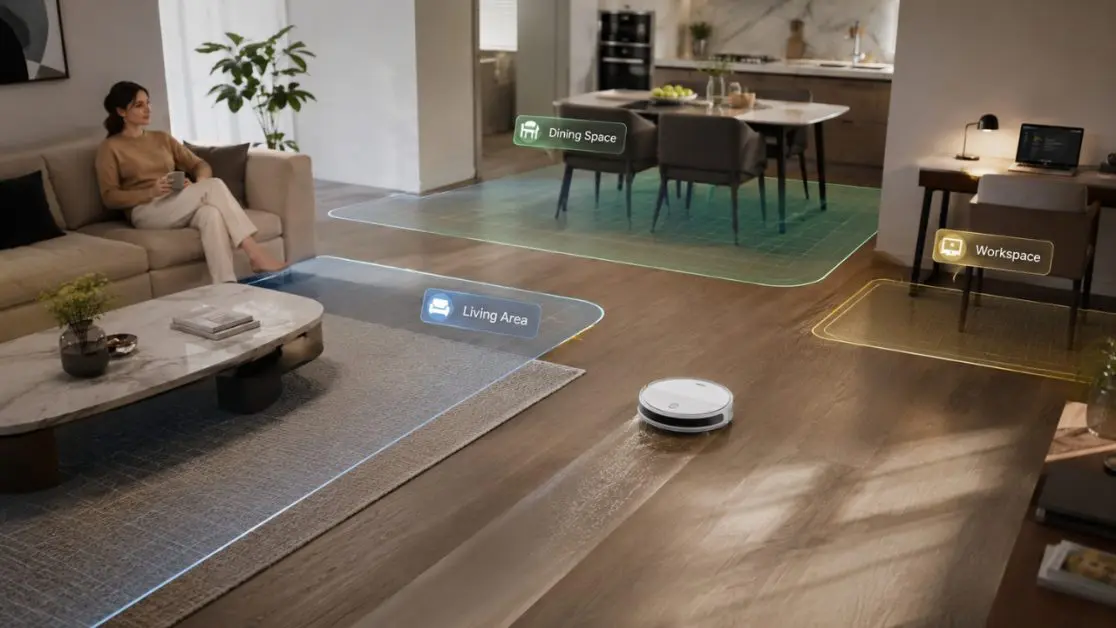
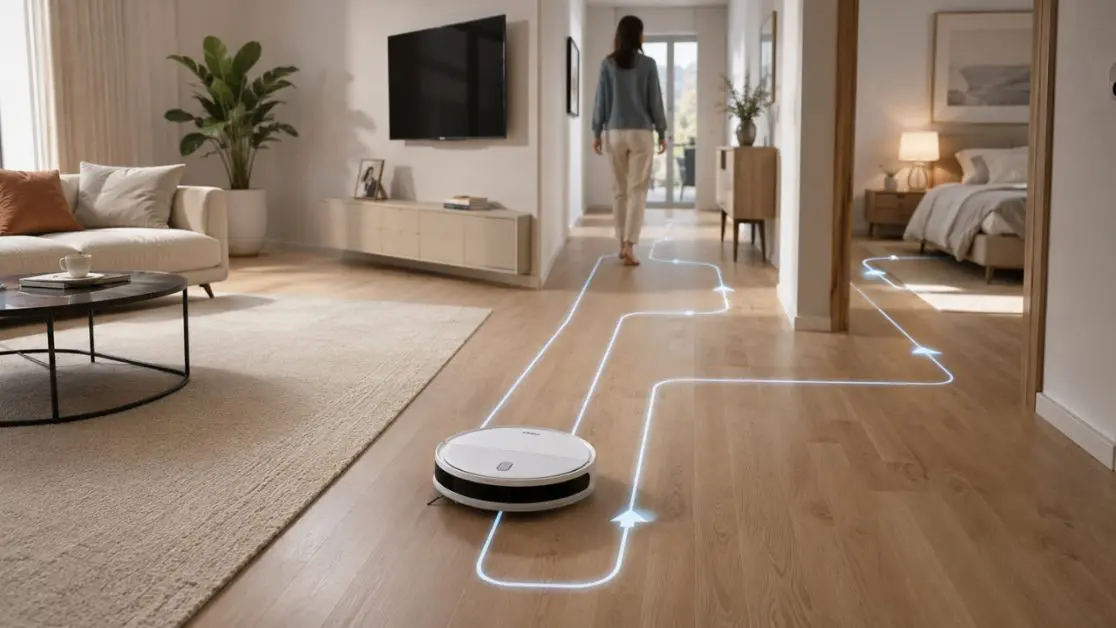
A mapping-enabled robot tries to understand its surroundings before and while cleaning. Rather than treating every movement as an isolated event, it uses information about the home to navigate more deliberately.
This is where laser navigation becomes particularly useful.
The Haier CIVIC X11 and CIVIC X11 PRO, for example, use laser navigation. Haier describes the technology as supporting precise, efficient cleaning along with obstacle avoidance and thorough coverage. Both models also offer memory for up to five maps.
In practical terms, mapping gives the robot something random cleaning lacks: context.
It isn’t merely asking, “Can I move forward?”
It is effectively working with a second question as well: “Where should I clean next?”
Why Five-Map Memory Can Be Useful
Not every Indian home exists on one uninterrupted floor.
Duplexes, villas and multi-level homes present an obvious challenge for robot cleaning because one floor plan cannot represent every level. The five-map memory available on the Haier CIVIC X11 range allows the system to retain multiple mapped areas. Haier specifically positions this functionality for efficient cleaning across five separate areas.
That makes mapping more than an impressive specification on a product page. It has a practical purpose in homes where cleaning requirements extend across different spaces.
Smart Mapping vs Random Cleaning at a Glance
| Cleaning consideration | Random cleaning | Smart mapping |
| Navigation style | Reactive movement around the available space | Structured navigation based on mapped surroundings |
| Route planning | Limited | More systematic |
| Repeated passes | Can occur more frequently | Mapping can help organise coverage |
| Complex layouts | May become less efficient | Better suited to planned navigation |
| Multiple mapped areas | Generally not the focus | Supported when the product offers multi-map memory |
| Customised cleaning potential | More limited | Can support more targeted cleaning features |
The important distinction isn’t whether one robot moves faster than another. It is whether that movement is purposeful.
Navigation Alone Doesn’t Clean a Floor
Here is the catch people sometimes miss.
A brilliant map cannot pick up a crumb.
Navigation determines where a robot goes; the vacuuming and mopping system determines what happens when it gets there. A capable robot vacuum therefore needs the two sides to work together.
This is where the Haier CIVIC X11 Robot Vacuum Cleaner becomes interesting for everyday cleaning. Alongside laser navigation and five-map memory, it provides maximum 5000Pa suction power and supports 2-in-1 mopping and sweeping. Haier lists its suitability across surfaces including tiles, marble, hardwood, carpets and linoleum.
That combination matters because Indian homes rarely contain just one kind of flooring.
There might be marble through the living room, tiles in another area and a rug somewhere in between. Navigation should help the appliance cover the home intelligently, while the actual cleaning hardware still needs to deal with what is under it.
What Does Smart Cleaning Look Like in Daily Life?
Consider a fairly ordinary morning.
There are crumbs around the dining table after breakfast. Dust has worked its way into the passage. A pet has left hair around the living room. Nobody particularly wants to spend the morning sweeping and mopping every accessible patch of flooring.
This is where automation starts earning its place.
The CIVIC X11 supports scheduled or customised cleaning, automatic return to charge and multiple sensors including AntiFall functionality. It also provides True IoT control through the mobile app, TV app, Google or Alexa. Its listed runtime is up to 120 minutes from a 2600mAh battery.
So the value proposition moves beyond “a vacuum cleaner without a handle”.
It becomes a cleaning system that can navigate, remember maps and operate with a higher degree of automation.
And Yes, Pet Homes Have Their Own Problem
Anyone with a dog or cat knows the routine. You clean the floor and somehow there is hair again. Almost immediately.
Haier specifically positions the CIVIC X11 as pet-friendly, with the product material highlighting its ability to clean pet hair and everyday pet messes. Combined with 5000Pa maximum suction, that makes it relevant to households dealing with recurring floor debris rather than only occasional cleaning.
Where the Haier CIVIC X11 PRO Takes Automation Further
There is another layer to robot vacuum ownership that doesn’t get discussed enough: somebody still has to deal with the dust collected by the robot.
The Haier CIVIC X11 PRO Robot Vacuum Cleaner addresses that with an auto-empty station. After cleaning, the robot can automatically empty its onboard dustbin into the station’s larger dust box. The product specifications list a 250ml onboard dustbin and 3.5L capacity alongside it.
That is a meaningful distinction.
The CIVIC X11 already brings together laser navigation, five-map memory, 5000Pa suction, wet-and-dry cleaning and smart controls. The CIVIC X11 PRO builds on that proposition by reducing another manual step, the frequent emptying of the robot’s dustbin.
Both models also include a 300ml water tank, brushless motor and up to 120 minutes of listed runtime.
So, Which Cleaning Approach Actually Works Better?
If the only requirement is cleaning a small, open area and efficiency is not particularly important, random navigation can still do the basic job.
But as homes become larger or layouts become more complicated, smart mapping has the stronger practical advantage. It gives the robot a structured understanding of the environment rather than relying primarily on repeated movement and course correction.
When choosing a robot vacuum, therefore, look beyond suction numbers alone. Consider whether the appliance can:
- Map the cleaning environment
- Remember multiple areas where required
- Navigate around household obstacles
- Support scheduled or customised cleaning
- Vacuum and mop according to your household needs
- Return automatically for charging
- Fit naturally into the smart-home controls you already use
These are the details that determine whether a robot vacuum feels genuinely autonomous after the novelty wears off.
A Smarter Route to Everyday Floor Care
The most useful robot vacuum isn’t necessarily the one that spends the longest time travelling around the house. It is the one that knows how to use that time.
That is the appeal of the Haier CIVIC X11 and CIVIC X11 PRO Robot Vacuum Cleaners. Laser navigation and five-map memory provide the intelligence behind movement, while 5000Pa suction, 2-in-1 vacuuming and mopping, smart controls and automatic return-to-charge functionality handle the practical side of everyday floor care. For households wanting an additional level of convenience, the CIVIC X11 PRO adds its auto empty station.
Random movement can eventually cover ground. Smart mapping is about knowing which ground needs covering in the first place. And for a busy Indian household, that is a much more useful definition of “smart”.
Frequently Asked Questions
1. What is smart mapping in a robot vacuum cleaner?
Smart mapping allows a robot vacuum cleaner to understand and remember the layout of a cleaning area instead of simply moving around without a structured route. The Haier CIVIC X11 and CIVIC X11 PRO use laser navigation and offer five-map memory, helping them navigate and clean mapped spaces more systematically.
2. Is smart mapping better than random cleaning?
For larger, multi-room or more complex home layouts, smart mapping generally offers a more organised approach. Rather than relying mainly on reactive movement, a mapping-enabled robot can use its understanding of the surroundings to navigate more purposefully.
3. Can the Haier CIVIC X11 remember multiple floor maps?
Yes. The Haier CIVIC X11 Robot Vacuum Cleaner supports built-in memory for up to five maps, making the feature particularly useful when different areas or floors need to be mapped for cleaning.
4. Does the Haier CIVIC X11 only vacuum floors?
No. The CIVIC X11 offers 2-in-1 vacuuming and mopping, with wet and dry cleaning modes. It also features up to 5000Pa suction power, a 250ml dustbin and a 300ml water tank.
5. How long can the Haier CIVIC X11 operate on a charge?
According to Haier’s product specifications, the CIVIC X11 has a 2600mAh battery with a listed runtime of up to 120 minutes. It also supports automatic return to charge.
6. What is the main difference between the Haier CIVIC X11 and CIVIC X11 PRO?
Both models offer features such as laser navigation, five-map memory, 5000Pa suction and smart controls. A notable addition on the CIVIC X11 PRO is its auto-empty station, which enables the robot to transfer collected dust automatically from its onboard dustbin into a larger dust box.