
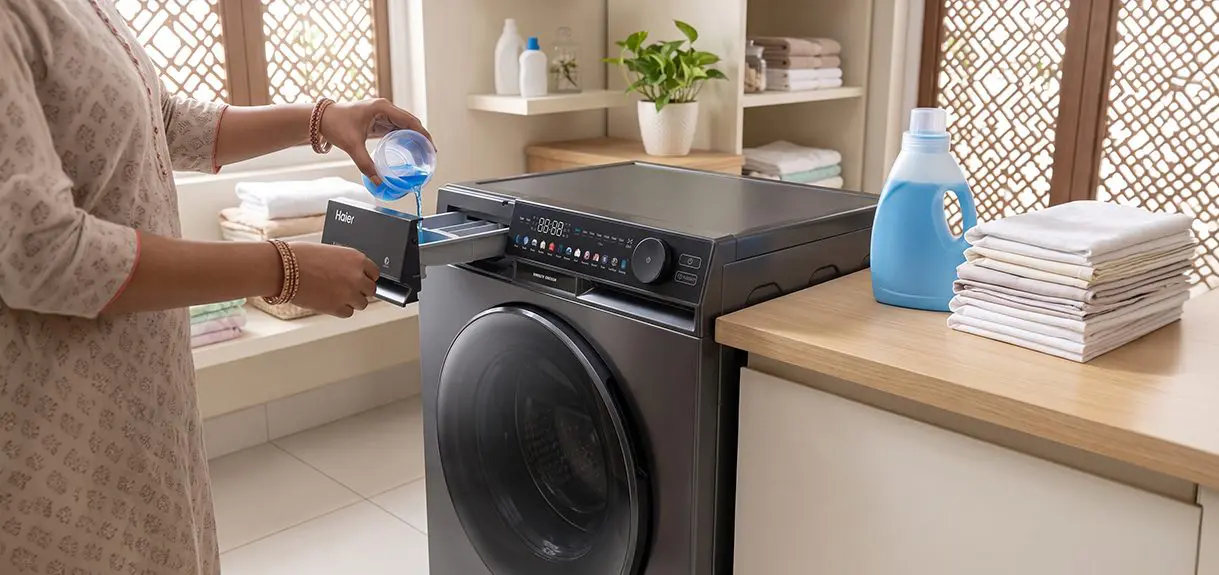

Most households measure detergent by instinct rather than by any fixed standard, and this is precisely where laundry outcomes begin to vary. Liquid laundry detergent appears straightforward to use, which is exactly why its quantity receives so little deliberate thought. A marginally heavier pour accumulates as residue over successive washes. A marginally lighter one leaves fabric looking worn before its time.
None of this calls for precision instruments or constant recalculation. It requires only a clearer understanding of what the dose depends on, and of how a washing machine is designed to handle that liquid once it reaches the drum.
Why Getting the Right Amount Matters
Detergent dosage is not a trivial consideration. It governs how clean garments emerge and how they feel to the touch afterwards. An excess quantity leaves the machine struggling to rinse it away completely. Fabric can turn stiff as a result. Whites can lose their brightness over repeated cycles. An insufficient quantity, in turn, leaves the wash unable to address grease, sweat, or ground-in dirt, particularly within a full load. Neither outcome indicates a fault in the machine. It indicates a dosage that has not been matched to the load at hand.
Liquid Detergent Dosage Guidelines You Should Follow
No single amount can be prescribed as universally correct for every wash cycle. Liquid detergent dosage guidelines are determined by several factors acting in combination, rather than by any one fixed rule. The liquid detergent amount should, therefore, be adjusted in accordance with load size, soil level, and water hardness.
A few considerations are worth checking before pouring:
- Load size: A half load requires less detergent than a full drum. Overdosing a small wash wastes product and adds residue.
- Soil level: Lightly worn clothes require less than heavily soiled workwear.
- Water hardness: Hard water reduces cleaning power, so regions with harder water often require a slightly higher dose.
- Fabric type: Delicates and everyday cottons do not require identical dosing.
- Cap markings: Most detergent caps carry level markers, which are worth relying on instead of estimating by eye.
Following the guidance printed on the bottle, adjusted slightly for local water conditions, resolves most dosage issues before they arise.
Washing Machine Detergent Dispenser Guide
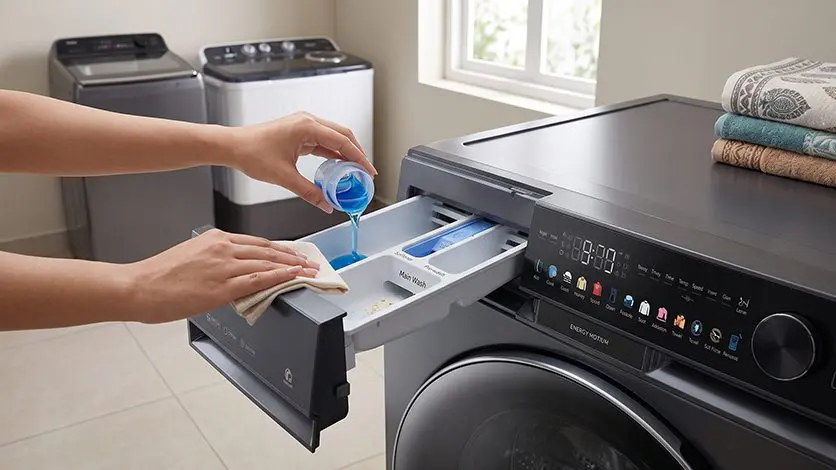
The placement of the detergent is a consideration equal in importance to the quantity used. A proper washing machine detergent dispenser guide begins with an understanding of the compartments involved. Front-load and top-load automatic machines are typically equipped with a drawer comprising separate sections for detergent, pre-wash, and fabric softener. Liquid detergent generally belongs in the main wash compartment.
Semi-automatic machines operate differently. There is no dedicated drawer, so the detergent is added directly into the wash tub once it fills with water. This makes accurate measuring even more essential, since nothing governs the release timing. Across every machine type, the dispenser or compartment should be cleaned periodically. Detergent buildup inside the drawer can affect how well the liquid mixes with incoming water during the next wash.
Best Practices for Liquid Laundry Detergent
A few habits make a noticeable difference over time. These best practices for liquid laundry detergent are simple, and consistency is what makes them effective.
- Measure on every occasion, even for a load that resembles the previous one.
- Use the dispenser drawer as intended, rather than pouring detergent directly onto clothes when a drawer is provided for that purpose.
- Use warmer water settings for oily or heavily soiled fabrics, since liquid detergent activates more effectively at slightly higher temperatures.
- Store the bottle upright, away from direct heat.
- Resist the instinct to add extra “just in case.” A second dose rarely results in a cleaner wash. It usually results in additional rinsing work for the machine.
Want to know which wash cycle actually suits your fabric?
Read this blog: Choosing the Right Wash Cycle for Every Fabric
How We at Haier Approach Detergent Dosing
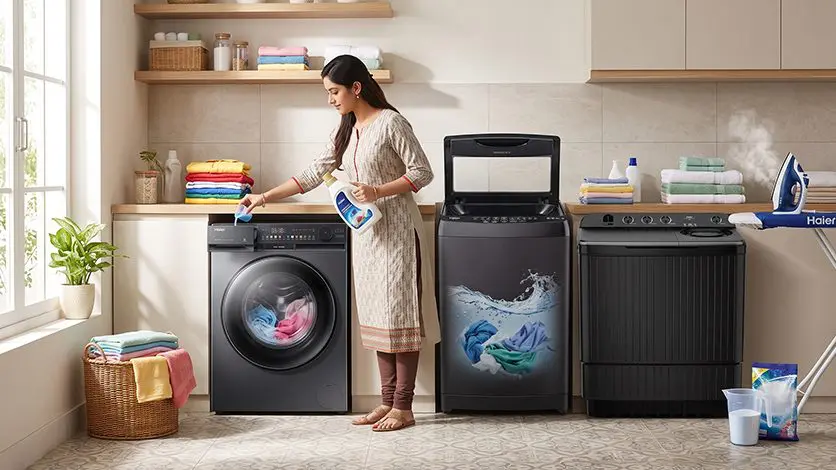
At Haier, we do not regard detergent dosing as something the user should have to estimate. We have built our washing machines around the principle that the correct amount, delivered the correct way, should not depend on memory or guesswork. Across our front load, top load, and semi-automatic ranges, we have approached this differently for each machine type, since each one interacts with liquid detergent in its own manner.
1> Front Load Range
In our front load machines, including the F-series, we introduced Smart Dosing, a system that calculates detergent quantity based on the laundry’s weight rather than a fixed estimate. A single fill can serve multiple washes, with the dose adjustable upward or downward as needed. Alongside this, Essence Wash pre-mixes detergent before spraying it directly onto the fabric, rather than allowing it to dissolve slowly in standing water, which permits deeper fibre penetration in less time. Dual Spray then operates during the rinse phase, flushing the drum door and gasket to prevent foam residue and mould spots. Combined with Anti-Bacterial Technology, steam functionality, and Ultra Fresh Air circulation after the cycle concludes, the process is designed to leave minimal detergent trace behind.
2> Top Load Range
Our top load machines take a different route toward the same objective. The Oceanus Wave Drum imitates the gentle motion of hand washing, which helps prevent detergent and fabric from clumping unevenly during the wash. Many top load models include an in-built heater, which improves how thoroughly detergent dissolves and acts on stains, since warmer water activates liquid formulas more effectively. Self-cleaning technology, using nano-material balls, scrubs the tub walls during regular use, helping prevent detergent and dirt from settling. Fuzzy Control senses load weight and adjusts water level automatically, so the detergent added is neither diluted incorrectly nor left under-rinsed.
3> Semi-Automatic Range
We recognise that semi-automatic machines require more involvement from the user, and dosing here depends entirely on how carefully it is measured and added. Since there is no automatic drawer system, we focused on what could be controlled mechanically. Our Magic Filter design captures lint and residue during the wash so it does not redeposit on clothing, and the spray-assisted rinse clears detergent more effectively than a standard drain-and-refill cycle.
Conclusion
Using liquid laundry detergent well is less about the product itself and more about the habits surrounding it. The correct liquid detergent amount, added in the correct place, changes how clean and fresh garments ultimately turn out. A machine can only work with what it is given. Regardless of the type relied upon, small adjustments to measurement and placement make a lasting difference to every load.
FAQs
How do Haier’s Anti-Bacterial Technology (ABT) and self-clean cycles handle detergent residue?
ABT targets bacterial buildup inside the drum, while our self-clean cycle uses nano-material balls and water flow to scrub the tub walls. Together, they reduce the detergent and dirt settling that can otherwise cause odour or residue over repeated washes.
Is washing liquid the same as detergent?
Not precisely. Washing liquid is generally a broader term, whereas liquid detergent is formulated specifically to break down dirt, oils, and stains during a wash cycle, using cleaning agents suited for fabric care.
Is liquid detergent good for a washing machine?
Yes. Liquid detergent dissolves easily in both hot and cold water, leaves less residue than powder in most cases, and works well with the dispenser drawers found in front-load and top-load automatic machines.
What role do Haier’s Dual Spray and Essence Wash technologies play in ensuring complete detergent rinsing?
Dual Spray flushes the drum door and gasket during rinsing to clear foam residue, while Essence Wash pre-mixes and sprays detergent directly onto fabric, helping ensure it penetrates fibres fully and rinses out more completely.