
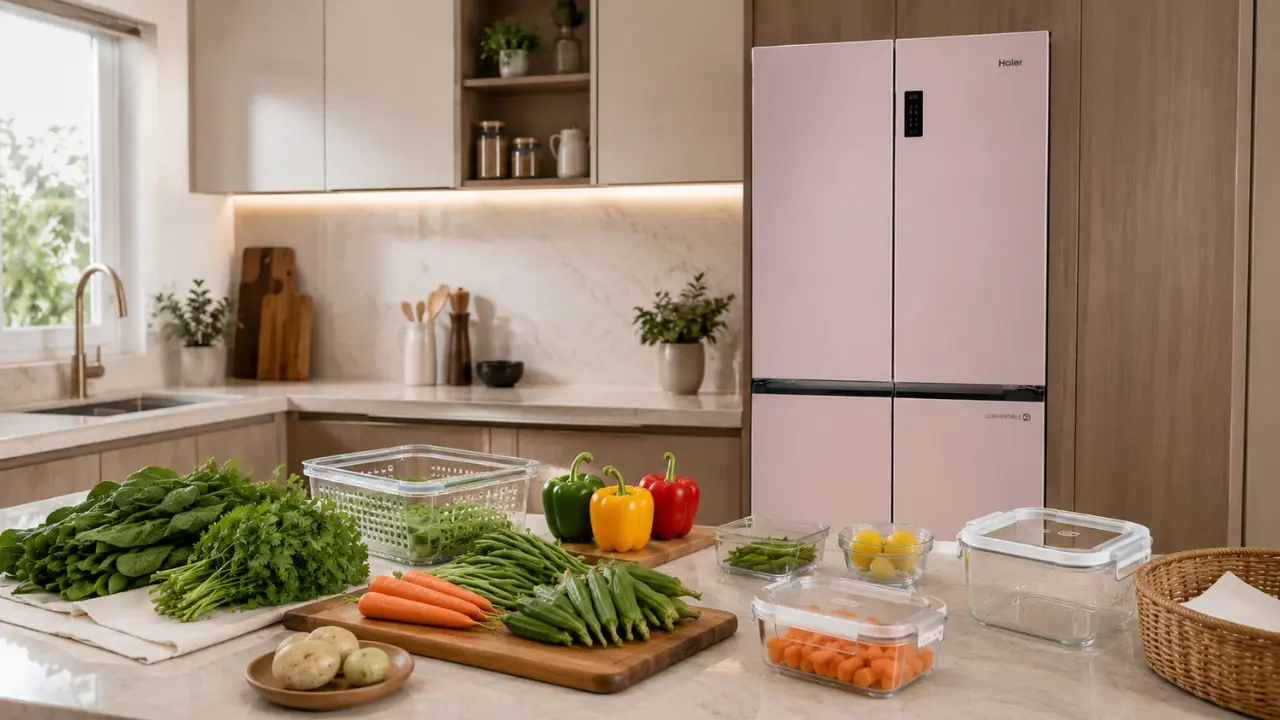

You buy coriander on Sunday. By Wednesday, half of it looks tired. The tomatoes have somehow lost their firmness, the green chillies are starting to wrinkle and there’s one capsicum that nobody noticed in the back of a container.
The refrigerator is a common scapegoat. However, storing vegetables is not as straightforward as placing fresh vegetables in a cold space.
The container matters. So does moisture, air movement, even the way vegetables are cleaned and prepared prior to storage, and, most of all, where they are placed in the refrigerator.
If Indian households regularly purchase palak and methi, bhindi, carrots, beans, cauliflower and lemons, then it makes a lot more sense to organise the refrigerator based on the stuff that is stored in it, instead of buying one container of each.
First, Stop Treating Every Vegetable the Same
A sealed box may work beautifully for chopped carrots but may not be the right choice for leafy greens carrying excess moisture.
That distinction is important.
Vegetables continue to contain and release moisture after purchase. Some dry out quickly; others deteriorate faster when moisture becomes trapped around them. Good storage is therefore about creating a suitable little environment around the product.
Before choosing a container, think about three things:
- How much moisture does the vegetable contain?
- Does it need some ventilation?
- Will it be stored whole, trimmed or chopped?
Once these questions become part of the routine, refrigerator organisation gets surprisingly easier.
1. Ventilated Containers for Everyday Vegetables
Containers with ventilation openings can be useful for vegetables that benefit from some air movement rather than being shut inside a completely airtight box.
Consider them for produce such as:
- Beans
- Capsicum
- Carrots
- Radish
- Cauliflower
- Broccoli
The important part is not to cram the container.
A vegetable box packed to the brim may look wonderfully organised for about five minutes, but overcrowding can restrict airflow and make it difficult to spot produce that should be used first.
Keep enough room for vegetables to sit comfortably and inspect them periodically.
2. Containers with Moisture Management for Leafy Greens
Leafy vegetables are usually where good intentions go to die.
Palak, methi, coriander and other greens can be particularly sensitive to excess surface moisture. Storing them while they are dripping wet is rarely a good idea.
If you wash greens before refrigeration, drain and dry them properly. A container lined with a clean absorbent kitchen towel can help deal with residual moisture. Replace the lining if it becomes noticeably damp.
For leafy vegetables, look for containers that are:
- Wide enough to avoid crushing the leaves
- Easy to open and inspect
- Suitable for adding an absorbent liner
- Large enough that greens are not compressed into a tight bundle
And don’t forget visibility. A transparent container has a simple advantage: you can actually see the coriander before buying another bunch.
3. Airtight Containers for Pre-Cut Vegetables
Weekday meal prep changes the storage equation.
Once vegetables have been peeled or chopped, exposed surfaces need greater protection than whole produce. Clean, food-safe airtight containers are a practical choice for prepared vegetables that are intended for refrigeration.
Use separate containers where possible rather than throwing onions, capsicum, carrots and other chopped ingredients into one large box simply because they are all destined for tomorrow’s dinner.
Smaller containers can also make portioning easier.
Glass or Food-Grade Plastic?
Either can be practical when the container is designed for food storage and used according to its manufacturer’s instructions.
Glass containers are easy to see through and can be convenient for organised meal preparation. Food-grade plastic containers are generally lighter and can be easier to handle when several boxes are stacked inside the refrigerator.
The better choice is the one that fits your routine and your refrigerator shelves properly.
4. Clear Stackable Containers for Better Visibility
Sometimes the biggest problem isn’t freshness. It is a memory.
A vegetable disappears behind two bowls and yesterday’s dal, and suddenly nobody remembers it exists.
Clear stackable containers help create visible zones for different products. More importantly, they can make better use of vertical refrigerator space without turning every grocery run into a game of Tetris.
Try simple categories such as:
- Leafy greens
- Meal-prep vegetables
- Chillies, ginger and smaller ingredients
- Carrots, beans and similar everyday produce
- Vegetables that should be used first
That last category is particularly useful. Keeping a small “use first” container near the front can reduce the chances of older vegetables being repeatedly pushed behind newer groceries.
5. Reusable Produce Bags for Flexible Storage
Not everything requires a rigid box.
Reusable produce bags can be convenient for irregularly shaped or bulky vegetables, especially when refrigerator space changes from one week to another.
The catch? Do not assume every reusable bag is automatically appropriate for refrigerator storage. Choose products specifically intended for food use and follow their care and storage instructions.
Also avoid packing damp vegetables tightly into a bag and forgetting about them. A container cannot compensate for poor preparation.
The Container Is Only Half the Story
Even an excellent vegetable container works better when the refrigerator itself provides usable, organised storage.
This is where refrigerator design becomes relevant.
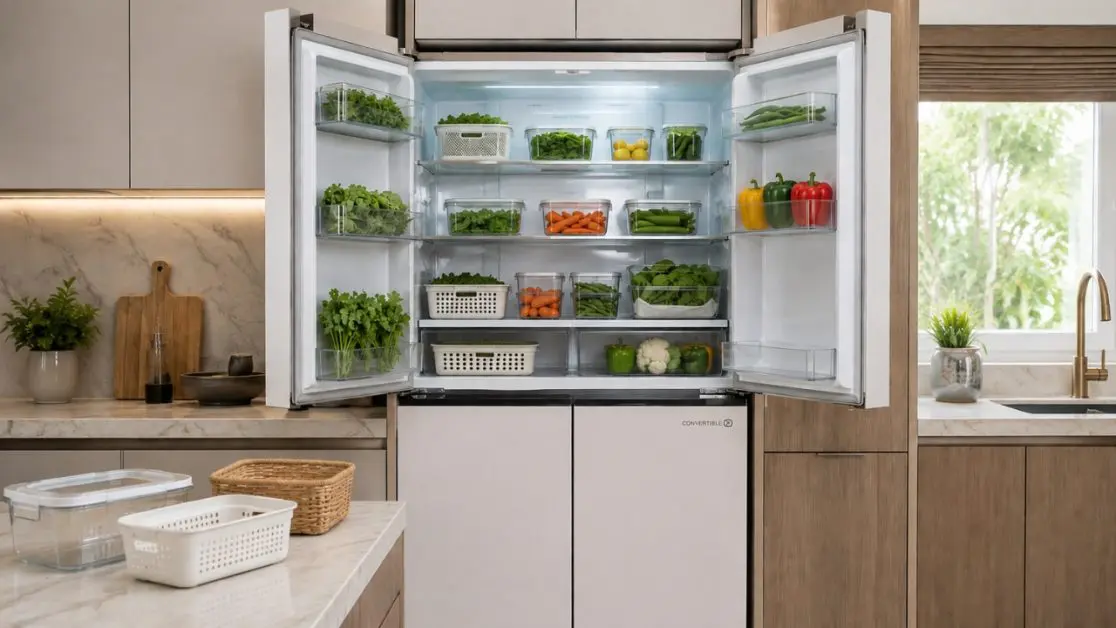
The Haier Lumiere 520L 3 Star French Door Refrigerator is designed around a 520-litre capacity and includes dedicated fruit and vegetable cases. The Lumiere configuration also provides organised storage zones, helping households separate different categories of food rather than piling everything together.
For Indian kitchens where weekly grocery shopping can mean several bags of vegetables, dairy products, beverages, leftovers and meal-prep ingredients arriving at once, that separation can be genuinely useful.
When Your Grocery Load Changes, Your Refrigerator Should Adapt Too
There are weeks when the freezer matters more. Then there are weeks after a large vegetable run, family gathering or festive shopping when additional refrigerator space becomes far more valuable.
The Haier Lumiere addresses this through its convertible configuration.
The product provides a 90-litre convertible section, while its configuration can offer up to 440 litres of refrigerator space when converted accordingly.
The Magic Convertible Zone is adjustable from -20°C to 5°C, with the product material specifically indicating 5°C as an option for fruits and vegetables.
That flexibility changes how containers can be planned. Instead of forcing an unusually large grocery haul into the same fixed arrangement every week, storage can be adapted according to what the household actually needs at that time.
Organisation Matters More Than Owning Twenty Containers
It is tempting to solve refrigerator clutter by buying more boxes.
Usually, that’s not the answer.
A better system uses fewer containers with clearly defined purposes. Keep frequently used vegetables accessible, place older produce towards the front and avoid stacking containers so deeply that the bottom layer becomes invisible.
The Lumiere’s movable door rack and shelf arrangement adds another layer of flexibility, while its toughened glass shelves are designed with Indian household storage requirements in mind. The product also incorporates a 95-degree anti-tipping door rack for bottles.
The point is simple: containers and refrigerator layout should work together.
A Quick Vegetable Storage Routine That Actually Works
Before closing the refrigerator after your next grocery run, spend a few extra minutes organising the produce.
- Sort first. Remove vegetables showing obvious spoilage before storage.
- Avoid storing produce soaking wet. Deal with excess surface moisture before refrigeration.
- Choose containers by vegetable type. Don’t automatically use airtight boxes for everything.
- Avoid overcrowding. Leave vegetables enough space instead of compressing them.
- Label prepared food. Dates are especially useful when vegetables have already been chopped.
- Keep older produce visible. Use it before opening or buying another batch.
- Clean containers regularly. Residue and trapped moisture should not become permanent residents of the vegetable drawer.
Nothing complicated. Just consistent.
Give Fresh Produce the Space It Deserves
The best container for vegetable storage isn’t one specific box that magically works for every sabzi in the house. It is the container that suits the produce, manages moisture appropriately, fits neatly into the refrigerator and makes the food easy to find.
Pair that thinking with a refrigerator designed for flexible organisation, and vegetable storage becomes considerably less chaotic.
For households that regularly keep substantial quantities of fresh produce, the Haier Lumiere 520L 3 Star French Door Refrigerator brings together dedicated fruit and vegetable cases, a 90-litre convertible section, flexible storage, toughened glass shelves and a spacious 520-litre layout. The Lumiere range is available in finishes including Rosette White, Mauve Pink and Pearl White.
Good vegetable storage begins with the humble container. But give those containers a refrigerator layout that can adapt around them, and the weekly grocery becomes much easier to manage.
Frequently Asked Questions
1. Which type of container is best for storing vegetables in the refrigerator?
There is no single container that suits every vegetable. Airtight food-safe containers are useful for many pre-cut vegetables, while leafy greens often need careful moisture management. Ventilated containers can be practical for produce that benefits from some airflow. The container should ultimately match the vegetable and how it has been prepared.
2. Should vegetables be washed before putting them in storage containers?
If vegetables are washed before refrigeration, excess surface moisture should be removed before storage. Leafy greens, in particular, should be drained and dried properly. An absorbent kitchen towel inside the container can also help manage residual moisture.
3. Are glass containers better than plastic containers for vegetables?
Both can work well when they are designed for food storage. Glass containers provide excellent visibility, while food-grade plastic containers tend to be lighter and convenient for stacking. Choose containers that are easy to clean, fit comfortably inside your refrigerator and suit your everyday storage routine.
4. How can I organise different vegetables inside a large refrigerator?
Create separate zones for leafy greens, everyday vegetables, pre-cut ingredients and produce that needs to be consumed first. Clear containers make identification easier. The Haier Lumiere 520L 3 Star French Door Refrigerator also provides dedicated fruit and vegetable cases and an organised storage configuration that can help separate different food categories.
5. Can the Haier Lumiere refrigerator provide additional space for vegetables?
Yes. The Haier Lumiere features a 90-litre convertible section, and its configuration can provide up to 440 litres of refrigerator space when converted accordingly. Its Magic Convertible Zone can be adjusted from -20°C to 5°C, giving households greater flexibility when storage requirements change.
6. What refrigerator features are useful for households that store plenty of fresh produce?
Look for adequate capacity, dedicated vegetable storage, flexible compartments, sturdy shelves and an interior layout that keeps food accessible. The Haier Lumiere 520L 3 Star French Door Refrigerator combines a 520-litre capacity with fruit and vegetable cases, toughened glass shelves and convertible storage, making it well suited to organising varied grocery loads in Indian households.