
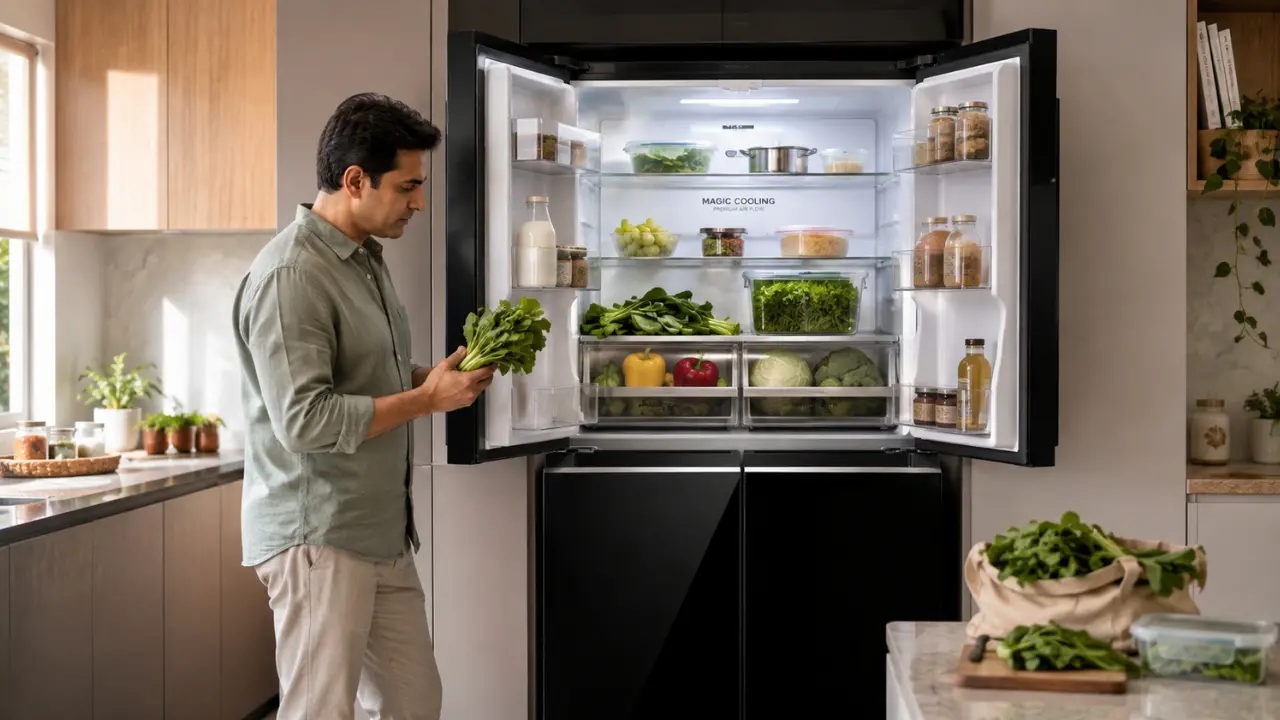

In the evening, you purchased fresh palak. The leaves were crisp, bright and practically out of the bag. Two days later? They are tired, flabby and not very tasty.
It occurs when you use coriander, methi, lettuce, spinach and many more leafy vegetables. While it may seem like the refrigerator is to blame, wilting is often caused by a specific trigger: leafy greens are especially prone to moisture loss, temperature, airflow and how they’re stored.
Being able to understand what makes greens go bad in the fridge can help minimize food waste and improve how Indian households organize them in the refrigerator.
So, what’s happening to those leaves then?
A Leaf Is Still Losing Moisture After Harvest
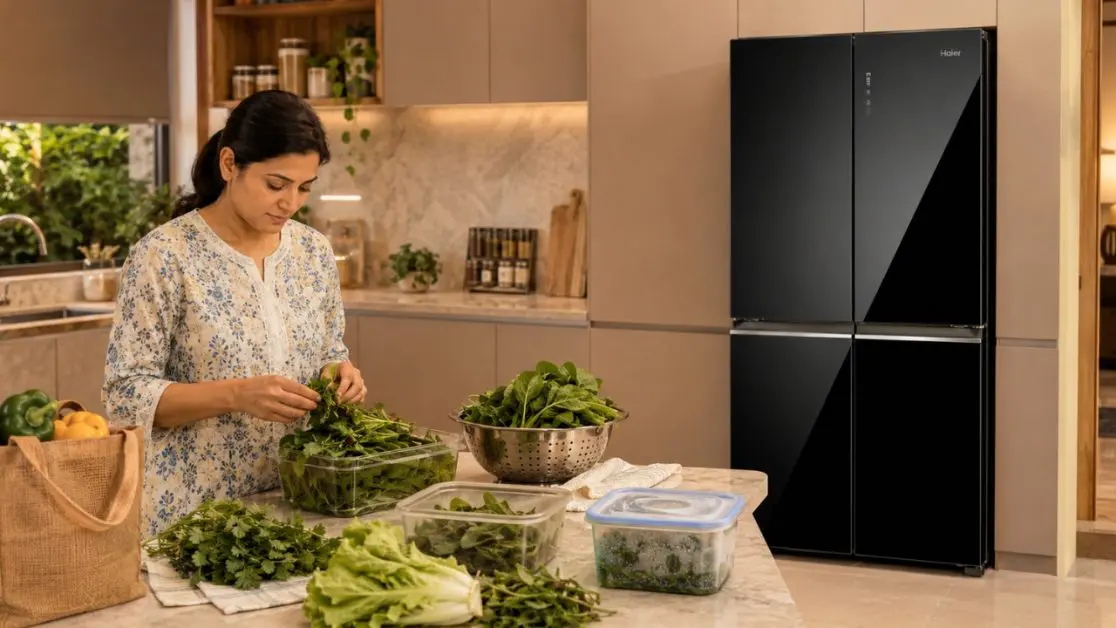
Leafy vegetables contain a considerable amount of water. Once harvested, however, they can no longer draw fresh moisture from the plant’s roots.
They continue to lose water through their surface. As moisture leaves the cells, the internal pressure that keeps the leaf firm gradually falls. The result is familiar: crisp leaves become soft and eventually wilt.
This explains why leafy vegetables demand slightly more thoughtful storage than potatoes, onions or many other everyday ingredients.
Several things can accelerate the process:
- Leaving greens uncovered inside the refrigerator
- Keeping them close to strong airflow
- Storing already damaged or yellowing leaves with fresh ones
- Allowing excess surface water to remain on the leaves
- Frequently moving them between noticeably different temperature conditions
There is another complication. Too little moisture can cause wilting, while too much trapped moisture can encourage deterioration. Getting the balance right matters.
Why Does Coriander Sometimes Wilt Faster Than Expected?
Coriander is almost a daily-use ingredient in many Indian kitchens, which also makes its deterioration particularly noticeable.
The leaves are delicate and have plenty of exposed surface area. If coriander is loosely placed on a refrigerator shelf, moisture can escape relatively quickly. Stuffing it into a wet plastic bag is not necessarily the answer either. Excess condensation creates a different storage problem.
A more practical routine is to sort the bunch before refrigeration.
Remove damaged or yellow leaves, get rid of excessive moisture and store the usable portion appropriately rather than simply putting the entire market bag into the refrigerator.
The same principle works well for methi and other delicate greens.
The Storage Mistakes That Quietly Shorten Freshness
Sometimes the problem begins before the refrigerator door even closes.
Washing and Immediately Packing Wet Greens
Cleaning vegetables before storage can be convenient, particularly when weekday mornings are hectic. But packing leafy greens while they are still dripping wet can leave excess moisture trapped around them.
If you wash greens before refrigeration, allow excess water to drain and dry them appropriately before storage.
Leaving Leaves Completely Exposed
At the opposite extreme, simply placing an open bunch on a shelf exposes a large leaf surface to the refrigerator environment.
Suitable containers or storage arrangements can help limit unnecessary moisture loss while keeping your refrigerator organised.
Packing Too Tightly
That huge bunch of palak may technically fit into a small container. That doesn’t mean squeezing it in is a good idea.
Crushing can bruise delicate leaves. Give greens enough room so that they are not unnecessarily compressed under heavier vegetables or containers.
Ignoring Damaged Leaves
One slimy leaf hiding at the bottom of a coriander bunch is easy to miss. Sorting greens before storage helps you remove visibly deteriorated portions rather than leaving them mixed with healthy leaves.
A Better Routine for Leafy Vegetables
You do not need an elaborate system. A few sensible habits can make vegetable storage far easier.
When You Bring Greens Home
Try this sequence:
- Sort first: Remove visibly damaged, yellow or deteriorating leaves.
- Remove excess moisture: If the greens have been washed, avoid storing them soaking wet.
- Use suitable storage: Avoid leaving delicate leaves completely exposed for extended periods.
- Avoid crushing: Keep heavy containers and vegetables away from fragile greens.
- Check periodically: Use leaves showing early signs of deterioration first.
There is also a simple buying lesson here. If your household needs half a bunch of coriander during the week, buying three because they look fresh at the market rarely makes economic sense once two bunches end up in the bin.
Freshness starts with sensible purchasing too.
Refrigerator Organisation Matters More Than It Seems
A refrigerator is not merely a cold cupboard.
Different foods have different storage requirements. Milk, cooked dal, frozen foods, fruit, vegetables and beverages do not necessarily benefit from being piled together wherever space happens to be available.
This becomes particularly relevant in Indian homes after a large weekly grocery run or before a festival, when refrigerator space can disappear surprisingly fast.
Keeping vegetables together, separating delicate produce from heavier items and avoiding overcrowding can make everyday food management more practical.
And this is where refrigerator design begins to matter.
How Haier Lumiere Fits Into a Fresh-Food-Heavy Kitchen
For households that regularly stock vegetables, fruit, beverages, dairy products, leftovers and frozen ingredients, storage flexibility can be just as important as overall capacity.
The Haier Lumiere 630L French Door Refrigerator (HRB-700KGU1) has a total capacity of 630 litres and uses a four-door configuration. Its specifications include dedicated fruit and vegetable cases along with toughened glass shelves, giving households defined spaces for organising different food categories.
More importantly, for changing household requirements, the Lumiere can provide up to 440 litres of total fridge space by combining its 350 litres of dedicated fridge space with the 90-litre Magic Convertible Zone. Haier describes this configuration as offering up to 85% fridge space.
That flexibility can be useful when a household suddenly needs more room for fresh groceries rather than frozen food.
Think about the week before Diwali, a family gathering, or simply the monthly supermarket run. The balance between refrigerator and freezer storage does not remain identical throughout the year.
The ability to adapt available space addresses that reality rather neatly.
ABT Pro Technology Adds Another Layer to Food Storage
Leafy-green freshness depends heavily on good handling and appropriate storage; no refrigerator feature can compensate for vegetables that were already badly damaged or incorrectly packed.
That distinction matters.
Within the Lumiere refrigerator, Haier provides ABT Pro Technology, which the product information describes as helping absorb odour and impurities while maintaining freshness. The product also states that ABT Pro can remove up to 99.99% of bacteria and viruses, subject to applicable terms and conditions.
For a refrigerator holding everything from vegetables and fruit to cheese, beverages and prepared foods, managing the overall storage environment is a useful consideration.
Smart Sense AI Brings Food Management Into the Picture
There is another reason food gets wasted: we forget what we bought.
That packet of greens pushed behind three containers might as well have disappeared.
Lumiere’s Smart Sense AI connects with the Haismart App. According to Haier’s product users can control refrigerator functions remotely, input and track storage, optimize storage management, create shopping lists and share those lists with family members. The system also adjusts temperature based on usage patterns for energy saving.
That changes the conversation slightly. Refrigerator performance is important, certainly, but managing what is inside the appliance matters too.
Better visibility can encourage households to buy with greater awareness and use ingredients before they are forgotten.
Crisp Greens Begin With Better Habits
There is no single trick that keeps every bunch of palak or coriander looking market-fresh indefinitely. Leafy vegetables naturally lose moisture after harvest, and their condition when purchased also influences how well they store.
What households can control is the storage environment and everyday handling.
Keep greens from becoming excessively wet or dry. Remove damaged leaves. Avoid crushing them. Organise produce thoughtfully. And when choosing a refrigerator for a fresh-food-heavy household, look beyond litres alone towards how intelligently that space can actually be used.
With its 630-litre capacity, four-door layout, convertible storage, dedicated fruit and vegetable cases, ABT Pro Technology and Smart Sense AI, the Haier Lumiere 630L French Door Refrigerator is designed around flexible food organisation rather than simply providing a large cold compartment.
Because sometimes the difference between crisp coriander and tomorrow’s food waste begins with something surprisingly ordinary: where and how you put it away.
Frequently Asked Questions
1. Why do leafy greens wilt in the refrigerator?
Leafy greens naturally lose moisture after harvest. As water leaves their cells, they lose firmness and become soft and wilted. Cold air, airflow, uncovered storage and improper handling can speed up moisture loss.
2. Should leafy vegetables be washed before storing them?
They can be washed before storage, but they should not be packed while soaking wet. Excess surface moisture can become trapped around the leaves and encourage deterioration. Allow greens to drain and dry appropriately before refrigerating.
3. How should coriander be stored in the refrigerator?
Start by removing yellow or damaged leaves and excess moisture. Store the usable coriander in a suitable storage arrangement that limits unnecessary moisture loss without trapping excessive condensation.
4. Why does coriander wilt so quickly?
Coriander has delicate leaves and a large exposed surface area, making it particularly susceptible to moisture loss. Leaving it uncovered or storing it under unsuitable conditions can cause it to lose freshness quickly.
5. Can excess moisture make leafy greens go bad?
Yes. While greens need protection from excessive moisture loss, trapped water and condensation can encourage deterioration. The goal is to maintain a suitable balance rather than keeping the leaves either completely dry or excessively wet.