

Choosing the right geyser isn’t just a question of tank size. The heating element’s power rating shapes how quickly water heats up, how much load it places on your home’s wiring, and how naturally it fits into your daily routine. Understanding the difference between a 2000 watt vs 3000 watt geyser goes a long way toward settling on the right geyser wattage for home use.
This decision can be confusing. Mainly because most buyers assume wattage is just a number. In practice, it affects everything from your monthly electricity bill to whether your existing wiring can safely handle the appliance. Getting it right at the point of purchase saves both money and hassle later, particularly in households where hot water demand shifts through the day, mornings especially.
What Does Geyser Wattage Actually Mean?
Geyser wattage reflects how much electrical power the heating element draws while it’s actively heating water. A 2000W geyser pulls 2 kilowatts; a 3000W unit pulls 3.
Wattage on its own doesn’t tell you how much electricity the appliance will use over a month. That comes down to how long the heater actually runs. A higher-wattage unit tends to heat water faster, but it also draws more power while it’s working.
Settling on the best wattage for geyser use, then, depends on a combination of factors: water capacity, how often the geyser is used, the electrical load your home can support, and how quickly you need hot water on tap.
2000 Watt vs 3000 Watt: The Core Difference
The real distinction in a 2000 watt vs 3000 watt geyser comparison comes down to how fast electrical energy reaches the heating element.
Heating Speed (How Fast You Get Hot Water)
A 3000W element delivers roughly 50% more power than a 2000W element under identical conditions, which generally means water reaches the set temperature faster, assuming capacity, inlet temperature, insulation and operating conditions are otherwise the same.
For smaller tanks, this difference matters less simply because there’s less total water to heat. In larger capacities, or households where hot water needs to be ready quickly, the faster heating of a 3000W unit becomes genuinely useful.
Put simply, a 2000 watt geyser heating time runs longer than a comparable 3000W model, though the exact figure shifts with tank size and the temperature of the incoming water.
Electricity Consumption and Running Cost
Run a 2000W geyser continuously for an hour and it consumes 2 units of electricity. A 3000W geyser uses 3 units over that same hour.
That said, a 3000W geyser costing 50% more to run isn’t a given. Faster heating usually means a shorter run time, so the two effects tend to offset each other to some extent. What really drives energy use is the amount of water being heated and how much its temperature needs to climb, wattage on its own doesn’t decide that.
Keep this in mind when comparing 2kW vs 3kW geyser options. Wattage sets how fast energy gets used; total consumption comes down to water volume and duration, not the rating printed on the unit.
Wiring, MCB and Home Load Considerations
A 3000W geyser draws a heavier instantaneous load than a 2000W unit. At roughly 230V, a 2000W appliance pulls around 8.7A, while a 3000W unit pulls closer to 13A.
Installation should account for the geyser’s rated current, cable thickness, MCB rating, earthing, and whatever else shares the same circuit. A dedicated circuit is generally the safer route for a high-power water heater, installed in line with applicable electrical standards.
How Much Electricity Does a Geyser Consume?
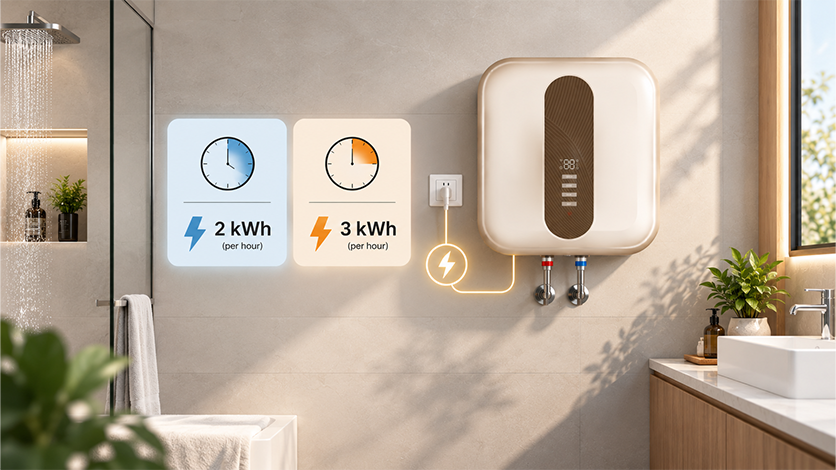
Understanding geyser power consumption means looking at wattage and operating time together, not wattage alone.
Units Consumed per Hour and per Month
The underlying calculation is straightforward:
Electricity consumed (kWh) = Power (kW) × Operating time (hours)
A 2000W geyser running for a full hour uses roughly 2 kWh, or 2 units. A 3000W geyser over the same hour uses about 3 units.
Monthly consumption comes down to how often the geyser actually runs. A 2000W unit used for 30 minutes daily works out to roughly 1 unit per day, or around 30 units across a month. A 3000W unit used for the same 30 minutes daily would land closer to 45 units.
Real-world consumption often comes in lower than these figures, since a storage geyser switches its heating element off once it hits the set temperature and cycles on and off as needed rather than running continuously.
How Capacity and Wattage Work Together
Capacity and wattage aren’t decisions to make separately. A 10L or 15L unit doesn’t necessarily need the same heating power as a 25L or larger tank, and the right combination depends on how quickly you want that water heated.
Our Haier 15L Square 5-Star Water Heater ES15V-SD, for instance, is rated at 2kW and includes a titanium heating element, shock-proof protection, IPX4 water resistance, and a 4-year product warranty with 7 years of coverage on the tank.
This is a good illustration of why wattage shouldn’t be the sole deciding factor. Tank capacity, insulation quality, the heating element itself, safety features and how the household actually uses hot water all shape the overall experience.
Which Wattage Is Better for Your Home?
There’s no single right answer here. The better fit depends on how much hot water your household needs and how quickly it needs to be ready.
When 2000W Is Enough
A 2000W unit works well for smaller households where hot-water demand stays moderate and a slightly longer wait isn’t a dealbreaker. If the home already runs several appliances off a limited electrical connection, the lower draw of a 2000W geyser also makes it the easier fit, since it won’t push the circuit as close to its limit. For a small or mid-sized storage tank, 2kW tends to strike a fair balance between how fast it heats and how much power it pulls to get there.
When 3000W Makes More Sense
A 3000W geyser is worth considering when fast heating matters and the home’s wiring can safely handle the extra load.
It’s particularly useful in households that need hot water reheated quickly between back-to-back uses, mornings in larger families being the obvious example. That said, speed alone shouldn’t drive the decision. The circuit, wiring, MCB rating, sanctioned load, and whatever else runs on the same line at the same time all need to be factored in first.
Tips to Reduce Your Geyser Electricity Bill
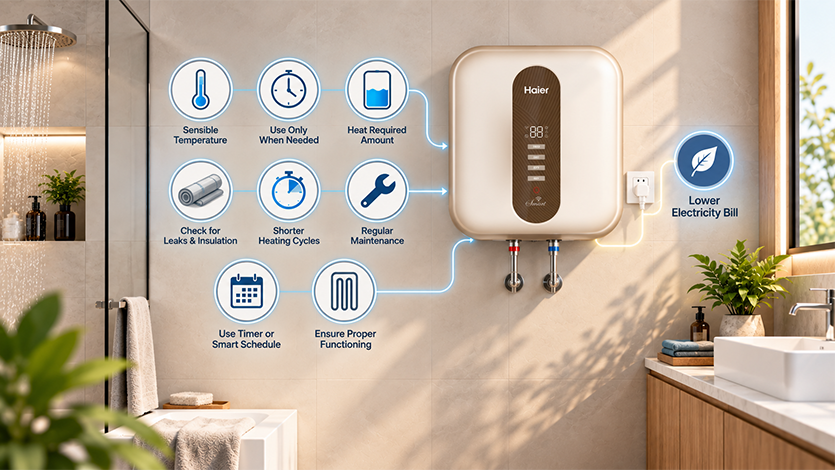
Sensible usage habits reduce consumption regardless of whether the geyser is rated 2000W or 3000W:
- Keep the thermostat at a sensible setting rather than pushing it to the maximum.
- Turn the geyser on only when hot water is actually needed, unless a scheduled routine works better for your household.
- Heat only as much water as the household will use, rather than running a full tank out of habit.
- Check the tank, plumbing connections and insulation now and then for wear or leaks.
- Keep heating cycles as short as the water temperature allows.
- Stick to the manufacturer’s recommended service schedule.
- Use a timer or smart plug if the geyser doesn’t already have scheduling built in.
- Make sure the thermostat and heating element are both working properly, a faulty one often runs longer than it should.
These habits tend to influence annual energy use more than the wattage rating itself does.
Wattage Selection Checklist
At the end of the day, picking between 2000W and 3000W is less about which number sounds more powerful and more about what your household actually needs day to day. A useful geyser wattage guide always starts with capacity and usage, then works backward to wattage, not the other way round. Anyone comparing a 3000 watt geyser electricity consumption to a 2000W option should focus on daily run time rather than the rating alone. Get the capacity and habits right, and either wattage will heat water efficiently without turning into an unexpected line item on the electricity bill.
FAQs
Which is better 2000 watt or 3000 watt geyser?
Neither wins outright, it depends on your household’s hot water needs and wiring capacity. A 2000W unit suits moderate usage with a lighter electrical load, while 3000W makes sense when faster heating matters and the circuit can support it.
How much electricity does a 2000 watt geyser consume?
Run continuously for an hour, it uses about 2 units of electricity. Actual daily consumption is usually lower, since the geyser cycles off once it hits the set temperature.
Does a higher-wattage geyser use more electricity?
Not necessarily by the same margin as the wattage difference suggests. A 3000W unit draws more power per hour, but it also heats water faster, so the shorter run time often balances things out.
Does a 3000 watt geyser heat water faster than a 2000 watt one?
Yes, a 3000W element delivers about 50% more power, so water typically reaches temperature quicker under similar conditions. The actual time gap still depends on tank capacity and the incoming water temperature.
Which geyser wattage is best for a home?
It comes down to household size and how quickly hot water is needed. Smaller homes with moderate use do fine with 2000W, while larger households needing quick reheating often benefit more from 3000W.
Can my home wiring handle a 3000 watt geyser?
That depends on your circuit’s rated current, MCB rating and what else runs on the same line. A 3000W geyser draws around 13A, so a dedicated circuit is usually the safer choice.
Which geyser uses less electricity?
A 2000W geyser uses less power per hour than a 3000W one. Total consumption still depends on how long each one actually runs, so the gap isn’t always as large as the wattage difference implies.
How can I reduce my geyser electricity bill?
Keep the thermostat at a reasonable setting, avoid heating more water than you’ll use, and switch it on only when needed. Regular servicing and checking the insulation also help keep consumption in check over time.
How much electricity does a 15 ltr geyser consume per month?
This varies with daily usage and wattage, but a 2kW unit used for around 30 minutes a day works out to roughly 30 units a month.