
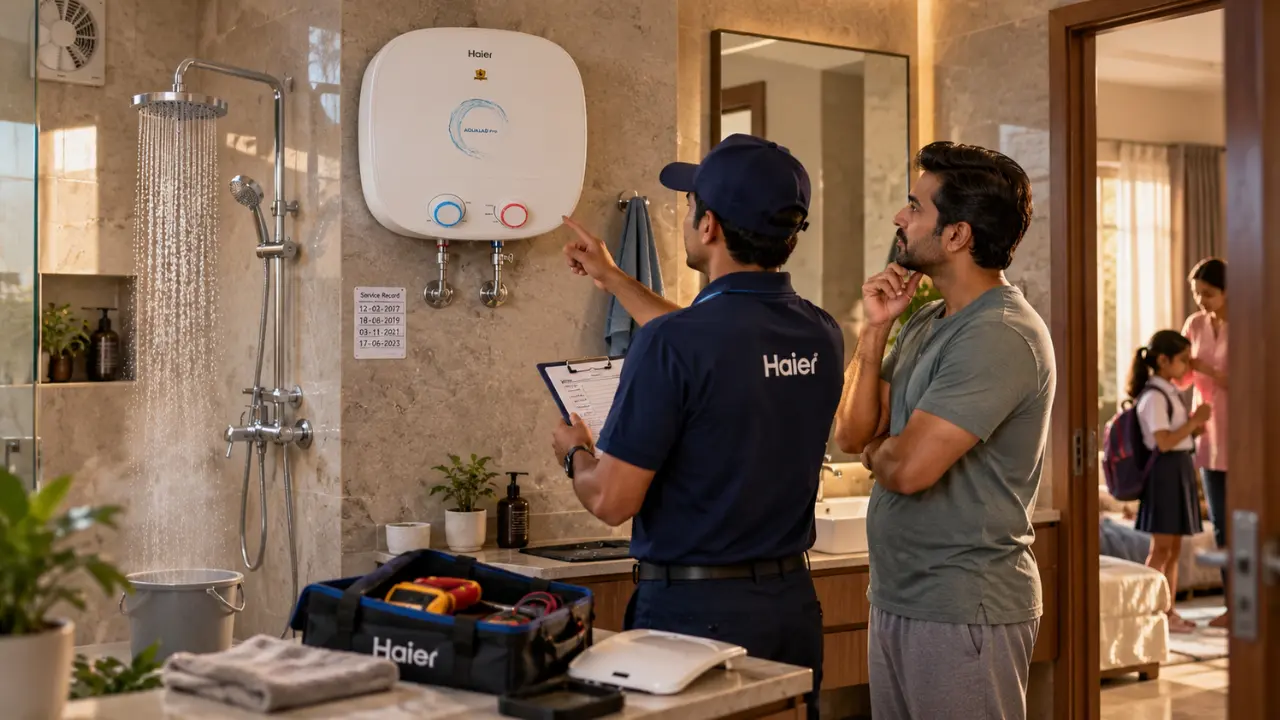

A geyser rarely stops working without giving you a few clues first.
Perhaps the water that once heated quickly now takes noticeably longer. Maybe the temperature fluctuates, the unit has started making unfamiliar sounds, or you are calling for repairs more often than you used to. None of these automatically means the geyser has reached the end of its life, but together they can tell you something important: age is only one part of a water heater’s lifespan.
For Indian households, the more useful question is not simply “What is the average life of a geyser?” It is whether the unit continues to heat reliably, safely and efficiently under the conditions in which it is being used.
Here is how to judge that properly.
What Is the Average Life of a Geyser?
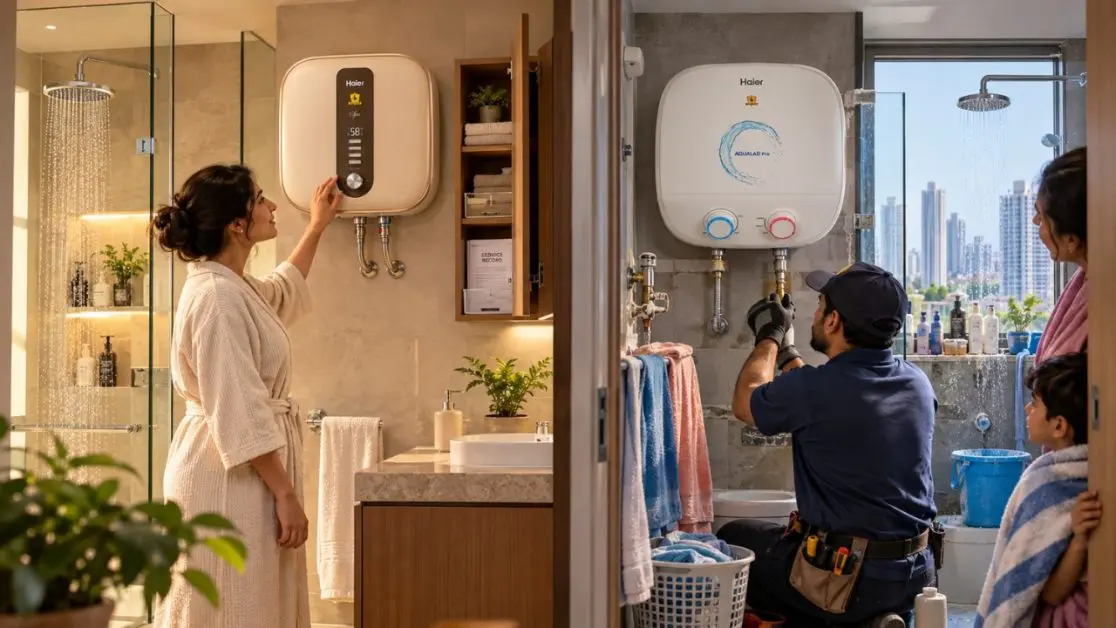
As a broad household estimate, a well-maintained electric water heater can often remain serviceable for around 8–12 years. This is not a fixed replacement deadline. Some units may require attention earlier, while others can continue operating beyond that range.
Why such a big difference?
Because a geyser installed in a home with hard water and heavy daily use has a very different working life from one used occasionally with more favourable water conditions.
Its longevity can be influenced by:
- Water quality and mineral content
- Frequency and intensity of use
- Tank and heating-element construction
- Water pressure
- Installation quality
- Corrosion protection
- Regular inspection and maintenance
- Whether small faults are addressed promptly
So, a seven-year-old geyser that is functioning normally should not be replaced purely because of its birthday. Likewise, a younger unit with repeated leaks, corrosion or electrical problems should not be assumed to be fine merely because it is “not that old”.
Does Geyser Capacity Decide Its Lifespan?
Not directly.
A common assumption is that a small geyser must wear out faster than a larger one. Capacity certainly affects how much hot water is available and how the heater fits into a household’s routine, but it does not by itself determine durability.
What is the lifespan of a 5-litre geyser?
There is no universal lifespan specifically for a 5-litre geyser. Its working life depends more on construction, water conditions, usage frequency and maintenance than on the five-litre figure printed on the specification sheet.
The same principle applies when asking about the lifespan of a 10-litre geyser or a larger storage water heater.
A smaller heater used repeatedly throughout the day may go through more heating cycles. A larger unit may hold water for longer periods and face different tank-related stresses. Neither situation automatically makes one size more durable.
How long does a 15-litre water heater last?
Again, capacity alone cannot give you a reliable number of years. A 15-litre storage water heater that has good corrosion resistance, suitable pressure handling and proper installation may provide dependable service for years, provided it is maintained appropriately.
Think of capacity primarily as a usage decision, not a lifespan rating.
What Actually Shortens a Water Heater’s Life?
Most geysers spend their lives quietly doing the same job, day after day. Behind the casing, though, water, heat, minerals and pressure are constantly interacting with the tank and heating components.
That is where wear begins.
1. Hard water and scale accumulation
Hard water contains dissolved minerals that can gradually form deposits inside the heater and around its heating element.
As scale builds up, heat transfer can become less effective. The heating element may consequently have to work harder or longer to bring water to the desired temperature.
If you have noticed that an older geyser takes considerably longer than before, scale is one possible reason.
2. Internal corrosion
Storage water heaters continually hold water against their inner surfaces. Corrosion-resistant tank construction therefore matters.
Once significant tank corrosion develops, repairs may become less practical particularly if the tank itself starts leaking.
3. Repeated heavy usage
A geyser serving several people every morning naturally experiences more heating cycles than a unit used once or twice a day.
That does not mean frequent use is wrong. It simply means usage patterns should be considered when evaluating ageing components.
4. Unsuitable or fluctuating pressure
Water pressure places another form of stress on the system. This is especially relevant in multi-storey and high-rise buildings, where selecting a water heater designed for the required working pressure becomes important.
5. Ignoring early warning signs
A minor issue can become a larger one when repeatedly ignored.
Strange sounds, unreliable heating, visible leakage or recurring electrical tripping deserve inspection rather than another few months of “it still works, so leave it”.
Repair or Replace? Watch for These Signs
There is no reason to discard an otherwise healthy geyser simply because it has been installed for several years. The opposite mistake repeatedly repairing a deteriorating appliance can be equally unhelpful.
Consider a professional inspection when you notice:
- Water leakage: Particularly leakage that appears to originate from the tank or body rather than an external plumbing connection.
- Visible rust or corrosion: Especially when accompanied by leaks or deterioration around the unit.
- Heating has become unusually slow: A sudden or progressive change deserves diagnosis.
- Hot water runs out differently than before: Reduced usable hot-water performance can indicate an internal issue.
- Unusual noises: Mineral deposits and component wear are among several possible causes.
- Temperature becomes inconsistent: Water becoming unexpectedly too hot or insufficiently heated should not simply be tolerated.
- Frequent breakdowns: Repeated repair costs can eventually make replacement the more practical route.
- Electrical issues: Repeated tripping, burning smells or other electrical abnormalities require prompt professional attention.
Safety-related symptoms should never be treated as normal ageing.
How Long Do Mini Water Heaters Last?
Compact and instant water heaters follow much the same rule: there is no meaningful lifespan number based solely on their small capacity.
What matters is the quality of the heating system, protection against overheating and pressure, water conditions, installation and how intensively the unit is used.
Haier’s 3L ISI Certified Instant Water Heater (EI3V-PRET), for example, incorporates Dual Thermal Proof (TTS). Its first overheat protection stops heating at 75°C, while a second protection is designed to automatically cut power if the temperature reaches 95°C.
The model also uses an Incoloy 800 stainless-steel heating element, which Haier specifies for longer service life, alongside a glass-lined tank intended to improve corrosion resistance and durability.
That distinction matters. When comparing mini water heaters, looking beyond capacity to the components and protective systems gives you a much more meaningful picture.
Can an Instant Geyser Blast?
This question sounds alarming, but it points to something worth understanding.
Water heaters combine electricity, high temperatures and pressurised water, which is why their safety systems, installation and maintenance matter. A properly functioning unit should regulate temperature and manage pressure within its designed operating conditions.
Do not attempt to bypass a thermostat, pressure-relief mechanism or other safety component. If a geyser is overheating, leaking, behaving unusually or showing signs of an electrical fault, switch it off safely and arrange professional inspection.
Haier’s 3L model, for instance, lists both over-heat and over-pressure protection and an MUV valve incorporating pressure relief, an anti-vacuum device, a non-return valve and water drainage functions.
In other words, safety should be treated as part of the buying decision from day one not something to think about only after a problem appears.
How Can You Help a Geyser Last Longer?
You cannot stop normal wear, but you can avoid making it worse.
Start with the right installation
A water heater needs appropriate electrical connections, earthing, plumbing and pressure conditions. Follow the manufacturer’s installation requirements and use qualified professionals.
Pay attention to water quality
Where hard water is an issue, mineral build-up may require more attention. Do not wait until heating performance has deteriorated substantially before having the appliance checked.
Get abnormal behaviour inspected
If the heater suddenly needs much longer to warm water, starts leaking or behaves unpredictably, early diagnosis may prevent further damage.
Avoid DIY internal repairs
A geyser is not the appliance to open up after watching a quick tutorial. Electrical components, heated water and pressure make professional servicing the sensible approach.
Choose durability features at purchase
Tank protection, heating-element construction, insulation, pressure capability and safety systems are worth examining before buying. They may matter considerably over years of ownership.
If Replacement Is Due, Look Beyond Litres
Replacing an old geyser is an opportunity to choose around your actual household rather than automatically buying the same capacity again.
Haier India’s current water-heater range illustrates the difference.
For compact hot-water requirements, the Haier 3L ISI Certified Instant Water Heater combines a 3-litre format with Dual Thermal Proof, an MUV valve, IPX4 water resistance, an Incoloy 800 SS heating element and 8-bar rated working pressure.
For households looking for storage capacity, the Haier 15L Square Spa Wi-Fi 5 Star Water Heater (ES15V-SD WIFI) offers a 15-litre capacity and 5-star rating. Its listed specifications include Shock Proof protection, over-heat and over-pressure protection, an IPX4 rating, 8-bar rated working pressure, PUF insulation and a titanium heating element.
The model also features a titanium-coated tank designed for corrosion resistance and durability, along with a Titanium Guard heating element.
Need greater storage? The Haier 25L Square AQUALAD PRO 4 Star Water Heater (ES25V-AQUALAD PRO) provides a 25-litre capacity with a 4-star rating, Shock Proof protection, over-heat and over-pressure protection, a titanium tank, 8-bar rated working pressure and PUF insulation.
Haier lists a 4-year product and 10-year tank warranty for this model, which is also useful context when evaluating a water heater as a longer-term household purchase.
The Better Question Is: How Well Is Your Geyser Ageing?
Eight or ten years on a calendar does not tell the whole story.
The condition of the tank, heating performance, safety systems, water quality, maintenance history and frequency of repairs together provide a far better indication of whether your geyser still has useful life left.
If it heats consistently, remains in sound condition and passes professional inspection, age alone need not send it to retirement. If leaks, corrosion, recurring failures or safety concerns are becoming familiar, replacement deserves serious consideration.
And when that time arrives, compare more than litres and heating speed. Look closely at tank construction, heating-element durability, pressure capability, insulation, safety features and warranty coverage.
Those are the details that matter long after the new geyser has stopped looking new.
Frequently Asked Questions
1. What is the average life of a geyser?
A well-maintained electric geyser can often remain serviceable for around 8–12 years, although there is no fixed lifespan for every unit. Water quality, usage frequency, tank construction, installation, maintenance and corrosion can all affect how long a water heater lasts.
2. What is the lifespan of a 5-litre geyser?
A 5-litre geyser does not have a specific lifespan simply because of its capacity. Its longevity depends more on the quality of its tank and heating element, local water conditions, maintenance and how frequently it is used. Smaller units used repeatedly throughout the day may experience more heating cycles.
3. How long do mini water heaters last?
Mini water heaters can provide years of service when correctly installed and maintained, but their compact size does not determine their lifespan. When choosing one, consider features related to overheating protection, pressure management, corrosion resistance and heating-element durability rather than focusing only on capacity.
4. What is the lifespan of a 10-litre geyser?
There is no universal lifespan specifically for a 10-litre geyser. A properly maintained unit can potentially serve for many years, while hard water, scale build-up, corrosion, intensive usage and neglected maintenance may shorten its working life.
5. How long does a 15-litre water heater last?
A 15-litre water heater’s lifespan depends on its construction and operating conditions rather than capacity alone. Tank corrosion resistance, heating-element quality, water pressure, usage and maintenance are important factors. Haier’s 15L Square Spa Wi-Fi model, for example, uses a titanium-coated tank designed for corrosion resistance and enhanced durability.