

The motor can change how a washing machine sounds, moves and performs during every wash. Two machines may offer the same capacity, yet their motor systems can produce very different results. That difference matters when noise, vibration and long-term operation become part of daily use. Washing machine motor types generally include belt drive, direct drive and inverter-based systems. Belt drive motors use a belt to turn the drum, while direct drive motors are more directly connected. Since inverter motors can change their speed according to the load, they help you to control your energy consumption and the operation of the motor. Knowing the differences makes it simpler to compare machines on more than just capacity and price.
How a Washing Machine Motor Drives the Drum
Every washing machine has a motor that turns the drum. In a wash, the drum rotates slowly and changes direction often. In a spin, it climbs past a thousand rotations a minute to push water out of the clothes. How the motor passes power to the drum is what separates one type from another.
Most washing machine motor types fall into two groups. In a belt drive setup, a rubber belt and a pulley carry the power across. In a direct drive setup, the motor connects straight to the drum shaft. Inverter technology is a separate idea, covered further down.
What Is a Belt Drive Washing Machine?
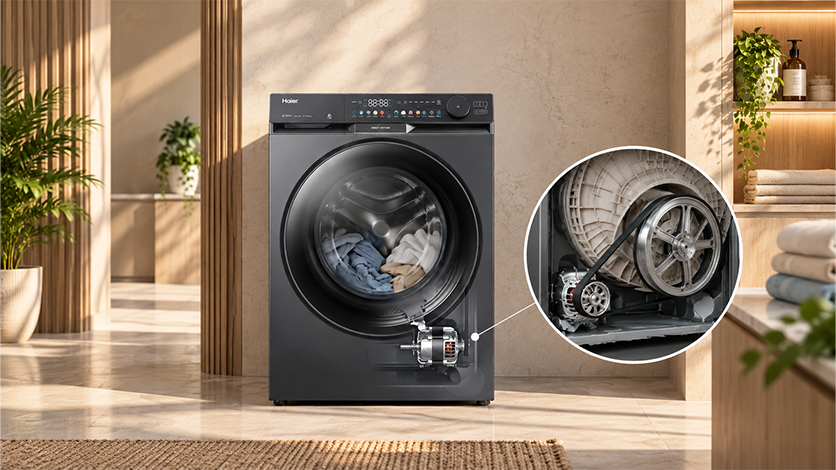
A belt drive washing machine places the motor below or behind the tub and links it to the drum with a belt wrapped around two pulleys. The motor turns the small pulley, the belt carries that movement to the larger one fixed to the drum, and the drum turns. The design has been around for decades and is still common.
Pros
- Technicians know the parts well, which keeps most repairs simple.
- A worn belt is one of the easier components to replace.
- The pulley system lets a modest motor deliver the turning power a heavy load needs.
Cons
- The belt and pulleys add moving parts, so a little more noise and shaking can show up at high spin speeds.
- The belt may need replacing after several years of regular use.
- The belt needs an occasional tension check during service to keep the drum turning evenly
What Is a Direct Drive Washing Machine?
In a direct drive washing machine, the motor attaches to the drum shaft itself, with no belt or pulley between them. When the motor turns, the drum turns at the same pace. Many direct drive designs use brushless motors, which also remove the carbon brushes that wear down in older motors.
Pros
- Fewer moving parts mean less friction, which usually brings lower noise.
- Spins feel steadier, with less shaking at high speeds.
- The motor tends to last longer because it carries less strain.
Cons
- Direct drive motors are more advanced, so repairs are best handled by a trained technician.
- Genuine parts are recommended for any motor repair.
- Reading the motor warranty carefully before buying is a sensible step.
Belt Drive vs Direct Drive: Key Differences
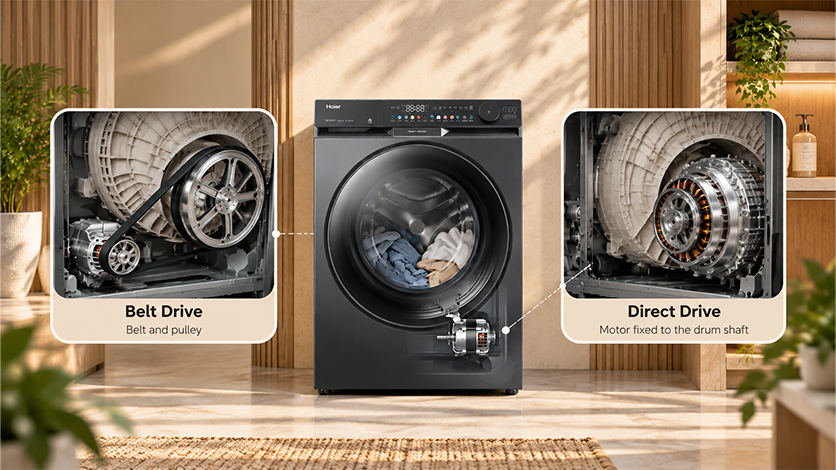
| Feature | Belt drive | Direct drive |
| Power transfer | Belt and pulley | Motor fixed to the drum shaft |
| Moving parts | More | Fewer |
| Noise and vibration | Moderate, more noticeable in fast spins | Lower |
| Upkeep | Belt may need replacing over time | Fewer parts to maintain |
| Motor life | Depends partly on belt condition | Tends to be longer |
| Common in | Conventional models | Newer and premium models |
Noise and Vibration
A belt carries movement with a little slack, and each pulley adds a small hum. At 1,000 rpm and above, those effects add up, and the cabinet can shake if the load is uneven. Direct drive removes that step. The drum follows the motor immediately, so the machine runs steadier and quieter, which matters in a flat where a spin cycle carries through the walls.
Durability and Maintenance
A belt stretches and cracks with heat and regular use. Replacing it is a routine job for a technician, but it does come up. A direct drive motor has no belt, so upkeep mostly means cleaning the filter and the drum. In both types, level placement and balanced loads protect the motor.
Efficiency and Price
Belt drive loses a small share of energy to friction in the belt and pulleys. Direct drive passes more of the motor’s power to the drum, which helps with energy use, especially alongside inverter control. Direct drive models are mostly found in the mid and premium ranges, while belt drive also covers entry-level options. Comparing the motor warranty tells you more than comparing the drive type alone.
Where Does Inverter Motor Technology Fit In?
Many buyers treat direct drive vs inverter motor as an either-or choice. It is not. Direct drive describes how the motor connects to the drum. Inverter describes how the electronics control the motor’s speed, so it can run slowly for a gentle wash and rise smoothly for a spin instead of switching fully on and off.
A machine can pair an inverter with a belt, or with direct drive. The second pairing tends to run smoothest, because the controlled speed reaches the drum with nothing in between. When you compare direct drive vs inverter motor listings, check whether the machine offers both.
Want to know if an inverter machine is worth the upgrade over a conventional one?
Read this blog: Inverter Washing Machine vs Conventional Washing Machine: Is It Worth Upgrading?
How Haier Builds Its Washing Machine Motors
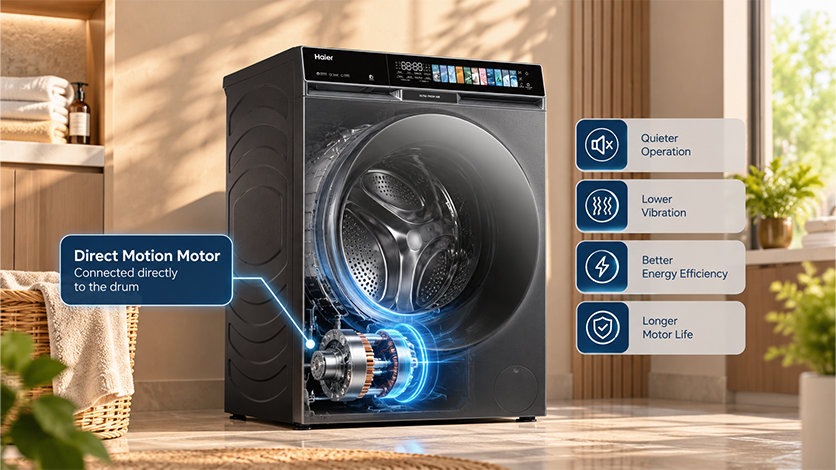
At Haier, we treat the motor as the base of every washing machine we design. The Direct Motion motor in our F11 series connects straight to the drum, which cuts friction and vibration. The result is quiet running, steady spins, energy savings and a long motor life.
Our front-load washing machines show this best. The Haier 12 Kg F9 uses a Direct Motion motor with 1400 RPM and a 12-year motor warranty. The Haier 12 Kg F11 pairs Direct Motion with inverter control. For a 10 kg load, the Haier F5 10 Kg offers an Inverter Motor with the same 12-year motor warranty.
Prefer to load from the top? Our top-load washing machines come with advanced technology motors, and the Haier 10 Kg HWM100-H326BK adds a 10-year motor warranty. For twin-tub washing, our semi-automatic washing machines, such as the 12 KG 196BK, carry a 5-year motor and 5-year spin motor warranty.
Which Motor Type Is Better for You?
No single answer fits every home. If you live in an apartment, run loads late at night or want the steadiest spin, a direct drive washing machine is the stronger pick. If you wash small loads now and then, or prefer a machine local technicians already know well, a belt drive washing machine does the job well too.
The belt drive vs direct drive washing machine debate also matters less than the warranty, capacity and spin speed you choose for your family size.
Motor Selection Checklist
Run through these points before you buy.
- Check whether the spec page lists direct drive, inverter, or both.
- Read the motor warranty period, which often says more than the drive type itself.
- Match the capacity and spin speed to your weekly laundry.
- Consider noise if the machine will stand near a bedroom.
- Ask about service availability in your city.
- Choose a level floor, since even a good motor shakes on an uneven surface
Conclusion
Belt drive and direct drive both wash clothes well, but they feel different over the years. Direct drive offers quieter spins, fewer parts and a longer motor life. Belt drive stays familiar and simple to service. Inverter control adds smoother speed on top of either. Compare the belt drive vs direct drive washing machine options against your space, load size and warranty, and the right choice becomes easier to see.
FAQs
Which is better, a belt drive or direct drive washing machine?
Direct drive usually runs quieter, shakes less and has fewer parts to maintain. Belt drive is familiar and easy to service. The better choice depends on your noise tolerance, load size, budget and the motor warranty on offer.
Is a direct drive washing machine better?
For most homes, yes. It has fewer moving parts, which brings lower noise, steadier spins and a longer motor life. Households with light usage and simple needs can still be well served by belt drive.
What is direct drive in a washing machine?
Direct drive means the motor is attached straight to the drum shaft, with no belt or pulley in between. The drum turns at the same pace as the motor, which reduces friction, vibration and noise.
Which motor is best for a washing machine?
A direct drive motor with inverter control is a strong combination. It gives quiet running, smooth speed changes and good energy use. Check the motor warranty as well, because it shows how long the brand supports the part.
Is a direct drive machine quieter?
Generally, yes. With no belt or pulleys, there is less friction and fewer parts to hum or rattle, so spins feel steadier. Noise also depends on load balance, the floor and how level the machine stands.
Do direct drive washing machines last longer?
The motor often does, because it carries less strain and has no belt to wear out. Machine life still depends on regular cleaning, balanced loads, level placement and timely service from a trained technician.
What kind of motor is used in washing machines?
Washing machines use either belt-drive motors, which turn the drum through a belt and pulley, or direct drive motors fixed to the drum shaft. Many newer models add inverter control to manage motor speed smoothly.