

Ever followed the pack instructions to the letter and still ended up with a cold centre? The reason is often microwave wattage, which decides how much energy reaches your food every second.
Higher numbers usually mean faster cooking, but watts are only one part of the story. Dish size, food type, and the power level you choose also shape the final result.
This Haier guide explains how microwave cooking power works, what common ratings mean, and which wattage suits everyday meals. You will also learn how to adjust cooking times with confidence.
What Does Microwave Wattage Mean?
Microwave wattage shows how much energy your oven delivers to food each second. A 1000-watt oven delivers more energy per second than a 700-watt one. That is why the same dish can finish sooner in one oven than another.
Many labels list the output wattage, which is the real cooking power. Some also show input power, which is the electricity the oven draws. Input figures are higher, so check which rating you are reading.
You can usually find the rating inside the door frame, on the back panel or in the user manual.
Haier lists both figures on its product pages. For example, the Haier Vogue 20L Blueberry Solo Microwave Oven shows 1150W input power and 700W microwave power. The 700W figure is the cooking power.
How Watts Affect Cooking Speed and Evenness
The link between microwave speed and watts is simple. More watts mean more energy per second, so food heats faster. Evenness is more complex, because it also depends on the turntable, the dish and the food itself.
Higher Wattage = Faster, More Even Cooking
A higher-wattage microwave reaches the target temperature faster. Shorter cooking can also mean fewer dried-out edges, so results often look more even. For example, a dish that needs 2 minutes at 1000 watts may need about 2 minutes 30 seconds at 800 watts.
Extra microwave power doesn’t solve every heating problem. Thick or dense food still needs time for heat to reach the centre. A short standing time after cooking helps the heat spread.
Why Low Wattage Can Overcook Edges
A low-wattage oven takes longer to heat the centre of a dish. Meanwhile, the thin edges and corners keep absorbing energy. They can dry out or overcook before the middle is hot, especially if you add extra time without checking the food.
These habits help at any wattage:
- Cook in short bursts and check the food between them.
- Stir or turn the dish partway through.
- Cover the food to hold in steam.
- Place thicker pieces toward the outside of the plate.
Common Microwave Wattages Explained
Most home microwaves range from about 600 to 1200 watts. The band you choose affects speed, price and the dishes you can cook comfortably. Here is how the common ranges compare.
600-800W, 900-1000W and Above
- 600-800W: Common in compact and solo models. A 700-watt microwave delivers 700 watts of cooking power at its highest setting. It handles reheating well, but dense or large dishes may need extra time.
- 900-1000W: Heats faster and handles larger portions better. It suits households that often cook rice, vegetables, and ready meals.
- Above 1000W: Cuts cooking time further. Large dishes and dense foods benefit most, but thin foods need closer watching.
Here is how a 700-watt vs 1000-watt microwave compares in daily use. The 1000-watt oven delivers about 43 percent more energy each second. As a result, a three-minute dish at 1000 watts may need about 4 minutes 15 seconds at 700 watts.
Choosing between 900 and 1000 watts is a smaller decision. The gap is only about 11 percent, so short dishes differ by seconds, not minutes. Features, capacity and cooking modes usually matter more at that level.
Power Levels vs Wattage: What’s the Difference?
Wattage is the maximum output your microwave can deliver. Microwave power levels let you use only part of it. Think of wattage as the engine size and power levels as the accelerator.
On many models, lower levels work by cycling the microwave energy on and off. For example, 50 percent on an 800-watt oven gives about 400 watts on average. Typical uses look like this:
- High (100%): Boiling water, reheating drinks and cooking thin foods quickly.
- Medium (50-70%): Cooking casseroles, eggs and dense dishes gently.
- Low (10-30%): Defrosting, melting chocolate and softening butter.
Shorter, well-controlled cooking can also help food retain more nutrients. Our guide on whether microwave cooking is healthy explains how.
How Much Wattage Do You Actually Need?
The right wattage depends on what you cook most often. For many households, 800 to 1000 watts is a practical range for everyday cooking. Think about your daily routine before you compare models.
For Reheating vs Real Cooking
- Reheating: 700 to 800 watts is usually enough for leftovers, tea and milk. The Haier 20L Black Solo Microwave Oven from the Solo range lists 700W micro power, 6 power levels, a defrost setting and a keep-warm function.
- Grilling and browning: A grill element adds browning to microwave cooking. The Haier 20L Grill Microwave in the Grill range pairs 700W micro power with a 1000W grill and 5 power levels.
- Real cooking in larger batches: Steaming vegetables, cooking rice or baking works better with 900 watts or more, plus the right mode. The Haier 30L Convection Microwave with In-Built Air Fryer from the Convection range lists 900W micro power and 5 power levels.
Each model’s wattage is listed on its product page, so check it before you buy. If you cook in large batches or rely on your microwave for most meals, consider a higher rating.
Reading Wattage on Packaged-Food Instructions
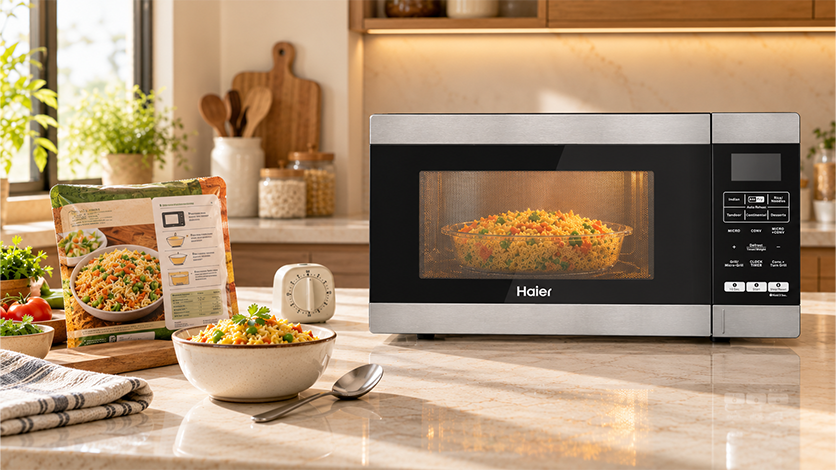
Ready meals and snacks often give cooking times for a set wattage, such as 800 or 1000 watts. Your oven may differ. A quick adjustment helps you avoid cold centres and dry edges.
Use this simple rule: new time = pack time × pack watts ÷ your watts. Here is an example for a pack that says 3 minutes at 1000 watts.
| Your microwave | Adjusted time |
| 1000 watts | 3 min |
| 900 watts | 3 min 20 s |
| 800 watts | 3 min 45 s |
| 700 watts | about 4 min 15 s |
Treat these times as a starting point. Check your microwave wattage first so the numbers work. Then stir if you can, make sure the food is steaming hot throughout, and add 20 to 30 seconds if needed. If the pack lists a time for your wattage, follow that instead.
Quick Wattage Guide
Use this table to match wattage to your cooking method.
| Wattage | Speed | Best for | Watch out for |
| 700W | Slower | Reheating, drinks and small portions | Longer times for dense or large dishes |
| 800W | Moderate | Daily reheating and simple cooking | Adjusting pack times written for 1000W |
| 900W | Fast | Everyday meals for small families | Thin foods overcook if time is not reduced |
| 1000W and above | Fastest | Large portions, frequent cooking and dense foods | Closer watching and shorter cooking times |
To compare options side by side, browse Haier’s Vogue microwave range and check the wattage listed on each product page.
Final Thoughts
Wattage sets how quickly a microwave heats your food. More watts usually mean shorter cooking times, but dish size, power level and food type decide how even the result is.
For simple reheating, 700 to 800 watts may be enough. If you cook full meals, steam vegetables or feed a family, 900 watts or more can save time and effort.
Whatever you choose, check the rating, adjust pack times, and cook in short bursts. These small habits deliver dependable results in any oven.
FAQs
How do microwave watts affect cooking speed?
More watts mean more energy reaches your food each second, so it heats faster. A 1000 watt oven can finish the same dish in roughly 30 percent less time than a 700 watt oven. Dense or large dishes still need standing time, so check that the centre is hot.
Is a higher-wattage microwave better?
Not always. A higher-wattage microwave cooks faster and handles larger portions well. However, it can overcook thin or delicate foods if you use the same time as a lower-wattage oven. Choose based on what you cook, and use the power levels to control the heat.
How many watts does a microwave need for everyday cooking?
For many households, 800 to 1000 watts works well for everyday cooking. At 700 to 800 watts, reheating is easy, though larger dishes take longer. At 900 watts and above, you save time on rice, vegetables and ready meals.
What is the difference between wattage and power levels?
Wattage is the maximum energy your microwave can deliver. Power levels let you use only part of that energy, such as 50 percent for gentle cooking or defrosting. Wattage stays fixed for each oven, while you can change the power level for every dish.
Does low wattage cook food unevenly?
It can. A low-wattage oven needs more time, so thin edges may dry out before the centre heats through. Cook in short bursts, stir or turn the dish halfway through, cover the food, and let it stand for a minute. These steps help heat spread more evenly.
How do I adjust recipe times for my microwave’s wattage?
Multiply the recipe time by the recipe’s wattage, then divide by your oven’s wattage. For example, 3 minutes at 1000 watts becomes 3 minutes 45 seconds at 800 watts. Treat this as a starting point and check that the food is steaming hot.