
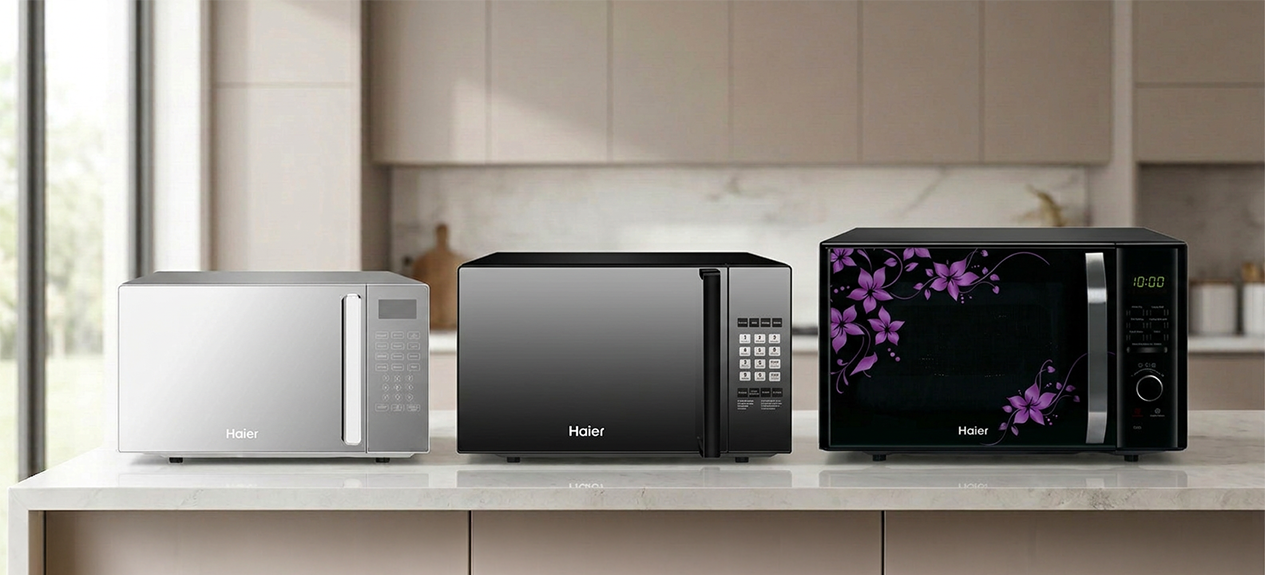

Microwave capacity decides how much food fits in at once, and how comfortably larger dishes, containers and cookware sit inside the cavity. Getting capacity right matters even more when the microwave is doing more than reheating, think baking, grilling, roasting, or putting together family-sized portions.
A microwave capacity guide helps narrow things down, from compact 20L models all the way up to larger 30L appliances. The right pick comes down to household size, cooking habits, how much counter space is available, and whether you’re looking at a solo, grill or convection model.
Why Microwave Capacity Matters
Capacity matters as it can tell you how much your microwave cavity can hold. That number tells you both the size of containers you can fit inside and how much food you can prepare in one go.
A smaller microwave does the job fine for reheating individual portions, while a larger one gives you more room for family-sized dishes and bulkier cookware. Capacity, then, is really a decision that should track the type of cooking the appliance will be handling.
Is a 20-Litre Microwave Too Small?
Not necessarily. A 20L microwave works well for individuals and couples whose main use is reheating food, defrosting ingredients, warming drinks, or putting together smaller portions.
It really comes down to what’s going in it. A 20L cavity can start to feel tight with larger dishes or when cooking for several people at once, especially with convection cooking, which needs extra breathing room around the cookware.
That said, for households with modest needs and tight counter space, a 20L model offers enough capacity without eating up room you don’t have to spare.
Microwave Capacity Guide (20L to 30L)
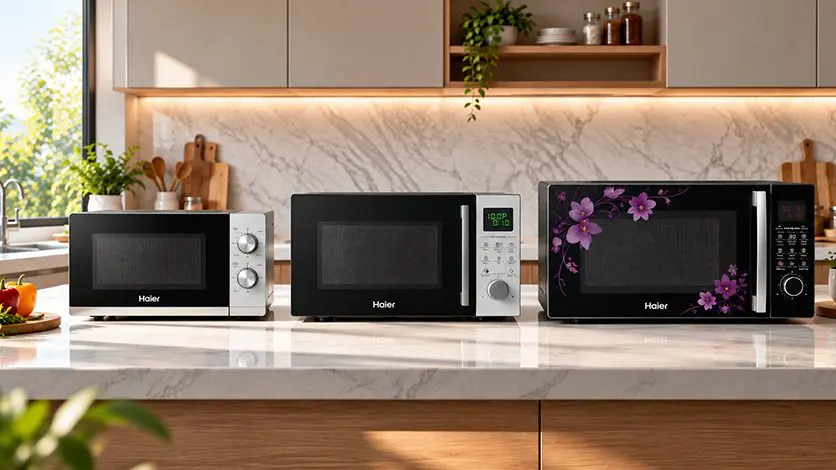
Microwaves between 20L and 30L cover a wide stretch of household needs. Moving up in capacity generally buys more flexibility for cookware and bigger portions, though it also means a larger appliance sitting on your counter.
20-23L: Singles, Couples and Reheating
The 20-23L range suits individuals and couples well. It handles reheating meals, defrosting frozen food, warming drinks and preparing smaller dishes without any strain.
This range also works nicely in kitchens where counter space is at a premium. Haier offers a 23L Convection Microwave with 203 auto-cook menus, four combination cooking functions and a stainless-steel cavity, making this capacity a solid fit for smaller households that still want convection cooking on hand.
The smallest microwave size you’ll typically find for practical home use sits around this range, though compact models below 20L do turn up in some markets.
24-28L: Small Families and Convection Cooking
The 24-28L range opens up more internal room while still fitting comfortably into most standard kitchens. It’s a sensible middle ground for small families that need to prepare larger portions or lean on convection cooking regularly.
A 28L microwave holds larger dishes than a compact 20L model and gives you more room to work with for baking, grilling and roasting. It’s worth considering the moment your cooking needs stretch beyond straightforward reheating.
29-30L+: Large Families and Baking
Microwaves at 29L and above suit larger households, frequent baking, and cooking bigger portions far better. That extra cavity space makes it easier to fit larger cookware and family-sized dishes without a squeeze.
Our Haier 30L Convection Microwave Oven, for instance, comes with a 315mm turntable, 400 auto-cook menus, combination cooking, low-temperature cooking and 2500W convection power, built for baking, roasting, grilling and everyday microwave cooking alike.
How Capacity Relates to Physical Size
Internal capacity and external dimensions run in parallel, but they’re not the same thing. Two microwaves rated at the same litre capacity can still differ in external size depending on cavity design, insulation, controls, ventilation and overall build.
When you’re weighing up the size of a 20 litre microwave, checking the actual width, depth and height matters more than guessing based on the litre rating alone.
Counter depth and overhead clearance are worth measuring before buying too. Adequate ventilation around the appliance counts, and it should sit on a stable, level surface once installed.
Solo vs Convection: How Type Affects the Size You Need
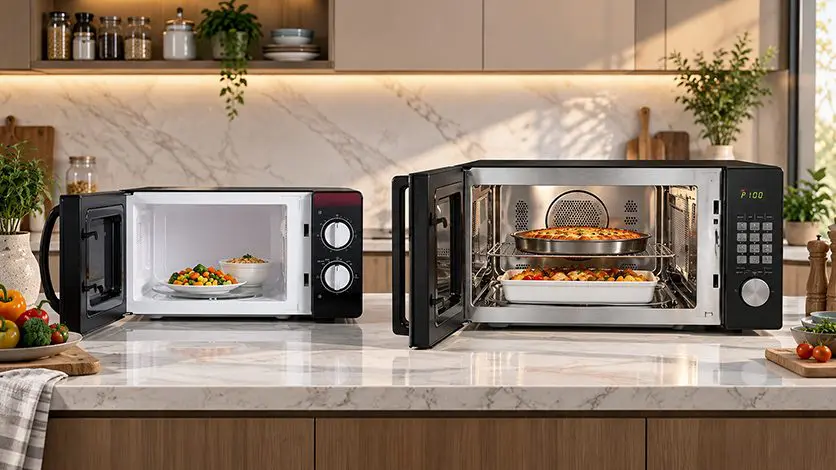
The type of microwave shapes how much capacity actually makes sense for a household. A solo microwave used mainly for reheating doesn’t need a large cavity, while a convection model benefits from extra space for baking trays, racks and bulkier cookware.
Convection cooking also tends to involve more elaborate dishes, which makes the gap between a compact and a larger cavity felt more sharply. Anyone torn between a 20L solo model and a bigger convection microwave should weigh cooking method alongside household size before deciding.
What Size Microwave Do You Need? (By Household)
The answer to what size microwave do I need hinges on both how many people you’re cooking for and how the appliance actually gets used. Household size is a useful starting point, but cooking habits can shift the ideal capacity up or down from there.
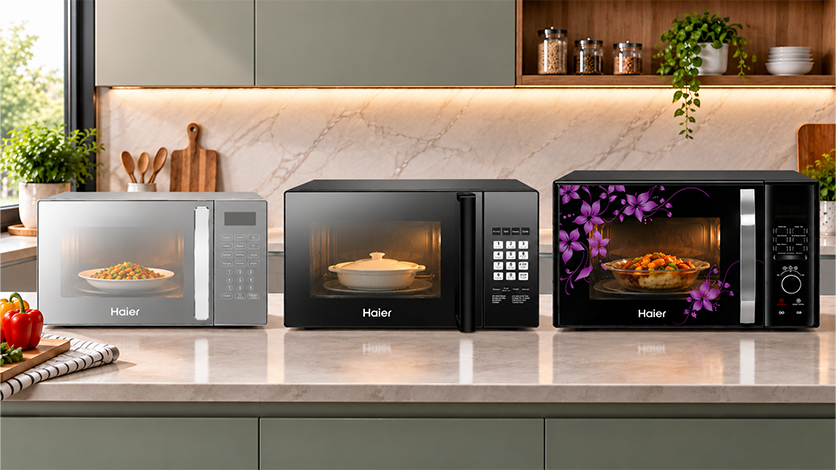
For one person or a couple, 20-23L usually covers everyday reheating and smaller meals just fine. A small family often finds 24-28L more practical, particularly with larger dishes or convection functions in the mix. Larger families, or households that bake or roast often, tend to benefit from a 29-30L cavity or bigger still.
For families hunting for the best microwave size for family use, 25-30L is a useful range to keep in mind, since it offers real flexibility without pushing you straight to the largest model on the shelf.
Capacity Selection Checklist
The gap between a 20 litre vs 30 litre microwave really comes down to usable cooking space, not just picking the bigger number. A 20L model handles basic reheating and smaller portions perfectly well, while a 30L microwave leaves room for family-sized meals, larger cookware, baking and roasting.
Capacity is worth matching to both your household’s cooking habits and the kitchen space you’ve got to work with. If reheating individual meals is mostly what the microwave will do, 20-23L covers that comfortably. If larger dishes or convection cooking are part of the regular routine, pushing toward 28-30L buys considerably more room to work with.
FAQs
What size microwave do I need for a family of 4?
A 25-30L microwave generally works well for a family of four. Going larger makes sense if the appliance will also handle baking, roasting or large dishes regularly.
What is the difference between a 20L and a 30L microwave?
A 30L microwave has a bigger internal cavity, fitting larger cookware and portions with ease. A 20L model takes up less space and suits smaller households and simpler cooking needs better.
What is the size of a 20-litre microwave?
External dimensions differ from model to model, even when the internal capacity reads 20L across the board. It’s worth checking width, depth and height individually before assuming it’ll fit your kitchen.
Is a 28-litre microwave big enough?
Yes, 28L works well as a versatile capacity for many small and medium-sized families. It offers more room than compact models and handles convection cooking, baking and larger portions comfortably.
What is the smallest microwave size available?
Compact household microwaves can dip below 20L in some cases, though 20-23L remains the common practical range for standard home use. Smaller capacities generally suit lighter cooking needs best.
Which microwave capacity is best for a couple?
A 20-23L microwave usually covers a couple’s needs when reheating meals and preparing smaller portions is the main use. A larger capacity becomes worthwhile if baking or bigger-portion cooking comes up often.
Is a 20 litres microwave small?
A 20L microwave counts as compact next to 25-30L models, though it’s not too small on its own terms. It handles everyday reheating and cooking comfortably for one or two people.
What size is a 30 liter microwave oven?
External dimensions on a 30L microwave vary by design. One current Haier 30L convection model, for example, measures roughly 520 × 508 × 326 mm.
How big is a 32 litre microwave?
A 32L microwave holds slightly more internal capacity than a 30L model, though external dimensions still vary by manufacturer and design. Checking the exact width, depth and height for the specific model remains the safest approach.