

The box of kaju katli has just come out of the refrigerator. You’re sitting with guests in the living room, the tea is brewing and you open the box and get those soft melt-in-the-mouth pieces you always wanted.
Rather, they’re surprisingly hard.
This is the same case with peda, barfi and even gulab jamun. Perishable sweets will keep better in the fridge, but refrigeration may also result in harder or less appealing sweets when they come out of the fridge.
Fortunately, it isn’t necessary to leave them outside for hours or heat them until they lose their shape.
To avoid melting the sweets, the preferred method of warming the Diwali sweets is through safe, controlled warming or by warming for a few seconds in a low power setting in a microwave. The proper technique will depend on the ingredients of the sweet and its water content, as well as its sensitivity to heat.
Why Do Diwali Sweets Get Hard When Refrigerated?
All types of mithai are not chilled the same way. Some get harder due to their fat levels turning solid at cooler temperatures. Others end up being less soft, due to moisture shifting in the sweet.
Consider kaju katli. It is very smooth because of the finely ground cashews, the sugar and a bit of ghee (depending on the recipe). After refrigeration, the sweet becomes rather firm.
Milk based sweets have a different consistency.
Peda and some types of barfi have khoya or milk solids. They can get more solid after being refrigerated, especially if stored improperly.
What Really Happens Within the Sweet?
When refrigerated sweets take the first bite, three factors will affect how they feel:
- Firmness of ghee and milk fat: Ghee and milk fat get harder at low temperatures, which results in less softness of peda and barfi.
- Variations in moisture distribution: Some sweets will feel drier or denser than others.
- Sugar crystallisation: In traditional mithai, sugar crystals can affect the texture of the mithai based on the recipe and the storage conditions.
The changes are not necessarily signs of spoilage of the sweets.
Softening, however, is no way to reverse spoilage. Throw away any sweet that smells strange, shows mould or any other signs of damage do not try to reheat.
What Diwali Sweets Can Be Softened Without Losing Their Shape?
When planning to use the microwave, think about what you want to cook. A gulab jamun soaked in syrup is different from a light kaju katli.
| Diwali sweet | Recommended method | What to avoid |
| Kaju katli | Brief covered resting at room temperature | Excessive microwave heating |
| Milk peda | The warming is done with very short, low power microwaves. | Extremely high temperatures for fat release. |
| Plain milk barfi | Gentle warm in small amounts | Prolonged heating |
| Gulab jamun | Heat slowly and add a bit of syrup. | Heating without syrup |
| Besan ladoo | Allow to rest for a short time at room temperature. | Allow the ghee to get too hot until it separates. |
| Chocolate-coated mithai | Serve cool, or per package directions. | Direct heating which melts the coating |
The goal is not to cook all the sweets. It’s to bring back the good eating texture and maintain its original appearance.
How to Soften Refrigerated Diwali Sweets in a Microwave?
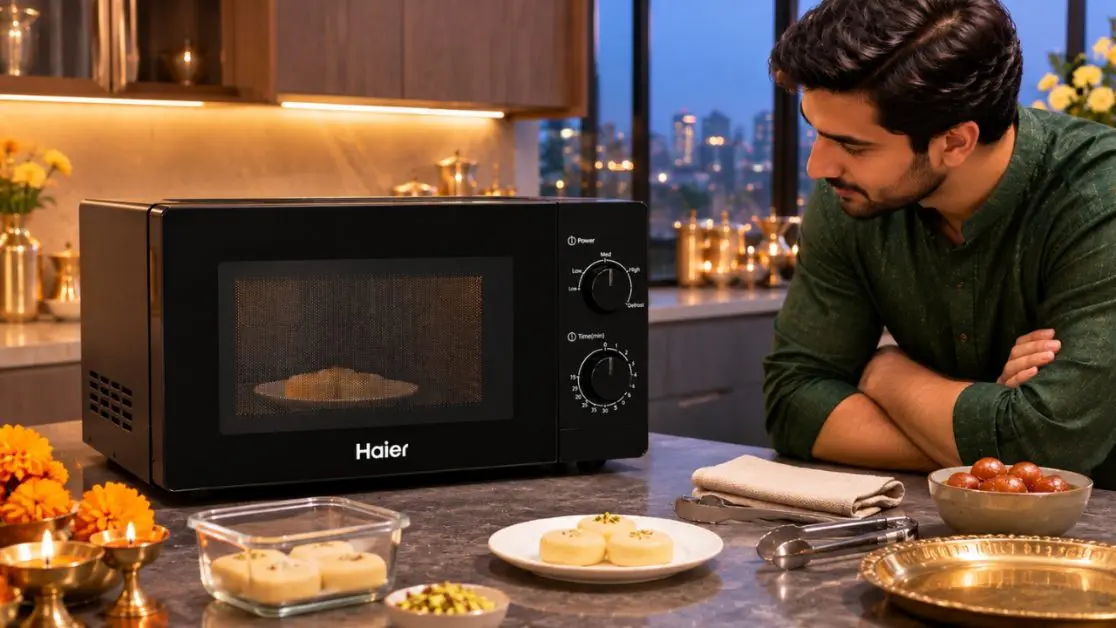
When guests come unannounced, and the time is short to prepare the mithai platter, a microwave can come in handy.
However, there is a place in which people go wrong.
They choose a high heat setting, cook the sweets for too long and find that they’ve got a hard centre and a melted edge.
Shorter cooking times and lower wattage are better suited for delicate Indian sweets.
Step 1: Remove Only the Quantity That Is Needed
Don’t reheat a whole box if serving four or five pieces.
Remove the necessary amount and leave the rest of the sweets in the refrigerator. This reduces unnecessary moving and handling and temperature fluctuations.
Step 2: Choose a Microwave-Safe Plate
Place sweets onto a ceramic or glass plate in the microwave.
Take off metallic foil decorations (silver varak) before putting them in the microwave. Do not put metal trays, foil packaging or pretty containers in the appliance.
Arrange the pieces without stacking.
Step 3: Select a Low Power Setting
When heating sweets in the microwave, start on a low setting and use very short time, e.g., 5 seconds for a small amount.
Examine the texture before putting in any additional time. The actual heat needs will vary depending on the portion size, recipe and microwave power.
Remember, sweets containing considerable sugar or fat can develop hot spots.
Step 4: Allow the Heat to Settle
When warming, leave sweets on plate for a short time.
This allows the temperature to even out. Before serving, make sure you check very thoroughly, particularly if the sweets have syrup or soft fillings.
Step 5: Serve Immediately
When the texture is appropriate, place the sweets on a serving dish.
Do not repeat-heat, as this can impact on their consistency and quality.
How Haier Solo Microwave Ovens Assist in Gentle Reheating
The kitchen is not just preparing food during the festive season of Diwali, but preparing a lot more snacks to make, leftovers to heat up and sweets to serve between visits from relatives.
A microwave oven with variant heating controls can help make these smaller kitchen chores easier.
Haier India provides a single microwave oven for cooking, reheating and defrosting. There are two models that can be considered: Haier 20L Solo Microwave Oven (HIL2001MWPH) and Haier 19L Solo Microwave Oven with Inverter Technology (HIL1901MBPB).
Haier 20L Solo Microwave Oven (HIL2001MWPH)
The Haier 20L Solo Microwave Oven (HIL2001MWPH) offers a 5 microwave power level setting, ideal for households that like to have simple controls.
This is especially important for foods that don’t need full power heating.
Its features include:
- Five power settings to choose from to adjust the intensity of the heating in the microwave.
- A 35-minute cooking timer for various cooking and reheating needs.
- An even 20 litre container that can be used on a daily basis.
- Defrosting frozen foods.
- A rotating turntable to support more uniform heating.
If the mithai is delicate, then it is better to use lower power settings than maximum power as it gives more control.
As always, the texture will be determined by the sweet itself, and by the careful control of the heating time.
Haier 19L Solo Microwave Oven with Inverter Technology (HIL1901MBPB)
The other is the Haier 19L Solo Inverter Microwave Oven (HIL1901MBPB).
Designed for everyday cooking, reheating and defrosting, this model incorporates an electronic transformer-based system.
Some of the features it has been listed for are:
- Cook, reheat and defrost in a single microwave.
- Electronic transformer technology (inverter).
- Energy-saving operation under the electronic transformer.
- Low operating noise (57dB(A)).
- A lightweight design for easier handling.
The 19 litre size could be suitable for households who are seeking a smaller option for regular reheating.
Soften sweets, following operating instructions as indicated in the model and leave short heating periods. However, using inverter technology does not rule out the risk of overheating precious desserts.
Both models are suitable for everyday festive food preparation but neither one should be considered to have a special mithai-softening programme.
How to Make Diwali Sweets Softer Without a Microwave?
Yes. In fact, some sweets benefit from no further heating.
For example, the taste of kaju katli can be improved by letting it cool for a brief time before refrigerating.
Try Controlled Room-Temperature Resting
Put on a clean, covered plate and let some of the cold come off of the parts.
The following are a few practical tips:
- Store sweets in a covered container to prevent dust and insects from getting in.
- Don’t put the plate in direct sunlight.
- Avoid leaving milk sweets at room temperature for long periods of time.
- Don’t keep warm and cool foods over and over again; return unused refrigerated foods promptly.
Perishable sweets should not be kept out of refrigeration for more than two hours, or for one hour if the temperature is above 32°C, as a food-safety precaution.
When you don’t know what’s in a sweet or how to store it, follow the manufacturer’s instructions.
What Are the Common Mistakes That Can Ruin Refrigerated Mithai?
Softening and melting can only be a few seconds of unnecessary heating.
Here are some errors to avoid.
Heating Different Sweets Together
The reaction of a gulab jamun and piece of kaju katli to heat is not the same.
One might be too hot before the other is as desired.
Separate them by type.
Pouring Water on to Dry Sweets
Applying water on barfi or peda could be a remedy, but it may create stickiness or alter the original consistency of the barfi or peda.
If it’s a choice between using controlled heat or adding moisture, it’s usually better to use controlled heat.
Using High Microwave Power
When using high power, this may lead to uneven heating particularly in small quantities.
A soft setting and regular checking will provide more control.
Heating Chocolate-Coated Sweets
The sweet may melt before the chocolate melts.
Refer to the instructions on the product for storage and serving on these varieties.
How to Store the Leftover Diwali Sweets?
Even as important as reheating is good storage.
Following Diwali functions, there are a few cases of different types of mithai, which are candy, in the refrigerator. However, the mixing of all things is not ideal.
Various sweets contain varying amounts of moisture, ingredients and require varying conditions for storage.
So that they retain their quality:
- Keep milk sweets in clean, airtight containers in the refrigerator.
- Store syrup-filled sweets in appropriate covered containers that have syrup.
- Distinguish dry from moist sweets.
- Use-by date and refrigeration directions as per manufacturer.
- Don’t place sweet treats next to strong-smelling, uncovered food items.
- If the storage history is not known or if there are signs of spoilage, discard leftovers.
A temperature of 4°C or lower is usually suggested for refrigerated perishable foods.
Oh, and don’t forget, refrigerated sweets do not last forever.
Transform Every Diwali Serving into a Fresh and Fun Experience
Serving guests a bowl of mithai that’s just right to their taste is a special experience. The peda should feel just so soft, the gulab jamun should be tasty but not too spicy and the kaju katli should have a fine texture.
It’s not a complicated way to get to that balance.
At times too little, too late is sufficient. If the heat is to be gentle, a microwave with a temperature regulating function may make the job easier.
Haier India presents the Haier 20L Solo Microwave Oven (HIL2001MWPH) and Haier 19L Solo Microwave Oven with Inverter Technology (HIL1901MBPB) – which are very useful for everyday reheating and food preparation.
Visit Haier India for a single microwave oven range and discover the perfect microwave to make the festive serving a bit more convenient.
After all, the idea of Diwali sweets is to eat them, not save them from an over heated plate.
Frequently Asked Questions
How do you soften refrigerated Diwali sweets without melting them?
Remove the required portion from the refrigerator and allow it to rest briefly at room temperature. For sweets suitable for reheating, use a microwave at low power in very short intervals. Check the texture frequently to prevent overheating, melting or changes in consistency.
Can you reheat kaju katli in a microwave?
Yes, but kaju katli requires extra care because excessive heat can affect its delicate texture. Allowing it to soften naturally at room temperature is generally preferable. If microwave warming is necessary, remove any silver foil and use a very low power setting for a few seconds.
Which microwave is suitable for gently reheating Diwali sweets?
A solo microwave with adjustable power levels can be useful for gentle reheating. The Haier 20L Solo Microwave Oven (HIL2001MWPH) offers five power levels, allowing users to adjust heating intensity according to the food. Short heating intervals are particularly important for delicate sweets.
Why does barfi become hard after refrigeration?
Barfi may become harder because milk fats solidify at lower temperatures and moisture distribution changes during storage. Its texture also depends on the ingredients and preparation method. Allowing refrigerated barfi to rest briefly at room temperature can help improve its eating consistency.
Can you soften refrigerated gulab jamun without making it soggy?
Yes. Gently warm gulab jamun with a little of its syrup in a microwave-safe bowl. Use a low power setting and short heating intervals, checking frequently. Avoid excessive heating, as the syrup can become very hot and the gulab jamun may lose its shape.