
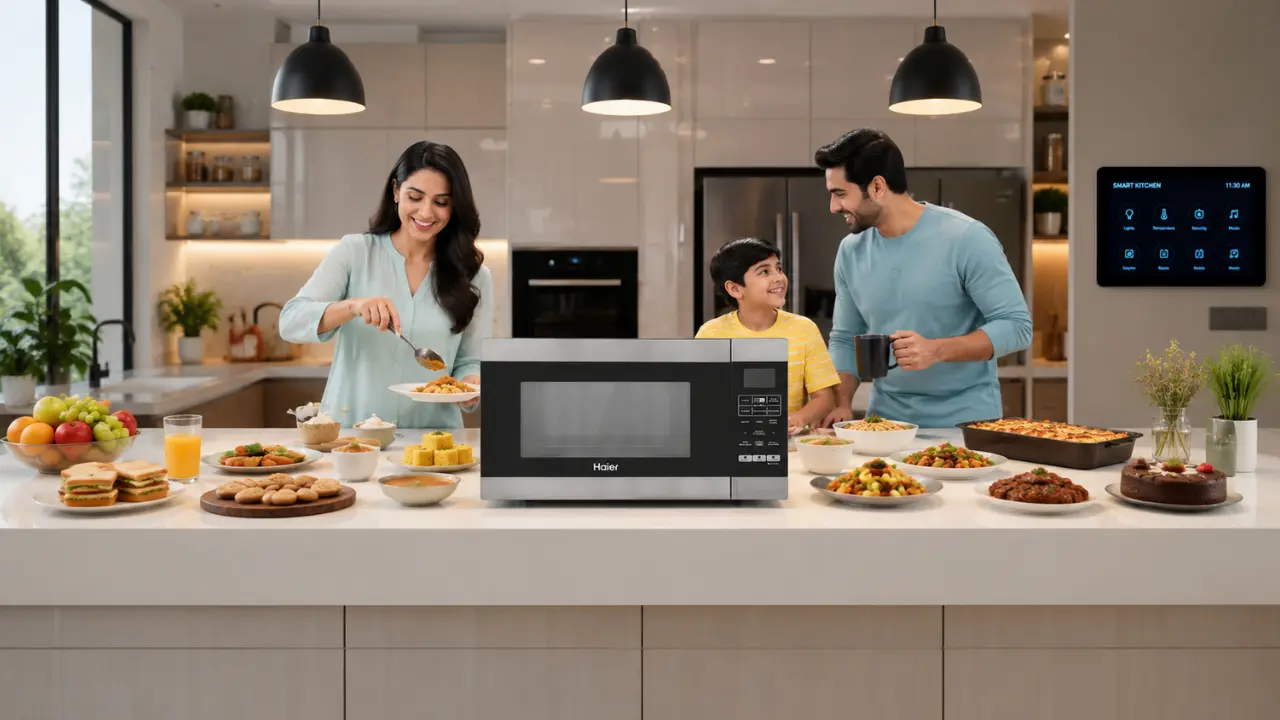

Microwaves cook faster because they heat food differently from traditional cooking methods. Instead of heating the cooking vessel first and then transferring heat to food, microwave technology uses electromagnetic waves that excite water molecules inside food, generating heat directly where it is needed. Modern convection microwaves go even further by combining microwave energy, grilling, convection airflow, and smart cooking programs to reduce cooking time while improving consistency.
A busy weekday evening tells the story better than any technical explanation.
Someone gets home after work at 8 PM. The vegetables are still in the refrigerator. The dough is ready, but dinner is not. In a conventional oven, preheating alone may take several minutes. On a gas stove, every dish demands attention.
A microwave changes the equation.
Food goes in. Heat appears almost instantly. Dinner moves from idea to reality much faster.
Most people see the result.
Few understand the system behind it.
And that system is surprisingly clever.
Why microwaves cook differently
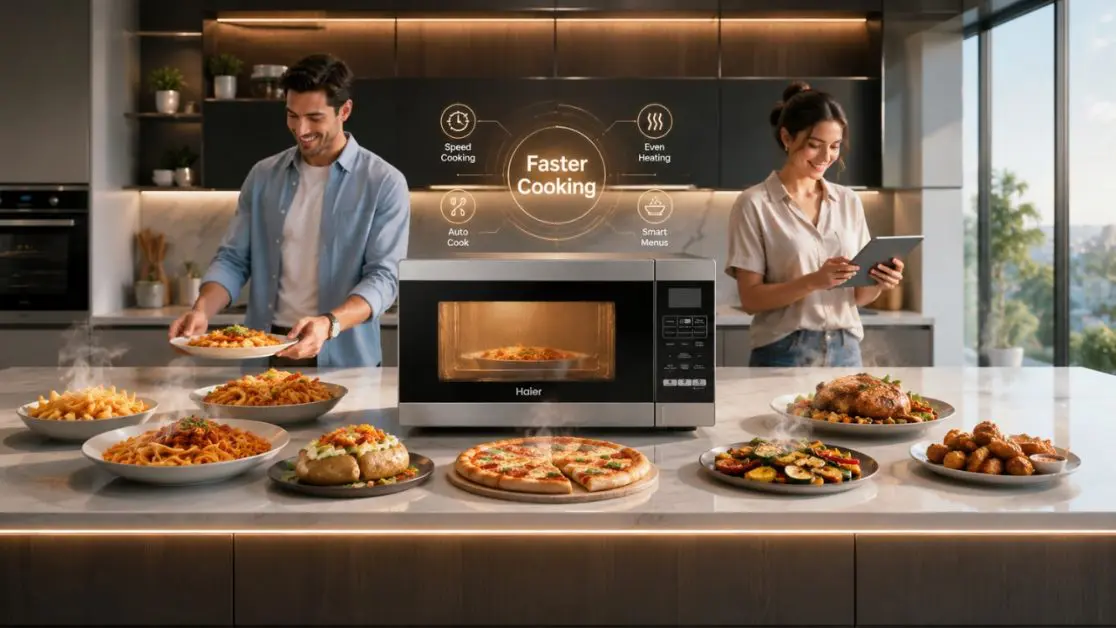
Traditional cooking relies on external heat.
A pan becomes hot. The heat moves into the food. The outer layer cooks first. The centre follows later.
Microwave technology works from another direction.
Heat begins inside the food
Microwave ovens generate electromagnetic waves. These waves interact primarily with water molecules present in food.
When the waves pass through food:
- Water molecules vibrate rapidly
- Friction creates heat
- Heat develops throughout the food instead of only on the surface
- Cooking time decreases significantly
The physicist Percy Spencer discovered this phenomenon in the 1940s when a chocolate bar in his pocket melted near radar equipment.
One accidental observation changed kitchens forever.
The principle remains the same today.
Technology has become far smarter.
Faster cooking is really about energy efficiency
Many people assume microwave cooking is simply “more powerful.”
That is not the reason.
The real advantage is efficiency.
Think about boiling water in a large vessel on a gas stove.
You are heating:
- The burner
- The vessel
- The surrounding air
- The kitchen environment
Only part of that energy reaches the food.
Microwave technology focuses energy directly on the food itself.
Less wasted heat.
Less waiting.
More efficiency.
That explains why reheating a bowl of dal often takes two minutes instead of fifteen.
A useful principle emerges here:
The fastest system is usually the one with the fewest unnecessary steps.
Microwave cooking follows that rule perfectly.
The hidden technologies that make modern microwaves faster
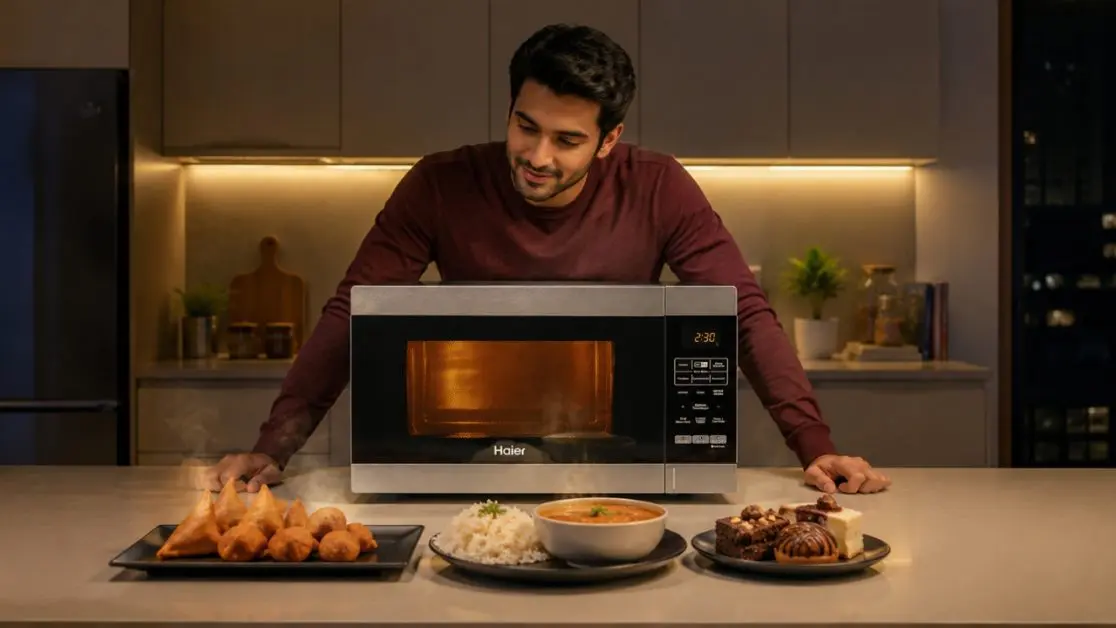
The microwave sitting in today’s kitchen is very different from early-generation models.
Modern convection microwaves use multiple technologies working together.
1. Combination cooking technology
One of the biggest advances in microwave performance is combination cooking.
Instead of relying only on microwave energy, the appliance combines:
- Microwave mode
- Convection mode
- Grill mode
When these systems work together, cooking speed improves substantially.
For example:
- Microwave energy cooks internally
- Convection heat browns the exterior
- Grill functions create texture and crispness
Haier’s 25L Convection Microwave includes combination cooking modes that help reduce cooking time by blending microwave, grill, and convection functions for suitable recipes. It also includes multi-stage cooking and extensive auto-cook menus for convenience.
The result feels simple.
The engineering behind it is not.
2. Pre-programmed cooking intelligence
Most cooking mistakes come from guesswork.
Too much time.
Too little power.
Incorrect settings.
Modern microwaves increasingly remove that uncertainty.
Auto-cook technology automatically adjusts cooking parameters based on selected dishes.
Benefits include:
- Optimised cooking duration
- Appropriate power levels
- More predictable outcomes
- Reduced monitoring
Haier’s microwave range includes extensive auto-cook functionality, with select models offering dozens or even hundreds of preset cooking programmes designed for different recipes.
The appliance handles calculations.
The user focuses on the meal.
3. Convection airflow systems
Cooking speed is not only about temperature.
It is also about heat distribution.
A common issue in older ovens was uneven cooking.
One side browned.
The other side remained undercooked.
Convection technology addresses this challenge.
How convection speeds up cooking
Convection systems circulate heated air around food.
This creates:
- Faster heat transfer
- More uniform cooking
- Better baking results
- Improved roasting performance
Food receives heat from multiple directions rather than a single source.
The difference becomes noticeable when baking pizzas, cakes, cookies, or Indian breads.
Even cooking means fewer corrections.
Fewer corrections mean less total cooking time.
Stainless steel cavities play a bigger role than most people realise
People often focus on external design.
The interior matters just as much.
Modern convection microwaves increasingly use stainless steel cavities for a reason.
Advantages include:
- Better heat reflection
- More efficient energy use
- Improved durability
- Easier cleaning
- Better hygiene
Several Haier convection microwave models feature stainless steel interiors specifically designed to support efficient and even cooking performance.
Small design decisions often create large performance gains.
This is one of them.
Faster cooking is becoming healthier cooking
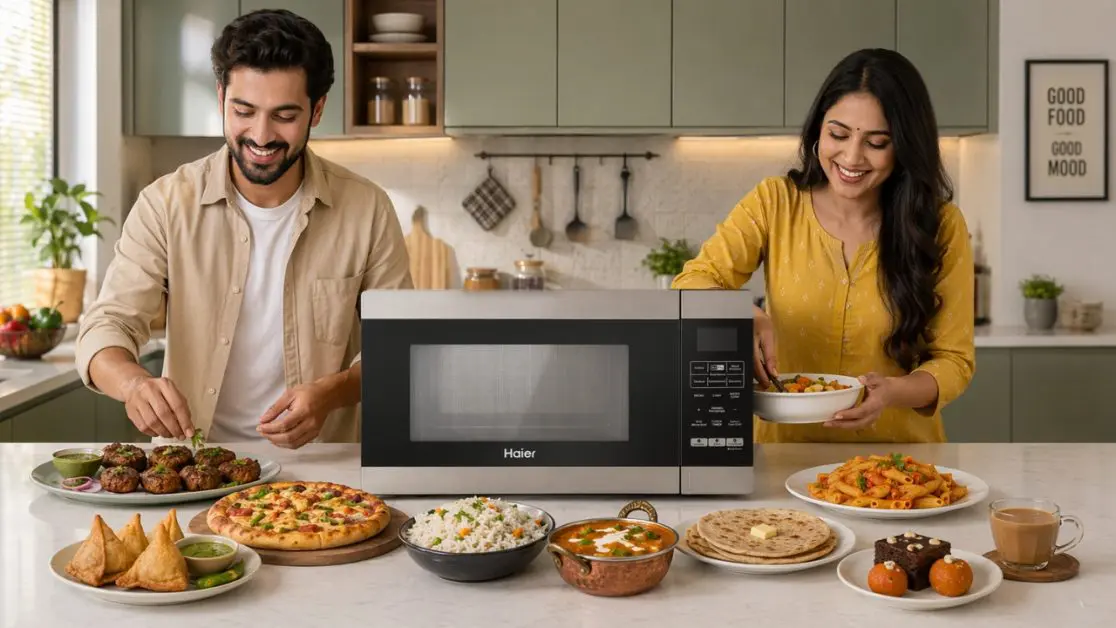
Speed once came with compromise.
Convenience foods often traded nutrition for time.
That assumption is changing.
Technology is reducing the trade-off
Modern microwave systems increasingly support:
- Low-oil cooking
- Air frying
- Grilling
- Controlled heating
The goal is no longer simply cooking quickly.
The goal is cooking efficiently without unnecessary oil.
Several modern convection microwave designs now incorporate features intended for reduced-oil cooking experiences and air-frying capabilities.
That shift reflects how Indian kitchens are evolving.
Families want convenience.
They also want healthier choices.
What happens when multiple technologies work together?
The most advanced microwaves no longer function as a single appliance.
They operate more like cooking platforms.
Consider what today’s premium convection microwave can combine:
- Microwave heating
- Convection baking
- Grill cooking
- Air frying
- Rotisserie functions
A larger-capacity Haier convection microwave integrates all these capabilities into one appliance, along with dedicated air-fryer menus and motorised rotisserie functionality.
That changes how people use kitchen space.
Instead of managing several appliances, one system performs multiple roles.
A good kitchen appliance saves more than time.
It saves decisions.
Common myths about faster microwave cooking
Myth 1: Faster cooking means lower quality
Not necessarily.
Quality depends on cooking method, recipe, temperature control, and appliance capability.
Modern convection microwaves produce baked goods, grilled foods, and roasted dishes that would surprise many first-time users.
Myth 2: Microwaves only reheat food
That may have been true decades ago.
Today’s models support:
- Baking
- Grilling
- Air frying
- Roasting
- Bread preparation
- Multi-stage cooking
Myth 3: Faster means less nutritious
Research published by food scientists over the years consistently shows that shorter cooking times can help preserve certain heat-sensitive nutrients because food spends less time exposed to prolonged heat.
The important variable is how food is cooked, not simply how quickly.
The bigger lesson behind microwave technology
The story of faster microwave cooking is not really about speed.
It is about removing friction.
Every useful technology does the same thing.
A navigation app removes uncertainty from travel.
Online banking removes waiting from transactions.
A modern microwave removes unnecessary time from meal preparation.
The best innovations rarely ask people to work harder.
They quietly remove steps.
That is what modern microwave technology has been doing for decades.
And with features such as combination cooking, convection airflow, stainless steel cavities, auto-cook programmes, air frying, and intelligent cooking modes, today’s microwaves continue to redefine what “fast cooking” actually means.
Because in most Indian homes, the real luxury is not just a faster meal.
It is getting a little more time back for everything that happens after dinner.
Frequently Asked Questions
How do I know if a convection microwave is worth buying for my family?
A convection microwave is useful if you frequently bake, grill, roast, or reheat food. It combines multiple cooking functions into one appliance, reducing cooking time and saving kitchen space.
Should I buy a microwave if I already have a gas stove and an oven?
Yes, if speed and convenience matter. Microwaves excel at reheating, quick cooking, and reducing the need for constant supervision.
Is a larger microwave always better?
Not necessarily. Larger capacity helps bigger families and larger dishes, but it also takes up more space. Capacity should match your cooking habits.
What is the difference between a solo, grill, and convection microwave?
Solo models mainly reheat and cook. Grill models add browning and crisping. Convection models combine microwave heating with circulating hot air for baking and roasting.
Do auto-cook menus actually make cooking easier?
Yes. They reduce guesswork by automatically selecting cooking time and power levels for specific dishes.