
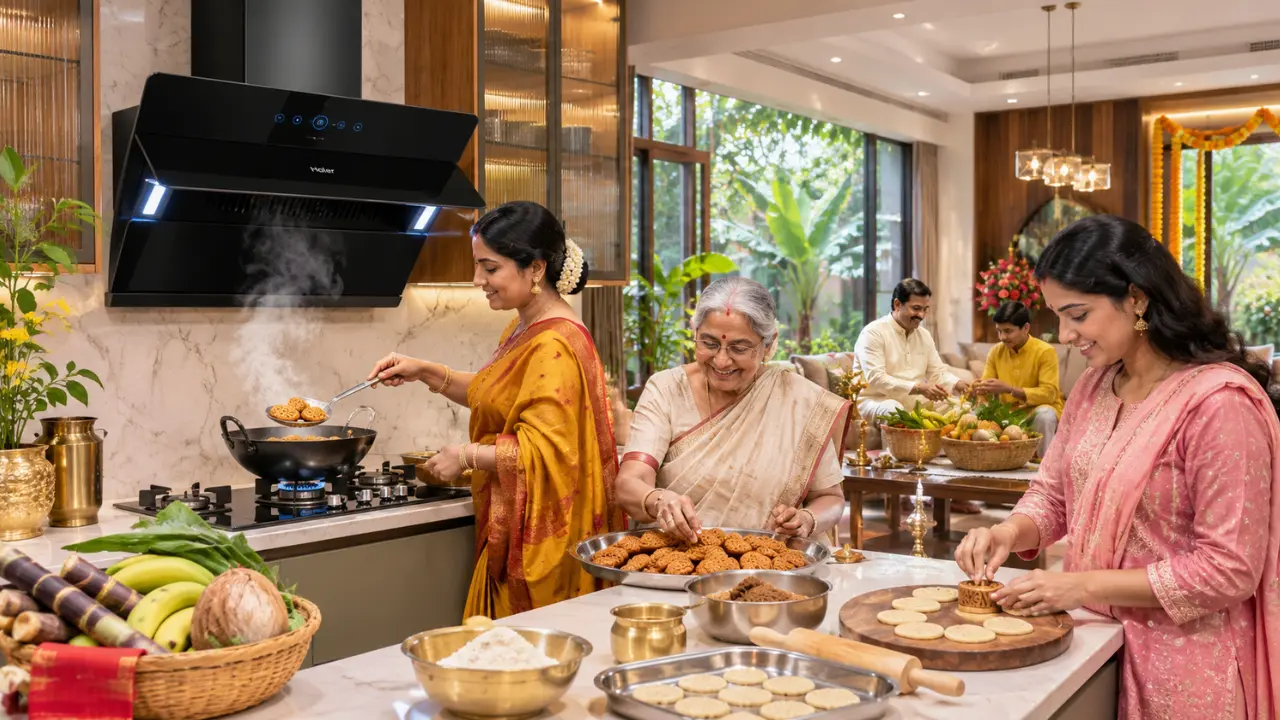

The following are some ways to help minimize the frying residue after preparing thekua:
The thekua is prepared. They are beautifully crisp, golden brown and set out on a steel plate for cooling. However, the kitchen is another matter.
There’s a lingering scent of hot ghee, the exhaust fan is still humming and the familiar fried-food smell has somehow filtered its way from the kitchen to the living room.
This isn’t unusual in the times of Chhath Puja preparations. The traditional way to make Thekua involves deep frying the wheat flour, jaggery or sugar and ghee. If multiple batches are cooked in succession, the cooking vapors may linger in the house long after the stove has been turned off.
So, how to get rid of frying odors from the kitchen without spoiling the holiday festivities?
Solutions include improved ventilation, better oil usage, appropriate cleaning and a proper kitchen chimney.
Why Does Fried Thekua Smell in the Kitchen?
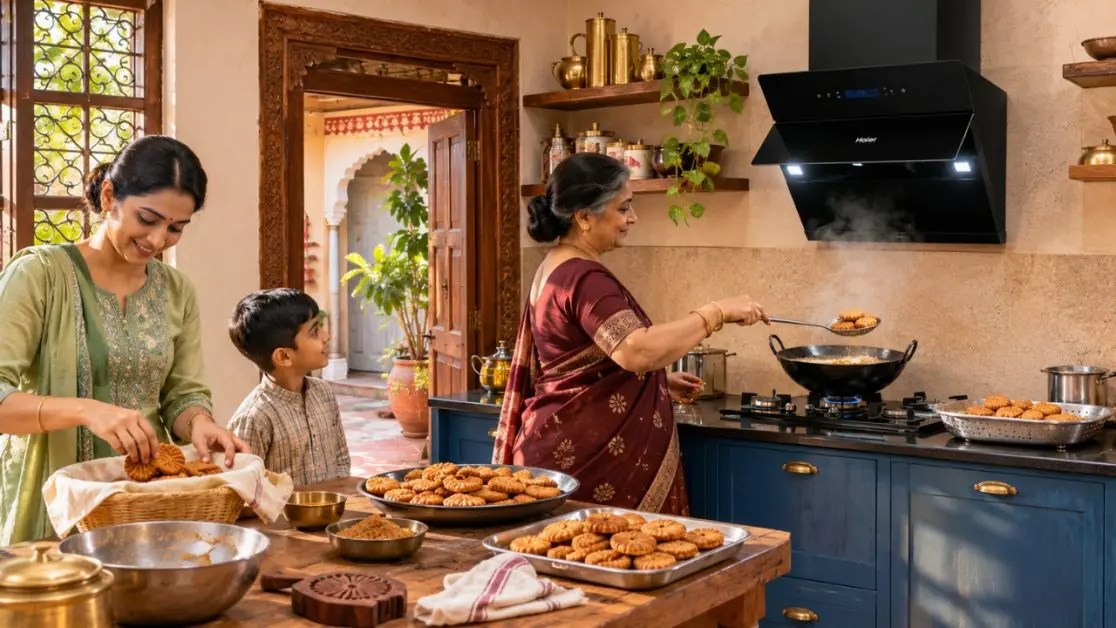
Deep frying emits more than the delightful smell of freshly-fried food. When ghee or oil is heated, it generates vapours and very small particles in the air that may fan out to the cooking space.
Some of these particles deposit on surfaces in the immediate vicinity such as kitchen tiles, cabinets, curtains, counter tops etc. Some are suspended in the air, especially if ventilation is restricted.
Where there are three conditions that aggravate the problem:
- Long hours of frying: During the preparation of thekua a lot of cooking oil is used which is kept hot for a long time.
- Poor ventilation: If there is no proper ventilation, the cooking fumes circulate in the kitchen.
- Oil build-up around the stove, chimney and backsplash can trap the foul food smells.
And this is a fact to remember. Cleaning the interior of a home is a crucial step in the cleanup process, as it involves dusting and removing grease particles that have accumulated on kitchen surfaces.Dusting and cleaning grease particles that have settled in the kitchen is an important part of cleaning a home, as opening a window after cooking may not accomplish this.
It’s as crucial to prevent their build-up as it is to eliminate the odour.
Start Controlling Frying Smells Before the First Batch
It’s not a job that’s going to be easy if you wait until the kitchen reek of fried food.
Instead, set up your cooking area prior to heating the ghee.
1. Turn Your Kitchen Chimney On as Early as Possible
A kitchen chimney collects cooking fumes close to their source, minimising fumes in neighbouring rooms.
Turn it on just before frying starts. Run it during the cooking time and for several minutes after, as per manufacturer’s instructions.
A chimney with adjustable suction can come in handy for families that make these in several batches.
2. Use the Correct Amount and Type of Frying Oil
Excessive smoke and foul odours can be a byproduct of overheated ghee.
It can be fried slowly controlled over a low to medium flame, with the centre being cooked and not the outside which can burn.
Keep in mind these useful tips:
- Do not heat ghee till it begins to smoke.
- Don’t overload the kadai when frying.
- Use an appropriate tool to remove burnt crumbs between batches.
- Reduce the flame if the ghee becomes excessively hot.
The key is to maintain temperature to preserve the texture of the thekua and to prevent the extra cooking vapors.
3. Make Sure the Kitchen Is Well-Ventilated
Let fresh air in through a window or other opening, if possible.
Do not have strong crosswinds directly across the stove as this can cause the flame to be blown back into the chimney and cause flame instability.
A properly installed ducted kitchen chimney can help direct cooking fumes outside of the home, instead of having them recirculate inside.
The Advantages of Haier Kitchen Chimneys for Frying Smoke Control
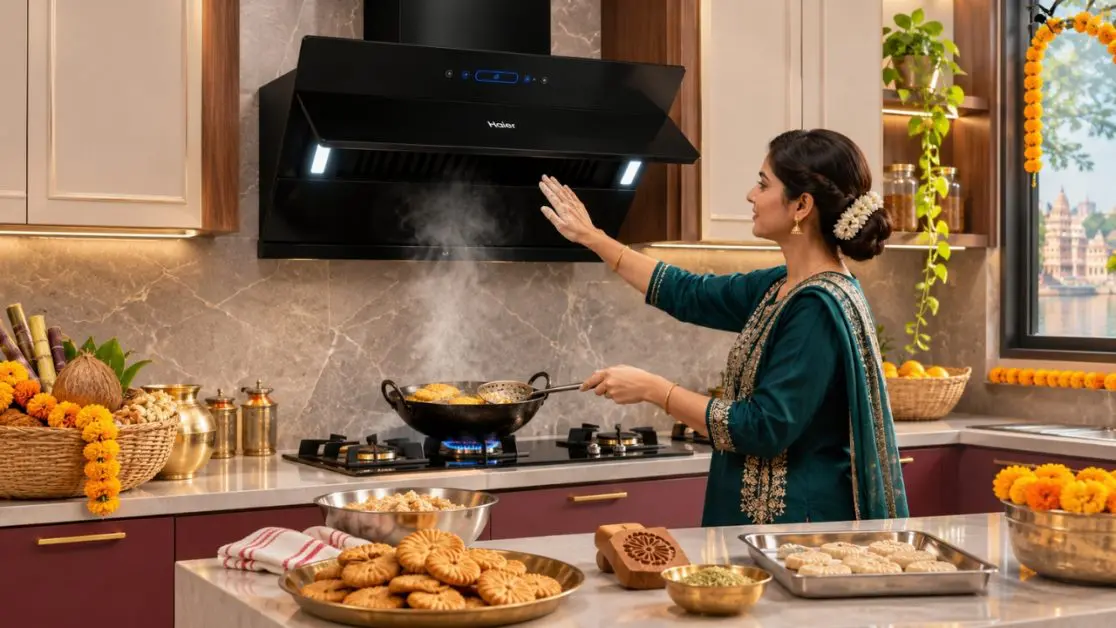
The kitchen is usually very busy for hours while performing Chhath Puja. Cooking thekua or regular dishes, managing the smoke and grease becomes important in the comfort of the cooking environment.
This is where Haier India’s filterless kitchen chimney can come in handy.
Consider two options Haier HIH-C1600-BLDC-IN and Haier HIH-C1750-BLDC-IN, both having features that meet rigorous Indian cooking needs.
Haier HIH-C1600-BLDC-IN: Powerful Suction for Indian Cooking
The Haier HIH-C1600-BLDC-IN vacuum has a strong suction power and is suitable for cooking use in the Indian kitchen.
The Haier BLDC Motor with 1650 m³/h Suction Power Spin Clean Filterless Chimney (HIH-C1600-BLDC-IN) is a high-efficiency suction power spin clean filterless chimney that is conveniently operated.
It has a rated suction capacity of 1650m³/h that assists in removing cooking fumes during intensive cooking such as frying.
There are a number of useful features on the chimney:
- 8 Speed + Boost: Slow or fast the extraction speed to suit the intensity of cooking and add a boost speed when necessary.
- BLDC Motor: Motor designed to be efficient and lower noise, with a power of 130W.
- Touch and Gesture Control: Control the chimney using touch controls or simple gestures.
- Heat Auto Clean: Loosens up any grease built up due to heat and allows it to flow to the oil collector.
- Cleaning Reminder: Reminds users of imminent cleaning after 30 hours of cumulative activity time, for timely maintenance.
The model is available in 60 cm size which may be considered for other kitchen layouts.
Adjustable suction setting is helpful for families preparing multiple batches of thekua as they vary the intensity of the cooking.
Haier HIH-C1750-BLDC-IN: Easy Ventilation in the Busy Kitchen
Alternatively, the Haier Colour User Panel with 1650 m³/h Suction Power Spin Clean Filterless Chimney (HIH-C1750-BLDC-IN) is available.
This chimney has a rated suction of 1650 m³/h, BLDC motor and no filter.
It has the following three main qualities:
- Easy-to-use touch and gesture control.
- Additional boost function and 8 speed settings.
- Introduce heat Auto Clean technology that can effectively deal with grease accumulation.
- Large oil collector for convenient cleaning.
- Reminder to clean after 30 amassed operating hours.
The larger 75 cm model might be suitable for matching cooking arrangements that need more surface area.
Both models also feature a one-minute delay-off function and a listed warranty of four years on the product and twelve years on the motor, subject to applicable warranty terms.
Importantly, optimal chimney function relies on proper installation, ducting, cooking and maintenance. No chimney will provide 100% of the removal of all cooking odors.
What Do You Do Right After the Thekua Frying?
After the end of the batch, there are a few minor steps that could make a world of difference.
Remove the Source of the Smell
Don’t leave the kadai containing used ghee uncovered on the stove for hours.
Let it cool down before handling or storing it. Strain and store the ghee if it is found to be fit for reuse. Dispose of oil that is too dark, burned or otherwise degraded.
Never pour hot oil down the kitchen sink!
Wipe Down the Greasy Surfaces
Clean counter tops, stovetops and backsplash after they get cool.
Oily deposits can be cleaned with a suitable kitchen degreaser or with a mild dishwashing solution.
Remember to check in the vicinity of the burners and lower parts of adjacent cabinets where grease can build up with repeated cooking.
Clean Your Chimney’s Oil Collector
Check the oil collector with the manufacturer’s maintenance guidelines if applicable.
Haier HIH-C1600-BLDC-IN and HIH-C1750-BLDC-IN models have Heat Auto Clean technology and special oil collection systems.
These features assist in the management of grease build-up in the appliance, but the appliance should still be cleaned regularly.
Can Natural Ingredients Remove Lingering Frying Smells?
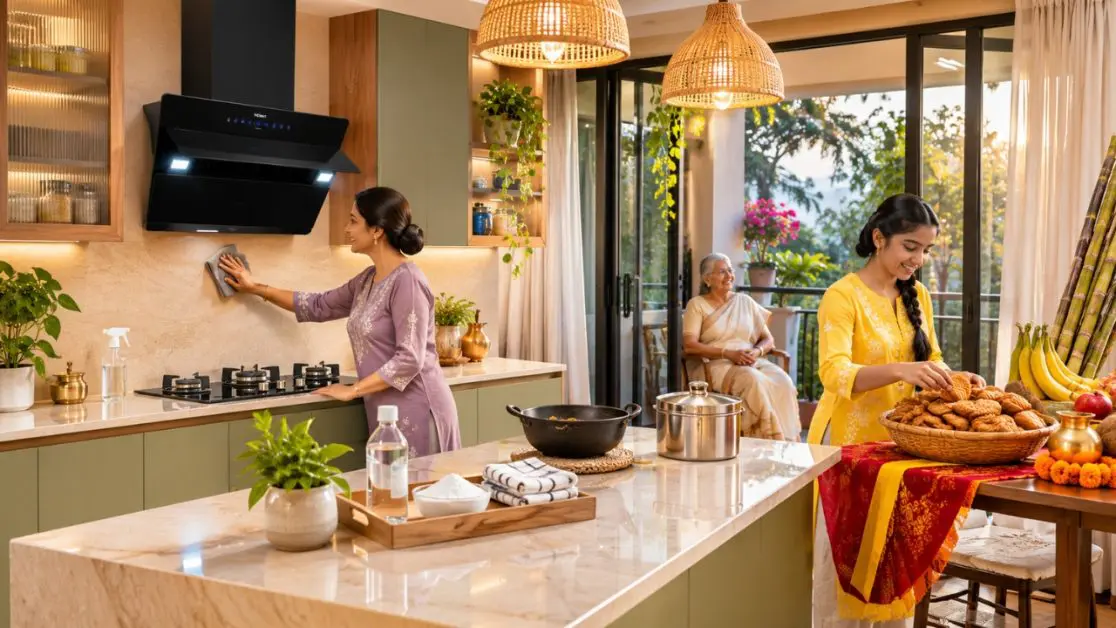
For minor remaining odours, some of the methods used in the home can be helpful, but should be used in addition to ventilation, not instead of it.
Consider the following:
- Baking soda: Put some in an open bowl, away from food preparation, to soak up some smells.
- White vinegar: This can help to remove a few lingering odors, but may have a strong scent of its own.
- Fresh air: After cooking, ventilate the room to circulate fresh air.
- Wash kitchen cloths: Wash towels and other fabrics that have come in contact with the frying oils; they may contain odours.
Don’t burn incense or spray strong perfumes or boil scented water just to mask cooking odors. These techniques can add more airborne materials to the situation, but don’t solve the grease or fumes.
A Cleaner Kitchen Makes Festive Cooking More Enjoyable
The making of thekua is one of the important rituals during Chhath Puja. There’s a familiar scent of freshly fried thekua and there’s nothing that must carry over into the home atmosphere except cooking fumes and grease.
By controlling cooking temperature, ventilation and cleaning regularly, families can keep cooking odours under control.
A suitable chimney can also be used to support cooking or frying in Indian style in kitchens where such cooking is a regular affair.
Haier India’s HIH-C1600-BLDC-IN and HIH-C1750-BLDC-IN filterless chimneys combine the features of 1650 m3/h suction, adjustable speed control, BLDC motor technology and Heat Auto Clean functionality.
Discover the Haier India kitchen chimney range to select a model that meets your cooking preferences, hob size and installation needs.
After all, the scent of freshly prepared thekua should be a part of the party, not a nuisance in the kitchen afterwards.
Frequently Asked Questions
How do you get rid of the frying smell after making thekua?
Use a kitchen chimney during frying, maintain suitable ventilation, remove used cooking oil after it cools, and clean greasy surfaces. These measures help reduce lingering cooking odours.
Can a kitchen chimney remove the smell of deep-frying?
A properly installed kitchen chimney can capture and extract a substantial portion of cooking fumes near the stove. However, its effectiveness depends on suction settings, ducting, installation, and maintenance.
Why does the kitchen still smell after frying is finished?
Grease particles and cooking vapours can settle on cabinets, tiles, curtains, and other surfaces. These deposits may continue releasing odours even after the cooking fumes have dispersed.
Is a filterless chimney suitable for frying thekua?
Yes. A suitable filterless chimney can help manage grease-laden cooking fumes during deep-frying. Haier’s HIH-C1600-BLDC-IN and HIH-C1750-BLDC-IN models feature 1650 m³/h rated suction and Heat Auto Clean technology.
Should you keep the chimney running after cooking?
Yes, keeping the chimney running briefly after cooking can help extract remaining fumes. Follow the operating guidance provided for your particular chimney model.