


The final round of spicy puris are done. The paneer gravy has been placed, sweets are laid out on the dining table and everyone is taking his/her seat for a relaxed afternoon of Bhai Dhooj.
However, one thing that will not leave the kitchen. Scent of oil being frying and spices roasting and tadka.
When lunch has finished, the cooking scents might have spread into the living room, around the dining table and even into the curtains. Not the ideal time to have guests lingering around for tea and conversation.
So how to get rid of the cooking odor in the kitchen without cleaning throughout Bhai Dooj?
The solution is to control the smoke and grease during cooking, ensure the adequate ventilation after cooking and clean the surface to where the odours accumulate. With a good kitchen chimney this can be done a lot easier.
Why is it that Cooking Smells still remain after Bhai Dooj Lunch?
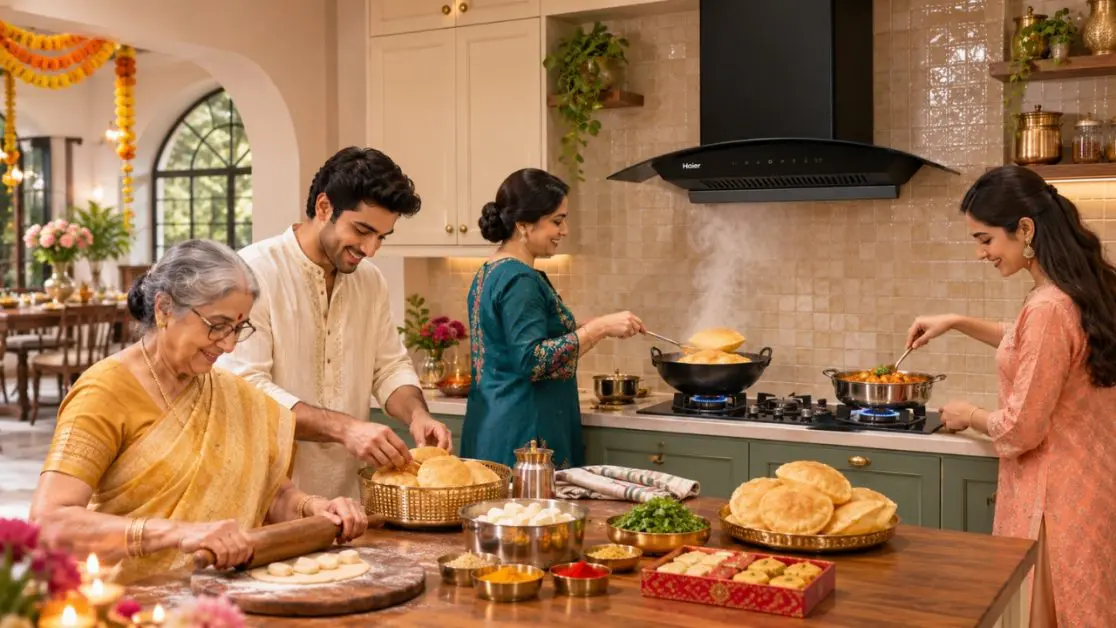
Festive cooking for Indians is a multi-layered affair, with a host of dishes being prepared simultaneously. One burner can be heated with hot oil, and another burner can be ready to go for sautéing onions, ginger-garlic paste and spices.
The ingredients result in various cooking emissions.
- Puris and pakoras can be a source of airborne oil droplets when they are deep fried, which may be deposited on surfaces nearby.
- Onion and Garlic preparations give off strong smelling volatile compounds.
- When roasting masalas, aromatic vapours are created and at high temperatures, often smoke.
- Ghee is used in frying, which produces a special flavor that could linger in the mouth after a meal.
It can be more obvious in a small kitchen or an open plan house where the preparation space is open right into the living room.
It also does not necessarily remove grease that has settled on the cabinets, tiles or fabrics, but opening a window after lunch could help eliminate odors from the air.
This is why proper Odour Control should be started prior to cooking.
Do remove cooking odours while preparing food
If all the Bhai Dooj lunch is not ready, it makes it more difficult.
Better is to control the cooking fumes while they are being generated.
Switch On the Kitchen Chimney Before Frying
A chimney above the hob traps smoke, grease-laden air and cooking fumes close to the hob, preventing them from spreading through the room.
Turn on right before frying or cooking foods that produce heavy fumes.
With puris or for a spicy paneer gravy, for instance, leave the chimney on while cooking.
If a ducted chimney is installed correctly, trapped cooking vapors can be vented to the outside, rather than to the inside of the kitchen.
Cooking intensity does vary from one person to another, so alter the suction as needed.
Not all dishes throw the same amount of smoke.
Typically, less jeera is extracted than a big batch of pakoras deep fried.
Adjust speed settings of a chimney as per the cooking activity.
Haier’s chimney models with strong suction and easily adjustable speed controls are recommended for kitchens where elaborate Indian cuisines are prepared frequently.
Such as the Haier 1700 m³/h Suction Power Heat Auto Clean Filterless Chimney (HIH-G90HM-N), which has two working speeds and a boost for 100 seconds to suit cooking at various intensities.
This versatility is especially helpful when switching from light sautéing to heavy frying in high-intensity cooking during the holiday season.
What to do after lunch: The first 20 minutes
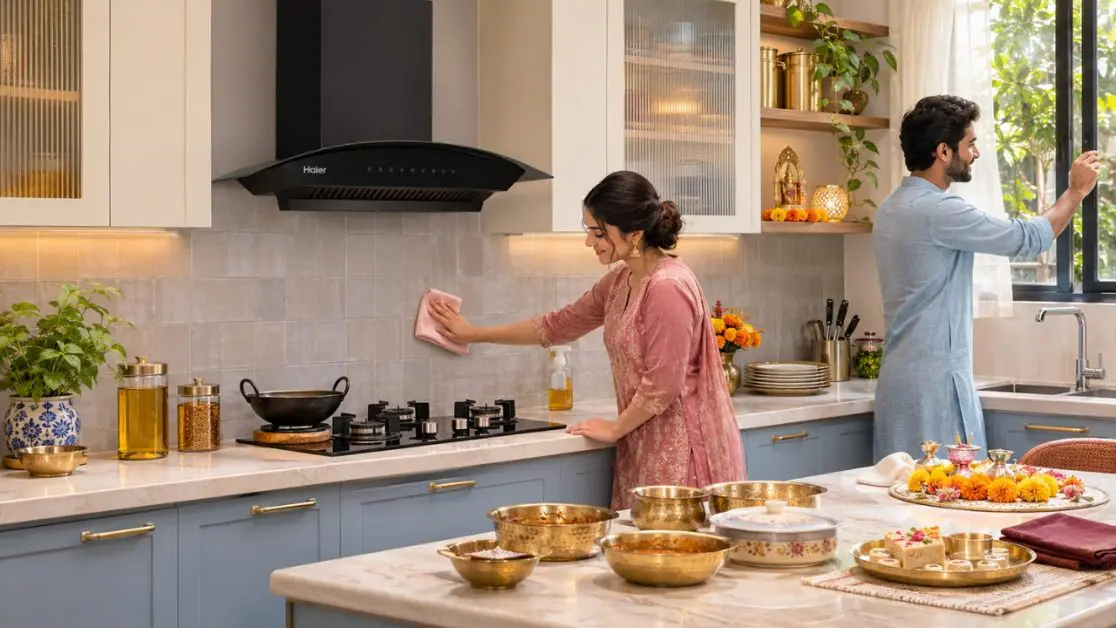
After cooking, there are a few tips that will help minimize the lingering odors.
1. Keep the Chimney Running Briefly
Do not turn off the gas when the chimney is turned off.
Let it run for a brief time to help to get rid of any cooking odors.
This Haier HIH-G90HM-N chimney has a delay-off function of 3 minutes which makes it convenient to resume extraction after cooking for a short while.
Additional ventilation may be required for more potent odours.
2. Create a Proper Ventilation Path
Open an appropriate kitchen window to allow some fresh air to circulate in the house, or use an exhaust fan.
But do not have a strong cross-breeze directly out from the hob when cooking. It can blow up the rising fumes and decrease the efficiency of the chimney in capturing the fumes.
If your chimney is vented, make sure the chimney exhaust pipe is clear.
3. Remove Used Cooking Oil
The small amount of frying oil that’s left in the pan?
It can keep causing bad odours in the kitchen.
Let the oil cool down and pour it into a suitable covered container to be reused or disposed of.
Don’t pour used cooking oil in kitchen drains as it may cause blocked drains.
4. Clean the Greasy Surfaces
Put a suitable kitchen-safe cleaning solution on a wipe and clean the hob, backsplash and around the countertop.
Focus on areas close to the frying station.
To eliminate the cooking smell, which is not just masking the smell, but removing it as well, and one of the causes of oily residue.
How Haier Kitchen Chimneys Help Manage Festive Cooking Fumes
If you have a kitchen that is used on a regular basis for frying, tadka and kitchen cookery that is not quite as simple, then you need the right kitchen ventilation equipment as much as you need the right cooking equipment
Haier India has a filter-less kitchen chimney range that provides features to help ease the process of smoke extraction and regular cleaning.
Haier HIH-G90HM-N: 1700 m³/h Suction with Heat Auto Clean
Haier Colour User Interface With 1700 m³/h Suction Power Heat Auto Clean Filterless Chimney (HIH-G90HM-N) is a 90 cm arc-glass chimney for Indian cooking requirements.
It has the following main advantages:
- Suction capacity 1700m³/h for the removal of cooking fumes.
- Grease is more easily removed with the help of Heat Auto Clean technology.
- Touch and gesture controls for convenient operation while cooking.
- Two speed settings and 100 second boost.
- Two-part full-colour display and cleaning reminder after 90 cumulative operating hours.
- Oil collector: To collect extracted grease.
This kind can be great for households that cooks several meals regularly, due to its suction control and cleaning properties.
Haier HIH-G75HM-N: 1600 m³/h Suction with Spin Clean
If you’re interested in 75 cm chimney, the Strong Suction Power Spin Clean Filterless Chimney from Haier is another option, which has a filterless design.
It has 1600 m³/h suction capacity, touch & gesture operation, Spin Clean technology and delay-off 3-minute function.
The model incorporates an oil collector, and a reminder of cleaning after 15 cumulative operating hours.
The Haier HIH-G60HM-NE is a 60 cm Filterless Chimney
Haier 1600 m³/h Suction Power Spin Clean Filterless Chimney (HIH-G60HM-NE) is available in a size of 60 cm, which is ideal for proper kitchen design.
Its features include:
- 1600 m³/h suction capacity.
- Spin Clean technology.
- Touch & Gesture Controls.
- Boost of 200 seconds at 2 speeds.
- Reminder, collector of oil.
The three models have a filter-free design, which makes it easier to maintain them regularly than traditional chimneys that require filter cleaning.
Extraction performance will vary depending on installation, ducting and kitchen conditions.
What If the Cooking Smell Has Already Reached the Living Room?

Even with the finest efforts, it’s possible that the aroma from the frying can spread to the sofa and curtains.
Avoid using a harsh room deodorant. It can only temporarily cover up the smell, and not eliminate the cause of it.
Rather, take these steps:
- Open windows when outdoor air quality is conducive to doing so.
- Always wash cooking soiled kitchen towels and cloth napkins.
- Wipe down surfaces in the area that may have grease on them, such as nearby dining surfaces.
- Empty wastebasket quickly and cover it.
- If smells remain, wash fabric furnishings as per care guidelines.
If the kitchen is open, having the dining area set up away from the direct cooking breezes can also help to keep fumes to a minimum.
Even a little change in the way you cook can make a difference in your health
While it’s great to have a chimney in the kitchen, cooking methods are also important.
Do not allow oil to become smoky. Select the proper-sized pan sizes and the proper cooking temperatures.
Cover pots as much as possible, especially when simmering gravies that are very aromatic. Do not let grease build up around the burners and keep the hob clean.
Also, keep in mind that self-cleaning doesn’t take care of all the maintenance needs of a chimney. The attention of the oil collector and accessible outside surface remains to be addressed per the manufacturer’s instructions.
Enjoy a more comfortable family celebration with Haier
Bhai Dooj is celebrating the bond of sharing the meal together, giving gifts and enjoying time with siblings. The aroma of frying oil shouldn’t be the biggest part of the afternoon meal.
Getting a handle on kitchen odours is a lot easier when they are managed with proper ventilation, cleaning, and cooking techniques.
If you are looking to upgrade your kitchen, then Haier India’s filterless chimneys have high suction power and include features like gesture controls, cleaning reminder and auto cleaning functions.
Browse Haier India’s range of kitchen chimney for an ideal choice that matches your cooking style and kitchen space.
After a festive family lunchtime the discussion should really go on and on, after all
Frequently Asked Questions
How can I remove cooking smells quickly after Bhai Dooj lunch?
Keep the kitchen chimney or exhaust ventilation running, open suitable windows, remove used cooking oil and wipe greasy surfaces. These steps help address both airborne odours and their sources.
Does a kitchen chimney remove frying smells?
A properly installed kitchen chimney can capture a significant portion of frying fumes near the cooking source. Ducted models exhaust captured air outdoors, although complete odour removal cannot be guaranteed.
How long should I keep the chimney running after cooking?
A few additional minutes can help clear residual fumes. The appropriate duration depends on the intensity of cooking, ventilation conditions and the chimney’s operating instructions.
Are filterless chimneys suitable for Indian cooking?
Yes. Filterless chimneys with appropriate suction capacity can be suitable for Indian cooking involving frying and tadka. Proper installation and regular maintenance remain important.
What is the difference between Heat Auto Clean and Spin Clean?
Heat Auto Clean uses heat to help loosen accumulated grease, while Spin Clean is a cleaning mechanism intended to simplify chimney maintenance. The available technology depends on the Haier chimney model.