
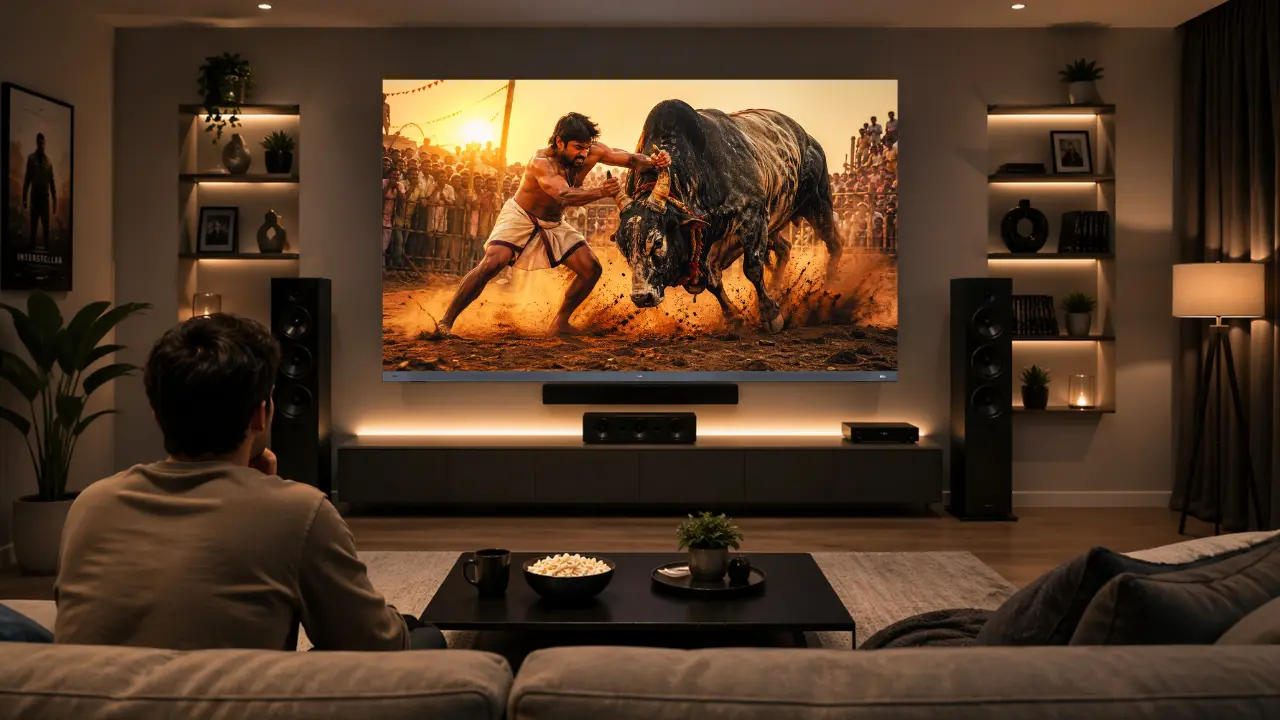

Watching content on large screen TVs improves immersion, enhances shared experiences, and delivers true-to-life picture and sound.
It turns everyday viewing into something more engaging, more social, and more comfortable while unlocking the full potential of 4K, HDR, and surround sound technologies.
Why does size change how we experience content?
It’s Sunday evening.
India is chasing a tight score. The room is tense. Someone is standing. Someone is shouting at the TV.
Now shrink that moment to a phone screen.
The emotion disappears.
Because size does not just change what you see.
It changes what you feel.
A larger screen does one thing better than anything else.
It makes the moment bigger than the room you are sitting in.
Bigger screens don’t show more. They make you feel more.
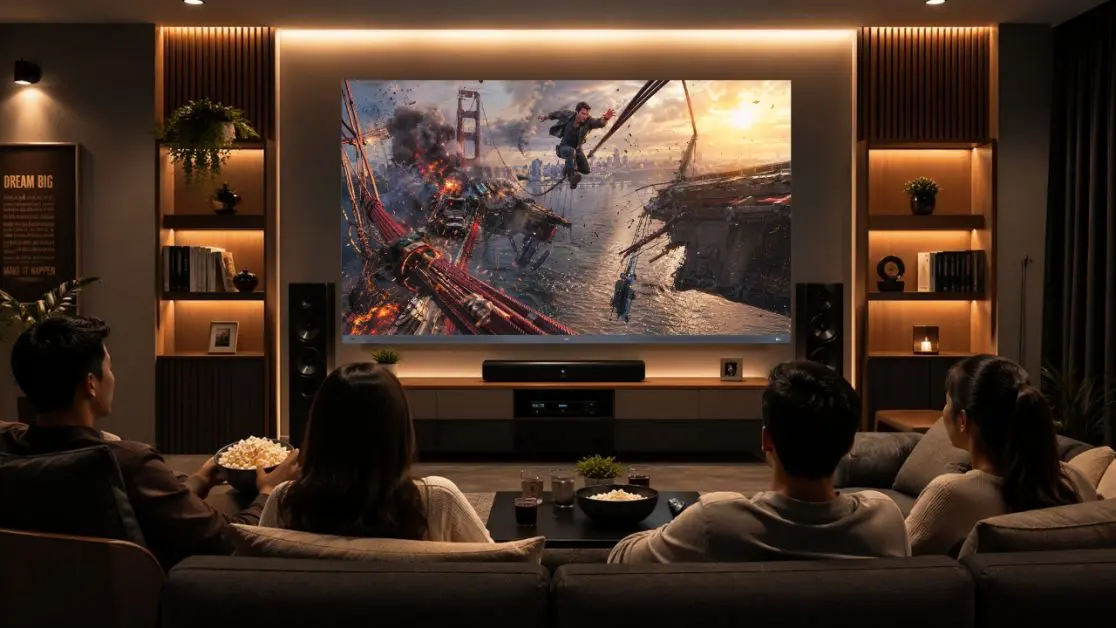
Most people think large screen TVs simply enlarge visuals.
That’s surface-level thinking.
What actually changes are three deeper systems:
- Field of vision expands
- Distractions reduce
- Emotional engagement increases
This is why a 254cm (100) display does not feel like a device.
It feels like a window.
Take the Haier S90 QLED 254cm (100) Google TV (H100S90FUX). Its AI Ultra Sense Processor recognises scenes in real time and adjusts colour, contrast, and motion for a sharper, more lifelike experience.
The outcome is simple.
You stop watching content.
You start being inside it.
What are the real benefits of watching content on large screen TVs?
Let’s break this down clearly.
1. Immersion that mirrors real life
Large screen TVs replicate how we naturally see the world.
Wide. Deep. Continuous.
Technologies like Mini LED bring deeper blacks, brighter highlights, and wider viewing angles for a more immersive experience.
Consider the Haier M80F Mini LED 215cm (85) Google TV Sound By KEF (H85M80FUX).
- Mini LED display enhances contrast
- Dolby Vision improves brightness and realism
- Wide viewing angles keep visuals consistent
The benefit:
Movies stop feeling like content. They feel like environments.
2. Sound that surrounds, not follows
Here’s something most people overlook.
Sound changes with scale.
Large TVs often include technologies like Dolby Atmos and multi-channel audio systems that create three-dimensional sound.
For example:
- The Haier M80F Mini LED 215cm (85) Google TV Sound By KEF (H85M80FUX) delivers 2.1 channel woofer sound
- The Haier M96 Series 254cm (100) QD-Mini LED AI Smart Google TV (H100M96FUX) offers multi-layered sound with advanced speaker systems
The benefit:
You don’t just hear sound. You feel where it is coming from.
3. Shared viewing becomes natural
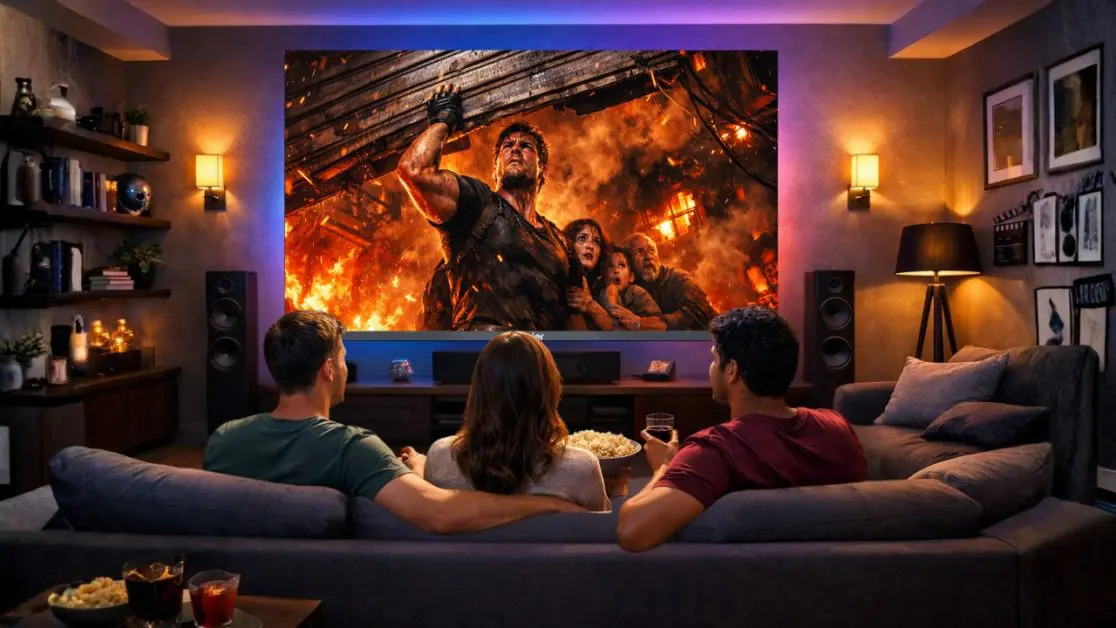
Small screens isolate people.
Large screens bring them together.
Think about how content is consumed in Indian homes:
- IPL nights with friends
- Family movie marathons
- Festive YouTube playlists
A large screen becomes the centre of the room.
| Scenario | Small Screen | Large Screen |
| Cricket match | Personal viewing | Collective energy |
| Movie night | Individual focus | Shared emotion |
| Kids watching | Distracted | Fully engaged |
The benefit:
Content becomes a shared experience, not a personal habit.
4. You finally use content at its full quality
We live in a world of high-quality content.
But most people never see it fully.
Large screen TVs unlock:
- 4K HDR detail
- Dolby Vision and HDR10+
- High refresh rate visuals
The Haier S90 QLED 254cm (100) Google TV (H100S90FUX) supports Dolby Vision IQ and HDR10+, adjusting brightness scene by scene for better clarity.
The benefit:
You stop underutilising what you are already paying for.
What changes when you upgrade to a large screen TV?
Let’s simplify the decision.
One option is: Stay small
- Lower cost
- Easy to place
- Limited immersion
- Compromised experience
The second option is: Go mid-size
- Balanced setup
- Works in compact homes
- Moderate upgrade in experience
The third option is: Go large
- Full immersion
- Better audio-visual sync
- Social viewing advantage
- Future-ready
The truth is simple:
- Small screens save money today
- Large screens save experiences for years
How large screen TVs improve everyday life in Indian homes
This is where the real value shows up.
Work and productivity
Large TVs double up as work displays.
- Video calls feel clearer
- Presentations look sharper
- Multitasking becomes easier
Impact:
Less strain. More clarity.
Learning and kids’ engagement
Children respond to scale.
Educational content on larger screens becomes:
- Easier to understand
- More engaging
- Less distracting
Impact:
Learning feels like discovery, not instruction.
Gaming and performance
Gaming changes completely on large screens.
Features like 144Hz refresh rate reduce motion blur and improve responsiveness.
The Haier M92 Series 189cm (75) QD-Mini LED Smart AI Google TV (H75M92FUX) supports advanced gaming features like VRR and AMD FreeSync Premium Pro for smoother gameplay.
Impact:
You don’t play games on a screen.
You step into them.
The hidden benefit most people ignore
Comfort.
Long viewing sessions strain the eyes.
Modern large screen TVs solve this with:
- Low blue light technology
- Flicker-free displays
- AI ambient light adjustment
Impact:
Watching becomes easier on the eyes, even over long hours.
What should you consider before choosing a large screen TV?
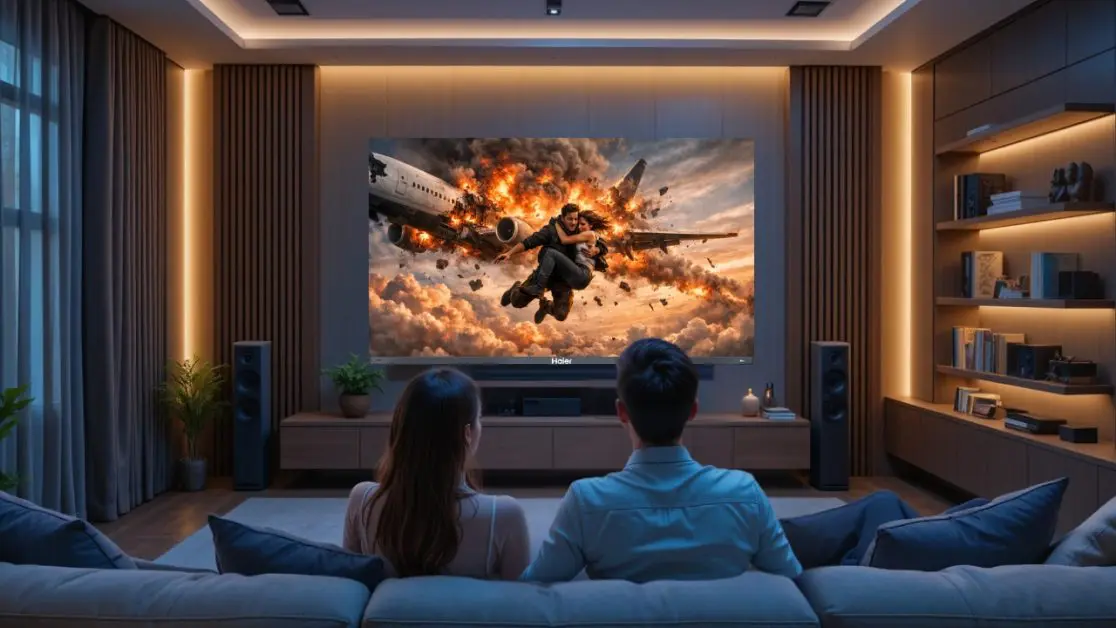
Bigger is not the goal.
Better is.
1. Room size and distance
- Small rooms: 55 to 65 inches
- Medium rooms: 65 to 75 inches
- Large spaces: 215cm (85) and above
2. Content preference
- Movies: Prioritise HDR and contrast
- Sports: Look for higher refresh rates
- Gaming: Focus on response time and VRR
3. Audio setup
- Built-in systems like KEF-powered sound elevate the experience significantly
4. Smart ecosystem
- Voice control
- App integration
- AI content recommendations
Insight:
A large screen works best when everything around it is equally smart.
Why large screen TVs are trending in India
This shift is not accidental.
It is driven by three clear forces:
1. Content is becoming cinematic
OTT platforms now produce high-quality visuals.
2. Homes are becoming experience zones
Living rooms are no longer passive spaces.
3. Technology is more accessible
AI picture optimisation, HDR, and immersive sound are now widely available.
The bigger insight
A large screen TV is not about size.
It is about presence.
Presence of:
- Better visuals
- Richer sound
- Shared moments
In a world full of distractions,
a large screen does something rare.
It holds your attention.
Final thought
Small screens fit into your life.
Large screens reshape it.
And sometimes, the difference between watching and experiencing
is not technology.
It is just scale done right.
Frequently Asked Questions
Is buying a large screen TV actually worth it for my home?
Yes if you value immersion, shared experiences, and future-ready features like 4K HDR and Dolby Atmos. It’s less about size and more about how it transforms viewing into an experience.
Will a bigger TV really feel different or is it just marketing hype?
It feels different because your field of vision expands, distractions reduce, and emotional engagement increases. The impact is psychological, not just visual.
I’m confused between upgrading my phone or buying a big TV which will actually improve my daily entertainment more?
A large TV will likely have a bigger impact. Phones improve personal viewing, but TVs transform shared and immersive experiences at home.
I mostly watch OTT shows after work. Will a large TV change how I feel or just how things look?
It changes how you feel. Storytelling becomes more engaging because your brain perceives it as a more real, environment-like experience.
Does a bigger TV improve picture quality or just make things bigger?
It unlocks the full potential of high-quality content like 4K, HDR, and Dolby Vision, making visuals richer and more lifelike.
Why do movies feel more cinematic on larger screens?
Because they mimic real-world vision wide, immersive, and continuously reducing awareness of the surrounding room.
Is refresh rate important on large TVs?
Yes, especially for sports and gaming. Higher refresh rates (like 120Hz or 144Hz) reduce motion blur.
What smart features matter most in large TVs?
AI picture optimization, voice control, app ecosystems, and adaptive brightness.
Do AI-powered TVs really make a difference?
Yes. TVs like Haier S90 QLED 254cm (100) Google TV use AI processors to adjust scenes in real time, improving clarity and realism automatically.
Is sound quality better on larger TVs?
Typically yes. Models like Haier M80F Mini LED 215cm (85) Google TV include enhanced speaker systems and technologies like Dolby Atmos.