
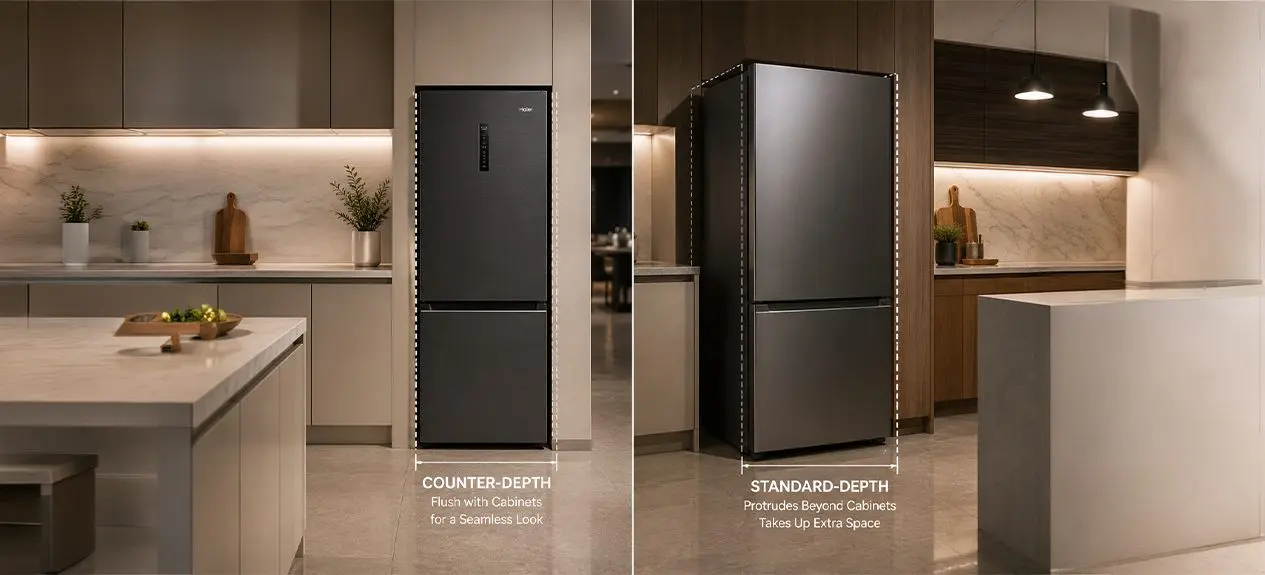

When you’re designing or redesigning a kitchen, refrigerator depth becomes surprisingly important. It’s one of those decisions that doesn’t seem critical until you live with the consequences. A standard refrigerator sticks out from your counter by a decent margin, typically 750- 850 mm deep when most kitchen counters are only 600mm. A counter-depth model sits flush, usually around 650-700mm, creating that seamless integrated look. On paper, that difference sounds aesthetic. In practice, it affects both how your kitchen functions and how much food you can actually store.
The real question isn’t which is objectively better. It’s which makes sense for your specific household, your kitchen layout, and how you actually cook and shop.
Read More: How to Choose the Right Refrigerator Size for Your Family
What Standard Refrigerator Depth Actually Means and Why It Sticks Out
The Numbers: Standard Refrigerator Size Dimensions in India
Indian refrigerators typically measure between 750 and 850mm deep. That measurement includes the back panel, the compressor housing, the cooling coils, and all the mechanical components. It’s not random. Refrigerators need that depth to work properly. The space houses the compressor at the back, insulation layers, and the systems that keep food cold. This depth became standard decades ago because it’s what the technology requires.
Your kitchen counter, meanwhile, is usually around 600mm deep. So your refrigerator naturally extends 150-250mm beyond it, depending on the model. That projection is why some kitchens feel cramped around the fridge.
Why Most Indian Homes Use Standard Depth Refrigerators
Capacity is the biggest reason. A standard-depth refrigerator holds significantly more food than a counter-depth alternative with the same width and height. For families buying groceries weekly, freezing leftovers, and maintaining frozen inventory, that extra volume matters. You open the door, and there’s actually room for everything. It works.
The other reason is practical history. Most kitchens, especially older homes and even many newer modular kitchens, were designed with standard-depth appliances in mind. The alcoves, the spacing between cabinets, the overall layout assumes a certain appliance footprint. Changing that creates complications.
What a Counter-Depth or Shallow Depth Refrigerator Actually Is
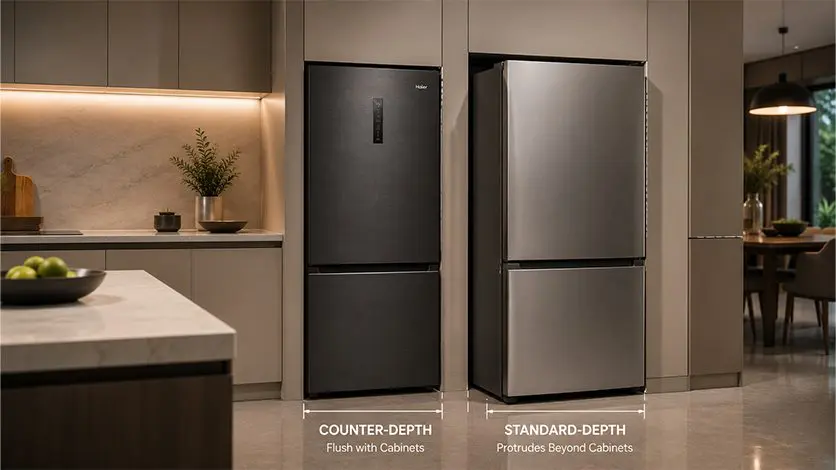
The Flush-Fit Design: What Counter-Depth Means in Practice
A counter-depth refrigerator doesn’t stick out. It sits at about 650-700mm deep, flush with your cabinet faces. Walk past it and you see a seamless line from cabinet to fridge to cabinet. It looks intentional, designed, integrated. Modern kitchens with clean aesthetics benefit from this. The visual coherence appeals to people who care about how their kitchen looks.
Getting that flush fit requires different engineering. The components have to fit in a tighter space. Manufacturers have to be more creative about compressor placement and component arrangement. It’s doable, but the constraints matter.
The Capacity Trade-Off You Need to Know Before Deciding
Here’s the actual consequence: a counter-depth model typically holds 15-25 percent less food than a standard-depth unit of similar height and width. That’s not nothing. For a household of five that buys groceries weekly and freezes meals, that loss becomes genuinely noticeable. You’re reorganizing shelves more often. You’re making decisions about what actually fits. Some people end up buying a separate small freezer for overflow, which defeats the entire purpose of choosing counter-depth.
For a single person or couple who buys fresh daily and doesn’t maintain frozen inventory, it’s irrelevant. For anyone else, acknowledge this reality before deciding.
Counter-Depth vs Standard Depth: How to Decide Based on Your Kitchen Layout
The Walkway Rule: Minimum Clearance in Indian Kitchens
Think about how people actually move through your kitchen. If your refrigerator door opens into a narrow walkway or high-traffic area, a standard-depth unit that sticks out creates genuine workflow friction. People bump into it. The door opening into the space becomes problematic. A counter-depth model solves this by staying flush.
In larger kitchens with adequate space, that same standard-depth fridge causes no real issues. It’s just there. Nobody notices or cares about the depth once there’s enough space around it.
Modular Kitchen Compatibility
Most modular kitchens built in the last 10-15 years were designed for standard-depth refrigerators. The appliance cavity, the cabinet spacing, the alcove dimensions all assume standard depth. Put a counter-depth unit in that space and you get gaps, incomplete cabinetry, or an overall feeling that something’s off. Unless your kitchen was specifically designed for counter-depth, standard depth integrates more cleanly with the existing design.
If your kitchen was custom-built for counter-depth, then obviously that’s what it needs.
Open-Plan Kitchens and Living Spaces
If your kitchen opens directly into your living room or dining area, refrigerator depth becomes more visually prominent. A 150mm protrusion from the counter line is noticeable when it’s part of the view from your couch. In a separate, enclosed kitchen, nobody really sees the depth difference. It’s purely aesthetic at that point.
Read More: Best Refrigerator Designs for Open Kitchen Layouts
When a Shallow Depth Refrigerator Is Worth the Capacity Trade-Off
Households and Situations Where Counter-Depth Makes Practical Sense
Counter-depth works if you live alone or as a couple without kids. You buy groceries more frequently, eat fresh meals regularly, and don’t maintain bulk frozen inventory. The capacity isn’t a problem because you don’t need it. You get the clean aesthetic without any real functional compromise.
It also works for people who genuinely prioritize kitchen design and open-plan aesthetics over maximum storage. If a seamless kitchen line is important to how you live and entertain, the capacity trade-off might be worth it to you.
When to Stay With a Standard Depth Refrigerator
If you have four or more people in your household, buy groceries once or twice weekly, or freeze prepared meals regularly, standard depth is the practical choice. You need the volume. The extra capacity prevents the constant reshuffling that comes with undersized storage.
If your kitchen was built for standard appliances and you don’t want to deal with custom cabinetry work, standard depth fits without complications. If you care about capacity per rupee spent, standard depth delivers better value. Most modular kitchens still default to standard depth, so it’s usually the simpler, less expensive choice.
Before You Decide, Actually Measure
Stop assuming and start measuring. Measure your kitchen depth from counter to back wall. Measure your main walkway width. Open a fridge door in your space and see how much of the area it actually blocks. Visit a showroom and stand in front of both formats. Feel the difference physically rather than imagining it.
Check your modular kitchen paperwork if you have it. Specifications will tell you what appliance dimensions your cabinetry actually supports. Sometimes you think you can do counter-depth when your kitchen was built for standard. Sometimes the opposite is true. The spec sheet doesn’t lie.
Actually think through your storage needs for a week. What do you freeze? How much? How often do you shop? Be honest about this, not aspirational. That honesty prevents buying wrong.
How Haier’s Range Works for Different Kitchen Depths
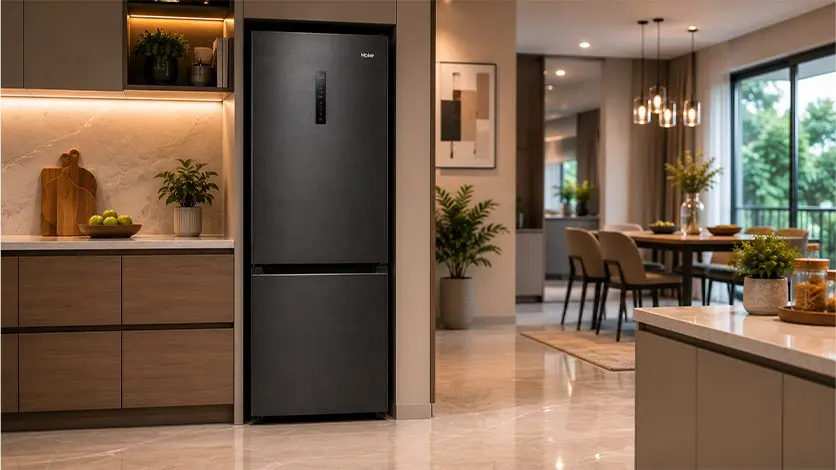
Haier makes refrigerators in different formats that handle various kitchen constraints. Bottom-mounted models put the fridge section at eye level with the freezer below, which takes up less depth than traditional designs. The Jhukna Mat feature means you’re not bending far into the lower compartment to reach frozen items. For kitchens where depth is tight, this format helps. Top-mounted double-door options are standard options that work for typical Indian households of three to four people without demanding excessive depth.
Their convertible technology actually matters more when you’re working with smaller capacity. The ability to switch between fridge and freezer space (14-in-1 on some models, 10-in-1 on others) lets you use every litre efficiently. When you don’t have abundant storage, flexibility becomes important.
The triple inverter and dual fan cooling distributes temperature evenly across all shelves, which is more critical in shallower units where air circulation behaves differently. Smart Sense AI learns your household’s patterns and adjusts cooling proactively rather than reacting to temperature changes. The 10-year compressor warranty applies across their range, which signals genuine confidence in build quality regardless of which depth format you choose.
Haier’s Smart Convertible technology on the 2-Door range offers complete flexibility between fridge and freezer space. For buyers choosing counter-depth due to space constraints, this flexibility actually addresses the capacity concern by letting you optimize every bit of available space.
What Actually Matters
Counter-depth refrigerators look better in modern kitchens and integrate seamlessly with clean cabinetry. They’re the right choice if your kitchen layout benefits from that flush fit and your household doesn’t need maximum storage. Standard-depth units hold significantly more food and fit most existing kitchens without complications. They work if you have a larger household or stock significant inventory.
Don’t let aesthetics alone drive this decision. Measure your space. Think honestly about your actual storage needs. Consider whether capacity or appearance matters more for your specific situation. The right choice aligns with how you actually live, not with design magazines.
Frequently Asked Questions
Who should choose a counter-depth refrigerator?
Single professionals, couples without kids, and very small households that eat fresh and don’t stock much frozen food. You benefit from the clean look without storage problems. This works if you shop frequently and prefer fresh ingredients to frozen bulk.
Who should choose a standard-depth refrigerator?
Families of four or more, anyone who freezes meals regularly, or households that shop weekly and maintain frozen inventory. Standard depth gives you the capacity you actually need without daily frustration about fitting things in.
Which refrigerator is better for a small kitchen?
Measure your walkway first. If a standard-depth unit blocks traffic flow and creates real congestion, counter-depth solves that problem. But if you need storage and your kitchen was built for standard depth, the capacity advantage outweighs the slight protrusion. Size doesn’t always mean you should sacrifice capacity.
Does refrigerator depth affect energy efficiency?
Not directly. A well-designed counter-depth unit with good insulation and efficient compressor technology performs as well as a standard-depth model. Don’t assume depth determines efficiency. Check energy ratings instead.