
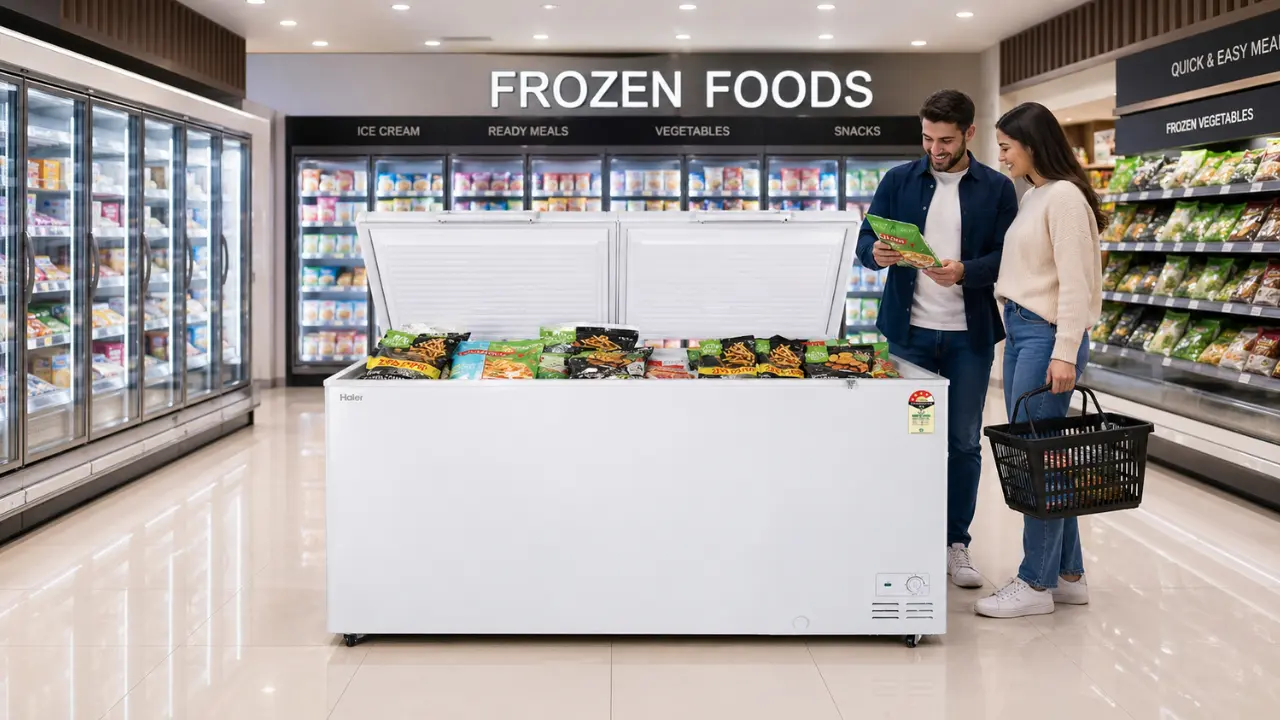

Walk into any commercial kitchen in India at 6 AM. Before the first order fires, someone is already pulling frozen stock from a chest freezer. Prawns portioned three weeks ago. Chicken mince bought in bulk during a price dip. Dessert bases prepped on a slow Monday, waiting for a busy Saturday.
That freezer is not cold storage. It is a working capital, sitting at -26°C.
For businesses that deal in perishable inventory, a deep freezer does not just preserve food. It preserves margin.
Spoilage is a cost most businesses undercount.
The Food Safety and Standards Authority of India estimates that India loses close to 16% of its fruit and vegetable production to post-harvest waste every year. For frozen goods and perishables in commercial settings, the number is harder to pin down because most businesses absorb spoilage quietly. It shows up as a dip in gross margin, not as a line item.
A deep freezer rated to hold -18°C or below stops bacterial growth almost entirely. Not slowing it. Stop it. That means inventory purchased today can be sold or used weeks, sometimes months later, without quality degradation. For a business buying frozen goods in bulk, this converts a perishable commodity into something closer to shelf-stable inventory.
The financial math is straightforward. If a restaurant throws away ₹8,000 worth of protein every week because refrigerator storage only gives it a 3-day window, that is ₹4.16 lakh gone in a year. A Haier 500-litre Hard Top Deep Freezer. The unit pays for itself before the first quarter ends.
Bulk Purchasing Only Works If Storage Works
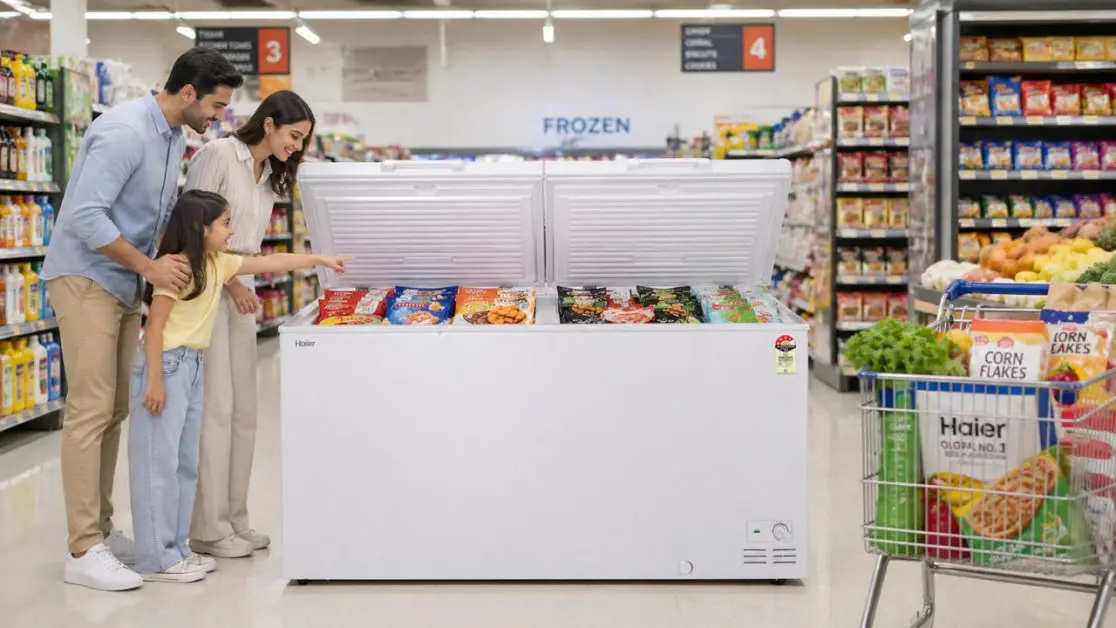
Every procurement manager knows that buying in volume brings the per-unit cost down. Frozen seafood bought in 50 kg lots costs meaningfully less than the same thing bought 10 kg at a time. Dairy ingredients for a bakery chain, frozen vegetables for a QSR franchise, ice cream stock for a distributor ahead of summer. All of them benefit from bulk buying.
But bulk buying without adequate frozen storage is just accelerated spoilage with extra steps.
This is where capacity and reliability intersect. Haier’s Hard Top range runs from 145 litres up to 788 litres, which means:
- A standalone sweet shop can start with the 145-litre HFC-145SPW4 and freeze mithai ingredients through the wedding season without running out of space
- A mid-sized cloud kitchen running 300 orders a day can use a 500-litre double-door model and rotate stock across a full week of prep
- A frozen food distribution hub can deploy the 788-litre HFC-788DPW4 per unit across multiple nodes and hold enough inventory to ride out supply disruptions
The point is not just that bigger freezers exist. It is that the right capacity, matched to business throughput, turns storage from an overhead into a competitive advantage. You buy when prices are low. You sell when demand is high. The freezer holds the gap.
Energy Costs Determine Whether Storage Saves Money Or Eats It
A deep freezer that preserves ₹4 lakh worth of food but adds ₹1.5 lakh to the annual electricity bill has not saved ₹4 lakh. It has saved ₹2.5 lakh. Still good. But the energy cost is the variable that separates a smart investment from a mediocre one.
Haier builds three things into the Hard Top and Combo Chest Freezer lines that directly affect running costs:
- Embossed PCM inner liner: This improves cabinet insulation and reduces how often defrost cycles need to run. Fewer defrosts mean the compressor rests more. A resting compressor draws zero power.
- R290a refrigerant: Beyond its low global warming potential, R290a is thermodynamically efficient. It requires less energy to achieve the same cooling output compared to older refrigerants like R134a. The compressor works less to reach and hold -18°C.
- 160V to 270V wide voltage operation: In most Indian commercial areas, voltage fluctuations are constant. An external stabiliser consumes power on its own and adds another failure point. Eliminating it cuts both energy cost and maintenance cost.
None of these features exist in isolation. They compound. Better insulation means fewer compressor cycles. A more efficient refrigerant means each cycle uses less electricity. Stable voltage handling means the compressor is not straining against inconsistent input. The system works as a system.
Dual-Zone Storage And What It Changes For Mixed-Inventory Businesses
Some businesses do not need everything frozen. A restaurant stores fresh produce alongside frozen proteins. A bakery keeps butter and cream chilled while ice cream bases stay frozen. A caterer running weekend events needs both temperature zones available simultaneously.
Haier’s Combo Chest Freezer range splits a single cabinet into a chiller zone (0°C to 10°C) and a freezer zone (below -26°C). The 550-litre HFC-550CPW uses a 55:45 split between the two compartments and runs dual condensers so each zone maintains its temperature independently.
For a business that would otherwise buy a separate refrigerator and a separate freezer, this is one unit, one power connection, one footprint on the floor. A comparable refrigerator-plus-freezer setup from most commercial brands would cost more and occupy twice the floor space.
Floor space, in a commercial kitchen or a retail backroom, is not free. Every square foot occupied by equipment is a square foot that cannot hold prep tables, packaging stations, or additional inventory. The combo format gives floor space back to the business.
The Warranty Question, Answered Simply
Haier covers every deep freezer in across ranges with a 4-year comprehensive warranty. Not just the compressor. The full unit.
For a business owner, this means the machine is covered through the period where most manufacturing defects or premature component failures would show up.
That changes the risk profile of the purchase. A deep freezer with a 4-year warranty is not a ₹35,000 bet. It is a ₹35,000 bet with a safety net that extends through roughly 1,400 days of continuous commercial use.
What Long-Term Food Storage Actually Means For A Business
It means buying protein when wholesale prices drop in January and selling it through the premium pricing window of March and April. It means prepping 500 portions of a wedding menu item across three days instead of cramming it into one chaotic morning.
In simple terms, it means a frozen food brand can distribute its products with confidence, assured that they will maintain their quality and consistency upon arrival be it at a busy restaurant in your town or a high-demand retail outlet
Long-term food storage is not about hoarding. It is about decoupling purchase timing from consumption timing. The deep freezer is the mechanism that makes that decoupling possible.
Explore the full deep freezer range on Haier India’s official store.
Frequently Asked Questions
I’m running a small food business. How do I know if a deep freezer is actually worth the investment?
A deep freezer pays for itself when the savings from reduced spoilage and bulk purchasing exceed its upfront and running cost. If you’re currently losing inventory due to short shelf life, the ROI often shows up within months.
Am I overestimating how much food I can realistically store and sell later?
This depends on your sales cycle. If your demand fluctuates (weekends, seasonal spikes), a freezer helps align inventory with those peaks instead of forcing daily fresh purchases.
Should I buy a larger freezer now or upgrade later as my business grows?
If your growth is predictable, buying slightly above your current capacity avoids future reinvestment. But oversizing too much increases idle energy costs.
I see cheaper freezers in the market. Why shouldn’t I just go with the lowest price?
Lower-cost units often compromise on insulation, energy efficiency, or voltage tolerance. Over time, higher electricity bills and maintenance can outweigh initial savings.
Do features like special liners or refrigerants really make a difference, or is it just marketing?
They matter. Better insulation reduces compressor cycles, and efficient refrigerants lower energy consumption both directly impact operating cost.
I deal with voltage fluctuations daily. Will that damage my freezer?
Units designed for wide voltage ranges (like 160V–270V) can operate without stabilizers, reducing both risk and extra power usage.
What’s the benefit of a dual-zone freezer for my business?
Dual-zone units allow simultaneous chilling and freezing. This is ideal if you handle mixed inventory (e.g., dairy + frozen goods) without buying separate machines.
Can one freezer really replace both a fridge and a freezer setup?
Combo models can. They save floor space, reduce equipment costs, and simplify operations.