
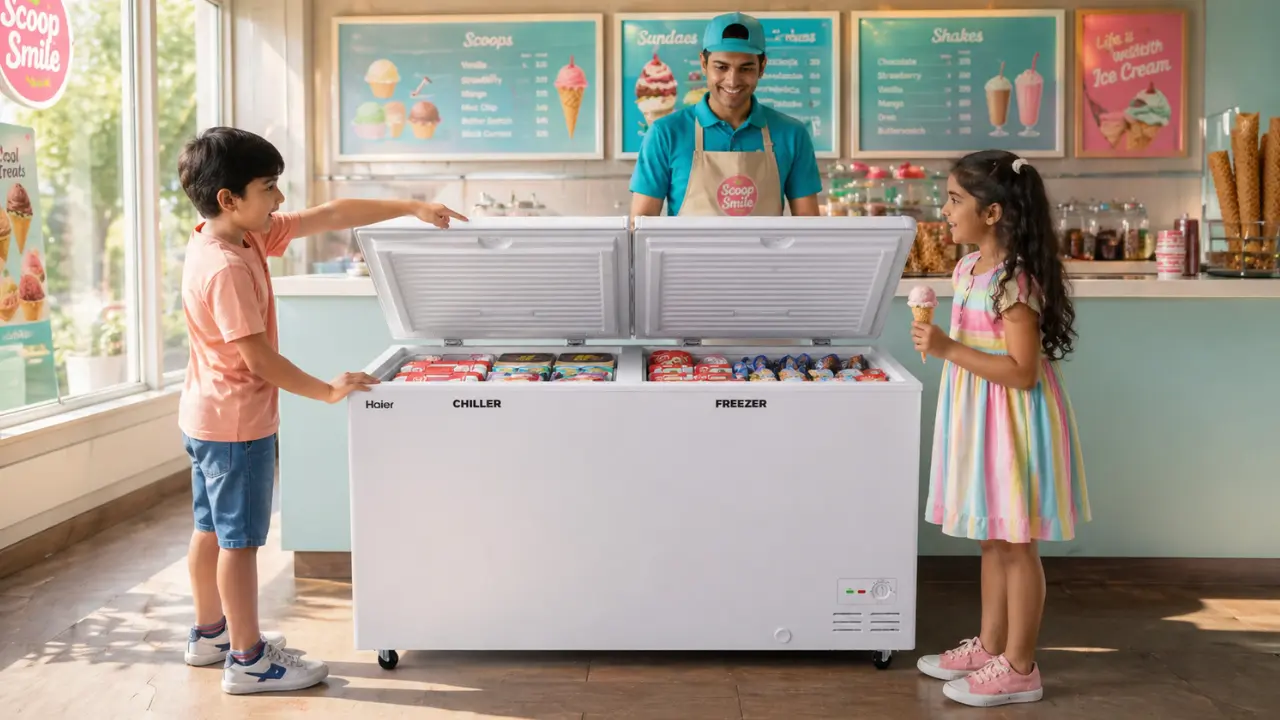

A deep freezer is a commercial-grade cooling unit that holds temperatures at or below -26°C, built to store perishable goods far longer than a standard refrigerator ever could. For businesses across India, from a single kirana shop storing frozen goods to managing cold chain logistics, the deep freezer is not a luxury, it is infrastructure.
If that sounds like a big claim, try watching a restaurant owner throw away spoiled food for a day. You’ll quickly see how the numbers start to matter.
The machine behind the cold.
Most people treat a deep freezer like a big box that keeps things frozen. Fair enough. But the mechanics underneath that lid are worth understanding, especially if electricity bills land on your desk every month.
A deep freezer works on the vapour compression cycle. Here is how that plays out in practice:
- A compressor pushes refrigerant gas (in Haier’s case, R290a, a hydrocarbon with low global warming potential) through the system at high pressure
- The gas moves through a condenser, where it releases heat and turns into a liquid
- That liquid passes through an expansion valve, dropping in pressure rapidly
- It enters the evaporator coils inside the freezer cabinet, absorbs heat from the stored goods, and turns back into gas
- The cycle repeats
That loop runs thousands of times a day. The compressor is the engine of this entire operation. A weak compressor means inconsistent temperatures, higher electricity draw, and faster wear on every other component.
Haier’s Hard Top Deep Freezers come with compressors designed to operate within a range 160V to 270V range . In a country where voltage fluctuations are not an exception but a daily reality, especially in tier 2 and tier 3 towns, this is a practical consideration, not a spec sheet filler.
Why Businesses Care About This Differently Than Households
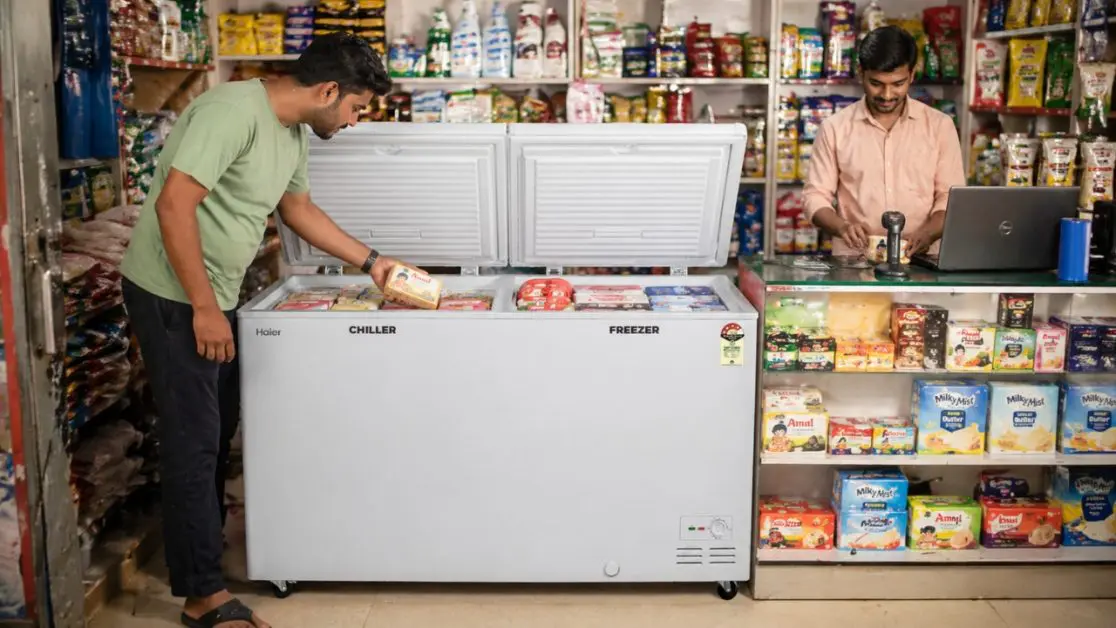
A household freezer might run at 60% capacity most weeks. A commercial freezer in a dairy distribution centre runs at full load, sometimes 18 hours a day, through an Indian summer where ambient temperatures cross 45°C. The operating conditions are entirely different. So are the consequences of failure.
When a deep freezer in a commercial setup, it’s not just a small loss it can mean lakhs of rupees in spoiled inventory, broken cold chain compliance, and even lost contracts.
That’s why buying decisions shouldn’t be based only on price. What really matters is reliability, uptime, and long-term return on investment choosing equipment that protects your business, not just your budget.
For small and mid-scale businesses, three things tend to dominate the conversation:
- Energy consumption per litre of storage: A 500-litre Haier Hard Top unit rated for low energy consumption means the monthly electricity cost stays manageable even when the unit runs round the clock. For a small ice cream parlour or a meat shop, this is the difference between a profitable month and a breakeven one.
- Compressor reliability across voltage swings: If the compressor can handle electricity fluctuations without a separate stabilizer, that’s one less piece of equipment to buy, one less point of failure, and one less thing to maintain.
- Recovery time after door openings: In a retail environment, the door opens dozens of times a day. How fast the unit pulls temperature back down to -26°C after each opening determines how well the product inside holds up. Haier’s trapezoid door design on the Hard Top deep Freezers reduces cold air loss during each opening, which means the compressor works less hard to recover.
Hard Top Versus Combo Chest: Picking The Right Format
Haier India sells Hard Top deep freezers in two primary configurations, and the choice between them is less about preference and more about what the business actually needs to store.
Convertible Hard Top Deep Freezers are single-temperature units. Everything inside sits at the same freezing temperature. They range from 145 litres up to 788 litres.
Combo Chest Freezers split the cabinet into two temperature zones. One side works as a chiller (0°C to 10°C), the other as a freezer (below -26°C). The 550-litre HFC-550CPW, for instance, uses a 55:45 chiller-to-freezer ratio with dual condenser technology.
This dual-zone setup matters for businesses that handle both chilled and frozen inventory. A restaurant storing fresh vegetables alongside frozen seafood. A bakery keeping cream chilled and ice cream frozen. Two temperature needs, one piece of equipment, one electricity connection.
The Energy Argument, Laid Out Plainly
India’s commercial electricity rates vary by state, but they are not cheap. In Maharashtra, commercial tariffs can cross ₹12 per unit. In Tamil Nadu, they sit lower but still add up fast when a freezer runs continuously.
A deep freezer that draws less power per cooling cycle saves money every single day it operates. Over a four-year ownership period, the cumulative savings often exceed the price difference between a cheaper unit and a better-engineered one.
The embossed PCM inner liner used across both product lines improves insulation and reduces defrosting frequency. Less defrost cycles means fewer interruptions to the cooling cycle, which means the compressor kicks in less often, resulting in lower electricity consumption.
Wide voltage operation (160V to 270V) eliminates the need for an external voltage stabiliser, which itself consumes power. That is a saving most buyers forget to calculate.
The Small Details That Matter At Scale
When a business operates five or ten deep freezers across locations, small design choices compound.
- Castor wheels on every Haier unit mean a single person can reposition a 500-litre freezer without calling for help. In a warehouse reorganisation or a seasonal layout change, this saves labour hours.
- Inbuilt lock protects inventory in shared commercial spaces. Shrinkage is a real cost centre for many small businesses.
- Four-year comprehensive warranty across the entire range shifts the ownership risk to Haier, not the buyer covering the period when most compressor failures typically occur. This ensures complete peace of mind, with internal leakage also covered and no charges for service team visits during the warranty period. Customers simply need to complete demo registration within 14 days of purchase.
- Hinge doors instead of sliding mechanisms offer full-width access to the cabinet. Loading and unloading bulk inventory gets faster.
None of these individually change the business case. All of them together do.
Where This Fits For Different Scales Of Operation
A street-side juice vendor freezing fruit pulp needs a 145-litre single-door unit. Plug it in, fill it up, done.
A mid-sized catering company serving 200 meals a day needs a 500-litre double-door convertible. Probably two of them. That is for reliable frozen storage that handles daily abuse.
A frozen food distributor running a cold chain across three cities needs the 788-litre HFC-788DPW4 at each node, the capital cost is modest relative to the inventory value it protects.
A multi-cuisine restaurant that handles both fresh and frozen ingredients picks the Combo Chest range. The 550-litre model can replaces what would otherwise be two separate appliances drawing two separate power connections.
The product line covers the spectrum. What stays consistent is the R290a refrigerant (environmentally compliant), the stabiliser-free operation, and the warranty terms.
Buying a deep freezer is not a purchasing decision. It is an infrastructure decision. And infrastructure decisions compound, for better or worse, every single day the business operates.
Explore the full range on Haier India’s official store.
Frequently Asked Questions
I run a small shop. Do I really need a deep freezer or is a regular fridge enough?
If you’re storing frozen goods (ice cream, meat, frozen snacks), a regular fridge won’t cut it. A deep freezer maintains -26°C or lower, which prevents spoilage and preserves texture. A fridge fluctuates too much and will cost you inventory losses over time.
Why are deep freezers more expensive? Am I overpaying for just “extra cold”?
You’re not paying for colder temperatures alone you’re paying for:
Stronger compressors (continuous operation)
Better insulation
Faster temperature recovery
For businesses, this translates into lower spoilage and consistent quality, which usually outweighs the upfront cost.
Should I choose a bigger freezer now or upgrade later?
If your usage is likely to grow, go bigger now. Running a freezer at 80–90% capacity is more efficient than constantly overloading a smaller unit. Adding another freezer later also increases electricity and space costs.
Is energy efficiency really that big of a deal for my monthly costs?
Yes, especially in India where commercial tariffs can go ₹10–₹12 per unit. A slightly more efficient freezer can save thousands per year, often covering the price difference within 2–3 years.
Do I really need a stabilizer with a deep freezer?
Not if the unit supports wide voltage operation (160V–270V).
Skipping a stabilizer:
Saves upfront cost
Reduces energy usage
Removes another failure point
What’s the benefit of a combo chest freezer?
It gives you:
Freezer + chiller in one unit
Single power connection
Better space efficiency
Ideal for restaurants handling both fresh and frozen goods.
Why do things like wheels and locks even matter?
At scale, they matter a lot:
Wheels = easy repositioning
Locks = inventory protection
Hinged doors = faster loading
Small features lead to real operational efficiency gains over time.