


Avoid common mistakes when buying a deep freezer not because the buyer picked a bad brand. They go wrong because the buyer looked at two numbers, capacity and price, and ignored everything else.
Capacity tells you how much fits inside. Price tells you what leaves your bank account on day one.
Neither tells you what the machine will cost to run over four years, whether it will survive the voltage mess in your commercial area, or how fast it recovers temperature after the lid has been open for a few mins during a busy lunch rush.
The features that matter most are the ones that show up on your electricity bill, your maintenance log, and your spoilage report. Here is what to actually look for.
Compressor And Voltage Handling Come First
It is the component that circulates refrigerant, pulls heat out of the cabinet, and maintains temperature. If the compressor is underpowered, the unit struggles to hold -26°C when ambient temperatures climb. If it is poorly insulated from voltage instability, it burns out.
Indian power grids are not kind to compressors. Voltage in commercial zones routinely swings between 160V and 280V. Many residential colonies in tier 2 cities are not much better. Every swing forces the compressor to adjust its draw. Cheap compressors handle this badly. They overheat, trip, or simply die.
What to check before buying:
- Does the unit operate without an external voltage stabiliser? If the answer is no, add ₹2,000 to ₹4,000 for the stabiliser, plus the electricity it will consume for the entire life of the freezer
- What is the rated voltage range? Anything narrower than 160V to 270V will need protection in most Indian commercial and semi-urban locations
- Is the compressor rated for continuous duty? A freezer in a dairy shop or a cloud kitchen runs almost round the clock. A compressor designed for intermittent household use will not last
Haier’s Hard Top Deep Freezer is built to operate reliably within a voltage range of 160V to 270V and importantly, it does so without requiring an external stabilizer. That’s not just a convenience feature. For a business running the freezer 18 hours a day through the summer, it can mean the difference between a compressor that lasts four years and one that fails in just eighteen months.
Insulation Quality Decides Your Running Cost
Two freezers with identical capacity can have wildly different electricity consumption. The difference almost always comes down to insulation.
Insulation determines how long the cabinet holds its target temperature after the compressor cycles off. Better insulation means longer hold times. Longer hold times mean the compressor rests more. A resting compressor uses zero electricity.
The material lining the interior of the cabinet matters here more than most buyers realise. A standard steel liner conducts cold reasonably well but does little to buffer temperature swings. An embossed PCM (phase change material) inner liner, the kind Haier uses across its deep freezer lines, actively absorbs and releases thermal energy. Think of it as a secondary cooling reserve that kicks in during the gap between compressor cycles.
The practical outcome: fewer defrost cycles, more stable internal temperature, and less total compressor run time per day. Over 365 days, this compounds into a measurable difference on the electricity bill.
For a small business paying ₹10 to ₹14 per unit of commercial electricity, even a 10% reduction in daily compressor run time saves ₹3,000 to ₹5,000 annually. That is not dramatic. But it is free money, every year, for doing nothing differently.
Refrigerant Type Is Not A Detail You Skip
Older deep freezers commonly use R134a refrigerant. It works. It also has a global warming potential (GWP) of 1,430, and it requires more energy to achieve the same cooling output as newer alternatives.
R290a, the hydrocarbon refrigerant used in Haier’s deep freezer range, has a GWP of 3. That is not a typo. Three. Beyond the environmental angle, R290a is thermodynamically more efficient. The compressor needs fewer watts to pull the same amount of heat from the cabinet.
For a buyer evaluating two similarly priced units, one running R134a and the other running R290a, the R290a unit will cost less to operate every month. The gap widens in hotter climates where the compressor works harder and longer.
This is one of those features that never appears in a showroom conversation but shows up clearly in the annual cost of ownership.
Door Design Affects More Than Appearance
In a commercial setting, the freezer door opens dozens of times a day. Every opening lets warm air flood the cabinet. The compressor then has to work to bring the temperature back down.
Two design choices reduce this loss:
Trapezoid door profile
Haier’s Combo Chest Freezers use a trapezoid-shaped door that creates a tighter seal and minimises the volume of cold air that escapes during each opening. Less air loss means faster temperature recovery. Faster recovery means less compressor strain.
Hinge doors over sliding doors
A hinge door opens fully, giving complete access to the cabinet interior. Sliding doors block half the opening at any given time, which leads to longer door-open durations as staff dig through inventory. Longer open time means more cold air is lost. Hinge doors let you grab what you need and close the lid in seconds.
For a business operating a 500-litre freezer in a busy environment, door design directly influences daily energy consumption. It is not cosmetic.
Single-Zone Versus Dual-Zone Storage
Not every business needs everything frozen. A restaurant stores marinated chicken at 4°C and frozen prawns at -20°C. A bakery keeps cream chilled and ice cream frozen. A caterer needs both temperature ranges accessible throughout the day.
Buying a separate refrigerator and a separate deep freezer solves this. But it also means two power connections, two appliance footprints, and two sets of maintenance.
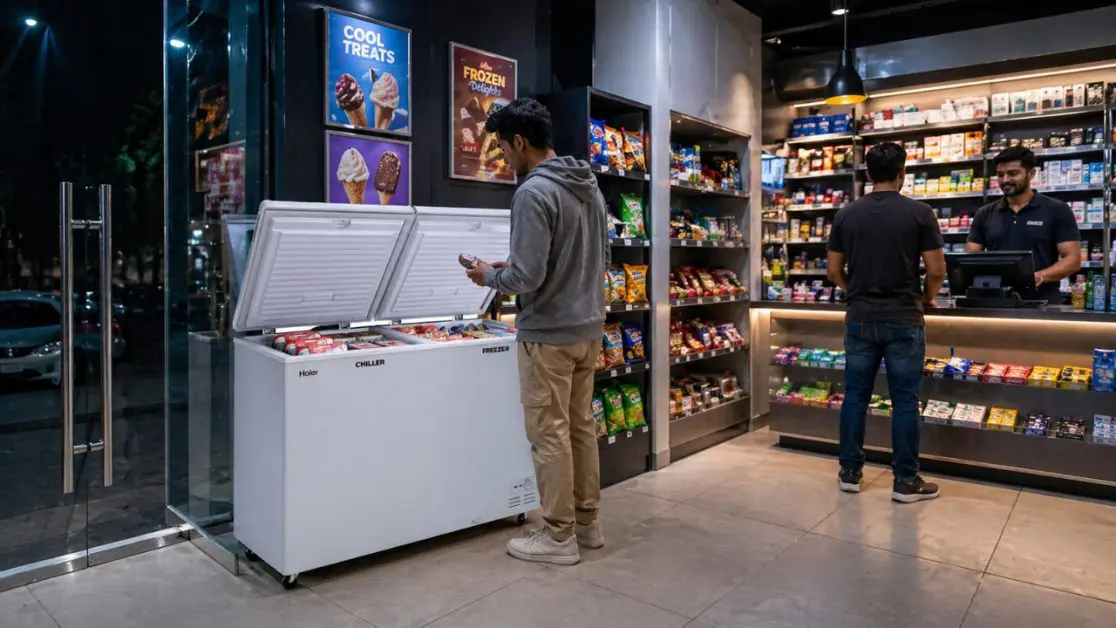
Haier’s Combo Chest Freezer range puts both zones in one cabinet. The 550-litre HFC-550CPW splits storage into a chiller compartment (0°C to 10°C) and a freezer compartment (below -26°C), using a 55:45 ratio. Dual condensers keep each zone independent, so opening the chiller side does not warm up the freezer side.
The 350-litre model. The 550-litre model sits. For a business that needs both temperature ranges, the combo format saves floor space, reduces total energy draw, and eliminates the need for a second appliance.
Build Quality And Warranty Terms Tell You What The Manufacturer Actually Believes
Any company can print impressive specs on a product page. The warranty terms reveal whether the company trusts its own engineering.
Haier covers every deep freezer in the Hard Top and Combo Chest ranges with a 4-year comprehensive warranty. Not compressor-only. The full unit. That means if the thermostat, the condenser fan, the door gasket, or any other component fails within four years, the cost sits with Haier.
Other features that signal build quality:
- Heavy-duty castor wheels (50mm) allow a fully loaded freezer to be repositioned by one person. In a warehouse or commercial kitchen that reorganises seasonally, this saves labour time every single move
- Inbuilt lock protects inventory in shared spaces. For a business with multiple staff accessing storage, this is a shrinkage control measure, not a convenience feature
- Universal castor legs (4 per unit) provide stability on uneven flooring, which is common in Indian commercial kitchens and storage rooms
These are not premium additions. They come standard across the range, from the ₹18,900 entry-level 145-litre unit flagship 788-litre model.
The Checklist, Compressed
Before signing a purchase order for any deep freezer, verify these six things. In order of impact on long-term cost:
- Refrigerant type and its energy efficiency
- Insulation material and defrost cycle frequency
- Door design and cold air retention
- Single-zone or dual-zone requirement
- Warranty coverage, full unit versus compressor-only
Capacity and price are the starting point. They are not the decision. The features listed above are what separate a deep freezer that earns its keep from one that quietly drains money every month it runs.
Explore the full range on Haier India’s official store.
Frequently Asked Questions
I’m overwhelmed. How do I actually choose the right deep freezer without overthinking it?
Ignore brand hype and focus on 6 things: compressor quality, voltage range, insulation, refrigerant type, door design, and warranty. These directly affect your long-term cost and reliability, not just the purchase price.
I keep comparing capacity and price, but I still feel unsure what am I missing?
You’re missing operating costs. Two freezers with the same capacity can differ significantly in electricity usage due to insulation and refrigerant efficiency.
Should I stretch my budget for a “better” freezer, or stick to a basic one?
Stretch if it improves compressor durability, insulation, or energy efficiency. These pay back over time through lower electricity bills and fewer repairs.
I run a small food business. What matters more: upfront cost or running cost?
Running cost. Over 3–4 years, electricity and maintenance can exceed the purchase price if you choose poorly.
Are fancy features worth it, or are they just marketing?
Most are unnecessary, but some (like dual-zone storage, good insulation liners, and strong door seals) directly improve usability and cost efficiency.
I open my freezer constantly. What design helps reduce energy loss?
Hinge doors and tight-seal designs. They allow quicker access and reduce cold air escape compared to sliding doors.
Should I get a single-zone or dual-zone freezer?
Single-zone: If you only store frozen items
Dual-zone: If you need both chilled and frozen storage in one unit (saves space and electricity)
I have limited space. Should I buy a separate fridge + freezer or a combo unit?
Combo units (dual-zone) are more space-efficient and reduce total power usage and maintenance.
Do small features like wheels and locks actually matter?
Yes in real use. Wheels save labor during repositioning, and locks prevent stock loss in shared environments.